At $8 input / $40 output per million for Astra and $2 / $10 for Sol, the sticker says Astra costs 4x. The bill says something narrower: in the FrontierCode task-cost figures below Sol does routine coding at about one-fifth the cost ($1.29 vs $5.97), while Astra leads the strongest domain-specific tests by roughly 4–10 points where one clean run can replace repeated attempts.
What OpenAI actually charges, and where you can use them
OpenAI positions Astra for the hardest projects and Sol for everyday work (launch announcement). Track plan usage and API spend as separate meters: ChatGPT/Codex plan usage does not pay for API calls and API calls do not draw down plan quotas. Both models share a 1,050,000-token context window, up to 922,000 input tokens and 128,000 output tokens per request, text plus image in and text out. Model IDs are gpt-6.2-astra and gpt-6.2-sol on the Responses and Chat Completions APIs.
Standard API prices, per million tokens:
| Model | Input | Cached input | Cache write (30m) | Output |
|---|---|---|---|---|
| GPT-6.2 Astra | $8.00 | $0.40 | $10.00 | $40.00 |
| GPT-6.2 Sol | $2.00 | $0.10 | $2.50 | $10.00 |
| GPT-6 Astra (predecessor) | $10.00 | $1.00 | $12.50 | $50.00 |
| GPT-6.1 Sol (predecessor) | $2.00 | $0.10 | $2.50 | $10.00 |
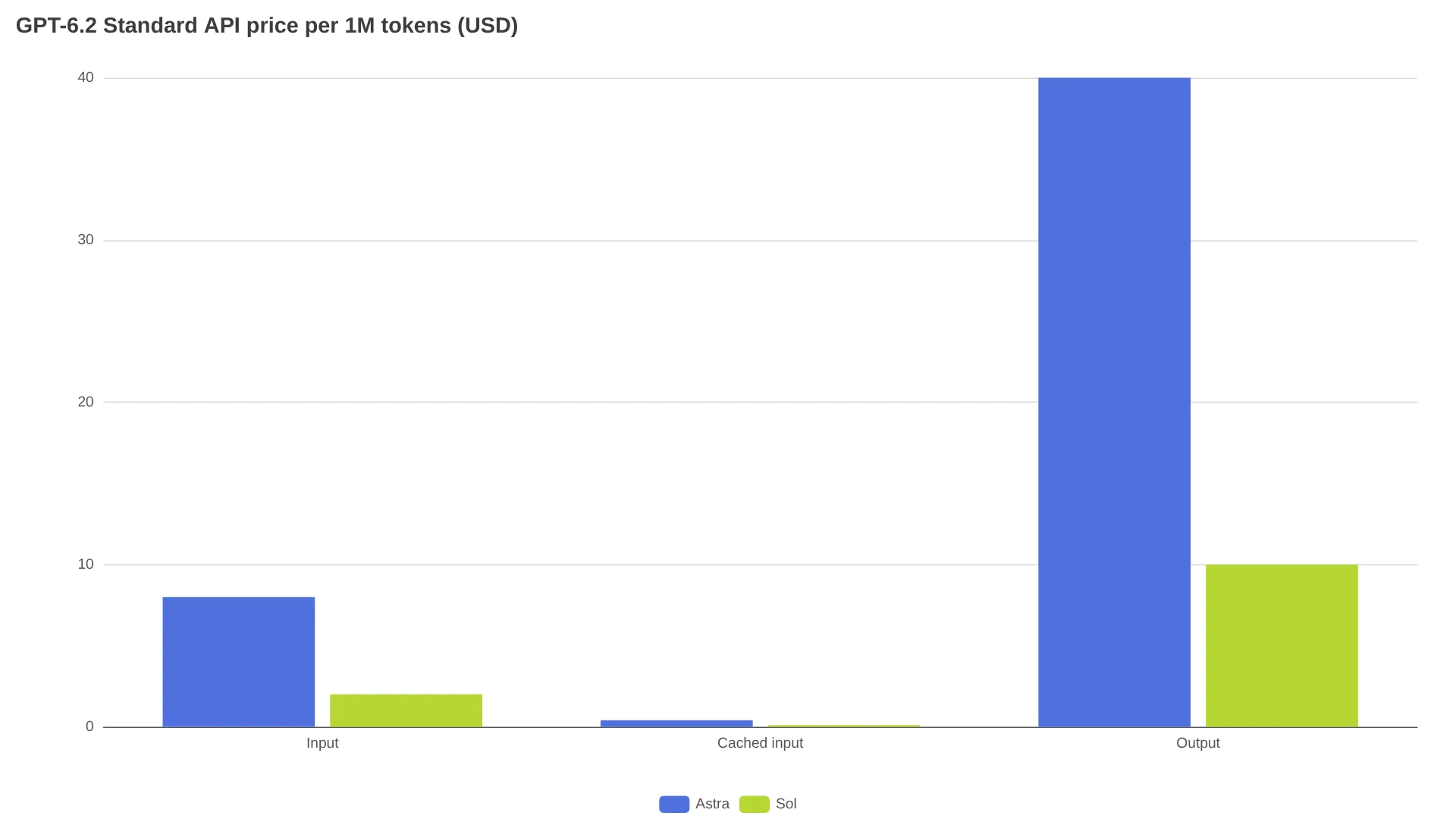
Astra is 20% cheaper than GPT-6 Astra on input and output and 60% cheaper on cached input. Sol keeps GPT-6.1 Sol pricing. At launch on November 17, 2026 both are generally available in the API; Batch is 50% off Standard and background windows are 30–40% off (GenAI Brief tier breakdown).
Three multipliers that change the bill
1. Cache writes are billed, not free. Cached reads cost 5% of input ($0.40 for Astra, $0.10 for Sol). Writing to cache costs 1.25x input for 30-minute TTL ($10.00 for Astra, $2.50 for Sol) and 2.5x for 12-hour retention, per GenAI Brief's rate table. Example: rewriting 108,000 history tokens after a cache miss bills as 108,000 × $10/M = $1.08 on Astra or 108,000 × $2.50/M = $0.27 on Sol, before output.
2. The 272,000-token cliff reprices the whole request. Over 272K input tokens, input doubles ($8 to $16 for Astra, $2 to $4 for Sol) and output rises 1.5x ($40 to $60 for Astra, $10 to $15 for Sol). In GenAI Brief's worked pricing test, adding 20K history to cross the line moved a $0.344 Astra turn to $0.624, an 81% jump on 7% more input. Summarize or truncate history before 272K; if that changes the cached prefix, budget for a cache miss.
3. Speed tiers multiply everything. Fast is 2x Standard. Ultrafast is 3x through February 28, 2027, then 6x from March 1, 2027 (US residency only; Standard/Fast/Batch support US and EU), per GenAI Brief's tier rules and OpenAI's processing-tier docs. At 3x, Astra output is $120/M; at 6x it is $240/M.
Cost per task, not per token
At equal token counts Astra costs 4x Sol. It wins only by using fewer tokens, needing fewer attempts, or avoiding expensive human correction. Break-even rule: one Astra attempt must replace more than four Sol attempts at the same token footprint, or cut weighted tokens by roughly 75%, to win on direct API spend.
Reported task costs (different benchmarks, effort settings, and cost methods, so use directionally and confirm with your own replay):
| Source / workload | Astra | Sol | Implication |
|---|---|---|---|
| Artificial Analysis Intelligence Index, max effort | 62 at $4.00/task, 10.4 min (GPT-6 Astra: 57 at $6.24) | 57 at $1.01/task, 7.9 min | Sol matches GPT-6 Astra score of 57 at roughly one-sixth the $6.24 task cost |
| FrontierCode 2.0 via DataCamp, max effort | 44.2% at $5.97/task | 43.8% at $1.29/task | 0.4-point gap for ~5x task cost; in this coding evidence Astra does not clear the bar |
| Harvey LAB-AA / SecureSWE / Terminal-Bench-Science via DataCamp | 15.0% / 65.7% / 77.1% | 11.1% / 55.6% / 68.0% | Astra gap is largest here; test Astra for legal, secure code, science |
| BenchCAD 2.1 Core via DataCamp | 82.5% | 73.1% | ~9-point CAD gap supports Astra test for CAD work |
| DataCamp slide rebuild, single-run test | $0.22, 4,968 output tokens | $0.07, font sizes exact | No visible quality gap on this template task; Sol won on cost |
| Agents' Last Exam via DataCamp summary of OpenAI numbers, Sol High vs old Astra Max | — | Sol High 72.0% at $0.69/task vs GPT-6 Astra Max 73.1% at $8.99 | ~1 point less for ~1/13 cost on this setting |
Worked example with correct math: at $0.10 per Sol try and 2 successes in 3, Sol costs $0.15 per accepted result, which Astra at $0.40 per try cannot beat on success rate alone. Astra wins when Sol's success collapses, such as 1 success in 5 tries ($0.50 per accepted) versus Astra succeeding first try ($0.40). OpenAI reports 22% fewer output tokens for Astra on GDPval v2; treat vendor claims as directional.
Start with Sol for routine coding and high-volume agents; test Astra for legal, CAD, or long scientific runs. Route to Astra only when total spend / accepted tasks, including retries and correction, is lower.
Keep the prefix stable, or pay for the rewrite
Mid-conversation changes to instructions, tools, schemas, or prior output can void the cache and trigger re-reasoning in GPT-6.2.
To preserve prefix caching (GenAI Brief integration notes, OpenAI model docs):
- Append a new developer message or
configuration_updateinstead of rewriting opening messages. - Add tools via
additional_toolsor gate withtool_choice/allowed_toolsinstead of swapping the tool list mid-thread. - Shorten old tool output and downsize images before first send.
- Diagnose with Prompt Cache Diagnostics and Responses
input_transformations(prefix_mismatch) before moving production traffic.
Migration checklist for Astra and Sol
Per EpiFive's migration guide and GenAI Brief's integration rules, checked against OpenAI's model comparison:
- Change
modeltogpt-6.2-astraorgpt-6.2-sol. - Start at
reasoning.effort: medium(Responses) orreasoning_effort: medium(Chat Completions).noneis rejected; uselowfor short-latency calls. - Delete
temperature,top_p, andlogprobs/top_logprobsfrom requests. Move tool calling to the Responses API. - If migrating from GPT-5.5 or earlier, replace
prompt_cache_retentionwithprompt_cache_options.ttl: "30m"and budget for cache-write spend. - With Zero Data Retention,
storeis treated asfalse— resend prior output items in order, including encrypted reasoning items. - Replay 30 short tasks per model (pass rate, retries, output tokens, cost per accepted result) plus one long agent session with stable prefix versus one prefix edit (cache-hit rate, total task cost).