Neon on high is the strongest value here for long-context agents when low wrong-answer rates matter; Astra and Sol stay cheaper per task. This is a launch-day synthesis of official specs, boards, and independent tests. I did not run Neon personally.
Neon is a faster Carbon for agents, with one clear tradeoff
Gemini 4 Neon launched November 18, 2026 as gemini-4-neon, the middle Gemini 4 model between Hydrogen and Carbon, per Google and 9to5Google. Google reports faster end-to-end completion than Carbon at lower cost per task, echoed by DeepMind staff calling it cheaper and faster than Carbon (@_mohansolo). It ranks #3 on the Artificial Analysis Index at 61 on xhigh and #2 on Agent Arena at 1336 across 4,200+ sessions. Same-board Arena scores for Opus 5.5 and Fable 5.2 were not published in the launch materials reviewed, so the head-to-head below uses index ranks plus same-task tests.
Price, window, and where it lives
Neon costs $3 per million input, $15 output, $0.15 cached input, per Google. Context is 1,048,576 tokens with a 65,536-token single-response cap. Thinking levels low / medium / high (default) / xhigh bill as output: higher levels can consume more reasoning tokens and raise the bill. The high default is documented in DataCamp's level breakdown and SpringPrompt's API notes.
Paid-only with no free tier, per eesel's API check. Surfaces per Google and 9to5Google: paid API in AI Studio, Gemini for business, Antigravity (Pro/Ultra), Gemini app (Pro/Ultra, replaces Argon), Android Studio, plus Cursor at 63.7% CursorBench default effort vs 57.3% Hydrogen, per Cursor.
| Model | Input / output per 1M | Default thinking |
|---|---|---|
| Gemini 4 Neon | $3 / $15, cached $0.15 | high |
| Gemini 4 Hydrogen | $1.50 / $7.50 | high |
| Gemini 4 Carbon | $2 / $10 thru Nov 30, then $4 / $20 | medium |
| Claude Opus 5.5 | $4 / $20, max setting tested | max tested |
| GPT-6.2 Sol | $2 / $10, max setting tested | max tested |
Rival prices and best-setting labels as compiled in eesel's comparison table. From December 1 Neon is 25% cheaper per token than Carbon. Details: Neon pricing.
Use the API to pin thinking levels; use the app or Antigravity for managed quota. Quota reports are anecdotal planning signals only: ~1–3% of Pro quota per chat vs ~5% for a 10-minute 3-subagent run, per user reports.
Benchmarks vs Opus 5.5, Fable 5.2, and Sol
Scores are vendor-reported via Google, compiled in eesel and DataCamp.
| Test | Neon | Rival | Takeaway |
|---|---|---|---|
| Vals Index | 70.9%, #2 | Fable ~71.3% | Near top |
| AutomationBench | 56.3%, #1 | Opus 42.5%, Sol 41.3% | Agent lead |
| GraphWalks 256K–1M | 95.2% | Opus 66.8%, Sol 80.1% | Long-context lead; replay your longest file first, since some Argon users report over-summarization (thread) |
| Terminal-Bench 4.1 | 65.2% | Opus 65.8% | Near tie, Opus +0.6 |
| FrontierCode 2.0 | 46.2% | Opus 47.3% | Opus +1.1 |
| CursorBench 4.1 | 63.7–65.4% | Opus 58.1% | Neon leads default effort |
Cost per task flips token pricing, per Artificial Analysis via eesel:
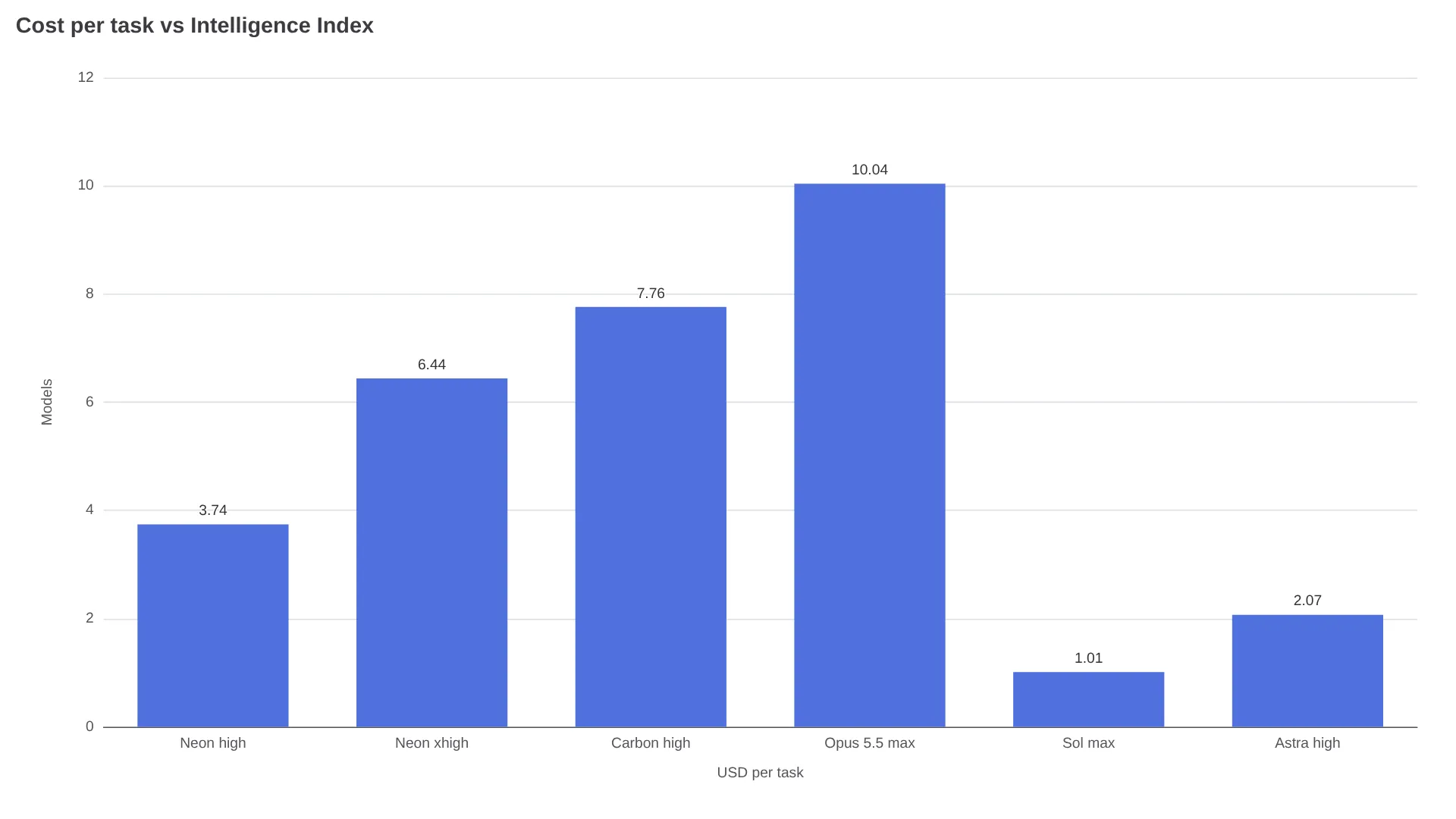
Neon high 59.6 for $3.74 in 14.8 min; Carbon high 60.0 for $7.76 in 37.2 min; Opus max 59.1 for $10.04; Astra high 60.1 for $2.07; Sol max 57.3 for $1.01. Neon xhigh hits 61.4 for $6.44 in 21.5 min. Run high unless 1.8 points is worth $2.70 and 6.7 minutes.
Neon vs Fable 5.2: early reports favor split roles
Provider-harness SWE-sweep (Antigravity harness): Neon 39.0% vs Opus 10.1%, Sol 8.3%. Shared mini-SWE harness: 12.8% vs Sol 11.6% vs Opus 3.6%, per DataCamp. Much of the headline gap is harness, not pure model.
"I'm running Fable 5.2 as the orchestrator and dev with Neon as the coding agents and it's the best stack I've ever run." — u/1969Stingray (thread)
Anecdotally, users favor Fable for orchestration and Neon for implementation; validate on your repo. On AA-Omniscience Neon posts 14% wrong-instead-of-declining vs 50% Opus, 55% Sol, 58% Astra and Fable, but coverage is 59–60% correct vs 66% Astra and 77% Fable, per eesel.
Hands-on: chess, listings, and 105 real bugs
| Test | Result | Limit |
|---|---|---|
Chess page, 3 runs medium (DataCamp) | Neon 3/3 at $0.83–$1.06; Carbon 1/3, two hit 65K cap; 16 games, zero illegal moves | One task; Carbon likely finishes with background mode |
| CatalogBench factual (SpringPrompt) | 78.6% publish-ready x3, 1st of 35; reads specs off packaging | Sales 32.1%, decks 24th, surveys 22nd on budget |
| 105 replanted bugs (@PawelHuryn) | Neon xhigh 63 vs Astra 62.7, Fable 58, Carbon 57.3 | Single tester |
SpringPrompt used OpenRouter medium while Google API defaults to high, so verbosity differs. Isolated AI Studio leakage reports exist (thread). For chat, eesel timing puts Neon xhigh at 56.5s to first token, so prefer medium or Hydrogen for interactive replies.
Pick by workload
| Workload | Pick | Why |
|---|---|---|
| Hard agents, long docs, refactors | Neon high | 59.6 at $3.74, #2 Agent Arena, 3/3 chess |
| Longest-horizon builds | Carbon, per Google's family positioning | Google reserves Carbon for hardest projects; no same-task proof test here |
| Orchestration + coding | Fable lead + Neon coders | Anecdotal hybrid above; validate first |
| Lowest task bill | Sol max $1.01; Astra high $2.07 scores higher | Both had higher wrong-answer rates on AA-Omniscience |
| Interactive chat | Hydrogen or Neon medium | xhigh first-token latency too high for chat |
| Regulated use | Hold pending docs | Full safety report still pending Nov 19; approve only against your required docs |
Test it yourself in one afternoon
Run the same prompt, same files, and same thinking budget on Neon high, your current default, and one cheap alternative. Record success, cost, time, and wrong answers. That one comparison beats any board for your queue. Opus-side math: Opus 5.5 review, Fable 5.2 review.