If you pay per token, Gemini 4 Neon API pricing is a timing call: Carbon is cheaper for the next 11 days, Neon is 25% cheaper from December 1. Google launched Gemini 4 Neon on November 18, 2026 at $3 per 1M input tokens and $15 per 1M output, with a 1M-token window and no free tier.
The November 30 price flip decides everything
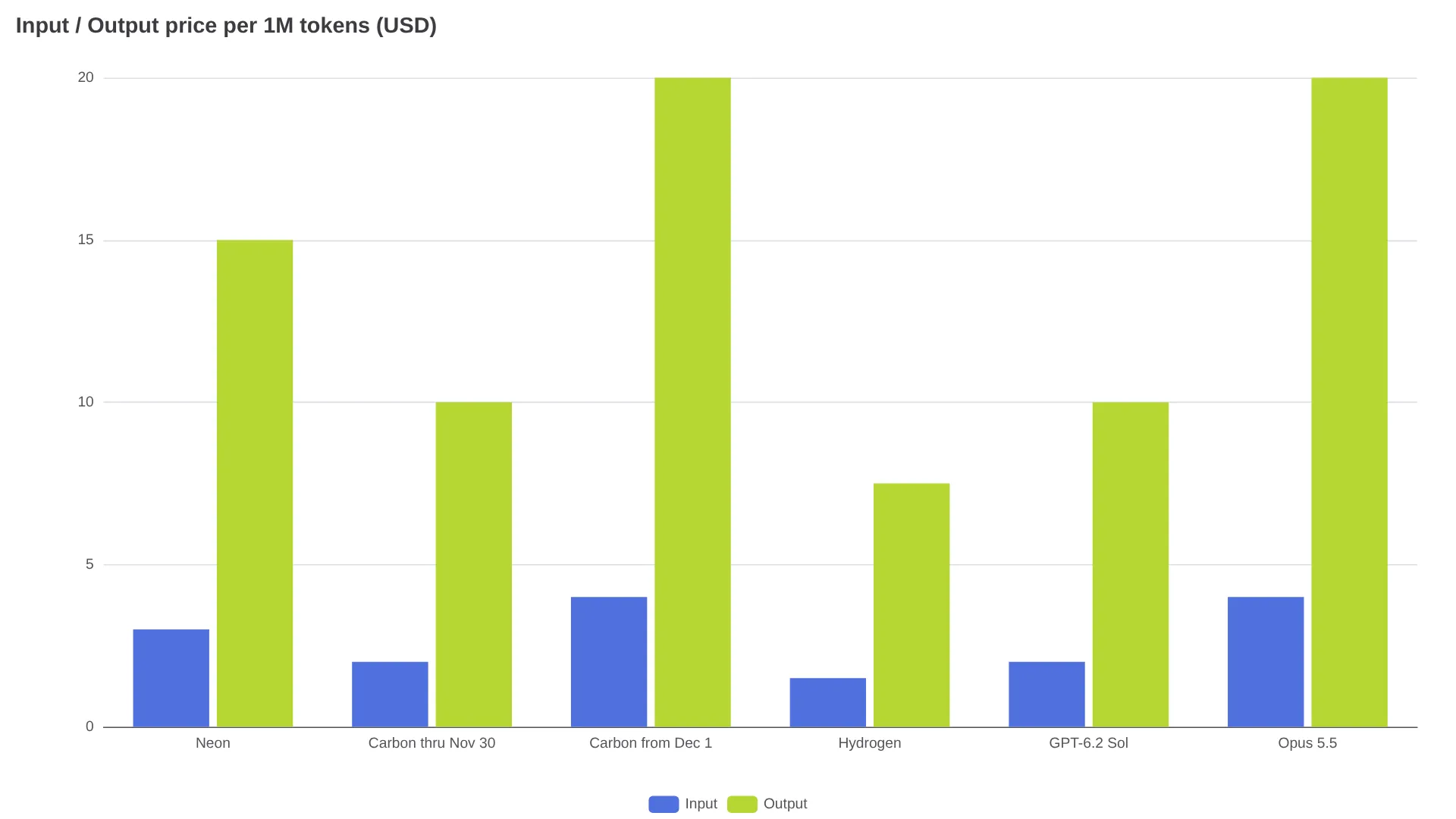
Gemini 4 Neon API pricing only makes sense against the calendar. Through November 30, 2026, Gemini 4 Carbon costs $2 input / $10 output per 1M tokens on introductory pricing; from December 1, Carbon and Argon move to $4 / $20, which makes Neon at $3 / $15 exactly 25% cheaper per token (pricing comparison). Until November 30, Neon is 50% more expensive than Carbon at promotional token rates.
Google frames the comparison as cost per task, claiming 32% lower per-task cost than Carbon at high thinking and at least 36% savings at xhigh versus unnamed competitors (launch analysis). Budget on the published $3/$15 token rates; the per-task figures are Google-reported with no named baseline.
Where Neon sits in the Gemini 4 lineup
Gemini 4 Neon is the middle option: above Hydrogen for reasoning depth, approaching Carbon quality with faster execution, according to OpenRouter's model positioning. Carbon was the frontier coding default, Argon the flagship reasoning model for math and science work, and Hydrogen the $1.50 / $7.50 high-volume workhorse (price index). Neon supports four reasoning levels — low, medium, high, xhigh — with high as default (provider specs).
Availability at launch, per Google's announcement and the launch breakdown:
| Surface | Neon access |
|---|---|
| Gemini API | Paid developers, model ID gemini-4-neon (catalogue listing) |
| AI Studio / Gemini app / Antigravity | Paid tier plus Google AI Pro and Ultra |
Antigravity's Neon label needs caution. Users in the Antigravity thread report the orchestrator entry may still resolve to a Carbon system prompt in some sessions, with one reply summarizing it as "its just the orchestrator. not neon" (thread). Until Google publishes build-ID mapping, bill on the API model ID, not the UI label.
What $3/$15 really buys
Standard rates are $3.00 input, $15.00 output, and $0.15 cached input per 1M tokens (official announcement), flat across the full 1,048,576-token context (pricing check). Third-party indexes list Batch at $1.50 / $7.50, Flex at $1.50 / $7.50, and Priority at $5.40 / $27.00 (specs and provider table), but Google had not published Neon Batch/Flex/Priority on its general pricing page at launch — treat Neon as Standard-only until that page updates (launch analysis).
Reusable formula: cost = fresh input / 1M × $3 + cached input / 1M × $0.15 + output including thinking / 1M × $15.
Three billing rules rewrite the sticker price (launch analysis and pricing reference):
- Thinking tokens bill as output. Output at $15 dominates every bill.
- Caching is implicit only, minimum 4,096-token prompt, 95% off eligible cached input. No explicit
cachedContentscache and no cache-write fee. - Synchronous output caps at 65,536 tokens (specs). Longer output needs background execution.
Short prompts under 4,096 tokens get zero cache benefit (pricing reference). A 1,200-input-token support bot cannot use the $0.15 rate at all.
What two modeled workloads cost
Modeled at fixed token counts; excludes retries and variable reasoning length. Output share is the point. All rows use the same cache ratios with each model's own list rates from the launch pricing table.
Coding session: 50 calls, 80,000 input tokens per call, 90% from cache, 2,500 output tokens per call including thinking. Totals: 400,000 fresh input, 3.6M cached, 125,000 output.
| Model | Session cost |
|---|---|
| Gemini 4 Neon $3/$15 | $3.62 ($1.20 fresh + $0.54 cached + $1.88 output = $3.615) |
| Carbon thru Nov 30 $2/$10 | $2.41 |
| Carbon from Dec 1 $4/$20 | $4.82 |
| Hydrogen $1.50/$7.50 | $1.81 |
| GPT-6.2 Sol $2/$10 | $2.41 |
Support at scale: 10,000 conversations/day for 30 days, 6,000 input tokens each with 75% cache-eligible, 500 output tokens each. Totals: 450M fresh, 1.35B cached, 150M output.
| Model | Monthly cost |
|---|---|
| Gemini 4 Neon $3/$15 | $3,802.50 (of which $2,250 is output) |
| Carbon thru Nov 30 $2/$10 | $2,535.00 |
| Carbon from Dec 1 $4/$20 | $5,070.00 |
| Hydrogen $1.50/$7.50 | $1,901.25 |
| GPT-6.2 Sol $2/$10 | $2,535.00 |
Neon costs 2x Hydrogen per token and 50% more than Sol at $2/$10, so Neon must finish tasks in fewer tokens or retries to win on task price. The cited benchmark figures (Intelligence Index 61 rank #3, Coding Agent Index rank #1) are vendor-reported and do not establish lower real-world task cost (benchmark roundup).
Token price is not your quota
App percentages do not convert to API dollars. One Pro user reports long-context Neon sessions at 1-2% per message:
Also tried switching existing conversations with long context to Neon and seeing 1-2% usage per message, looks like this one might actually be usable on the Pro plan! — u/biblecrumble (thread)
App quota reflects five-hour windows, thinking level, and tool calls. API billing counts every processed token including thinking plus separate Search grounding per query (launch analysis). Budget API work in dollars from the tables above and subscription headroom from your own high vs xhigh runs.
Switch in one line, then fix three things
Carbon, Argon, or Hydrogen callers migrate by changing the model ID to gemini-4-neon (launch analysis). Three gotchas still break calls (launch analysis):
- Set
thinking_levelexplicitly. Neon defaults to high. - Remove
cached_contentfields. Explicit caching is unsupported. - Remove
temperature,top_p,top_k. Out-of-range values return HTTP 400, other values are ignored.
Also raise max_output_tokens toward 65,536 or use background execution for long outputs.
Should you switch now or milk Carbon first
| Situation | Pick |
|---|---|
| Ship before Nov 30, need max reasoning | Stay on Carbon $2/$10, test Neon in parallel |
| December production agents, long context | Neon $3/$15 is the list-price candidate — validate task success and retries before switching |
| High-volume simple chat | Stay on Hydrogen $1.50/$7.50, the only free-tier option in this set (pricing index) |
| Cheapest frontier list price today | GPT-6.2 Sol at $2/$10, if stack allows OpenAI |
| Need Batch paper trail | Wait — Neon Batch unpublished |
FAQ
How much does Gemini 4 Neon API cost?
$3 input, $15 output, $0.15 cached input per 1M tokens, per Google.
What are the context and output limits?
1,048,576 input tokens; 65,536 synchronous output tokens.
Is there a free tier?
No. Neon is paid-only; Hydrogen keeps a free tier.
Are Batch, Flex, or Priority available?
Unpublished by Google at launch; third-party listings show $1.50/$7.50 Batch/Flex and $5.40/$27 Priority — confirm before budgeting.
How does caching work?
Implicit only, 4,096-token minimum, 95% off eligible cached input.
What is the model ID?
gemini-4-neon.
Neon vs Hydrogen vs Carbon: which to use?
Hydrogen for cheap volume; Carbon through Nov 30 for cheapest frontier tokens; Neon from Dec 1 for advanced reasoning 25% below Carbon's $4/$20 rate.
What does a 2,000-input plus 500-output request cost?
$0.0135 at list, before caching. Thinking bills as output.