 AIREITER
A million-token context and a $0 endpoint make the Nemotron 3 Ultra API look like an easy default. It is not: the free route is useful for evaluation, while production depends on provider reliability, data handling, and a paid fallback.
Is the Nemotron 3 Ultra API worth using?
The Nemotron 3 Ultra API is worth testing for long-running text agents, large-document analysis, and coding workflows that benefit from a very long context. It is a poor default for low-latency routine chat, confidential prompts on a logged free endpoint, or a production service with no fallback.
NVIDIA released Nemotron 3 Ultra on June 4, 2026. The official model card identifies the NVFP4 checkpoint as version 1.0 GA, licensed for commercial and non-commercial use under OpenMDW 1.1.
| Decision fact | Verified value | Why it matters |
|---|---|---|
| Model size | 550B total, 55B active | Sparse compute does not make the full weights small |
| Maximum context | Up to 1M tokens | Provider limits may be lower by route |
| Modality | Text input and output | No image or video understanding |
| Official NVFP4 SWE-Bench Verified | 69.7 | Relevant evidence for coding-agent evaluation |
| Official NVFP4 RULER 1M | 94.0 | Supports the long-context use case |
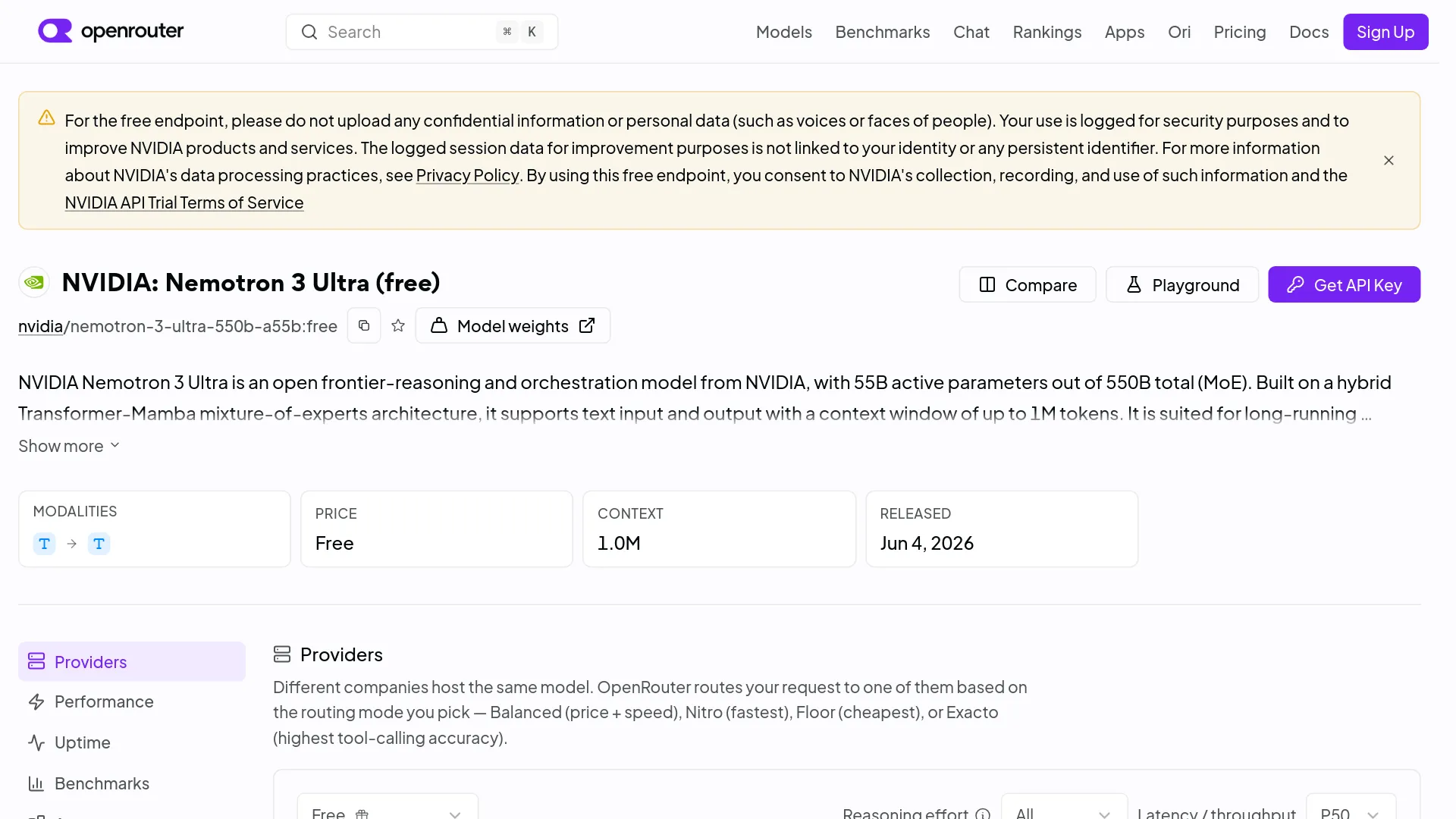
| OpenRouter free price | $0 input, $0 output | Suitable for trials, not an SLA |
| OpenRouter free availability snapshot | 84.07% successful over three days | Reachable did not always mean usable |
| Official self-host minimum | 4x B200-class or 8x H100 | Not a normal workstation deployment |
The benchmark values above come from NVIDIA's model card and should be treated as first-party results. OpenRouter's availability is a dynamic provider measurement, not a permanent guarantee.
Call the free Nemotron 3 Ultra API in five minutes
The quickest free route uses OpenRouter's OpenAI-compatible chat-completions endpoint and the exact model ID nvidia/nemotron-3-ultra-550b-a55b:free. Create an OpenRouter key, keep it in an environment variable, and send a small test before attempting a long-context job.
- Create an API key in OpenRouter.
- Export it as
OPENROUTER_API_KEY. - Call
/api/v1/chat/completionswith the free model ID. - Log HTTP status, latency, and empty responses during evaluation.
- Add a paid route or another model before using the workflow in production.
curl https://openrouter.ai/api/v1/chat/completions \
  -H "Authorization: Bearer $OPENROUTER_API_KEY" \
  -H "Content-Type: application/json" \
  -d '{
    "model": "nvidia/nemotron-3-ultra-550b-a55b:free",
    "messages": [
      {
        "role": "user",
        "content": "Return three risks in this migration plan as a numbered list."
      }
    ],
    "max_tokens": 500
  }'
The same route works with the OpenAI Python client by changing base_url and model:
import os
from openai import OpenAI

client = OpenAI(
    api_key=os.environ["OPENROUTER_API_KEY"],
    base_url="https://openrouter.ai/api/v1",
)

response = client.chat.completions.create(
    model="nvidia/nemotron-3-ultra-550b-a55b:free",
    messages=[
        {
            "role": "user",
            "content": "Inspect this plan and list the three highest-impact risks.",
        }
    ],
    max_tokens=500,
)

print(response.choices[0].message.content)
What the free route actually guarantees
The free Nemotron 3 Ultra route guarantees neither unlimited capacity nor production availability. The OpenRouter listing labels free endpoints as rate limited but does not publish an exact quota on the model page; its September 19 snapshot showed 100% reachability but only 84.07% successful availability over three days, with errors and empty responses counted as failures.
OpenRouter displayed a 1M-token context, a 65,536-token maximum completion, tool calling, 2.28-second median latency, and 29 tokens per second median throughput in that snapshot.
There is also a provider-specific feature boundary: the free OpenRouter listing supported tools and tool_choice but did not enforce response_format. Segmind's paid route documents JSON Schema output at $0.625 per million input tokens and $2.75 per million output tokens. Code that relies on strict JSON must test the chosen provider rather than infer support from the base model.
Do not send confidential or personal data through the free OpenRouter route. Its listing says usage is logged for security and may be used to improve NVIDIA products and services. On a 429, timeout, or empty response, use bounded exponential backoff and then fail over to a paid route; do not retry an agent action indefinitely.
What 550B A55B changes in practice
The 550B-A55B label means Nemotron 3 Ultra stores 550 billion total parameters while activating about 55 billion for each token. NVIDIA combines LatentMoE routing, Mamba-2, selected attention layers, and Multi-Token Prediction. Sparse activation reduces per-token computation, but the full weights still have to be stored, distributed, or offloaded; A55B does not make this a 55B deployment.
NVIDIA's research release reports up to 1M tokens of context and compares throughput on an unusual 8,000-token input plus 64,000-token output workload. NVIDIA claims 5.9x the throughput of GLM-5.1-754B-A40B, 4.8x Kimi-K2.6-1T-A32B, and 1.6x Qwen-3.5-397B-17B. The page omits absolute throughput and hardware details, so those multipliers should not be converted into API latency expectations.
The official BF16/NVFP4 table is more useful for deployment choices:
| Benchmark | BF16 | NVFP4 | Practical reading |
|---|---|---|---|
| SWE-Bench Verified | 71.9 | 69.7 | Quantization costs 2.2 points on this coding test |
| Terminal Bench 2.1 | 56.4 | 53.9 | Agentic terminal work also drops |
| TauBench V3 average | 70.9 | 70.3 | Tool-use average stays close |
| GPQA, no tools | 87.0 | 87.9 | NVFP4 is not uniformly weaker |
| RULER 1M | 94.7 | 94.0 | Long-context retrieval remains close |
| OmniScience non-hallucination | 78.7 | 75.5 | Factuality checks still matter |
The movement is task-dependent: NVFP4 drops 3.2 points on non-hallucination but gains 0.9 points on GPQA.
Choose by task, not parameter count
Nemotron 3 Ultra should be compared with DeepSeek V4, GLM 5.2, and Qwen 3.8 Max on the workload that will ship, not on model size. No same-harness result collected for this guide supports a universal winner, so the defensible comparison is a test plan with verified boundaries.
| Task | Start with | Evidence and test before choosing |
|---|---|---|
| Million-token retrieval or document synthesis | Nemotron 3 Ultra | Official NVFP4 RULER 1M is 94.0; test retrieval accuracy and prefill latency at the real prompt length |
| Long-running coding agent | Nemotron 3 Ultra or DeepSeek V4 | Nemotron scores 69.7 on SWE-Bench Verified and 53.9 on Terminal Bench 2.1; compare repository task success and tool-call validity in one harness |
| Structured-output automation | GLM 5.2, Qwen 3.8 Max, or a Nemotron provider with schema support | OpenRouter free does not enforce response_format; measure schema adherence and retries on the exact route |
| High-volume short requests | DeepSeek V4, GLM 5.2, or Qwen 3.8 Max | Compare cost per successful task and p95 latency; Ultra's scale is not automatically useful |
| Open-weight deployment with NVIDIA hardware | Nemotron 3 Ultra | Compare BF16 and NVFP4 on the target task, then calculate sustained utilization |
DeepSeek V4 and GLM 5.2 have dedicated API surfaces on AIReiter, while Qwen 3.8 Max is available as a hosted chat model: DeepSeek V4 Pro API guide, GLM 5.2 API review, and Qwen 3.8 Max API pricing. These are evaluation alternatives, not claims that one model wins every task.
Can you run Nemotron 3 Ultra locally?
Nemotron 3 Ultra can be self-hosted, but “local” means data-center hardware or a DGX Station, not a laptop. NVIDIA lists 4x GB200, 4x B200, 4x GB300, 4x B300, or 8x H100 as minimum configurations for the normal deployment path.
The official vLLM examples in NVIDIA's model card use 4-way tensor and expert parallelism, FP8 KV cache, chunked prefill, and MTP speculative decoding. A standard example defaults to 262,144 tokens; enabling 1,048,576 tokens requires an explicit override, so the headline context is not the default serving configuration.
NVIDIA also documents a special single DGX Station deployment. It runs the NVFP4 checkpoint on one integrated GB300 GPU by making up to 150 GiB of coherent CPU memory available and offloading expert weights. That recipe requires vLLM 0.22.0, the Blackwell-specific NVFP4 backend, and the DGX Station memory architecture; it does not generalize to an ordinary one-GPU PC.
| Deployment | Choose it when | Main constraint |
|---|---|---|
| OpenRouter free API | Evaluating prompts and tool behavior | Rate limits, logging, and variable availability |
| Paid hosted API | Shipping before usage justifies hardware | Provider pricing, precision, context, and feature differences |
| 4x B200-class / 8x H100 self-host | Sustained volume, data control, or model customization matters | Capital cost and distributed inference operations |
| Single GB300 DGX Station with offload | You own that exact coherent-memory system | Offload latency and hardware specificity |
Nemotron 3 Ultra API FAQ
Is the Nemotron 3 Ultra API free?
Yes. OpenRouter lists nvidia/nemotron-3-ultra-550b-a55b:free at $0 for input and output tokens, but the endpoint is rate limited and logged.
Does Nemotron 3 Ultra really support one million tokens?
NVIDIA specifies a 1M-token maximum, but provider routes can expose lower defaults; NVIDIA's vLLM example defaults to 262,144 tokens unless the operator enables 1,048,576.
Does the API support tools and structured JSON?
The model supports tools, but enforcement depends on the provider: OpenRouter free lacks enforced response_format, while Segmind documents strict JSON Schema.
Can I use Nemotron 3 Ultra commercially?
NVIDIA states that the OpenMDW 1.1 release permits commercial and non-commercial use. Review the license terms linked from the official model card for redistribution and deployment obligations.
Can I turn reasoning off?
NVIDIA's API documentation exposes enable_thinking=True/False. Hosted providers may map this control differently, so verify the accepted parameter and token accounting on the selected route.
Is 550B A55B equivalent to a dense 55B model?
No. About 55B parameters are active per token, but all 550B parameters must still be stored, distributed, or offloaded.
A deployment decision, not a benchmark trophy
The best first move is the free Nemotron 3 Ultra API with non-sensitive prompts and a small evaluation set. Move to a paid endpoint when failures, schema enforcement, or predictable capacity matter; self-host only when measured utilization, privacy, or customization can justify at least four current high-memory GPUs or the documented DGX Station path.
| Your result after testing | Next action |
|---|---|
| Quality is strong, but free calls fail or queue | Add a paid Nemotron route and retry policy |
| Long-context retrieval is the differentiator | Test the largest real document and measure prefill time |
| JSON failures dominate | Use a provider with schema enforcement or compare GLM/Qwen routes |
| Short-task cost or latency dominates | Prefer a smaller model and keep Ultra for escalations |
| Data cannot leave your network | Budget the official multi-GPU deployment before committing |