 AIREITER
Every route to GLM-5.2 accepts an OpenAI-shaped request, and almost none of them behave the same way behind it. Since its June 16 launch, the GLM-5.2 API has been worth integrating for cost-sensitive coding and agent work — if you wrap three failure modes yourself: tool-call semantics, retry storms, and cache accounting. The $1.40/$4.40 per-million list price is real; what a finished task actually costs you is a different number, and that gap is what this review measures.
What "OpenAI-compatible" actually covers — and where it stops
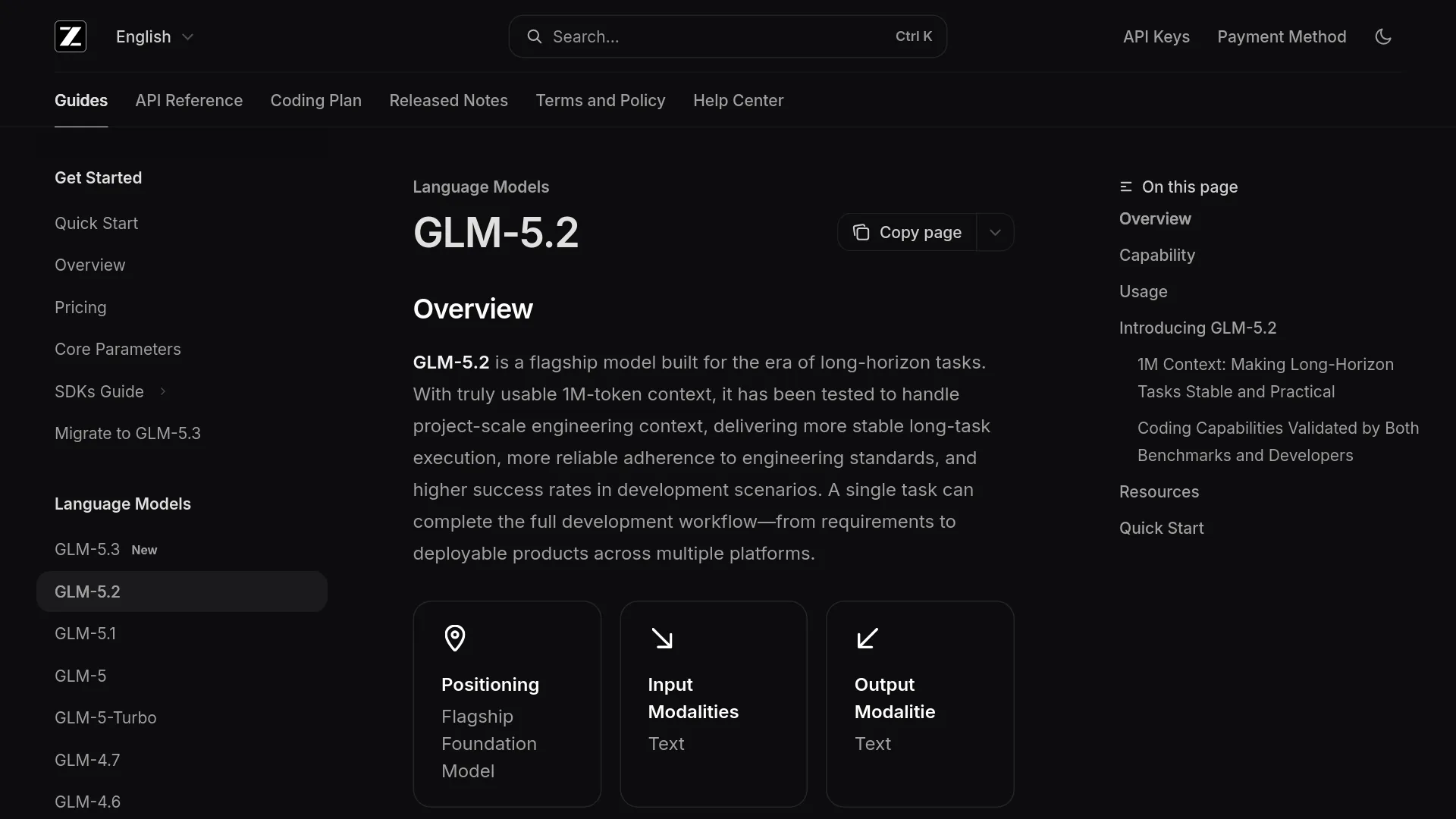
The official GLM-5.2 docs bless the OpenAI Python SDK with base URL https://api.z.ai/api/paas/v4/ and model id glm-5.2, so a basic chat integration really is a three-line change. Compatibility covers the request shape. It does not cover response semantics, OpenAI's optional control fields, or the newer Responses API surface.
| Documented contract | Value |
|---|---|
| Modality | Text in, text out (no vision) |
| Context window | 1M tokens |
| Max output | 128K tokens |
| Documented capabilities | Thinking mode, streaming, function call, context caching, structured output, MCP |
| Metered endpoint | https://api.z.ai/api/paas/v4/ |
| Coding Plan endpoint | https://api.z.ai/api/coding/paas/v4 |
| Anthropic-compatible endpoint | https://api.z.ai/api/anthropic |
| Official SDKs | zai-sdk (Python), Java, OpenAI SDK |
The first boundary: Z.ai has no Responses API at all — "Codex only supports the Responses API format, which isn't available at Z.ai," u/quinncom, with others routing through ZenMux as a translation layer. The second: the Claude Code route works through the Anthropic-compatible endpoint, but configuration notes from @armor_rust flag two traps — use AUTH_TOKEN rather than API_KEY (the latter triggers a trust confirmation that can permanently refuse after one rejection), and note that subscription and pay-as-you-go base URLs differ. The full walkthrough is in our Claude Code setup guide.
As one developer put it: "api compatibility stops at request shape; tool calling still needs provider-specific evals" — @sebuzdugan.
Tool calling: passes narrow tests, spirals in long loops
In short, controlled tool loops the GLM-5.2 API returns exactly what the docs promise. In long-running agent loops, heavy users report corrupted call sequences that loop until your own caps stop them. Both findings are true at once, and your risk depends entirely on which kind of loop you're building.
The documented contract, per Z.ai's docs as tested by GLM52.ai's 27-request Docker suite: up to 128 function definitions, names capped at 64 characters matching ^[a-zA-Z0-9_-]+$, JSON Schema parameters, arguments returned as a JSON string your app must validate, and only tool_choice: "auto" documented. That suite passed 27/27 requests on the Coding Plan route — 4/4 exact tool-and-argument matches, 3/3 correct no-tool refusals, 4/4 two-orders-in-two-top-level-calls, at a 5.3-second median latency.
The trap is the fields OpenAI users assume exist. When GLM52.ai sent conflicting probes, the endpoint returned HTTP 200 and then ignored the instructions:
| OpenAI-style control sent | Observed behavior |
|---|---|
tool_choice: "required" + "do not use any tool" | Stopped, zero calls |
| Forced-function object + "never use this tool" | Stopped, zero calls |
parallel_tool_calls: false + two-order prompt | Returned two calls anyway |
strict: true | Accepted once; no evidence of schema enforcement |
HTTP acceptance is not a behavior contract, and long loops are where the seams open.
A developer who ran roughly four billion tokens through the model put it bluntly: "biggest issue with GLM 5.2 4bil tokens in was the lack of vision, some tool call confusion, tool call corruption death (it just spirals)" — @RasputinKaiser. There is also a single, unreplied report of the model encoding a second tool call inside the first call's arguments — one case, but exactly the failure class a client-side loop defends against.
The defense that works in practice: keep the model dumb about orchestration. One developer runs NVIDIA NIM with tool_call: false and lets the agent framework own the entire loop; the bounded reference loop caps model steps at four, allows at most four calls per turn, and validates every argument JSON before execution.
Streaming and latency: the numbers nobody advertises
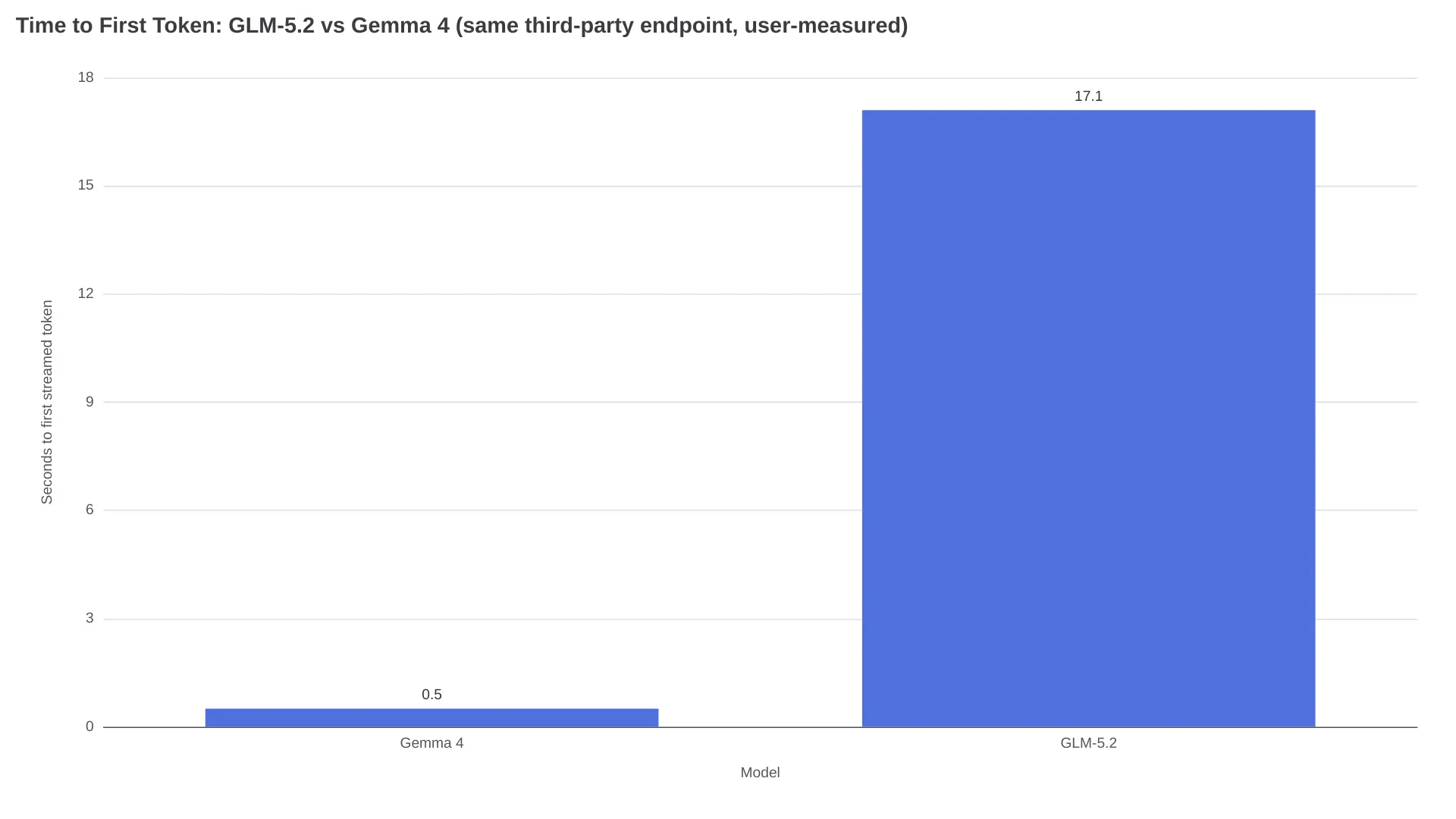
First-token latency is the API's weakest measured number. A side-by-side endpoint test on Sarvam pegged GLM-5.2 at 148 tokens per second streaming against Gemma 4's 260, with time-to-first-token of 17.1 seconds against 0.5 — "starts generating 33x sooner," @noctus91.
Advertised throughput has the same problem:
"All these GLM 5.2 providers advertise 200+ tok/s. Yet you try them and get 50 tok/s" — @tomgreenwald, who calls it "benchmaxxing but for providers."
Two more failure shapes reported on subscription routes: streams that die mid-session — "the streaming just...stopped," after which a GLM Pro Coding Plan user gave up entirely — and degradation that arrives with scale: "when you reach 300k+ context the model getting slow" (@mosh_Ontong). For contrast, DataLLM Lab's executed nine-task benchmark on its own gateway averaged 12.3 seconds per completed task — the endpoint, not the model, decides most of your latency story.
Rate limits and 429s: retry as a way of life
Z.ai's model documentation publishes no rate-limit table, so developers discover their limits empirically, through 429s. On the Coding Plan routes, the community picture is that retries are normal operation, not an exception path. These threads identify failure modes rather than prevalence rates, but they cluster consistently.
From a rate-limits thread in r/ZaiGLM:
- "Right now hitting 429/529 on coding max plan nearly for every second request. No concurrency..." — u/A-B-user
- "Yes, almost every request is retried, but the results are very good" — u/hyeluoh
- "It works fine (super slow but no errors) if I use single concurrency for glm52" — u/evia89
The errors are client-dependent: the same API key works in ZCode while throwing 429s in OpenClaw, which another user glosses as a "too busy" message. Subscription layers compound it — Chinese users report the Coding Plan auto-switching 5.2 workloads to GLM-5.3 (which eats quota faster) and third-party Coding Plan resellers rate-limiting after a handful of calls.
Engineering answers that hold up: exponential backoff with jitter, idempotency keys on anything that writes, a retry budget per task rather than per request, and a concurrency=1 degradation mode you can flip on automatically. The retry patterns in our OpenRouter 429 fix guide apply unchanged here.
The cache-billing question Z.ai hasn't answered
Context caching is documented, and cached input listed at roughly $0.26 per million tokens against $1.40 fresh input when we checked provider pages on July 13. The unresolved complaint — the highest-engagement API grievance in the community threads we reviewed — is that on some routes, repeated context is billed as fresh input anyway, which multiplies the cost of every agent loop that resends a long system prompt.
"cached tokens are not working properly on GLM 5.2. The repeated context is being counted as normal input instead of cached tokens." — @Da7_Tech, who calls it "a serious billing/cache accounting problem."
In that thread: the same task finished by Claude Opus 4.8 in under 1.5M tokens left GLM-5.2 incomplete after 53M tokens with the five-hour quota at 100%, while the app's own counter showed about 1.67M.
Two months later, the same developer was still summarizing: "plenty of users complain that cache hits appear to count against usage. If that happens to you, the value of the plan collapses." No official response appeared in those threads through late August.
Until this is confirmed fixed, treat cached-input pricing as a best case you must verify against your own invoices: log cached_tokens from the usage object on every response and reconcile weekly.
Reasoning effort: one knob, three names
The official surface is thinking.type (enabled/disabled) plus reasoning_effort with high and max values — the docs' own examples ship reasoning_effort: "max". Z.ai's launch guidance said max pushes capability and high balances performance against token efficiency, with max recommended for code.
Two integration facts follow. First, coding routes default to max: "It defaults to max so you don't need to unless you want to scale it down" (r/ZaiGLM). Reasoning tokens meter at output rates, so the default silently multiplies spend — and on Coding Plans, users who documented the plan's accounting report max-effort calls consume 3x quota during the weekday 14:00–18:00 Beijing window, stacked on a five-hour window plus weekly credits.
Second, the knob often doesn't reach the backend: OpenCode users report "currently it does not let you tweak reasoning effort" for custom providers, and some clients surface the same setting under a third name, xhigh, which they may not forward at all (r/opencodeCLI). Verbosity rides the same knob — a developer running daily comparisons noted a rival model was "not as verbose as Opus-4.8 or GLM-5.2."
Same model string, different models: endpoint drift
glm-5.2 is one model string pointed at materially different deployments. When endpoint-accuracy results circulated in early August, Z.ai's own lead asked the community "to test the official GLM-5.2 API as an additional reference point. It may score above 100%" — @ZixuanLi_. The reference point he named was the official API, not the third-party endpoints the report had measured.
What drift looks like in practice: output-token caps set low enough to truncate reasoning mid-stream, launch-window throughput that fades (the "benchmaxxing" pattern above), and context ceilings that differ by host — Together AI serves GLM-5.2 at 256K while the official API (1M per docs) and the aggregators in our July comparison carry the full window.
Pricing spreads even wider than behavior: against Z.ai's $1.40/$4.40 list, OpenRouter listed $0.42/$1.32 in our July provider comparison, with cached-input rates ranging from $0.14 (Fireworks) to $0.26. Pick your endpoint for the workload, then re-test on that exact endpoint — a behavior pass on one route is not transferable.
Before you ship: a 30-minute pre-flight test
Every failure mode above is detectable in half an hour, before you commit a production workload. Run these against the exact endpoint, model string, and SDK you plan to ship:
- Conflict-probe the tool contract. Send
tool_choice: "required"with an instruction to use no tools, andparallel_tool_calls: falsewith a two-order prompt. Expect both to be ignored; if your orchestration depends on either, stop here. - Retry soak. Fire 50 requests at your intended concurrency and log the 429/529 rate plus retry-success ratio. If retries exceed roughly a third of requests — a conservative operational threshold — drop concurrency to 1 and re-measure.
- Cache accounting check. Resend an identical 10K-token prefix five times; sum
cached_tokensfrom the usage responses and reconcile against what your dashboard billed as input. A mismatch here invalidates your cost model. - Latency soak at real context size. Measure time-to-first-token and mid-stream stalls at representative context sizes, not a 1K-token smoke test — the >300K slowdown is invisible otherwise.
- Route decision. The Coding Plan is built for interactive coding tools — plan-accounting writeups report it isn't licensed to serve websites, bots, or SaaS traffic — so product backends belong on the metered API.
The trade-off that doesn't resolve: GLM-5.2 sells some of the cheapest capable coding tokens on the market, and the admission price is wrapper engineering that frontier APIs fold into per-token cost instead.
GLM-5.2 API review FAQ
Can I use the OpenAI SDK with GLM-5.2?
Yes, for chat completions — point base_url at https://api.z.ai/api/paas/v4/ with model glm-5.2. No Responses API exists, so OpenAI's newer surface (and Codex) needs a translation layer.
Does the GLM-5.2 API support streaming, function calling, and structured output?
All three are documented capabilities, alongside context caching and MCP. The caveats are behavioral: streaming stability varies by endpoint, and OpenAI tool-control fields (tool_choice beyond auto, parallel_tool_calls, strict) are not honored.
What model string and base URL should I use?
Official metered route: glm-5.2 at https://api.z.ai/api/paas/v4/. The Coding Plan uses a different base, and OpenRouter lists the model as z-ai/glm-5.2.
Why is GLM-5.2 slow or unusually verbose?
Coding routes default to max reasoning effort, which meters as output tokens, and community reports put sustained throughput nearer 50 tok/s against 200+ advertised. Latency and verbosity are usually configuration-plus-endpoint artifacts before they are model limits.
Can the GLM Coding Plan power my application's API?
No — plan-accounting writeups report the subscription is for interactive coding tools and excludes serving websites, bots, or SaaS products. Beijing peak-hour quota multipliers make it hostile to steady traffic anyway.
Is the 1M context window available on every provider?
No. The official API and most aggregators carry 1M, but Together AI caps GLM-5.2 at 256K — enough to change the architecture of repo-scale workflows.
Related Reading
- GLM-5.2 Review: Two Months After the Hype — model quality, benchmarks, and who should run it
- GLM 5.2 API: Cheapest Access, Pricing & Free Keys — the full provider pricing matrix
- GLM-5.2 vs GLM-5.3 — whether the August successor changes the calculus