 AIREITER
Meta's Muse Glimmer landed on August 10, 2026, and the local AI community immediately started stress-testing whether a 30B dense multimodal model could replace Qwen 3.6 27B on consumer hardware. The short answer: Muse Glimmer fits on a single RTX 3090 with full 262K context and delivers 236 tok/s on an RTX 5090 with DFlash, but it trails Qwen 3.6 27B by 9 points on TerminalBench 2.1 and has a tendency to refuse OS-level automation tasks.
What is Muse Glimmer 30B?
Muse Glimmer is a 30B-parameter dense multimodal model released by Meta Superintelligence Labs under the Apache 2.0 license. It is purpose-built for local, resident agent workflows - not for topping coding leaderboards. The model combines a 27.9B text decoder with a 1.9B ViT vision encoder and a GELU-based multimodal projector, giving it both text and image understanding. Architecture details below are from the SGLang Day-0 support blog.
Architecture at a glance
| Specification | Detail |
|---|---|
| Total parameters | 30B |
| Text decoder | 27.9B dense |
| Vision encoder | 1.9B ViT |
| Transformer layers | 52 |
| Attention | Grouped-query (32 query heads, 2 KV heads - 16:1 GQA) |
| Feed-forward | SwiGLU |
| Context window | 128K+ (tested to 262K) |
| License | Apache 2.0 |
The architecture uses a hybrid attention scheme: three 2,048-token sliding-window-attention layers followed by one full-sequence-attention layer every fourth step. This design pairs RoPE for local-window layers with NoPE for full-attention layers, enabling context extension beyond the training limit. The 16:1 grouped-query attention ratio keeps the KV cache small - a community measurement shows roughly 1.8 GiB for 131K tokens in F16, which is why the model can hold full-length context on a 24 GB GPU where Qwen 3.6 27B tops out at 70K tokens in the same F16 configuration.
Can Muse Glimmer run on your hardware?
The answer depends heavily on your quantization choice. SGLang provides official checkpoints in BF16, NVFP4+MXFP8, GGUF Q4_K_M, GGUF Q4K-Dynamic, and MLX 4-bit formats. Community testers have also pushed the model to 2-bit GGUF for extreme low-VRAM setups.
VRAM requirements by configuration
| Configuration | Approximate VRAM | Hardware target |
|---|---|---|
| BF16 | ~60 GB | Single H100 |
| NVFP4 + MXFP8 | ~19.5 GB | RTX 5090 / DGX Spark |
| NVFP4 + BF16 DFlash | 18 GB + 5 GB speculator | RTX 5090 |
| Q4_K_XL + DFlash + mmproj + 262K context | ~22-23 GB | RTX 3090 (24 GB) |
| 2-bit GGUF | ~14 GB | RTX 4060 Ti / lower-end |
| MLX Q4 (Apple Silicon) | Unified memory | Mac mini / MacBook Pro |
A Reddit user demonstrated that Muse Glimmer in Q4_K_XL with DFlash speculative decoding, the multimodal projection file, and F16 KV cache fits comfortably in 22-23 GB on a single RTX 3090 - with the full 262,144-token context active. They retrieved two needles from a ~150K-token haystack on the first attempt.
For comparison, Qwen 3.6 27B on the same RTX 3090 reaches only 70K tokens with F16 KV cache (or 125K with Q8 KV cache), and Gemma 4 31B reaches 52K F16 (or 81K Q8). The KV cache efficiency from Muse Glimmer's 16:1 GQA ratio is the primary reason it can hold more context on the same hardware.
Setup paths: For NVIDIA, use SGLang or llama.cpp with the NVFP4 or GGUF checkpoint and enable --speculative-algorithm DFLASH. For Apple Silicon, use the MLX backend (DFlash not available). An M3 Max user with 96 GB unified memory reported 17 tokens/s and noted Muse Glimmer was faster than both Qwen and Gemma on that system.
How fast is Muse Glimmer?
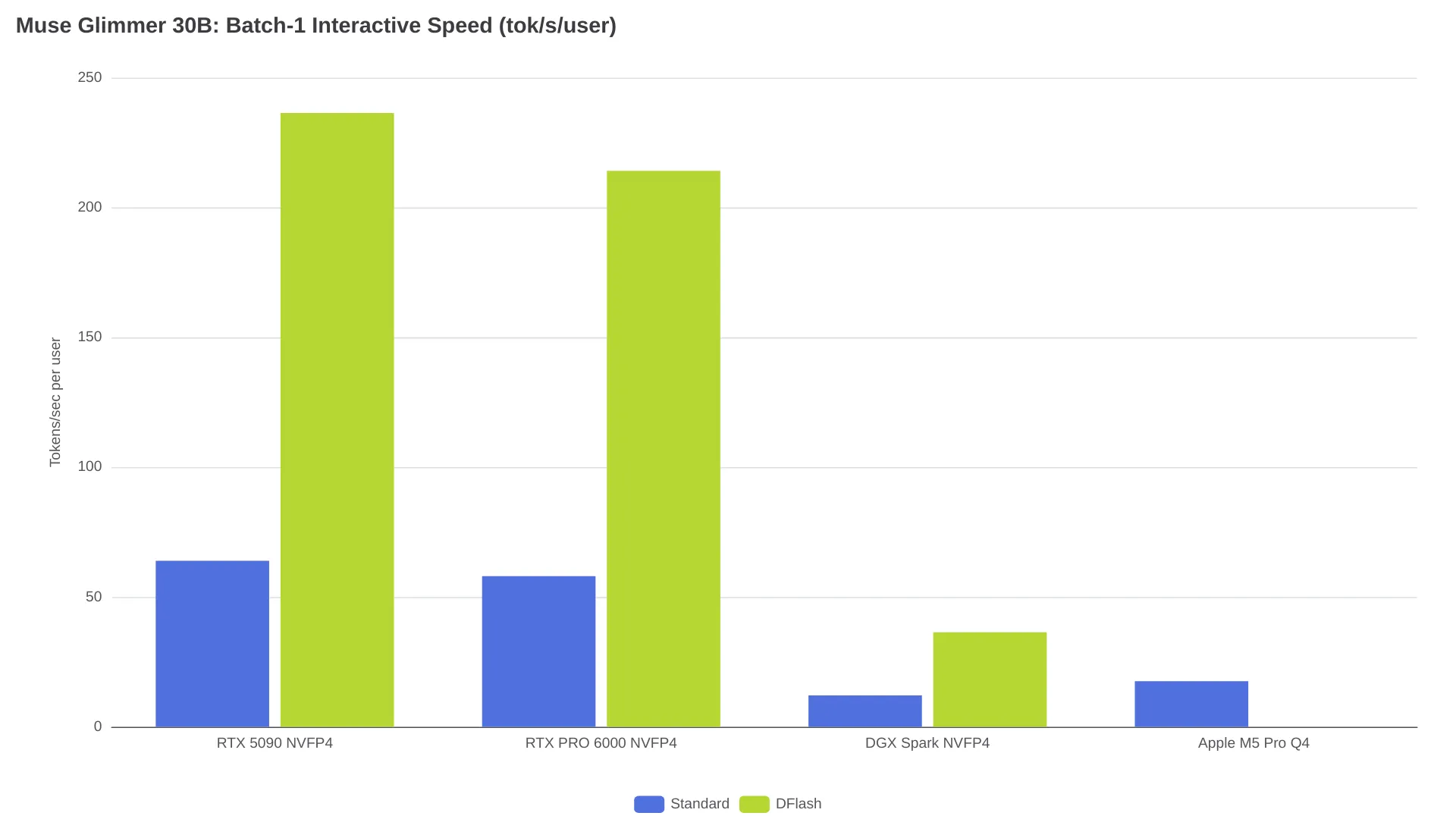
SGLang published a benchmark table across seven hardware configurations, sweeping batch sizes 1 through 8. DFlash speculative decoding - enabled with --speculative-algorithm DFLASH - delivers 1.9x to 4.3x speedup on batch-1 interactive throughput across NVIDIA platforms.
Key SGLang benchmark numbers
| Platform | Precision | Decoding | Batch-1 tok/s/user | Batch-8 tok/s |
|---|---|---|---|---|
| NVIDIA B300 | BF16 | DFlash | 308.51 | 261 |
| RTX 5090 | NVFP4 | DFlash | 236.4 | 1,452 |
| RTX 5090 | Q4_K_M | DFlash | 140.7 | 332 |
| RTX PRO 6000 | NVFP4 | DFlash | 214.11 | 403 |
| DGX Spark | NVFP4 | DFlash | 36.4 | 301 |
| Apple M5 Pro | Q4 | Standard | 17.6 | 56.9 |
The 1,452 output tokens/s at batch 8 on an RTX 5090 is aggregate throughput; for single-user local inference, the 236 tok/s figure with DFlash on NVFP4 is the relevant one. Without DFlash, the same configuration drops to 63.9 tok/s. Community reports align: a user on an RTX 5090 with Unsloth's Q5_K_M quantization reported 220-253 tokens/s.
DFlash performance depends on draft acceptance rates - users on Vulkan/RX 7900 XTX and SYCL/B70 both reported low draft acceptance and slower overall throughput.
Muse Glimmer vs Qwen 3.6 27B: Which should you pick?
TerminalBench 2.1 scores
| Model | TerminalBench 2.1 | Context on RTX 3090 (F16 KV) |
|---|---|---|
| Qwen 3.6 27B | 60.7 | ~70K tokens |
| Muse Glimmer 30B | 51.7 | ~262K tokens |
| Gemma 4 31B | 43.4 | ~52K tokens |
TerminalBench 2.1 scores cited in community discussion. Context figures from RTX 3090 testing.
Qwen 3.6 27B leads by 9 points on TerminalBench 2.1, the benchmark most community members treat as critical for evaluating whether a model can execute reliable terminal commands over a long task horizon. In direct coding tests, the gap is consistent: one user's private eval suite scored Qwen 12/13 versus Glimmer 11/13, and Qwen generated a 953-line Tokyo tourism page correctly on the first attempt while Glimmer produced under 200 lines (full thread).
"not even close to Qwen 3.6 27B" - Reddit user BarberIcy366, after Glimmer produced only 220 lines of HTML for an 8-ball pool game while consuming 21,000 tokens (r/LocalLLaMA). The same thread includes a report that Qwen 3.6 27B completed a Tetris implementation 1.7x faster with MTP enabled.
However, Glimmer has genuine advantages in specific areas:
- Context capacity: 262K tokens on a single RTX 3090 vs. 70K for Qwen at the same F16 KV setting - a 3.7x advantage for large-codebase work.
- KV cache efficiency: The 16:1 GQA ratio means Glimmer's KV cache is dramatically smaller, leaving more VRAM for context.
- Vision capability: Glimmer is multimodal out of the box; Qwen 3.6 27B is text-only in its base form.
- MCP and tool-Q&A: One user reported that while Glimmer trails Qwen for terminal coding, it shows promise for MCP-assisted codebase search and question-answering workflows.
- Writing quality: Multiple users preferred Glimmer's natural-language output over Qwen's.
One commenter summarized the tradeoff: Glimmer is "Qwen 3.6 27B plus 5% writing style and minus 5% agentic capability."
Bottom line
If your primary workload is one-shot coding or autonomous terminal agents, Qwen 3.6 27B remains the stronger choice - it scored 9 points higher on TerminalBench 2.1 and does not exhibit the safety refusals that plague Glimmer for OS-level automation. If you need long-context retrieval, multimodal input, or MCP-assisted workflows on a single consumer GPU, Muse Glimmer is worth testing. Wait for community fine-tunes if you need reliable terminal automation.
Known issues and gotchas
The max_tokens trap
Muse Glimmer spends a significant portion of its token budget on internal reasoning before producing output. If max_tokens is set too low, the model may exhaust its budget mid-thought and return an empty response. One user initially scored Glimmer 6/13 on their eval suite; raising the output-token budget brought it to 11/13 (source thread). Set max_tokens high enough to accommodate reasoning overhead, or responses may terminate mid-thought.
Safety refusals for OS-level automation
Multiple users report that Muse Glimmer refuses tasks involving mouse control, keyboard automation, or other OS-level tool calls. The model frames these as potential security risks even when the request involves standard Python library usage.
"Moving a mouse programmatically can be misused for automation, clickjacking, or bypassing security prompts." - Muse Glimmer refusal as reported by Reddit user Cold_Tree190 (r/LocalLLaMA)
Starting a new session with more context about the intended use case can sometimes resolve the refusal, but within a session where the model has already declined, it tends to hold its position.
Inconsistent tool calling
Community reports on tool-calling reliability range from "hasn't failed once" in a C codebase to endless loops and empty API responses in other setups. Unsloth Q4 and Q5 quants were reported to loop heavily during tool calling in some configurations, while official GGUFs targeting 24 GB and 32 GB VRAM may behave more reliably (source thread).
Regional download restrictions
The official Hugging Face page reportedly disables downloads in Hong Kong, Macau, and China. Third-party GGUF distributions from Unsloth remain available as an alternative.
Related reading: Muse Spark 1.2 API pricing guide | Best free OpenRouter models for programming 2026