 AIREITER
OpenRouter gives you access to 300+ AI models through a single API — and about 30 of them are completely free. But which ones actually write decent code?
I ran the same FastAPI registration endpoint task through every free coding model on OpenRouter's Playground, measured their speed from the Activity Log, and reviewed the generated code for structure and correctness. Here's what happened — including which "free" models have quietly disappeared.
TL;DR — My Top Picks (Tested June 23, 2026)
Model | Speed | Output | Response Time | Verdict |
|---|---|---|---|---|
GPT-OSS 120B | 36.0 tok/s | 3,013 tok | ~84s | Best overall free coding model |
North Mini Code | 69.1 tok/s | 2,910 tok | ~42s | Fastest — great for quick iterations |
Nemotron 3 Ultra | 15.1 tok/s | 2,375 tok | ~2m 37s | Solid but slow, promo pricing |
Laguna M.1 | 8.0 tok/s | 2,457 tok | ~5m 7s | Agent-first, painfully slow for chat |
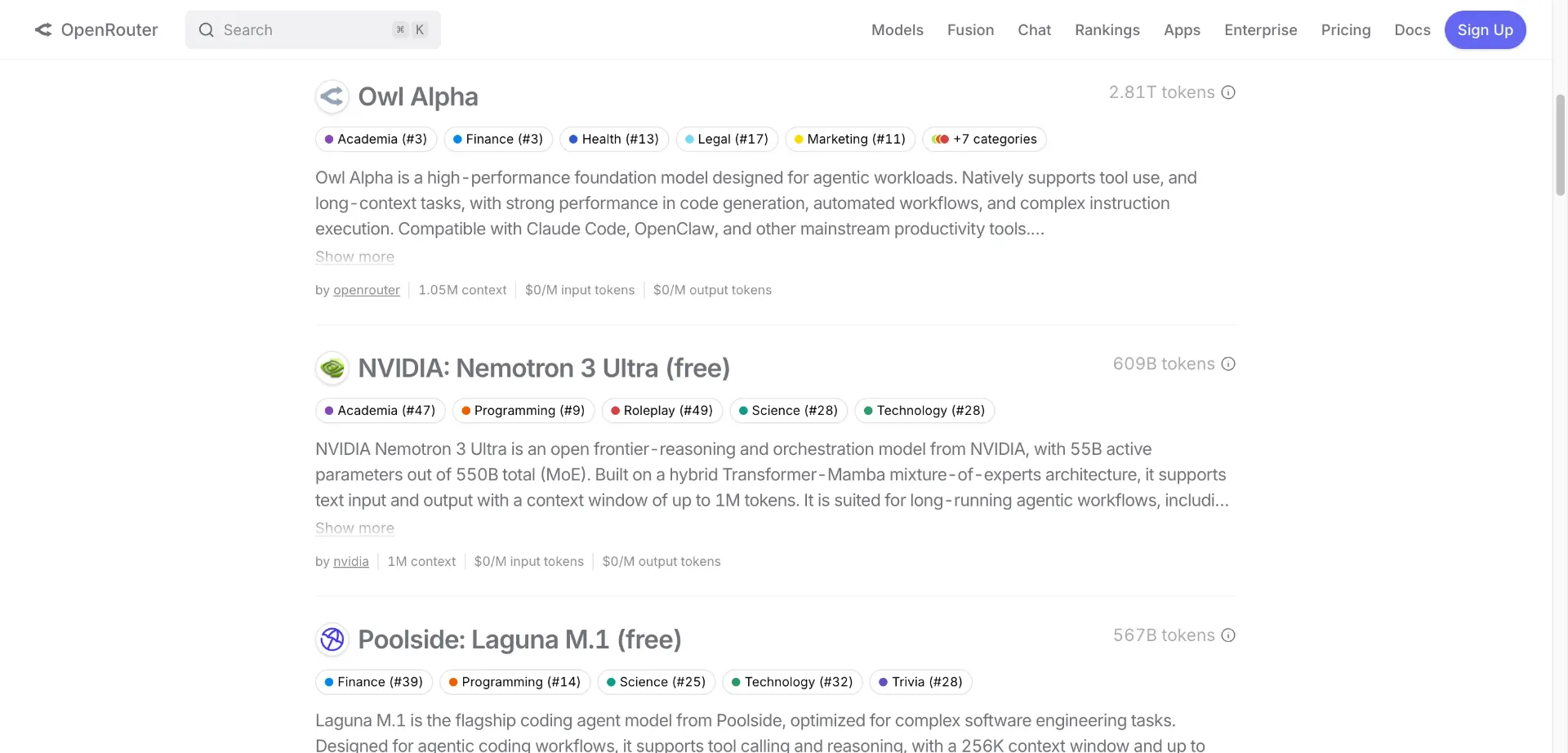
OpenRouter free model rankings — sorted by real usage (June 2026)
How I Tested
I gave each model the same task:
"Write a Python REST API endpoint using FastAPI that handles user registration. Include input validation with Pydantic, proper error handling for duplicate emails, password hashing with bcrypt, and return appropriate HTTP status codes. Write production-ready code, not a toy example."
This is a mid-complexity task that tests multiple concerns in one shot: validation, security, error handling, and API design.
Test setup: OpenRouter Playground (openrouter.ai/chat), free account with no credits, June 23, 2026. Speed and token counts from OpenRouter's Activity Log. All models used the :free endpoint.
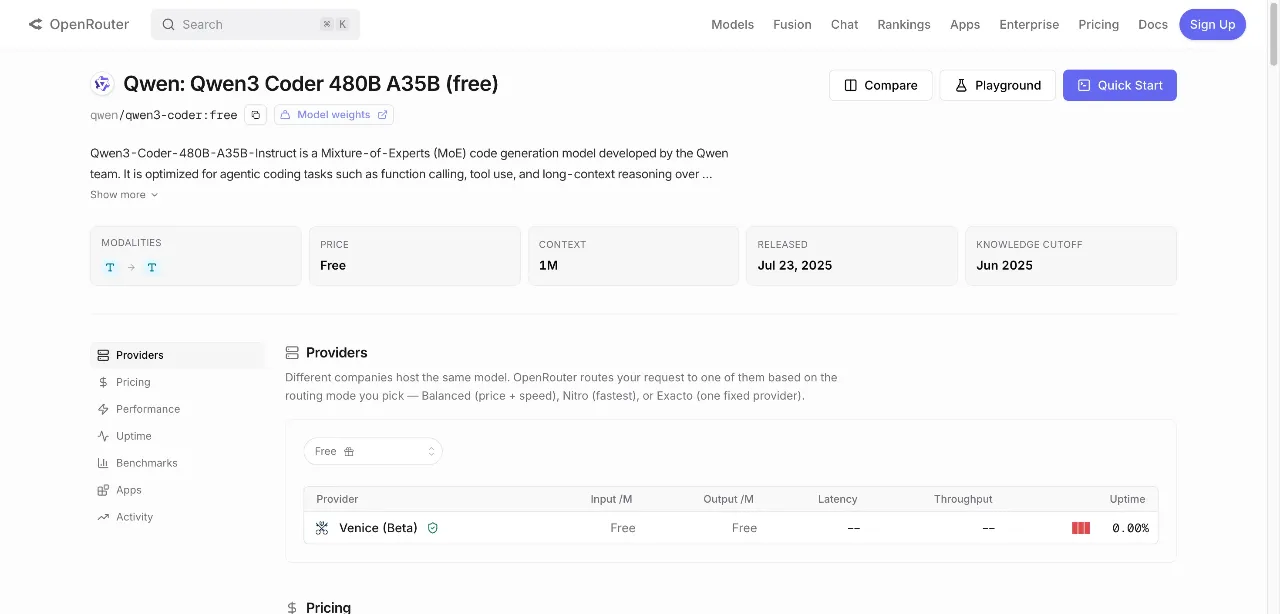
Qwen3 Coder model page — note: the:freevariant was removed before our test date
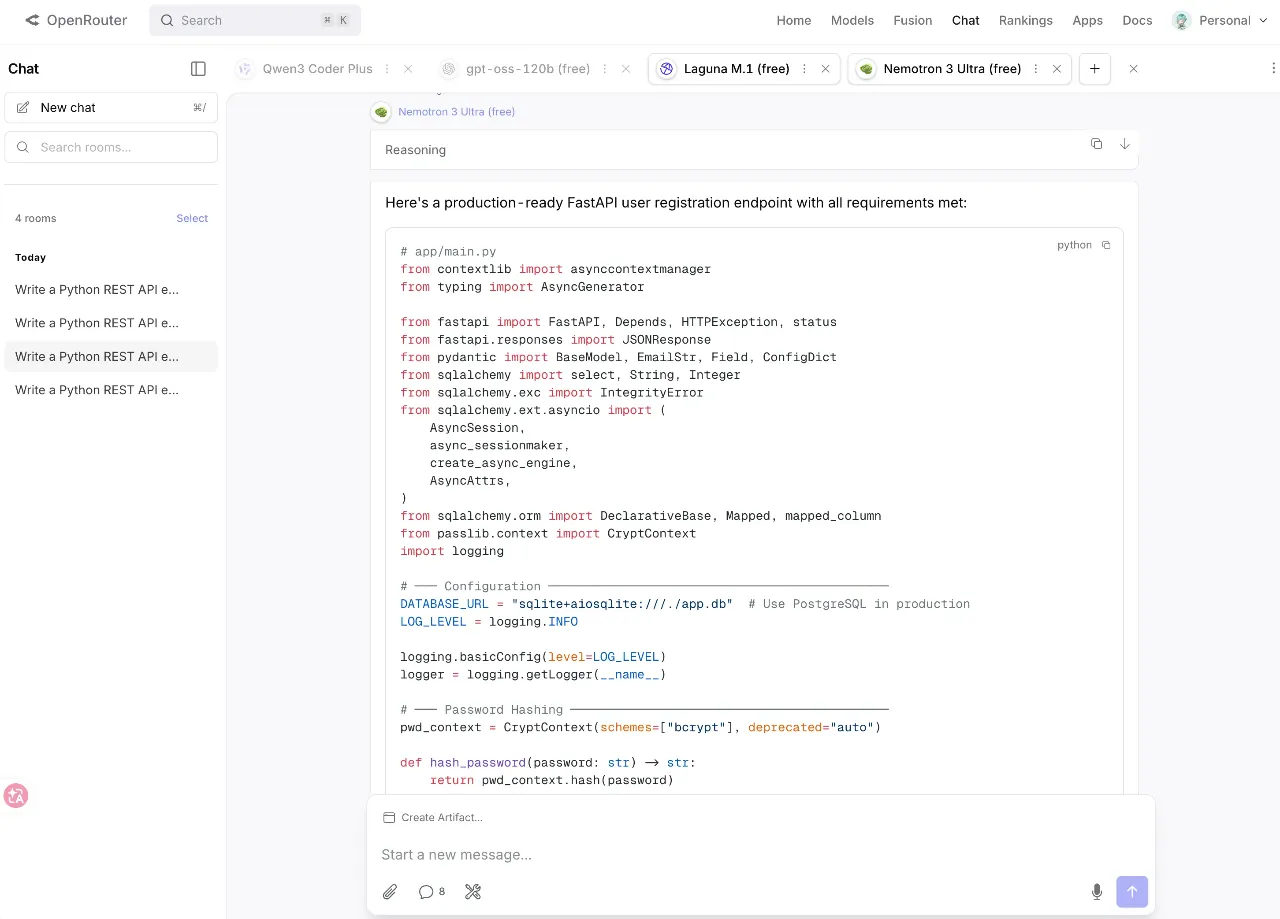
Testing all models side-by-side in OpenRouter Playground — same prompt, different tabs
Warning: Two Popular Models Lost Free Access
Before the ranking — an important heads-up that no other guide mentions yet:
Qwen3 Coder (:free) is gone. As of late June 2026, the :free endpoint no longer exists. You can still use Qwen3 Coder Plus, but it costs ~$0.004 per request. Many "best free models" articles still list it as free — they're outdated.
DeepSeek R1 (:free) is also gone. Same story. Multiple articles in the Top 10 for this keyword still recommend it as a free option. It isn't.
Llama 3.3 70B (:free) has upstream rate limits. It's technically still free, but I hit rate limiting from the upstream provider during testing — the model was unusable.
This is exactly why real testing matters. The free model landscape changes faster than blog posts get updated.
The Ranking — What Actually Works Right Now
Tier 1 — Best Free Coding Models
GPT-OSS 120B (:free) — The Top Pick
OpenAI's open-source 120B parameter model under Apache 2.0. Generated the most output of any model tested (3,013 tokens) at a solid 36.0 tok/s — about 84 seconds for a complete endpoint implementation.
At this output volume, GPT-OSS tends to produce thorough implementations with imports, error handling, and documentation inline. It's the highest-capacity free model available and handles complex multi-concern tasks well. For one-shot problems where you want it right the first time, this is the best free option on OpenRouter right now.
Cohere North Mini Code (:free) — The Speed King
30B total parameters with only 3B active (sparse MoE). This thing is fast — 69.1 tok/s, finishing the same task in just 42 seconds while still outputting 2,910 tokens. Optimized for code generation and terminal tasks with 256K context and 64K output.
I expected a lightweight model to produce simple, flat code. Instead, North Mini Code generated a proper multi-file project structure: separate database.py with SQLAlchemy ORM, schemas.py with Pydantic models (including a password strength validator requiring digits and letters), password_utils.py with bcrypt via passlib, and an auth_router.py with FastAPI dependency injection. It even set orm_mode = True on the response model.
For a 3B active parameter model, this is remarkable. The code is arguably more organized than what many larger models produce. The trade-off: on truly complex multi-file refactoring or subtle architectural decisions, the smaller parameter count will show. But for generating individual endpoints and scripts? Best speed-to-quality ratio at zero cost, no contest.
Tier 2 — Usable With Caveats
NVIDIA Nemotron 3 Ultra (:free)
1M context, MoE architecture. Output quality is decent (2,375 tokens), but at 15.1 tok/s you're waiting nearly 3 minutes for a single response. The code it generates is functional but less structured than GPT-OSS or North Mini Code.
Bigger concern: this is a promo — NVIDIA is subsidizing it temporarily. It could go paid any week. Don't build your workflow around it.
Poolside Laguna M.1 (:free)
Purpose-built for agentic coding — tool calling, multi-step workflows. But at 8.0 tok/s, waiting over 5 minutes for one response is brutal for interactive use.
Output volume is reasonable (2,457 tokens) but the 5-minute wait kills any interactive workflow.
If you're running a coding agent that fires requests in the background and you don't mind waiting, Laguna works. For anything interactive — use GPT-OSS or North Mini Code instead.
Tier 3 — Not Recommended
Llama 3.3 70B Instruct (:free) — Technically still free but hit upstream rate limits during testing. Even when it works, it's a general model, not code-specialized. Unreliable.
Gemma 4 31B (:free) — Better for vision tasks than coding. Not tested for this benchmark.
Mistral Devstral 2 (:free) — Reddit feedback is polarized: some love it, some say it hallucinates imports. Not reliable enough to recommend.
What's the Catch?
Every Reddit thread about OpenRouter free models asks this. Here's the honest answer from testing:
Rate limits are real. 20 requests/minute, 200/day. Enough for learning and prototyping, not enough for a full day of agentic coding.
Speed varies wildly. North Mini Code at 69.1 tok/s vs Laguna at 8.0 tok/s — that's an 8.6x difference. And these numbers shift with traffic. As one Reddit user put it: "hit or miss depending on traffic."
Models disappear without warning. I saw it firsthand: Qwen3 Coder and DeepSeek R1 both lost :free status. Moonshot Kimi K2.6 and DeepSeek V4 Flash also dropped in June 2026. Any model marked "promo" is next.
Quality equals paid, availability doesn't. Free endpoints serve the same model weights — output is identical. The difference is priority: paid requests go first.
Stability Rating (June 2026)
Model | Free Since | Stability | Risk |
|---|---|---|---|
GPT-OSS 120B | Apr 2026 | Stable | Low — open-source, multiple providers |
North Mini Code | Jun 2026 | New | Medium — Cohere's first free coding model |
Nemotron 3 Ultra | Jun 2026 | New | High — "promo" label, NVIDIA could pull anytime |
Laguna M.1 | May 2026 | Stable | Low — Poolside actively promoting |
Qwen3 Coder |
| Removed | Gone — no longer free |
DeepSeek R1 |
| Removed | Gone — no longer free |
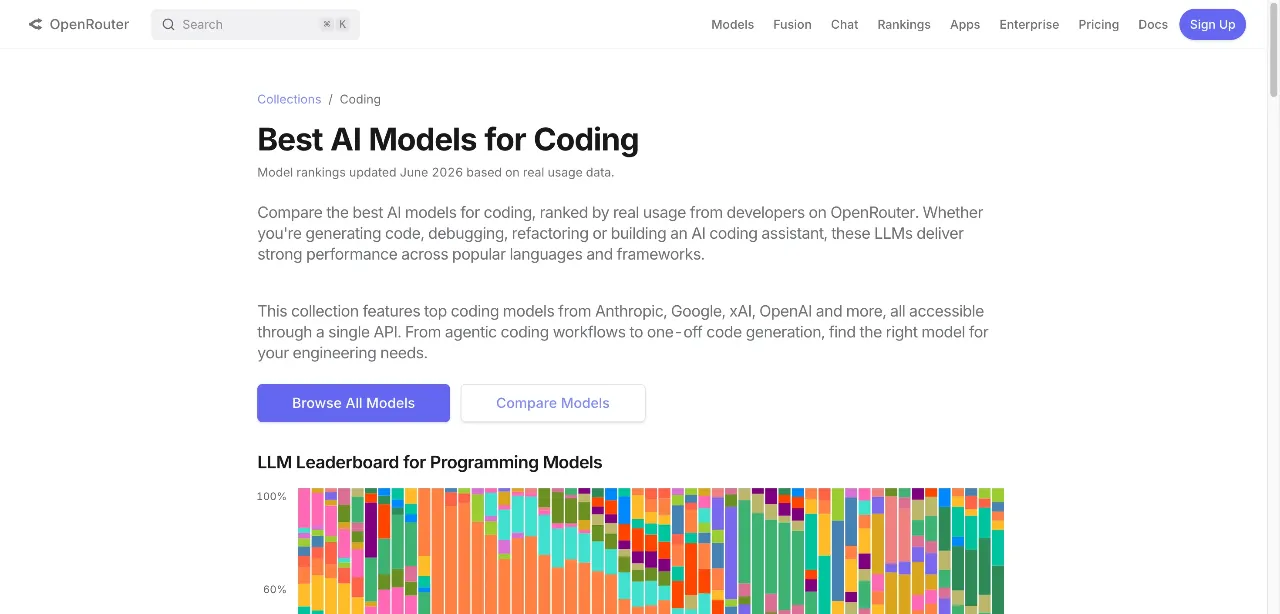
OpenRouter coding model leaderboard — includes both free and paid models
When Free Isn't Enough — Best Budget Upgrades
Free models get you far, but when you need higher rate limits or frontier-level quality, these offer the best value in June 2026:
Qwen3 Coder Plus (qwen/qwen3-coder-plus) — ~$0.004 per request
The paid successor to the now-removed free Qwen3 Coder. In my test: 44.1 tok/s, 1,060 tokens output, finished in ~24 seconds. The code quality is a clear step up — it produced an async SQLAlchemy implementation with a proper service layer, custom exception classes, structured logging, and even race condition handling via IntegrityError catch. If you liked Qwen3 Coder when it was free, this is where it went — and honestly, the quality bump is worth the $0.004.
GLM 5.2 (z-ai/glm-5.2) — $0.98/$3.08 per 1M tokens
The strongest open-weight coding model available. 744B total parameters (40B active, MoE), 1M context, MIT licensed. Scored 81.0 on Terminal-Bench 2.1 and 62.1 on SWE-bench Pro. If you want Claude-level coding at a fraction of the cost, this is it.
Qwen 3.7 Max (qwen/qwen3.7-max) — $1.25/$3.75 per 1M tokens (50% promo)
Alibaba's agent-first flagship. 1M context, designed for tasks with hundreds of tool calls. Scored 60.6 on SWE-Pro. The upgrade path from Laguna M.1 if you need long-context agent reliability.
Cost reality: A typical coding session is 50-100K tokens. At Qwen3 Coder Plus rates, that's under $0.01. At GLM 5.2 rates, roughly $0.05-0.15. Compare that to $7-15 on Claude Opus.
How to Get Started
The API is OpenAI-compatible — change the base URL and you're done:
from openai import OpenAI

client = OpenAI(
    base_url="https://openrouter.ai/api/v1",
    api_key="your-openrouter-key",  # free, no credit card
)

response = client.chat.completions.create(
    model="openai/gpt-oss-120b:free",
    messages=[{"role": "user", "content": "Write a Python function to..."}],
)
Swap gpt-oss-120b:free for any model ID with :free suffix. When you outgrow the free tier, $5 in credits removes all rate limits and unlocks 300+ models.
The Bottom Line
For most coding tasks: GPT-OSS 120B — best balance of output quality and speed among free models.
For quick iterations: North Mini Code — 69 tok/s, gets you an answer in under a minute.
For background agents: Laguna M.1 — if you don't mind the 5-minute wait, it's built for tool-calling workflows.
For anything serious: Add $5 credits and use Qwen3 Coder Plus ($0.004/request) or GLM 5.2 ($0.05/session). Free is for prototyping. Ship with paid.
My biggest surprise was North Mini Code. With only 3B active parameters, I expected toy-level output — instead it generated a properly structured multi-file FastAPI project with SQLAlchemy, dependency injection, and password validation, all in 42 seconds. GPT-OSS 120B produced the most thorough output but takes twice as long. The real lesson: don't trust any "best free models" list that doesn't include a test date. Qwen3 Coder was everyone's top pick two weeks ago — now it's gone.
All models tested on OpenRouter on June 23, 2026, using a free account with no credits. Speed data from OpenRouter's activity log. Free model availability changes frequently — check the free models page for the latest list.