 AIREITER
Muse Spark 1.2 runs a two-tier pricing model with a 12.5× input-price gap between tiers. Standard costs $1.25 per million input tokens and $4.25 per million output. Contributor drops those to $0.10 and $0.20, but Meta can train on your prompts and completions. The catch is that the cheaper tier is also throughput-capped at 60 requests per minute with a ~250K daily token limit, so your real savings depend on workload volume, not the per-token rate alone.
Standard vs Contributor: Two Tiers, One Model
Muse Spark 1.2 (model ID: muse-spark-1.2) is a reasoning-focused coding model from Meta with a 1,048,576-token context window, per Meta's developer docs. Both API tiers access the same model; the difference is price, data handling, and throughput.
| Dimension | Standard | Contributor |
|---|---|---|
| Model ID | muse-spark-1.2 | muse-spark-1.2-contributor |
| Input (per 1M tokens) | $1.25 | $0.10 |
| Cached input (per 1M tokens) | $0.15 | $0.002 |
| Output (per 1M tokens) | $4.25 | $0.20 |
| Context window | 1,048,576 tokens | 1,048,576 tokens |
| Long-context premium | None | None |
| Data privacy | Meta cannot train on your data | Meta may use prompts/outputs for training |
There is no long-context premium on either tier, per Meta's documentation.
On Standard, cached input costs $0.15/M, 8.3× cheaper than a fresh input. On Contributor, it drops to $0.002/M, sharply lowering costs for repeated codebase context.
"Muse Spark 1.2 is awesome... the price is ridiculous."
— User on r/opencode
Rate Limits That Cap Real Spend
Per-token price tells you half the story. The other half is throughput, and the two tiers diverge sharply:
| Limit | Standard | Contributor |
|---|---|---|
| Requests per minute | 3,000 | 60 |
| Tokens per minute | 4,000,000 | Much lower (daily-capped) |
| Daily token cap | Unlimited | ~250,000 tokens/day |
| Enforcement | Per team | Per team |
Rate limits are enforced per team, not per API key, so additional keys do not increase throughput, per Meta's pricing and rate limits documentation.
What 250K Tokens/Day Means for Coding
The Contributor daily cap of ~250,000 tokens is easier to evaluate using the same session model from the section below: each turn sends 8,000 input + 2,000 output = 10,000 tokens. At that rate, 250,000 tokens covers about 25 turns before the daily ceiling hits — roughly a single focused coding session, not a full workday of iterative development.
What a Real Coding Session Costs
Take a representative coding session: an agent loads 8,000 tokens of context (codebase + system prompt), generates 2,000 tokens of output (code edits + reasoning), and repeats this pattern 20 times in a session.
| Tier | Per-turn cost | 20-turn session |
|---|---|---|
| Muse Spark Standard | $0.0185 | $0.37 |
| Muse Spark Contributor | $0.0012 | $0.024 |
| GPT-5.6 Terra ($2/$12) | $0.0400 | $0.80 |
| Claude Opus 5 ($5/$25) | $0.0900 | $1.80 |
A 20-turn session costs $0.37 on Standard or $0.024 on Contributor; the latter uses roughly 200K of the 250K daily cap.
With cached input factored in (7:2:1 cache-hit ratio from Artificial Analysis), Muse Spark 1.2 Standard blends down to $0.78 per million tokens.
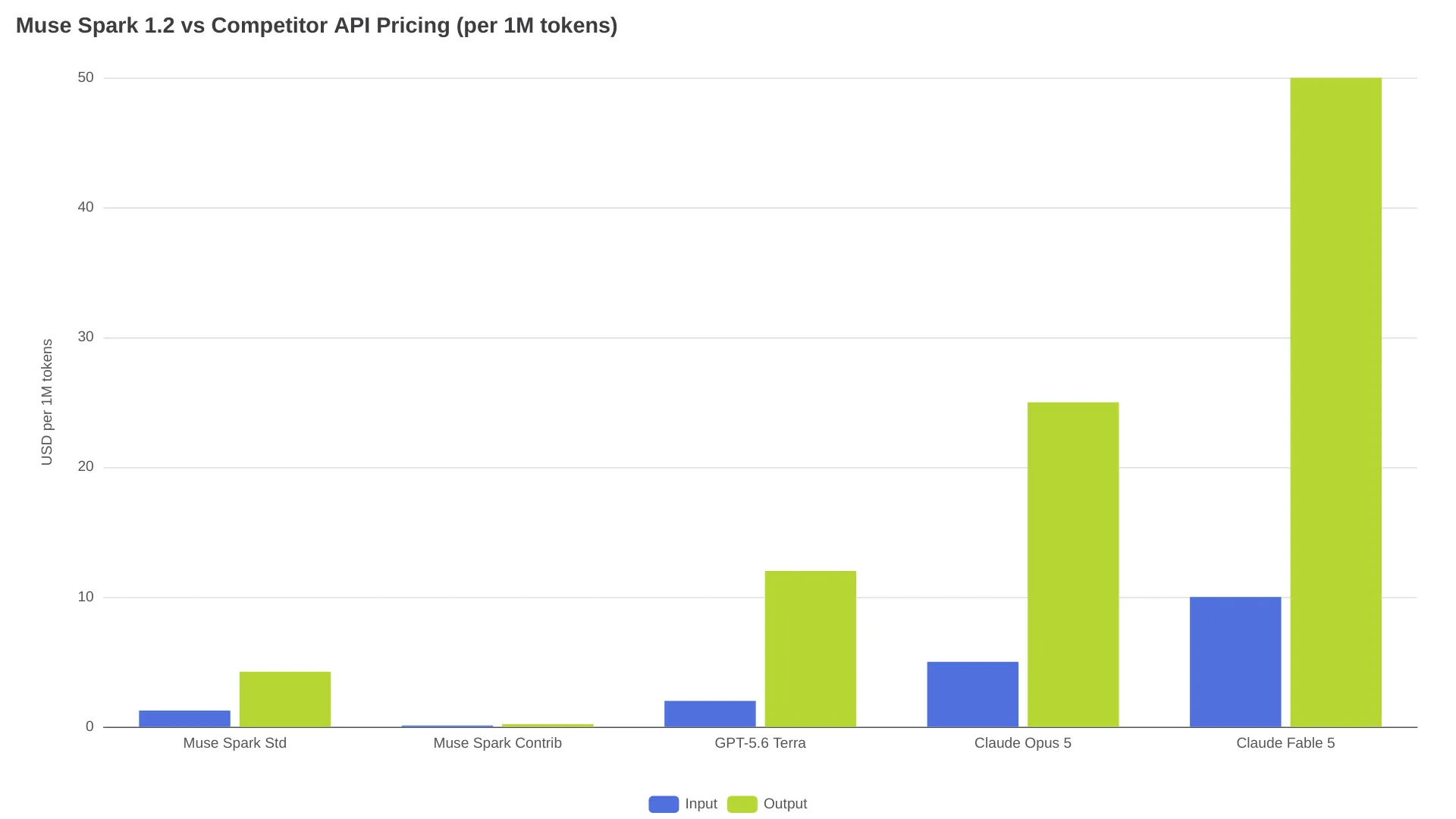
Muse Spark 1.2 vs Competitor Pricing
| Model | Input (per 1M) | Output (per 1M) | Blended cost* |
|---|---|---|---|
| Muse Spark 1.2 Standard | $1.25 | $4.25 | $0.78 |
| Muse Spark 1.2 Contributor | $0.10 | $0.20 | $0.04 |
| GPT-5.6 Terra | $2.00 | $12.00 | $3.00 |
| GPT-5.6 Sol | $5.00 | $30.00 | $7.50 |
| Claude Opus 5 | $5.00 | $25.00 | $7.00 |
| Claude Fable 5 | $10.00 | $50.00 | $14.00 |
\*Blended cost uses a 7:2:1 cache-hit:input:output ratio for Muse Spark rows: 0.7 × cached input + 0.2 × input + 0.1 × output. Competitor rows use a 90/10 fresh-input/output scenario for comparability. Ratio methodology from Artificial Analysis. Competitor prices from OpenAI and OpenRouter.
Artificial Analysis placed Muse Spark 1.2 on the cost-performance Pareto frontier, delivering intelligence comparable to Claude Opus 4.8 at roughly one-fifth the cost per task. The blended figures above are scenario estimates, not direct list-price comparisons; the 20-turn session table provides the cleaner apples-to-apples comparison using the same workload for every model.
On benchmarks, Muse Spark 1.2 inside Muse Code scores 82.9% on Terminal-Bench 2.1, trailing Claude Opus 5's 86.7%, according to VentureBeat.
Which Tier for Which Project
The tier choice is not purely about price — it is about matching data sensitivity, throughput, and latency tolerance to your project.
Pick Standard if:
- You handle proprietary or client code that cannot leave your control
- You need sustained throughput above 60 RPM
- Your daily token usage exceeds 250K
- You are integrating into a production pipeline with predictable load
Pick Contributor if:
- You are working on open-source or personal projects
- Your usage is exploratory or prototyping-heavy
- You want the lowest token cost for low-volume exploratory work and can stay within 60 RPM and ~250K tokens/day
- Your team is comfortable with Meta training on your prompts
There is a latency dimension worth noting. Orca Router reports 26.12s time-to-first-token for Spark 1.2 versus 2.90s for 1.1, a 9× regression that is a poor fit for workflows requiring near-immediate first streamed responses.
One more wrinkle: several users on Reddit report the Contributor tier is region-locked in some geographies. If you cannot find it in the API console, check whether it is available in your region before assuming it is unavailable.
You can also access Muse Spark 1.2 through third-party routers like OpenRouter, which offer the Standard tier at the same $1.25/$4.25 rates with potentially different rate-limit structures.
FAQ
Is there a free tier for Muse Spark 1.2?
The API itself has no free tier — it is pay-as-you-go on both Standard and Contributor, per Meta's pricing page. However, Muse Code, Meta's coding agent that runs Muse Spark 1.2, is free during beta with daily token limits.
Can I switch between Standard and Contributor mid-session?
Yes — switching is done by calling a different model ID (muse-spark-1.2 vs muse-spark-1.2-contributor), per Meta's documentation. Contributor access must be enabled for your region first.
Is the Contributor tier safe for production use?
Only if your data policy permits Meta to use your prompts and completions for training. For proprietary or client code, see the tier-selection criteria above.
How does Muse Spark 1.2 compare to its predecessor on price?
Pricing is unchanged from Muse Spark 1.1 — both Standard tiers cost $1.25/$4.25 per million tokens, per Meta's documentation. The Contributor tier is new to 1.2.