AIREITER
Suno Studio 2.0, shipped August 13, 2026 to Premier subscribers, finally adds the three things that kept Studio out of a producer's real workflow: MIDI recording, automation, and a playable wavetable synth. The quieter headline is exports. Premier now gets unlimited 32-bit/48kHz multitrack stems that don't touch Suno's coming 60-download monthly cap, which changes the math against per-track separation services. The honest limit: the Chat bar is beta, and generation consistency is an unresolved concern, documented in pre-2.0 reviews and unaddressed in Suno's launch notes.
What Studio 2.0 Changes Overnight
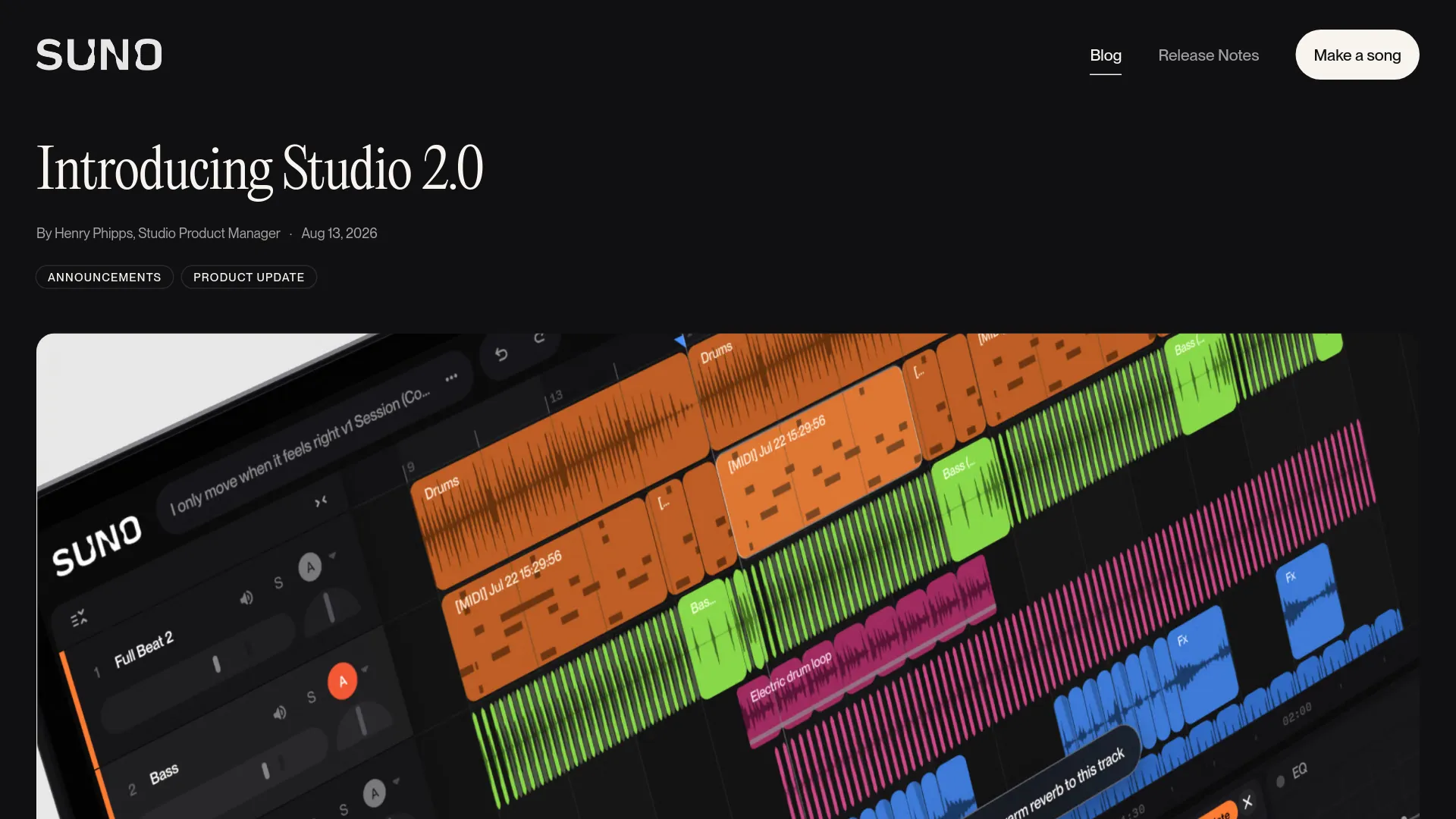
Studio 2.0 adds MIDI input, automation, a built-in synth, expanded effects, and higher-spec Premier exports to a tool that previously ran on text prompts and generated stems alone. Suno's launch post pitches the update as a correction to Studio 1.x's prompt-first design. The scope:
| Area | Studio 1.x (through 1.2) | Studio 2.0 (Aug 2026) |
|---|---|---|
| MIDI | None; audio-to-MIDI extraction only | Import, record, edit; MIDI learn; musical typing |
| Instruments | Generated stems only | Wavetable synth + arpeggiator + chord modes |
| Automation | None | Draw curves or record parameter movement |
| Effects | Basic per-track processing | Sidechain compression, convolution reverb, EQ, delay, distortion, gate |
| Separation | Stems from Suno songs | Splits imported external audio too |
| Exports | WAV stems, no published spec | Unlimited 32-bit/48kHz multitracks on Premier |
The timing maps neatly onto MusicTech's January 2026 review, which scored Studio 6/10 and dinged exactly these gaps: no MIDI writing, no automation, unpredictable generations, and artifacts that "do not withstand close scrutiny." Version 2.0 answers the first two directly. The last two, consistency and artifacts, are generation problems that a MIDI editor doesn't fix.
What Premier Actually Costs Now (and the $30 Confusion)
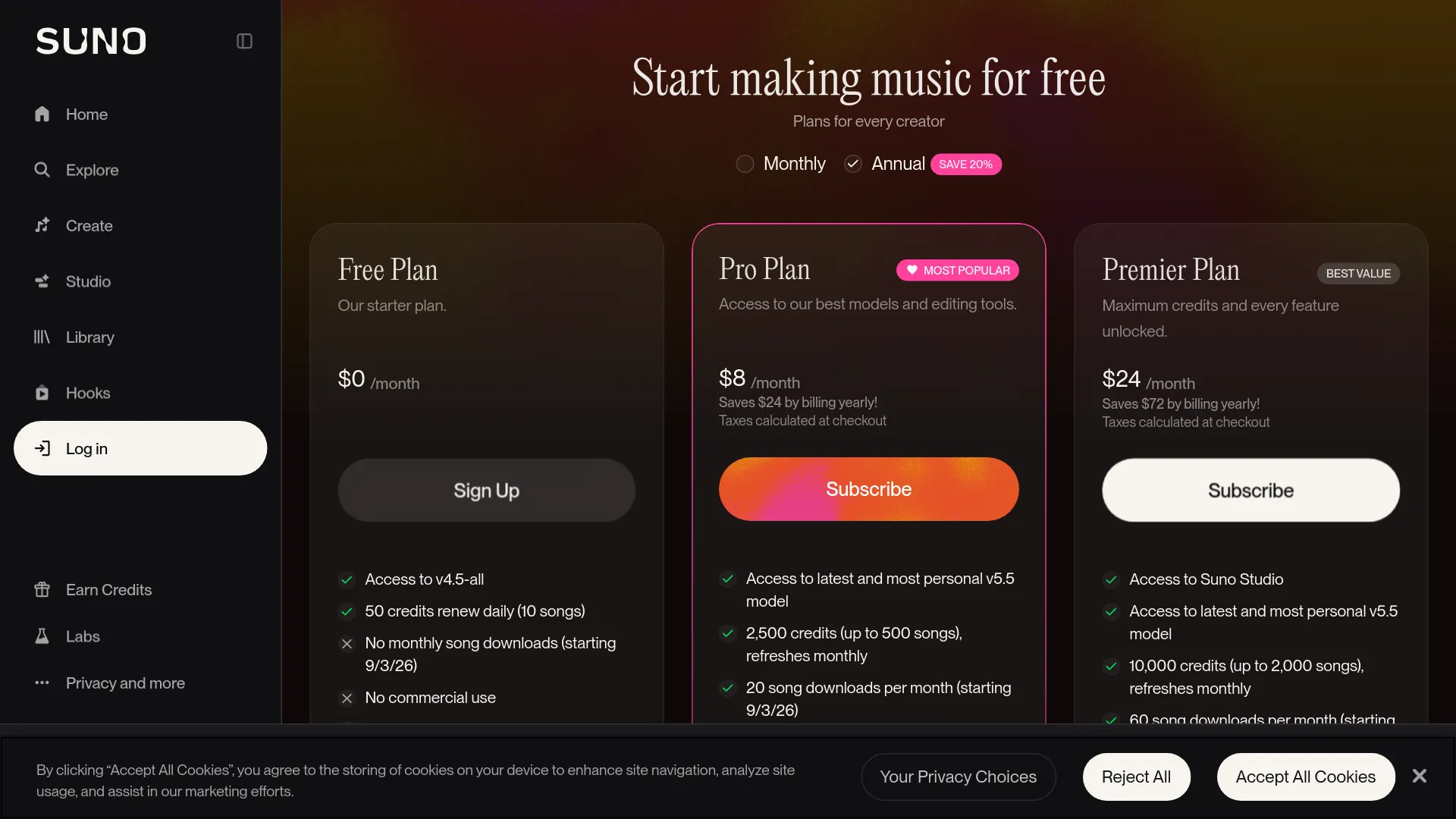
Studio 2.0 requires Suno's Premier plan; Pro and Free tiers cannot open it. Here is what suno.com/pricing listed when checked on August 17, 2026:
| Plan | Price | Credits | Studio access | Song downloads (from Sep 3, 2026) |
|---|---|---|---|---|
| Free | $0 | 50/day | No | 0 |
| Pro | $8/mo (~$6 annual) | 2,500/mo | No | 20/mo |
| Premier | $24/mo (~$18 annual) | 10,000/mo | Yes | 60/mo |
Premier also carries three stem-separation types (Auto, Split from mix, Advanced split) versus two on Pro.
One discrepancy worth flagging: MusicRadar's launch coverage (August 14) quoted Premier at $30/month or $24 billed annually, and Artifactr's June 2026 stems guide still lists $30. The live pricing page now lists $24 monthly with $72 in annual savings, so verify the checkout number before subscribing.
MIDI Recording and Automation Curves: Controllers, Musical Typing, and the 10-Credit Catch
MIDI in Studio 2.0 covers the full loop: import, record, and edit note data, either on the timeline or in a dedicated MIDI editor. "MIDI has been the most requested addition to Studio," Suno writes, and latency compensation now ships alongside it so recorded parts land where you played them.
Automation curves arrive in the same release: draw them by hand or record fader and knob movements as live lanes, on any track or plugin parameter, so filter sweeps and ducking no longer require baking effects into a generation.
No controller? Computer-keyboard musical typing ships with an arpeggiator and chord modes. With a hardware controller, supported uses include playing the built-in synths, transport control, and MIDI learn for mapping knobs to plugin parameters.
The catch is the generative side's credit metering. Studio's audio-to-MIDI "Get MIDI" command costs 10 credits per stem and outputs a transcription, not the original note data. Kevin at Melodex, who reports bass-octave errors and imprecise note durations in transcribed MIDI, budgets 5–10 minutes of editor cleanup per exported stem.
Ten credits is cheap against Premier's 10,000/month pool, roughly 1,000 extractions if you spend nothing else on generation. But MIDI from vocals isn't offered, only melodic instrumental stems. The reverse path, MIDI clips as prompts for new generated audio, retains the source part's pitch, rhythm, and dynamics while swapping timbre, per MusicRadar's demo.
Wavetable Synth, Stock Effects, and Chat-Made Plugins
The stock instrument rack is headlined by a wavetable synth, the first time Studio generates timbre from a playable engine rather than from a text prompt. The effects list reads like a DAW's factory folder: reverb (including convolution), delay, compression (including sidechain), distortion, EQ, and a noise gate, each sitting in the horizontal channel strip that now runs along the bottom of the interface.
The Chat bar (explicitly beta) is the stranger addition. It can build synth presets, arrange a session, batch-rename tracks, and generate custom audio plugins from a text description; MusicRadar's demo prompted a rotary-cabinet tremolo into existence and called custom-in-DAW plugin generation a first among DAWs. Plugin creation currently costs no credits, but Suno states plainly that "a credit structure may be introduced in the future." Treat free plugin generation as a launch-window subsidy, not a permanent feature.
The Export Math: Unlimited 32-bit/48kHz Stems vs. Per-Track Pricing
This is where Premier's value proposition gets concrete, because Suno's download policies quietly split exports into two very different doors.
What You're Allowed to Download
Suno's September 3, 2026 policy change caps regular song downloads: Free gets zero, Pro gets 20/month, Premier gets 60/month. Studio exports are separate. The Studio 2.0 announcement states Premier users can export multitracks and stems with no download limit, at 32-bit/48kHz. Users measuring downloaded files on r/SunoAI agree: Studio stems arrive as 32-bit 48kHz WAV, while the old menu-based "Extract Stems" path, which one user in that thread reports at 50 credits per run (a figure Suno's help docs don't confirm), hands over 16-bit 48kHz files.
That reconciles the conflicting numbers floating around. Melodex's guide cites 44.1kHz/16–24-bit for pre-2.0 exports, Reddit users measure 32-bit/48kHz for Studio: they're different doors, menu extraction for quick splits and Studio multitrack export for full sessions. Suno's help center still publishes no official spec sheet, so verify your file metadata before building a template around it. The user who compared both paths put the open question directly:
"But is there any difference in real quality?" — u/LyckeMi, r/SunoAI
Thirty-two-bit float can add headroom during mixing, and nothing in that thread shows the extra depth improves separation quality itself.
Per-Track Costs Elsewhere
Standalone separation services meter by the minute. LALAL.AI's pricing page defines consumption as file duration × number of selected stem types, so a 4-minute song split into 4 stems burns 16 processing minutes:
| Service | Price | What you get | Cost per 4-min, 4-stem track |
|---|---|---|---|
| LALAL.AI Lite | $7.50/mo | 90 fast-queue min | ~$1.33 |
| LALAL.AI Pro | $15/mo | 250 fast-queue min | ~$0.96 |
| LALAL.AI top-up minutes | $50–300 packs | 750–5,000 min | $0.96–1.07 |
| Suno menu "Extract Stems" | 50 credits/run (user-reported, unconfirmed) | 16-bit files | ~$0.12 in credit value |
| Moises free tier | $0 | 5 uploads/mo, 5-min files, 2- or 4-track | $0 (capped) |
| UVR / Demucs local | $0 | Your GPU, your time | $0 |
LALAL.AI's paid minutes buy fast-queue priority (relaxed-queue processing is unlimited on paid plans); Moises shows paid pricing only after login, and Demucs/UVR runs free locally.
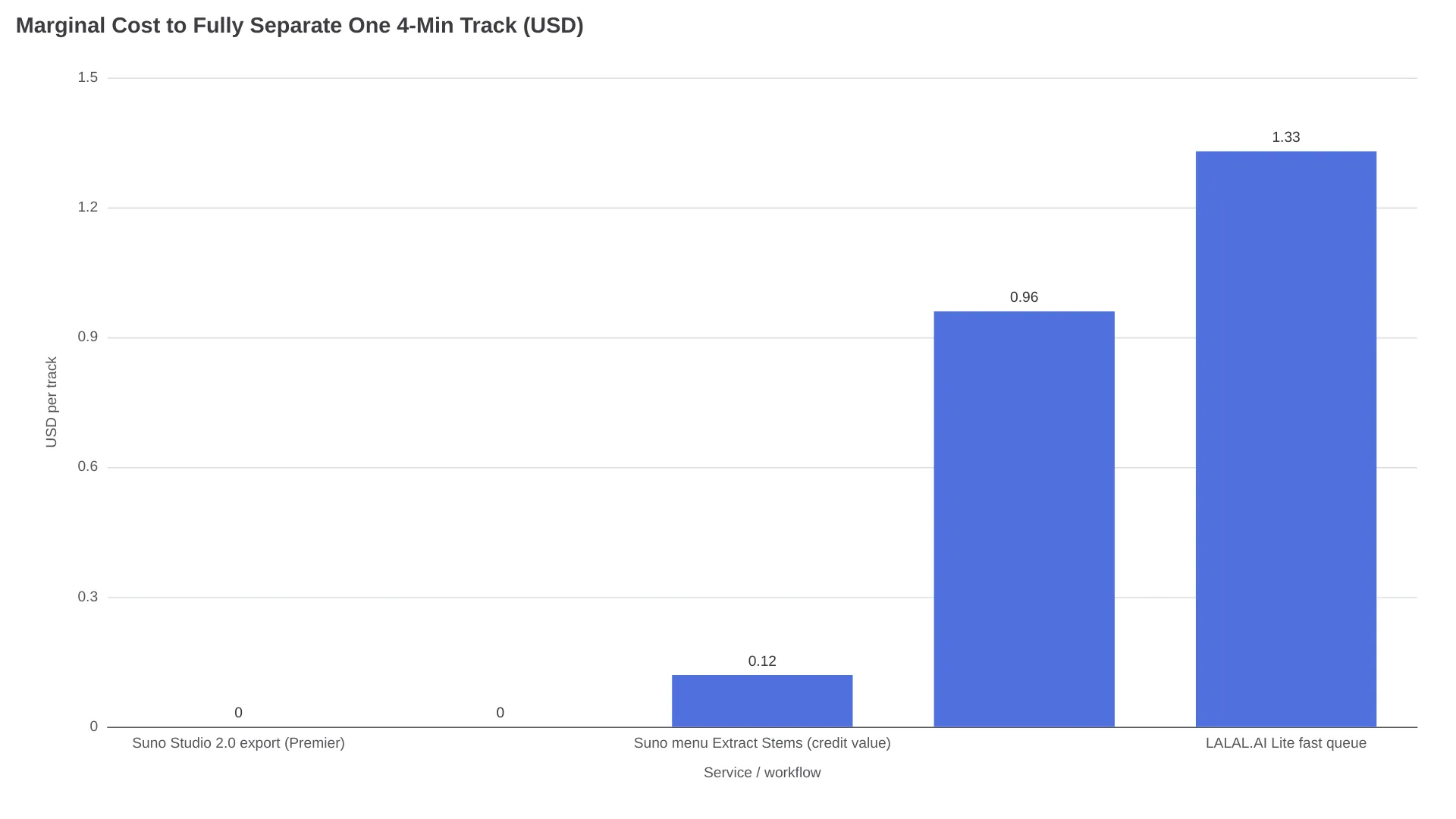
The verdict this math forces: as a pure separator, Premier loses. Ten separated tracks a month fits inside LALAL.AI Pro's $15/month (250 fast minutes covers about 15 tracks), and UVR does it for $0, versus $24 for Premier with 10,000 generation credits you didn't need.
But that comparison is backwards for Suno users. Studio exports ride inside a subscription that also covers generation, which Suno's plan page pegs at up to 2,000 songs from 10,000 credits (~5 credits per song), plus MIDI extraction at 10 credits each and the synth. If you generate in Suno and regularly export multitracks to finish in a DAW, the marginal cost per export is zero once the generation itself justifies Premier. Buy Premier for the generation pipeline; buy LALAL or run UVR when the audio already exists.
Where Studio 2.0 Still Frustrates
The Chat bar is labeled beta by Suno itself, and prompt adherence was already the pre-2.0 complaint. MusicTech's reviewer watched the model add "an unwanted synth solo over an a cappella passage despite the prompt," and reported smeared high-frequency transients and audible artifacts; Studio 2.0's launch notes make no claim that generation quality itself improved. MusicTech also found stem separation mis-assigns parts, and on vocals a long-time Suno user reports:
"the vocals can really be a hit and miss" — u/LyckeMi, r/SunoAI
Studio remains browser-only, with Safari bugs pushing MusicTech's reviewer to Chrome, and Suno's announcement says nothing about third-party VST/AU plugin loading, collaboration, or offline projects. MusicRadar also reports that Suno now watermarks downloads, so check Suno's current commercial-use terms before distributing release-ready output.
Who Should Pay for Premier This Month
| You are... | Call | Why |
|---|---|---|
| Generating in Suno, finishing multitracks in a DAW | Subscribe, if the 10k credits already fit your workflow | Unlimited 32-bit/48kHz exports ride along; export cost $0 once subscribed |
| Separating audio you already own | Skip | UVR free, Moises 5 free/mo, LALAL ~$0.96–1.33/track — all beat $24 |
| Posting Suno songs straight to social | Pro, $8 | Studio unneeded; 20 downloads/mo covers casual output |
| Working professional deadlines | Wait | Beta Chat + consistency issues (MusicTech: 6/10, pre-2.0) make Studio a sketchpad, not a deliverable tool |
Suno Studio 2.0 FAQ
Is Suno Studio 2.0 a full DAW now?
Almost. MIDI recording, automation, a wavetable synth, and per-track channel strips close the functional gap, but Studio runs in a browser, documents no third-party VST/AU plugin loading, and layers generative behavior (credits, watermarking) on top of normal DAW workflows.
Do Studio exports count against the 60-download cap?
No. From September 3, 2026, Premier's 60 monthly downloads apply to regular song downloads; Studio multitrack and stem exports carry no stated limit per Suno's 2.0 announcement.
Are Studio stems really 32-bit/48kHz?
Suno's Studio 2.0 announcement states 32-bit/48kHz for multitrack and stem exports, and users measuring downloaded files agree. The older menu-based "Extract Stems" path reportedly outputs 16-bit files, a different door with a different spec.
Can you use VST or AU plugins in Studio 2.0?
Suno documents no VST/AU loading in its announcement or help docs. Effects are the stock rack plus whatever the Chat bar generates; the escape hatch is exporting stems and MIDI to Ableton, Logic, or FL Studio.