 AIREITER
A 30-second single-pass video generator with 50-reference control sounds like a clear winner over a 15-second model — until you check whether you can actually call it. Seedance 2.5 was announced on July 31, 2026, but as of early August, its API endpoint on BytePlus ModelArk still says "coming soon." Kling 3.0 has been live and billable since February.
That availability gap is the first filter in this comparison, not the spec sheet.
Seedance 2.5 Is Announced but Not Callable — Kling 3.0 Has Been Shipping for Months
ByteDance's Seed team published the Seedance 2.5 launch post on July 31, 2026. The rollout channels — Jimeng AI, Doubao Pro, and Dreamina — were all still showing pre-launch banners or "coming soon" labels when checked that same day. BytePlus ModelArk published a model ID (dreamina-seedance-2-5-260628) and a rate card, but the API reference page carried a notice: "The Model Playground and API access will be available soon."
Kling 3.0, by contrast, launched in February 2026. It has months of production use behind it, published documentation for all resolution tiers, and live endpoints on multiple platforms including AIReiter.
| Status | Seedance 2.5 | Kling 3.0 |
|---|---|---|
| Announced | Jul 31, 2026 | Feb 5, 2026 |
| Public API | Coming soon (as of Aug 4) | Live |
| Consumer apps | Rolling out (Jimeng, Dreamina) | Live (Kling AI, CapCut) |
| Third-party gateways | Not yet | AIReiter, fal.ai, others |
If your project has a deadline this month, Kling 3.0 is not just the safer choice — it is the only current API choice.
What a 10-Second Clip Costs Through the API
Pricing structures differ. Kling 3.0 charges per second with audio as an optional add-on at 720p and 1080p (free at 4K). Seedance includes audio in every generation at no extra cost. That difference matters when you're budgeting volume.
The table below uses AIReiter's published rates for Kling 3.0 and BytePlus ModelArk's published rates for Seedance 2.5 (the only source, since the API is not open). Seedance 2.0 is included as a reference since it is the closest callable proxy.
| Model | 480p/s | 720p/s | 1080p/s | 4K/s |
|---|---|---|---|---|
| Seedance 2.5 | $0.103 | $0.231 | Not listed | Not listed |
| Seedance 2.0 | $0.07 | $0.15 | $0.37 | $0.78 |
| Kling 3.0 (no audio) | — | $0.095 | $0.127 | $0.477 |
| Kling 3.0 (with audio) | — | $0.143 | $0.191 | $0.477 |
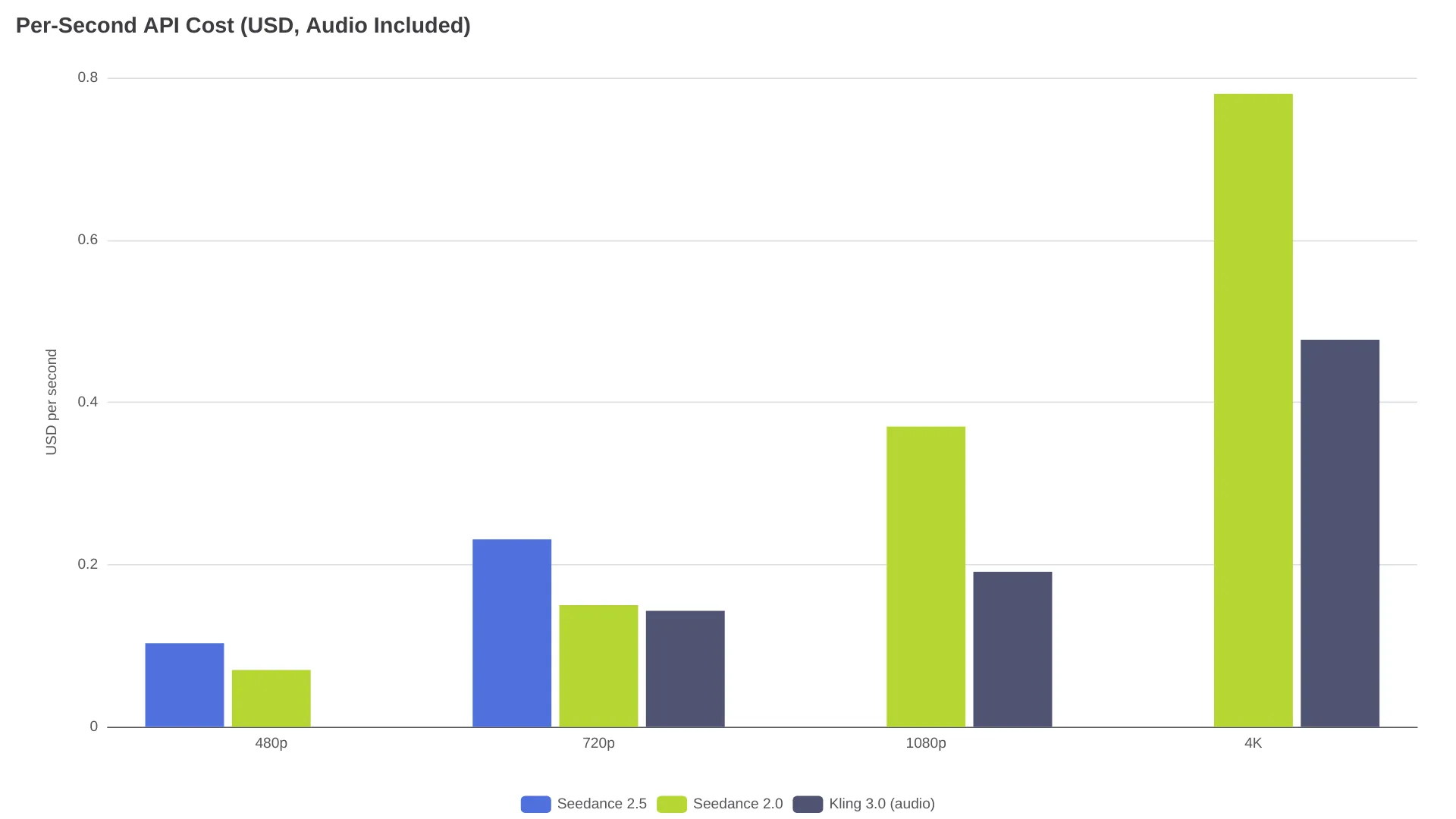
At 720p with audio, Kling 3.0 is 38% cheaper per second ($0.143 vs $0.231). But Seedance 2.5 generates up to 30 seconds natively while Kling tops out at 15. A 30-second Seedance 2.5 clip at 720p would cost roughly $6.93, while achieving the same duration on Kling requires two 15-second generations at $2.15 total — plus manual stitching, with no guarantee of visual continuity across cuts.
The real cost comparison depends on whether continuity across 30 seconds matters to your workflow. If it does, Seedance 2.5's higher per-second rate buys you something Kling structurally cannot deliver in a single pass.
Kling 3.0 has one pricing quirk worth noting: at 4K, audio is included for free ($0.477/s regardless). At 720p and 1080p, adding audio costs 50% more. Seedance's pricing always includes audio.
Feature-by-Feature: Seedance 2.5 Leads on Paper, Kling 3.0 Leads on Shipping Resolution
Seedance 2.5 wins in most headline spec categories. Kling 3.0 counters with higher shipping resolution and finer per-frame controls.
| Feature | Seedance 2.5 | Kling 3.0 |
|---|---|---|
| Max clip length | 30 seconds (single pass) | 15 seconds |
| Max resolution | 720p confirmed; 4K claimed but unpriced | 720p / 1080p / 4K (all priced) |
| Reference inputs | Up to 50 (30 images + 10 video + 10 audio) | Element system (image sets + video refs) |
| Audio generation | Native, included in base price | Native, extra cost at 720p/1080p |
| Region editing | Yes | No |
| 3D / green-screen input | Yes | No |
| Motion brush | No | Yes |
| Text rendering | Average | Strong (signs, logos stay legible) |
| Multi-character binding | Reference-driven | Element binding (more controllable) |
| Aspect ratios | 21:9, 16:9, 4:3, 1:1, 3:4, 9:16 | 16:9, 9:16, 1:1 |
| Negative prompt | No | Yes |
| CFG scale control | No | Yes (0–1) |
| API status | Coming soon | Live |
Two things stand out when you look past the headline numbers.
First, resolution. Seedance 2.5's rate card stops at 720p. ByteDance's launch post names no resolution ceiling, Dreamina advertises 4K, and Runway's product page claims "up to 30 seconds in 4K" — but that is Runway's claim, not ByteDance's. Until a 1080p or 4K row appears in ModelArk's pricing table, the only billable output is 480p and 720p. Kling 3.0 has shipped 4K since launch.
Second, control. Kling 3.0 exposes negative prompts and CFG scale, gives you motion brush for drawing movement paths directly on frames, and uses a structured element binding system that lets you tag persistent characters across shots. Seedance 2.5's controls are broader in scope (50 references, region editing, green-screen input) but less granular per frame.
Where Each Model Wins (By Task)
Long-Form Ads and Product Reveals — Seedance 2.5 (When It Ships)
Seedance 2.5's 30-second native generation is its genuine differentiator. A single continuous take eliminates visible seams, consistency drift, and manual assembly time. For a 30-second product launch video or social reel, that is one prompt, one wait, one file — versus three to six Kling generations plus editing.
The 50-reference input system amplifies this. Feed in product photos, brand assets, character sheets, mood boards, and audio clips in a single call, and the model anchors the output to all of them. ByteDance confirmed the breakdown: up to 30 images, 10 video clips, and 10 audio clips per generation.
Realistic Close-Ups and Portrait Scenes — Kling 3.0
Kling 3.0 handles human faces and subtle motion more reliably. Multiple Reddit users report that Seedance tends toward an "artificial" look on close-ups, while Kling preserves photorealistic detail.
"I've used it in Higgsfield a few times and the facial consistency is there, but my character always comes out looking artificial … despite the reference sheet being fully realistic. Using the same reference sheet in Kling 3.0, he comes out completely real looking." — u/ZucchiniFar3209, r/generativeAI
Kling also has the edge on text rendering — brand logos, price tags, and storefront signs stay legible where Seedance tends to produce blurry distortions.
Multi-Character Consistency
Both models tackle this problem, but differently. Kling 3.0's element binding system lets you define characters as @Element1 / @Element2 and maintain distinct visual identities across shots. Seedance relies on its reference stack — effective when you provide strong references from multiple angles, but characters can blend when there are too many.
"Seedance 2.0 holds face and character better than Kling when you swap wardrobe across shots, that was the real difference for me. Catch is it drifts if you push one prompt into a long multi-shot sequence, so I keep one prompt = one shot." — u/Fresh-Resolution182, r/generativeAI
The practical answer: Seedance is better at wardrobe swaps within a single shot. Kling is more reliable at keeping multiple characters distinct across a multi-shot sequence.
Audio-Synced Social Clips — Depends on Budget
Both models generate native audio. The difference is cost structure. Seedance includes audio in every generation. Kling charges a 50% premium for audio at 720p and 1080p ($0.095 → $0.143 per second at 720p), but bundles it free at 4K.
For a team producing 100 ten-second audio clips per month at 720p:
- Kling 3.0: $143 (100 × $1.43)
- Seedance 2.0: $150 (100 × $1.50, as a proxy since 2.5 is not callable)
- Seedance 2.5 (projected): $231 (100 × $2.31)
Kling is cheaper at every resolution tier in this comparison. Seedance's "audio included" bundling sounds like a savings, but Kling's base rate is low enough that even after the audio surcharge, it still comes in under Seedance 2.5's published per-second cost at 720p.
What Users Report After Real Production Use
Neither model is complaint-free. Here is what real users report, not what spec sheets promise.
Kling 3.0 pain points:
- Quality degradation during long sessions. One user documented that generation quality drops noticeably after 15–20 generations in a single session window. Restarting the session fixes it.
- Outfit changes break face consistency. Change a character's jacket and Kling sometimes changes their entire face.
- Queue times during peak hours: 30+ minute waits on Kling's native platform.
Seedance pain points:
- Close-up faces can look artificial despite photorealistic references.
- Audio manipulation: "I've also tried to use a short audio clip in Seedance a few times and it completely changes the audio (both speech and singing)."
- Long multi-shot sequences cause character drift; users recommend keeping one prompt per shot.
One commenter offered a useful heuristic:
"Anything with fast movement or speech then use Seedance or Grok. If it's up close and a portrait type scene without complex movement and you want it as sharp and clean as possible then Kling." — u/TelevisionAccurate35, r/generativeAI
Generation Cost for Three Common Workflows
Per-second rates are hard to plan against. Here is what three production scenarios cost in generation fees alone, using published pricing.
| Scenario | Kling 3.0 (1080p, audio) | Seedance 2.0 (720p, audio) | Seedance 2.5 (720p, projected) |
|---|---|---|---|
| 10s social clip | $1.91 | $1.50 | $2.31 |
| 30s product ad (single take) | $5.73 (2 clips + stitching) | $4.50 (2 clips + stitching) | $6.93 (1 clip, no stitching) |
| 60s brand film (4 clips) | $11.46 | $9.00 | $13.86 |
Seedance 2.5 is the most expensive per second — but for the 30-second product ad, it is the only model that eliminates the stitching step. That matters when continuity is worth more than the $1.20 premium.
For volume work where clips stay under 15 seconds and 1080p matters, Kling 3.0 is the cheaper and higher-resolution option.
The Availability Trade-off
Two questions decide which model you should build on.
Can you wait for Seedance 2.5's API? If your workflow needs 30-second continuous takes, massive reference stacks, or region-level editing, the answer is yes — but plan around Seedance 2.0 as your interim model, and budget for the 47–54% price increase when 2.5 becomes callable.
Do you need video this week? If yes, Kling 3.0 is the production choice. It ships at 1080p and 4K, has months of stability data, and is callable through AIReiter and other gateways today. Its 15-second limit and audio surcharge are real constraints, but they are constraints you can plan around.
ByteDance itself flagged one limitation worth watching:
"We recognize there is still room for improvement, particularly regarding the physical plausibility of complex motions and the stability of scenes involving interactions among multiple subjects." — ByteDance Seed, Jul 31, 2026
Multi-character interaction scenes are where both models need iteration. Budget for re-rolls, not first-pass keepers.
FAQ
Is Seedance 2.5 available right now?
ByteDance announced it on July 31, 2026, and named Jimeng AI and Doubao Pro as first channels. As of early August, consumer routes were still rolling out, and the BytePlus ModelArk API is marked "coming soon." No third-party gateway has a live Seedance 2.5 endpoint yet.
Which model is cheaper per second?
Kling 3.0 at 720p with audio costs $0.143/s through AIReiter. Seedance 2.5's published rate is $0.231/s at 720p (ModelArk). At 1080p, only Kling has a published rate ($0.191/s).
Does Kling 3.0 include audio in the price?
At 4K, yes — audio is included at $0.477/s. At 720p and 1080p, audio adds roughly 50% to the per-second cost. Without audio, 720p is $0.095/s; with audio, $0.143/s.
Can Seedance 2.5 output at 4K?
Dreamina and Runway advertise 4K. ByteDance's launch post names no resolution ceiling, but BytePlus ModelArk prices only 480p and 720p. Until a 4K row appears in the rate card, there is no billable 4K tier.
Which model is better for e-commerce product videos?
If the product video is under 15 seconds and you need 1080p, Kling 3.0 — it is live, cheaper, and higher resolution. If you need a single 30-second product reveal with brand-consistent references, wait for Seedance 2.5 and its 50-input reference system.