 AIREITER
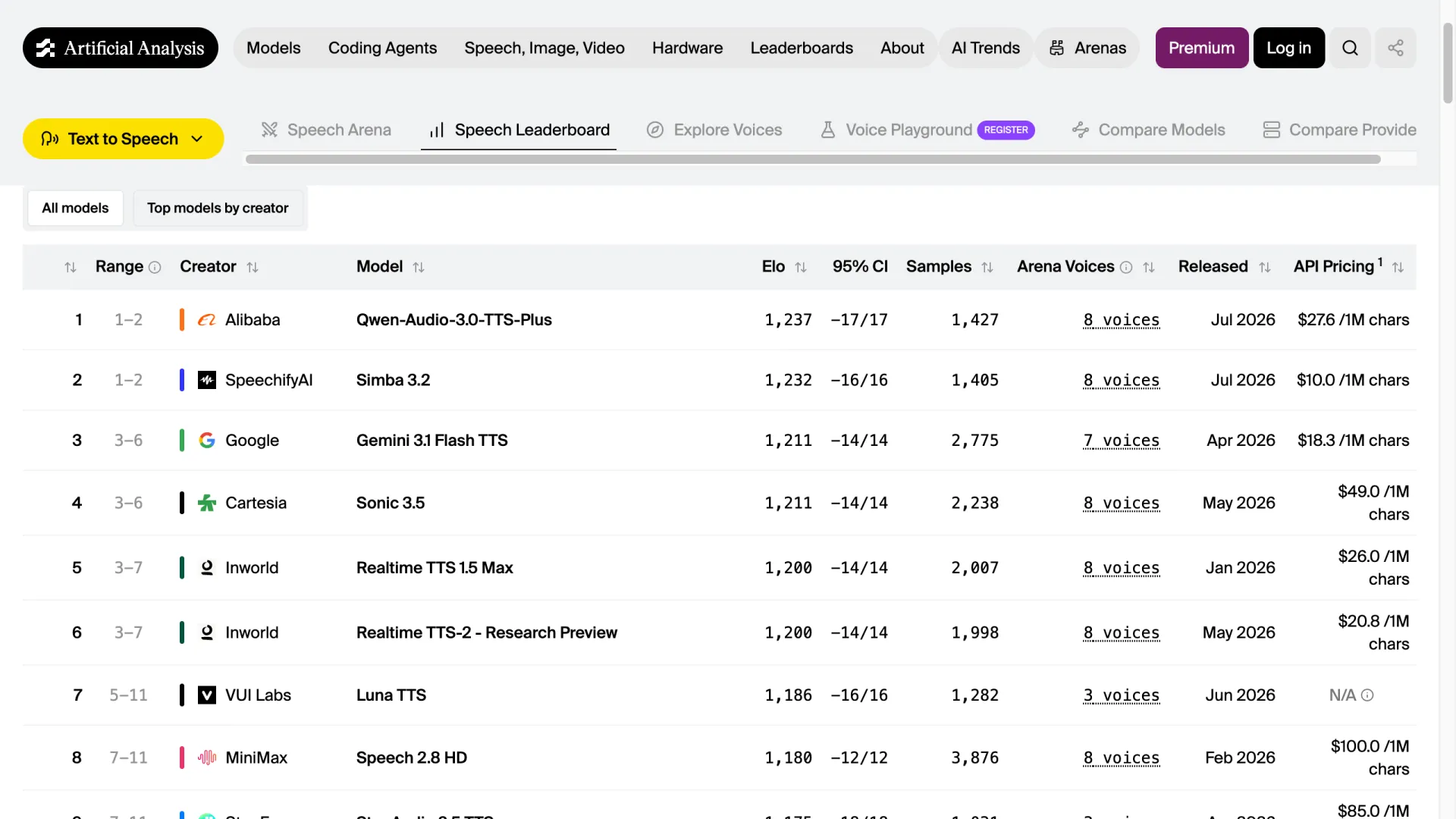
In July 2026, Alibaba's Qwen-Audio-3.0-TTS-Plus took the number-one spot on the Artificial Analysis Text-to-Speech arena with a Quality Elo of 1,237, ahead of Google's Gemini 3.1 Flash TTS, MiniMax Speech 2.8 HD, and ElevenLabs' Eleven v3. It also lists at $27.6 per million characters, roughly a third of what ElevenLabs and MiniMax charge for the tiers it outranks. It is not the cheapest model on the board, but no other model pairs its #1 quality with that price. (Figures are from July 20, 2026; vendors move rank and price often, so confirm both before you plan around them.)
Below is what the model is, how it earned that rank, what it costs, and when it is — or isn't — the right pick.
First, don't confuse it with Qwen3-TTS
Search "Qwen audio 3.0 TTS" and most results point at Qwen3-TTS, the open-weight speech family Alibaba released earlier and published on GitHub and a Hugging Face demo. That is the model people run locally, wire into ComfyUI, and rave about on Reddit for voice cloning. It is a different product from the one in this guide.
Qwen-Audio-3.0-TTS is the newer, hosted generation, delivered through Alibaba Cloud Model Studio (Bailian) rather than as downloadable weights. It ships in two tiers:
- Plus — the quality-first tier (the one that earns the #1 rank), aimed at audiobooks, narration, and dubbing where naturalness matters more than milliseconds.
- Flash — the latency-first tier, with first-packet latency around 300 ms, built for real-time interaction like voice agents and live assistants.
The generational gap is stark on the same leaderboard: the older Qwen3 TTS Flash sits at an Elo of 929 (rank ~76), while the new Plus tier leads at 1,237. Same brand lineage, a different class of model.
The two also serve different jobs. If you are choosing between them, this is the split:
| Qwen3-TTS (open-weight) | Qwen-Audio-3.0-TTS (hosted) | |
|---|---|---|
| How you get it | Download weights (GitHub / Hugging Face) | API via Alibaba Cloud Model Studio |
| Self-host / run locally | Yes | No — hosted only |
| ComfyUI & community nodes | Yes | No |
| Tiers | Single open family | Plus (quality) / Flash (~300 ms) |
| Language coverage | ~10 languages | 16 languages + 20 Chinese dialects |
| Arena Quality Elo | ~929 (Qwen3 TTS Flash) | 1,237 (Plus, #1) |
| Best for | Local control, data residency, tinkering | Top quality, dialects, production at scale |
Pick the open-weight line when hosting control or zero marginal cost matters most; pick the hosted 3.0 tiers when quality, dialect breadth, or not running your own GPUs matters more.
The benchmark that earned the rank
The Artificial Analysis arena is a blind, human-preference ranking run by an independent third party: listeners compare clips without knowing which model produced them, and the Elo score reflects how often each one wins.
Here is the top of the arena as of July 20, 2026:
| Rank | Model | Quality Elo | API price / 1M chars |
|---|---|---|---|
| 1 | Qwen-Audio-3.0-TTS-Plus (Alibaba) | 1,237 | $27.6 |
| 2 | Simba 3.2 (SpeechifyAI) | 1,232 | $10.0 |
| 3 | Gemini 3.1 Flash TTS (Google) | 1,211 | $18.3 |
| 4 | Sonic 3.5 (Cartesia) | 1,211 | $49.0 |
| 8 | MiniMax Speech 2.8 HD | 1,180 | $100.0 |
| 11 | ElevenLabs Eleven v3 | 1,173 | $100.0 |
Alibaba's own reported metrics point the same way as the independent ranking. On the multilingual CV3-Eval benchmark, the vendor reports the Plus tier averaging a word/character error rate of 3.96 and the Flash tier 3.87 — meaning the synthesized speech transcribes back almost as accurately as the source text. Speaker similarity, the measure of how closely a cloned voice matches its reference, is reported at 82.75 for Plus across all 16 tested languages. Those two figures are Alibaba's own; the Elo above is not. Treat any single benchmark as a starting point and test on your own audio.
What it does well
The rank comes from four capabilities that matter in production, documented on the official Qwen-Audio-3.0-TTS technical page.
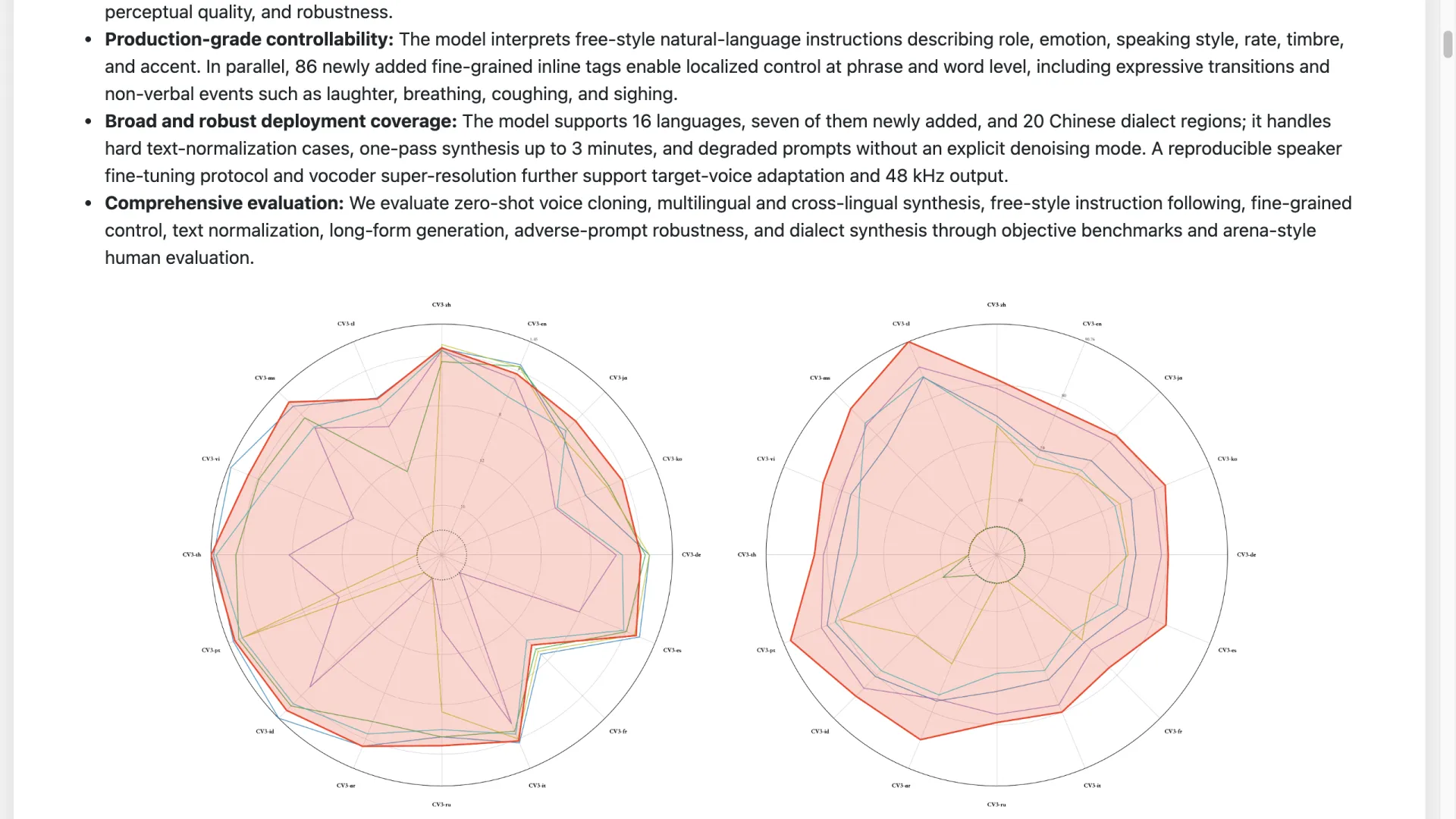
Free-style instruction control. You steer the voice with plain language — "read this as an anxious late-night radio host, slower near the end" — covering role, emotion, speaking style, rate, timbre, and accent. There is no separate markup language to learn for the broad strokes.
Fine-grained inline tags. For precise control, the model reads 86 inline tags placed directly in the text, including non-verbal events like laughter, breathing, coughing, and sighing. That is the difference between a flat read and a performance, and it is what makes the model usable for game dialogue, narration, and film dubbing.
Language and dialect breadth. It covers 16 languages — seven of them newly added, including Arabic, Indonesian, Portuguese, Thai, Vietnamese, Malay, and Tagalog — plus 20 Chinese dialect regions, from Cantonese and Shanghainese to Sichuanese and Northeastern. For teams shipping to Southeast Asia or across Chinese-speaking markets, that dialect coverage is hard to match elsewhere.
Robustness and output quality. It clones voices from noisy, reverberant, or unclear reference audio without a separate denoising step, synthesizes up to three minutes in a single pass for long-form narration, and outputs 48 kHz audio (the console rollout for 48 kHz is scheduled for July 24). Three-minute single-pass generation matters because stitching shorter clips is where prosody and timbre usually drift.
Pricing: top quality without the top-tier bill
Text-to-speech is billed per character of input text, so cost scales directly with how much you narrate.
At $27.6 per million characters, Qwen-Audio-3.0-TTS-Plus costs a fraction of the two legacy premium names it outranks: ElevenLabs Eleven v3 and MiniMax Speech 2.8 HD both list at $100 per million characters, about 3.6x more. In working terms, a 100,000-character audiobook (roughly a short novel) costs about $2.76 on Plus versus about $10 on those two.
Plus is not, however, the cheapest option overall. Two models a rung down on quality undercut it: Gemini 3.1 Flash TTS at $18.3 per million characters (rank 3) and Simba 3.2 at $10 (rank 2, nearly tied on Elo). So the accurate framing is narrow — Qwen offers top-ranked quality at a mid-tier price, not the lowest price on the board. If a few Elo points don't matter for your use case, you can pay less. (The public arena lists Plus pricing; Flash's per-character rate isn't published there yet, so check the console for the live Flash number.)
How to use Qwen-Audio-3.0-TTS
The direct route is Alibaba Cloud Model Studio (Bailian), with request formats and SDKs in the Model Studio documentation: provision an API key, then call the qwen-audio-3.0-tts-plus or qwen-audio-3.0-tts-flash model through the model-market endpoint. A reasonable starting point is to prototype on Flash to see whether its latency fits, then run the same scripts through Plus and compare — the right tier depends on whether your use case is live interaction or narration a listener hears end to end.
Teams already routing several providers through a compatible aggregator like AIReiter to keep billing on one surface can add it there instead of opening a separate Alibaba account; going direct is simplest if this is the only model you need.
If you need real-time conversation rather than one-shot narration, the TTS model is only one layer — the omni Realtime API and streaming ASR that pair with it are covered in the Qwen Audio 3 Realtime guide.
Should you use it?
- Pick Plus if you generate Chinese, dialect, or multilingual narration, audiobooks, or dubbing and want the highest naturalness per dollar.
- Pick Flash if you are building a real-time voice agent where a ~300 ms first packet matters more than the last few Elo points of quality.
- Look at Gemini 3.1 Flash TTS or Simba 3.2 if cost is the deciding factor and near-top quality is good enough — both are cheaper than Plus.
- Stay with ElevenLabs or Cartesia if you depend on their mature SDKs, larger prebuilt voice libraries, or English-first tooling and ecosystem, where they still lead regardless of arena position.
Among the models compared here, the combination of a #1 arena rank, 20 Chinese dialect regions, and $27.6/M pricing is one only Plus offers — which is why, if that mix fits your use case, it is worth running your own scripts through it before committing, rather than taking the ranking on faith.
FAQ
Is Qwen-Audio-3.0-TTS free?
No — the hosted Plus and Flash tiers are paid, billed per character through Alibaba Cloud Model Studio, at $27.6 per million characters for Plus. Alibaba Cloud has periodically offered free trial quotas, so check the console for a current offer in your region. The open-weight Qwen3-TTS is free to self-host.
Is Qwen-Audio-3.0-TTS open source? Can I download it?
The hosted Qwen-Audio-3.0-TTS-Plus/Flash tiers are not distributed as weights. The open-source model is the earlier Qwen3-TTS family, available on GitHub and Hugging Face for local use, cloning, and ComfyUI workflows. They are related but separate releases.
Does it support voice cloning?
Yes. It clones a target voice from reference audio, and is specifically tuned to hold up when that reference is noisy or reverberant — no separate cleanup step needed. Speaker similarity averages 82.75 on the Plus tier across 16 languages.
Qwen-Audio-3.0-TTS vs Qwen3-TTS-Flash — what's the difference?
Qwen3-TTS-Flash is part of the earlier open-weight generation and sits far lower on the arena (Elo ~929). Qwen-Audio-3.0-TTS is the new hosted generation; its Flash tier targets low latency and its Plus tier tops the quality ranking at Elo 1,237.
Is there a demo or ComfyUI support?
The open-weight Qwen3-TTS has a public Hugging Face demo and community ComfyUI nodes. The hosted Qwen-Audio-3.0-TTS tiers are accessed through the Alibaba Cloud Model Studio console rather than a standalone demo page.