 AIREITER
A support router does not need to write an essay; it needs to pick the right queue. Liquid AI d1 is built for that narrower job, and its $0.04 per million input tokens price is striking. The catch is that vendor speed and accuracy results do not establish reliable thresholds for your data.
What changed in the October 5 d1 release
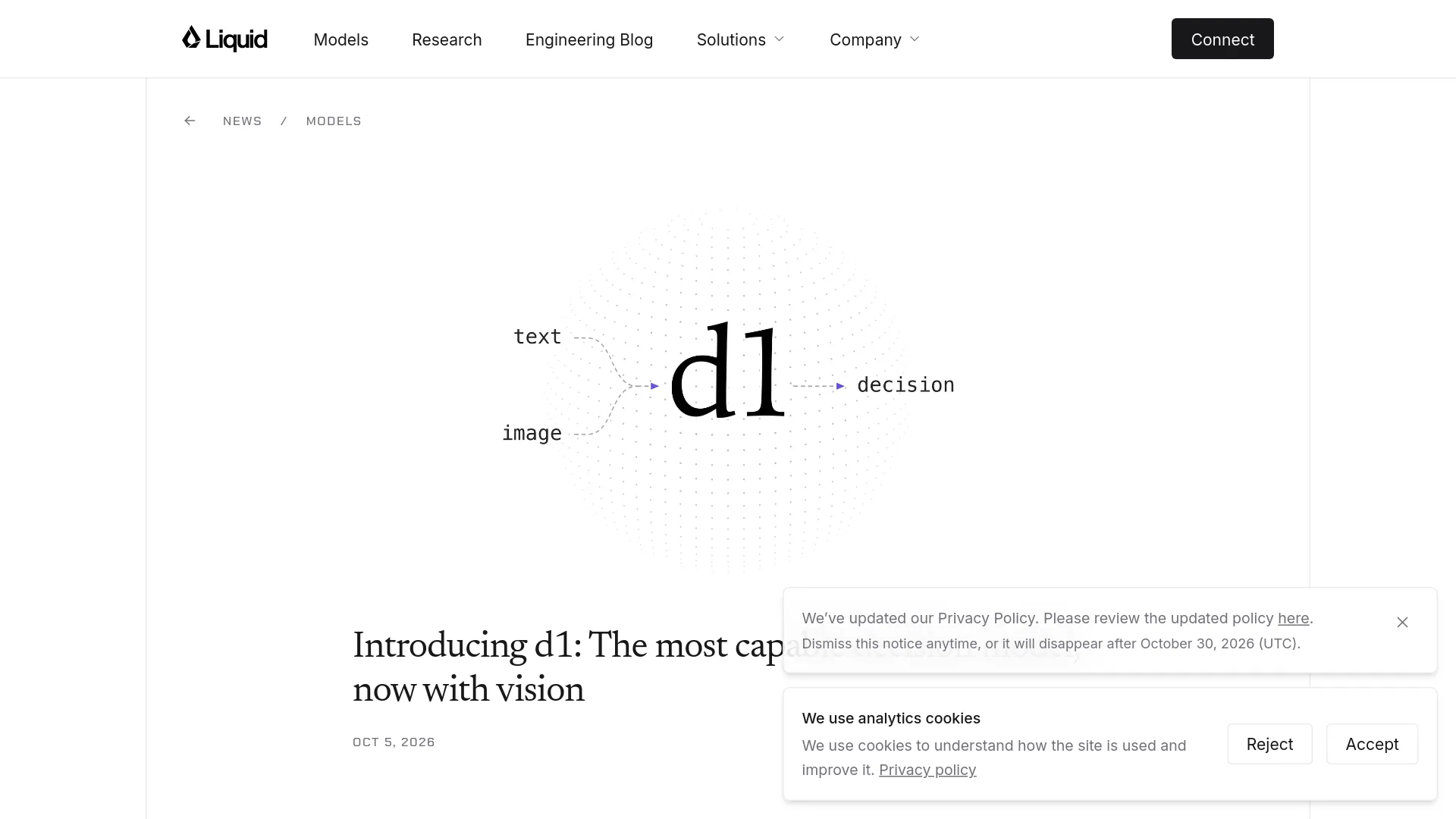
The October 5 release turned Liquid AI d1 from a text decision model into a multimodal model that accepts text, images, or both. Liquid AI’s announcement lists direct API access under the model name d1, plus text-only access through Vercel and OpenRouter while vision support remains pending on those gateways.
The October 5 Liquid AI announcement adds image inputs, publishes a $0.04/M input-token rate, and states that text decisions typically take 200–300 ms.
| Item | Current status on October 5, 2026 |
|---|---|
| Direct model ID | d1 |
| Direct endpoint | https://api.liquid.ai/decisions/v1/systemone |
| Inputs | Text, images, or both |
| Question types | Noul, Choice, Score |
| Text price | $0.04 per 1M input tokens |
| Output-token charge | None |
| Stated text latency | About 200–300 ms |
| Vercel and OpenRouter | Text available; vision planned |
| Downloadable d1 weights | Not announced |
Liquid describes a decision model as a system that receives a state, evaluates one or more typed questions, and returns probabilities rather than prose. That makes d1 a component for classification, routing, filtering, ranking, and approval gates—not a replacement for a chatbot or coding model.
Liquid AI d1 pricing is unusual—and easy to misread
Liquid AI d1 charges for input tokens and reports no generated output tokens. “Zero output tokens” does not mean a request has no response or that the service is free; it means the API returns typed decision values without autoregressively generating prose.
The official price is $0.04 per million input tokens. At that rate, one million requests containing 500 billed input tokens each would consume 500 million input tokens and cost about $20, before gateway markups or other platform charges.
| Workload | Billed input | Direct d1 cost at $0.04/M |
|---|---|---|
| 1M short tickets at 500 tokens each | 500M tokens | $20.00 |
| 100M short tickets at 500 tokens each | 50B tokens | $2,000.00 |
| 1M 1024×1024 images, image tokens only | 1.536B tokens | $61.44 |
| One 1024×1024 image | 1,536 tokens | $0.00006144 |
The same Liquid AI announcement says images use 1.5 tokens per 32×32-pixel patch. A 1024×1024 image therefore contributes 1,536 input tokens: 32×32 patches multiplied by 1.5 tokens.
There is another billing detail worth modeling. Liquid’s launch documentation states that each question is billed as its own prompt, including the question text and supplied images. Asking five questions about one large image can therefore cost materially more than asking one question, even though a multi-question request may avoid resending some shared state.
Where d1 can replace an LLM—and where it cannot
Liquid AI d1 is a sensible candidate when the output can be defined before the request. A conventional LLM remains the better choice when users need an explanation, generated content, code, or multi-step reasoning.
| Task | d1 fit | Why |
|---|---|---|
| Support-ticket routing | Strong | Choice can return a label and probabilities |
| Spam or policy filtering | Strong, after validation | Noul returns a yes probability for thresholding |
| Lead, urgency, or risk scoring | Strong | Score maps input onto an ordered rubric |
| Agent tool approval | Conditional | Cheap structured gate, but false approvals can be costly |
| Visual defect screening | Conditional | Vision is supported; production accuracy needs local testing |
| Drafting customer replies | Poor | d1 does not generate prose |
| Summarization or coding | Poor | The API is designed for decisions, not generated answers |
| Open-ended research | Poor | Fixed typed questions constrain the response |
The strongest operational advantage is not merely cheap tokens. Typed outputs remove the need to prompt a chat model for JSON, validate enums, repair malformed payloads, and pay for explanatory text that the application discards.
The narrow interface is also the main limitation. Liquid AI d1 cannot explain why it assigned a probability, and a confident number is not automatically a calibrated probability on a new domain.
A real-user discussion on r/LocalLLaMA reported no clear advantage over one-shot classifiers for simple branching tasks. The comment concerns the broader category, not a d1 test, but it identifies the right baseline: compare d1 with a simple classifier, not only with an expensive frontier LLM.
How the Liquid AI d1 API contract works
The Liquid AI d1 API sends a shared state plus one or more named questions. Noul handles yes/no probabilities, Choice selects among labels, and Score evaluates an ordered scale.
A minimal request follows the endpoint and payload shape shown in Liquid AI’s launch documentation:
import requests

payload = {
    "model": "d1",
    "state": "Customer was charged twice for order A-4471 and requests a refund.",
    "questions": {
        "refund_request": {
            "type": "noul",
            "instructions": "Is the customer requesting a refund?"
        },
        "queue": {
            "type": "choice",
            "instructions": "Which team should handle this ticket?",
            "options": ["billing", "technical", "account", "other"]
        }
    }
}

response = requests.post(
    "https://api.liquid.ai/decisions/v1/systemone",
    headers={"Authorization": "Bearer YOUR_LIQUID_API_KEY"},
    json=payload,
    timeout=30,
)
response.raise_for_status()
print(response.json()["answers"])
For vision, Liquid AI’s official announcement shows base64-encoded images sent in an images field alongside state and questions. A circuit-board inspection can ask a Noul question such as “Does this circuit board have a defect?” and read the returned probability from the named answer.
The API’s fixed question types are useful constraints. Define labels and score levels carefully, keep an explicit fallback such as other, and avoid treating the highest probability as permission to automate unless it clears a threshold tested on labeled examples.
The published evidence is promising but still vendor evidence
Liquid AI’s October 5 announcement reports that d1 matched or beat GPT-6.1 Sol on four of six applications, cost 19× to 200× less than GPT-6.1 Sol and Claude Opus 5.5, and was faster on every tested task. Those numbers support a pilot, but the announcement’s methodology used one run per model and application rather than repeated independent trials.
| Official result | Reported figure | Qualification |
|---|---|---|
| Text decision latency | 200–300 ms | Vendor-reported typical range |
| Visual inspection | 85%–97% accuracy | VisA-based demos; no full per-category table |
| Context compaction | 52% of tokens removed | Liquid says required outputs were retained |
| Tetris | 70 lines text-only; 81 with image | Demonstrates vision benefit in one game setup |
| Wordle | 12/12 solved; 3.8 guesses average | Screenshot-reading demo |
| Quick, Draw! | 5.2 of 6 drawings | Choice among 62 words; random baseline 0.6 |
Liquid’s methodology includes useful disclosures: each application ran once per model, up to eight requests were concurrent, costs used list prices without prompt-cache discounts, and some code questions and compaction sessions were written after the d1 pipeline was established. The post does not publish independent calibration curves, error costs, rate limits, or a full raw result table.
Select one repeated decision, label a holdout set, compare d1 with the current rule or classifier, then inspect false positives, false negatives, latency, and cost at the threshold the business would actually use. Shadow traffic is preferable before enabling automatic deletion, payment, access-control, or safety decisions.
Liquid AI d1 API FAQ
Is Liquid AI d1 free?
The October 5 official release lists d1 at $0.04 per million input tokens with no output-token charge. Gateway or third-party platform fees can differ from the direct API rate.
Can d1 run locally?
Liquid AI has not announced downloadable weights for the current d1 model. The October 5 post says open weights are planned for upcoming decision models, not that d1 itself is available for local deployment.
What context window does d1 have?
Liquid’s October 5 announcement does not state a context maximum. Production designs should verify the active limit through the chosen provider rather than rely on older directory entries.
Is d1 better than a normal classifier?
There is not enough independent evidence for a universal answer. d1 is attractive when labels or rubrics change frequently; a stable, inexpensive classifier may remain better for a narrow task with abundant labeled data.
The decision rule
Liquid AI d1 deserves a pilot when a costly LLM call ends in a label, probability, route, or score. The $0.04/M input-token rate, 200–300 ms vendor latency, typed outputs, and new vision support make the test inexpensive.
| Decision | Use this rule |
|---|---|
| Choose d1 | The output is fixed, uncertainty is useful, and policies change often |
| Test d1 first | Errors have operational cost or images are part of the decision |
| Keep a simple classifier | The taxonomy is stable and labeled data is plentiful |
| Keep a general LLM | The application needs explanations, prose, code, or reasoning |
| Skip automation | No labeled holdout or acceptable error threshold exists |
The unresolved trade-off is calibration: d1 can make a decision cheaply, but only your labeled production data can show whether its probability is safe to act on.