 AIREITER
Fal.ai is a generative media platform that gives developers API access to over 1,000 image, video, audio, and 3D models — including Flux, Kling, Veo 3, Seedance, and ElevenLabs — through a single unified API. It powers AI features at Canva, Perplexity, and Quora.
But Trustpilot tells a different story: 2.4 out of 5 stars. Reddit users complain about confusing docs and surprise bills. So which is it?
I signed up, loaded credits, and tested it myself. Here's what I found.
What Can You Actually Do with Fal ai?
Fal ai is not a consumer tool like Midjourney. It's an API-first platform for developers who want to integrate generative AI into their own products. Here's what it covers:
Image Generation
Models like Flux 2, Seedream V4, Ideogram 4, GPT Image 2, Nanobanana, and Krea 2. You send a text prompt via API, get an image back. Supports text-to-image, image-to-image, inpainting, and background removal. For a broader comparison of image models, see our Best AI Image Generators 2026.
The cheapest option is Qwen at $0.02 per megapixel. Seedream V4 runs $0.03 per image. Flux Kontext Pro costs $0.04.
Video Generation
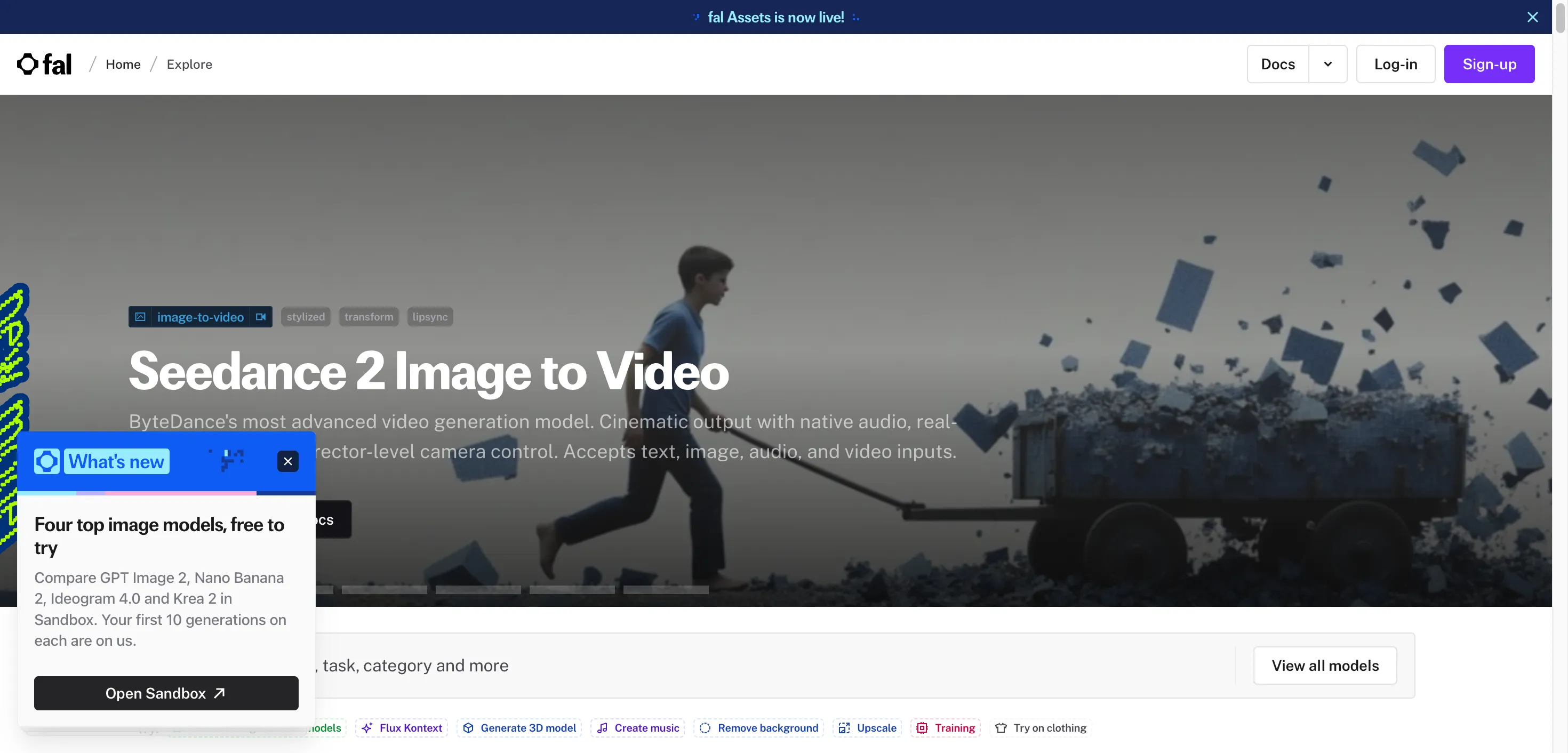
This is where fal.ai stands out from pure image platforms. You get access to Veo 3 (Google), Kling 3.0, Seedance 2 (ByteDance), Wan 2.5 (Alibaba), and Ovi — all through one API.
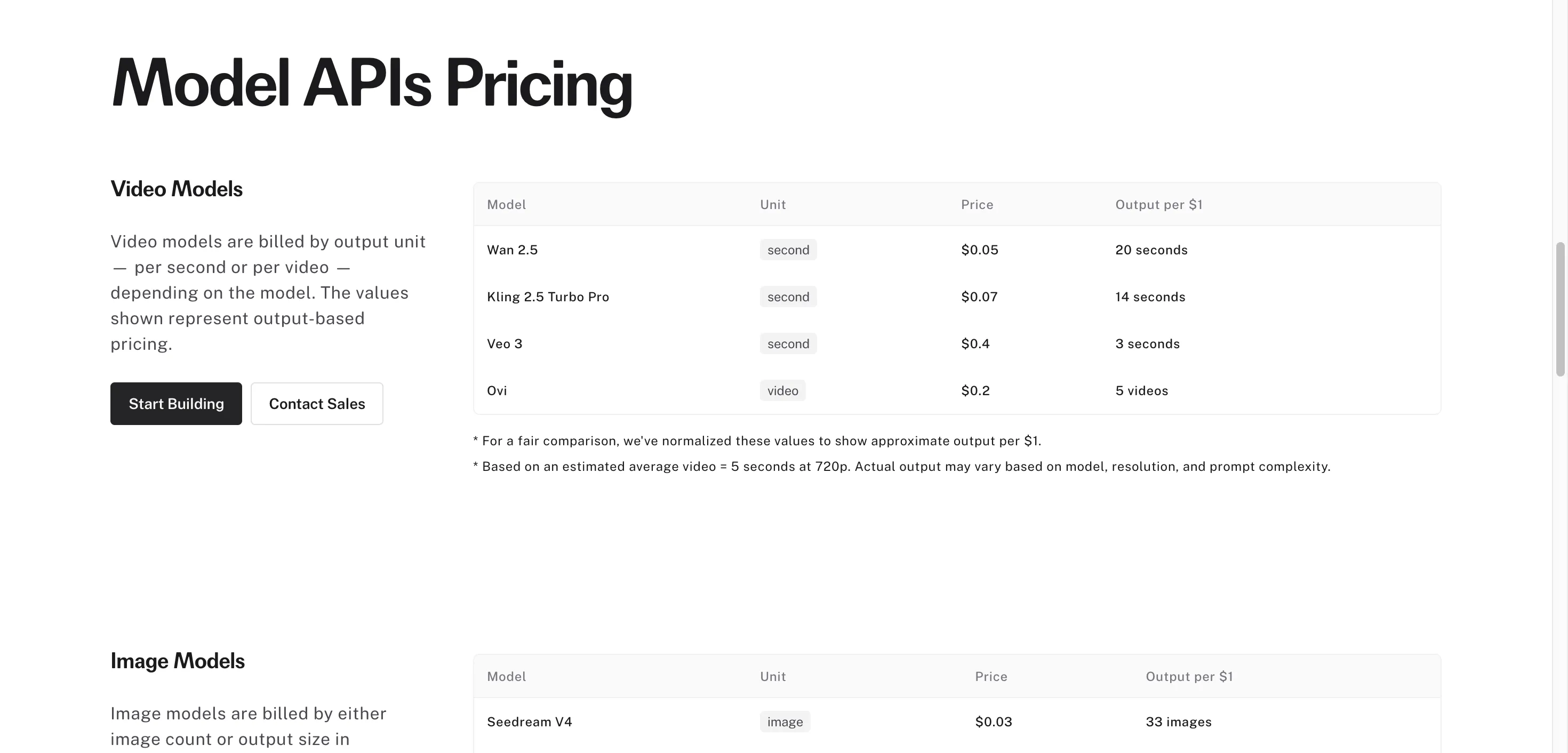
Pricing per second of generated video:
Wan 2.5: $0.05/s (cheapest, 20 seconds per $1)
Kling 2.5 Turbo Pro: $0.07/s
Veo 3: $0.40/s (most expensive, only 3 seconds per $1)
A 10-second video at 720p costs between $0.50 (Wan) and $4.00 (Veo 3). At scale, video costs add up fast — one Reddit user reported spending $50 through a single vibe-coded app.
Audio & Voice
ElevenLabs text-to-speech and other voice models are available. PlayAI's CEO specifically praised fal's "near-instant voice responses" and global scaling.
3D Generation
3D model generation is listed in their capabilities, though it's a smaller part of the catalog compared to image and video.
LoRA Fine-Tuning
You can train custom LoRA models (adapters that customize an existing model's style) in minutes and deploy them as private endpoints. This is a big deal for brands that need consistent visual identity across AI-generated content.
Fal.ai Pricing: What It Actually Costs
Fal.ai uses pay-per-use pricing with no monthly subscription. There is no permanent free tier — you purchase credits in advance and they're drawn down as you use the platform.
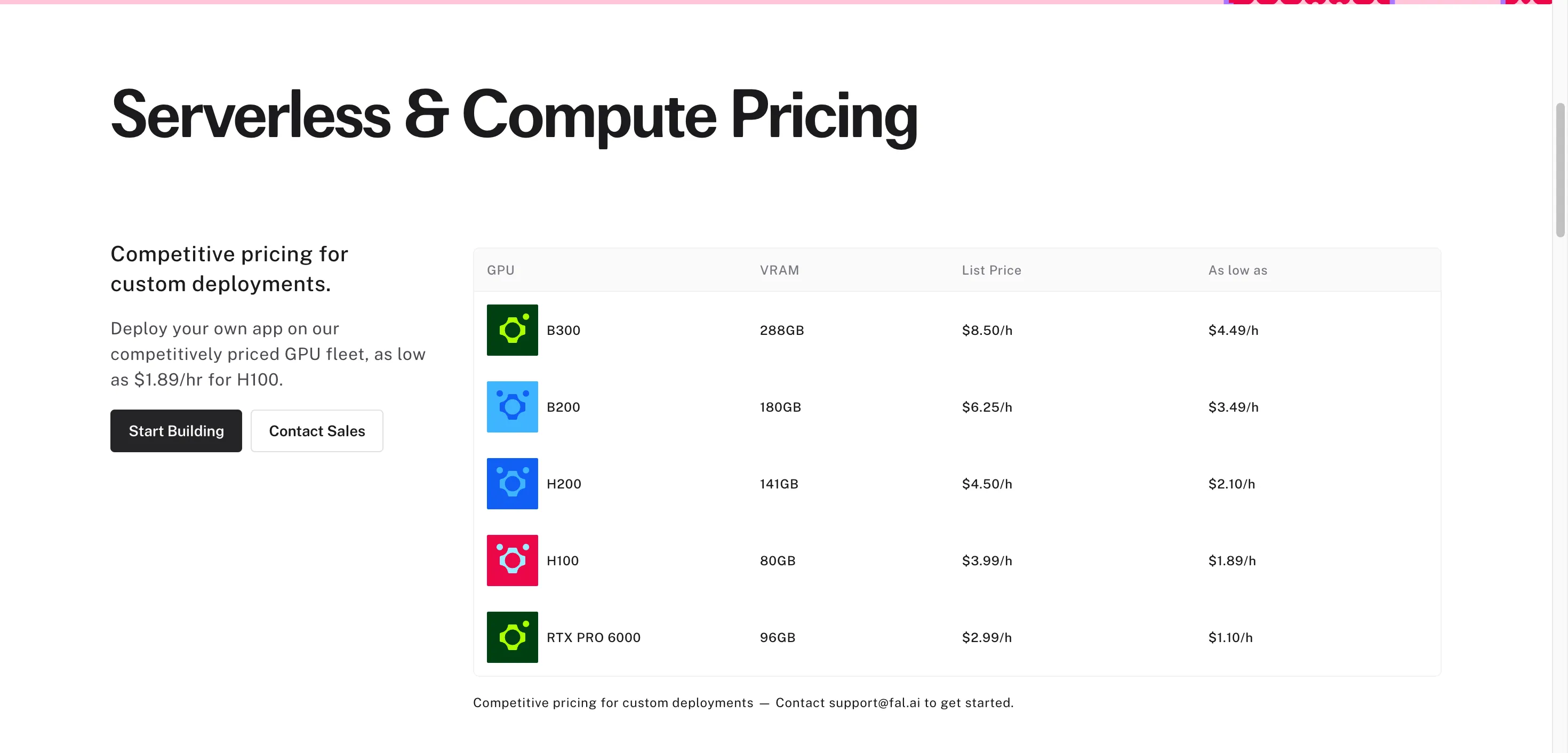
GPU Pricing (for Custom Deployments)
If you deploy your own models on fal's infrastructure:
GPU | VRAM | List Price | Volume Price |
|---|---|---|---|
B300 | 288 GB | $8.50/h | $4.49/h |
B200 | 180 GB | $6.25/h | $3.49/h |
H200 | 141 GB | $4.50/h | $2.10/h |
H100 | 80 GB | $3.99/h | $1.89/h |
RTX PRO 6000 | 96 GB | $2.99/h | $1.10/h |
The H100 at $1.89/h (volume) is competitive. For comparison, AWS charges $3+ per hour for equivalent GPU instances, and Lambda Labs charges around $2.49/h for H100s.
Model API Pricing (Per Output)
Most developers will use the per-output pricing instead of renting GPUs:
Image models — cost per image:
Model | Price | What You Get for $1 |
|---|---|---|
Qwen | $0.02/MP | 50 megapixels |
Seedream V4 | $0.03 | 33 images |
Flux Kontext Pro | $0.04 | 25 images |
Nanobanana | $0.04 | 25 images |
Video models — cost per second:
Model | Price | What You Get for $1 |
|---|---|---|
Wan 2.5 | $0.05/s | 20 seconds |
Kling 2.5 Turbo Pro | $0.07/s | 14 seconds |
Ovi | $0.20/video | 5 videos |
Veo 3 | $0.40/s | 3 seconds |
Key billing rules: you only pay for successful outputs — server errors and queue wait time are free. Adding audio to video roughly doubles the cost on most models.
How Does Fal ai Compare to Replicate on Price?
For the same models available on both platforms, fal.ai is generally 20-40% cheaper:
SDXL: fal ~40% cheaper than Replicate
Flux 2 Pro: $0.05 on fal vs $0.055 on Replicate
Wan 2.6 video: fal saves 44-80% depending on resolution
For a detailed Replicate breakdown, see our Replicate AI Review 2026.
The catch: fal and Replicate are both aggregators, not the original model providers. You're paying a markup over what direct API access from Kling or Veo would cost. The tradeoff is convenience — one SDK, one billing account, instant switching between models. If you only need a single model, platforms like Aireiter or Kie.ai can offer a simpler, more focused alternative.
Using the Fal ai API: Developer Experience
The API supports Python, JavaScript, and Swift through official SDKs. Here's what a basic image generation call looks like:
import { fal } from "@fal-ai/client";

const result = await fal.subscribe("fal-ai/fast-sdxl", {
  input: {
    prompt: "photo of a cat wearing a kimono"
  }
});
Every model page on fal.ai includes a Playground where you can test before writing code — enter a prompt, adjust parameters, see results. This is genuinely useful for comparing model outputs before committing to one.

What's Good
Unified API: One SDK for 1,000+ models across image, video, audio, and 3D. Switching from Flux to Kling is changing one string.
Speed: Fal claims their inference engine is up to 10x faster than standard GPU setups. The "near-zero cold starts" are a real advantage for user-facing apps where latency matters.
Scale-to-zero: You don't pay when nothing's running. No idle GPU costs.
Playground: Test any model before integrating. See exact API schemas, pricing, and copy-paste code examples.
What's Not Good
Documentation quality: Multiple Reddit users call it "not beginner-friendly" with "barely any examples." The Playground is great, but written docs need work.
Model version changes: Model parameters can change without warning. If your production app depends on specific output characteristics, this is a real risk. Pin versions when possible.
Data retention concerns: Uploaded files are guaranteed to be available for at least 7 days. After that, they "may be deleted at any time" — but there's no guarantee of deletion either. If you're processing sensitive images, read their data policy carefully.
Cost can spiral: Per-output billing sounds cheap until you're generating thousands of videos. That $50 Reddit example happened fast. Set billing alerts from day one.
Trustpilot score: 2.4/5 with 17 reviews. Take it with a grain of salt — developer tools often get review-bombed by frustrated free-tier users — but it's still notably low.
My Experience Testing Fal.ai
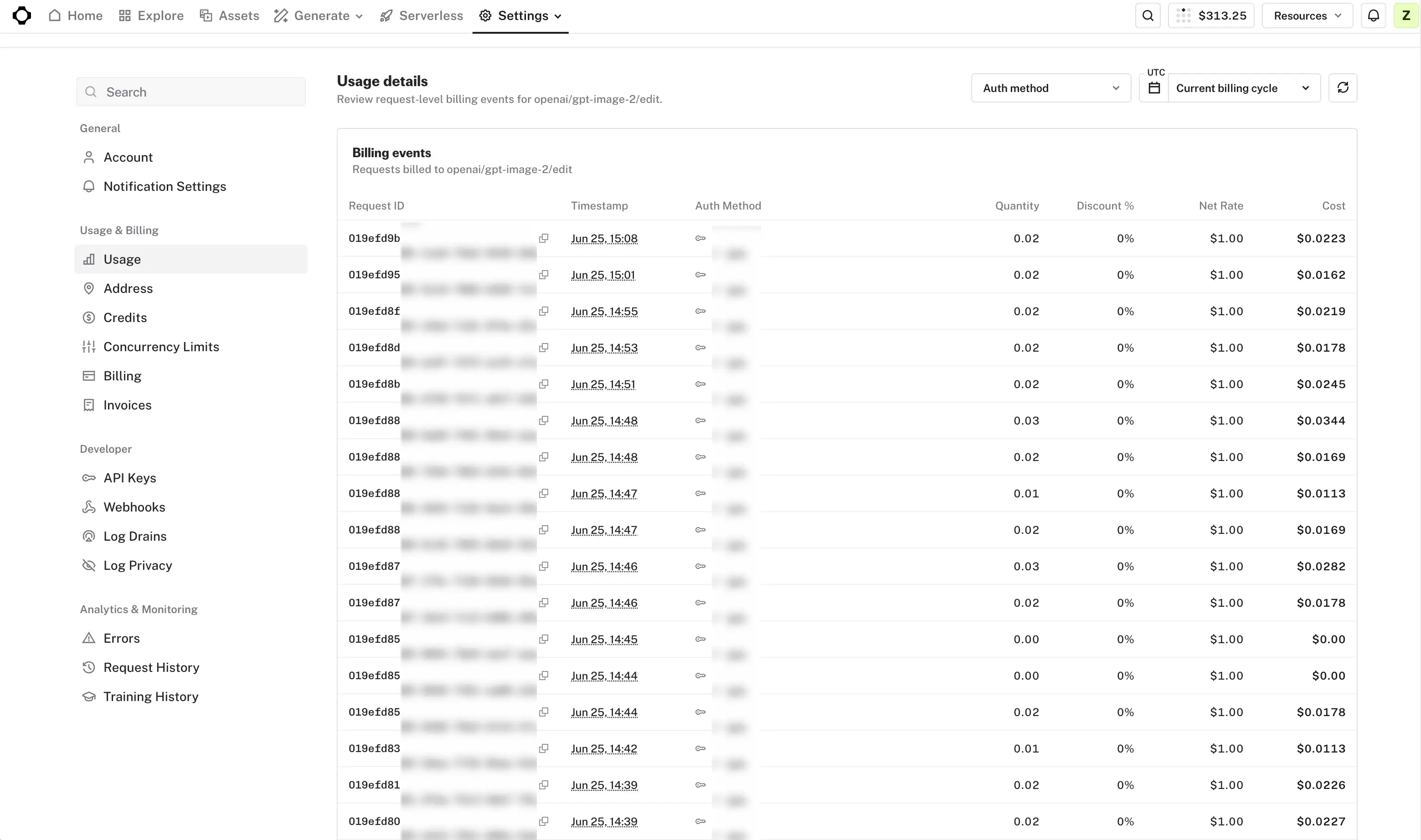
I have $300+ in credits on fal.ai and ran GPT Image 2 through both the Playground and the API to see what real-world usage looks like.
Cost per image: GPT Image 2 at medium quality costs about $0.02 per image ($1.00 per megapixel, with most outputs around 0.02 MP). Over 20+ API calls in 30 minutes, total spend was around $0.24 — so roughly a penny or two per generation.
Failed requests cost nothing: The usage log shows two entries with Quantity 0.00 and Cost $0.00. Fal's claim that you only pay for successful outputs checks out.
Speed: Both Nanobanana Pro and GPT Image 2 took about 30 seconds per generation in the Playground. That's not instant, but image generation models genuinely need that compute time. The experience felt smooth — no freezes, no errors, no confusing loading states.
Image quality: GPT Image 2 handled the test prompt well — a golden retriever with sunglasses at a beach bar came out photorealistic with accurate details (cocktail glass, wooden bar, tropical background).
Playground UX: Clean layout — prompt on the left, result on the right, one-click Run. The Form/JSON toggle and Schema button are developer-oriented touches. "Try in Sandbox" links to a more advanced coding environment. The whole flow from signup to first generated image was smooth — no friction points worth complaining about.
Who Should Use Fal.ai
Use fal.ai if you're:
A developer building a product that needs multiple generative AI models (image + video + audio)
Looking for the fastest inference speeds for diffusion models
Building a prototype and want to test many models through one API before committing
An enterprise needing SOC 2 compliance, SSO, and private endpoints
Skip fal ai if you're:
A non-technical creator who just wants to make images (use Midjourney or Leonardo instead)
Only using one specific model (go direct to that provider's API — it'll be cheaper)
On a tight budget with high volume video generation (costs add up, consider Replicate or direct APIs)
Uncomfortable with pay-per-use billing (no spending caps by default)
Bottom Line
Fal.ai is the strongest option right now for developers who need one API to access many generative media models — no other platform matches its combination of model count (1,000+), inference speed, and per-output pricing. The speed is real, the model selection is massive, and the pricing is competitive against Replicate.
The downsides are equally real: documentation needs improvement, costs can surprise you at scale, and the Trustpilot rating suggests customer support has room to grow.
Start by checking the pricing page for any current signup promotions. Test 2-3 models in the Playground. Set a billing alert before you write any production code. If speed and model variety are your top priorities, fal.ai delivers.
FAQ
Is fal ai free?
fal ai uses a prepaid credit model — no permanent free tier. You purchase credits and they're drawn down per output. Check the pricing page for current promotions.
How does fal ai pricing compare to Replicate?
For shared models (Flux, SDXL, Wan), fal.ai is typically 20-40% cheaper than Replicate. Both are aggregators, so direct API access from model providers (when available) will be cheapest. For more details, see our Replicate review and OpenRouter pricing guide.
Is fal ai good for beginners?
The Playground is beginner-friendly for testing. But the API documentation and onboarding have been criticized as sparse. If you're comfortable reading API docs and writing code, you'll be fine. If you want a no-code interface, look elsewhere.
What models does fal ai support?
Over 1,000 models including Flux 2, Veo 3, Kling 3.0, Seedance 2, Seedream V4, Ideogram 4, GPT Image 2, ElevenLabs, and many more. The catalog spans image, video, audio, and 3D generation.
Does fal ai delete uploaded files?
Files are guaranteed available for at least 7 days. After that, they may be deleted — but there's no guaranteed deletion timeline. Download your outputs promptly and don't rely on fal.ai as storage.