 AIREITER
Last updated: June 2026. Pricing pulled from replicate.com/pricing; per-call costs and queue times are from our own Replicate account's prediction log.
Short answer: Replicate is still one of the easiest ways to run thousands of open-source AI models through a single API — no GPU to provision, no Docker to babysit. But it now sits at a crossroads: cold starts remain its biggest weakness, and it's been acquired by Cloudflare. Whether you should use it comes down to one question — batch jobs and prototyping, or a latency-sensitive product?
Use Replicate if… | Look elsewhere if… |
|---|---|
You're prototyping or running batch/research jobs | You're shipping a latency-sensitive, user-facing feature |
You want the widest catalog of open models, zero setup | A 10–30s cold start would hurt your UX |
Usage is low-to-moderate and bursty | You need predictable, high-volume cost forecasting |
You like pay-as-you-go with no minimum | You want a strict SLA / guaranteed throughput |
This review is based on the current pricing page, hands-on use of our own account, and what developers are saying in the community.
What Replicate actually is
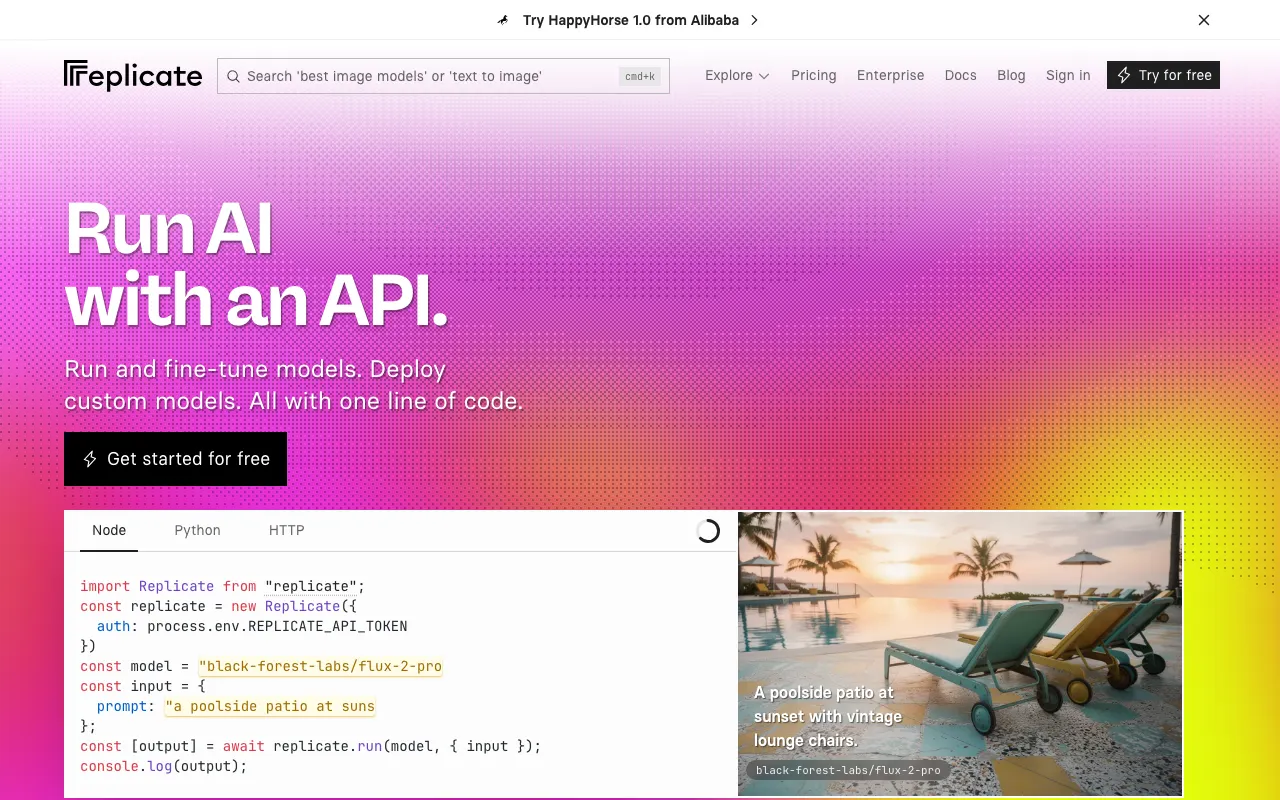
Replicate is a cloud platform that lets you run machine-learning models via a REST API. You don't manage infrastructure — you call a model, it spins up, runs, and bills you only for the seconds it was active. Two things made it popular:
A huge community model catalog — image (Flux, Stable Diffusion — the same models we compare in our best AI image generators guide), video, language (Llama, DeepSeek), audio, and thousands of community-published models.
The Cog framework — package your own model in a container and deploy it as an API endpoint.
Replicate publicly lists production customers including BuzzFeed, Character.ai, and Unsplash (replicate.com/customers), which tells you it scales for real workloads — within limits we'll get to.
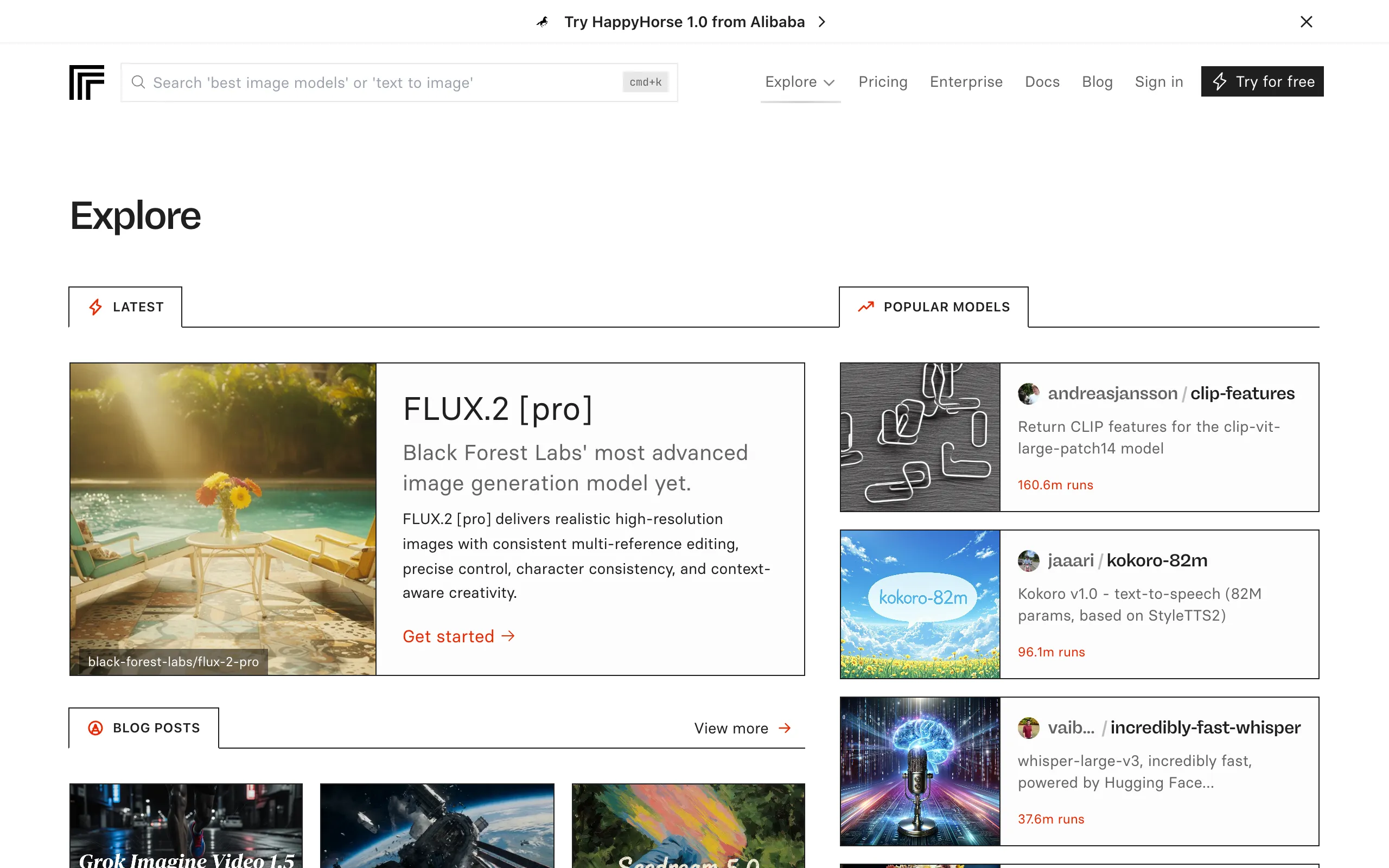
The Explore page mixes official models (Flux.2 pro) with community uploads — breadth is Replicate's real selling point.
Replicate pricing in 2026
Replicate has no monthly subscription. You pay per second of compute, and the rate depends on the hardware the model runs on. Here are the current public rates (June 2026):
Hardware | Per second | Per hour |
|---|---|---|
CPU (Small) | $0.000025 | $0.09 |
Nvidia T4 (16GB) | $0.000225 | $0.81 |
Nvidia L40S (48GB) | $0.000975 | $3.51 |
Nvidia A100 (80GB) | $0.001400 | $5.04 |
Nvidia H100 (80GB) | $0.001525 | $5.49 |
8x Nvidia H100 | $0.012200 | $43.92 |
Some official models are billed differently — by input/output instead of time:
Flux image models: ~$0.025–$0.04 per image
Video models: ~$0.09–$0.25 per second of output
Claude 3.7 Sonnet: $3.00 / million input tokens
DeepSeek R1: $3.75 / million input tokens
Rate limits: 600 predictions/minute, 3,000 requests/minute on other endpoints.
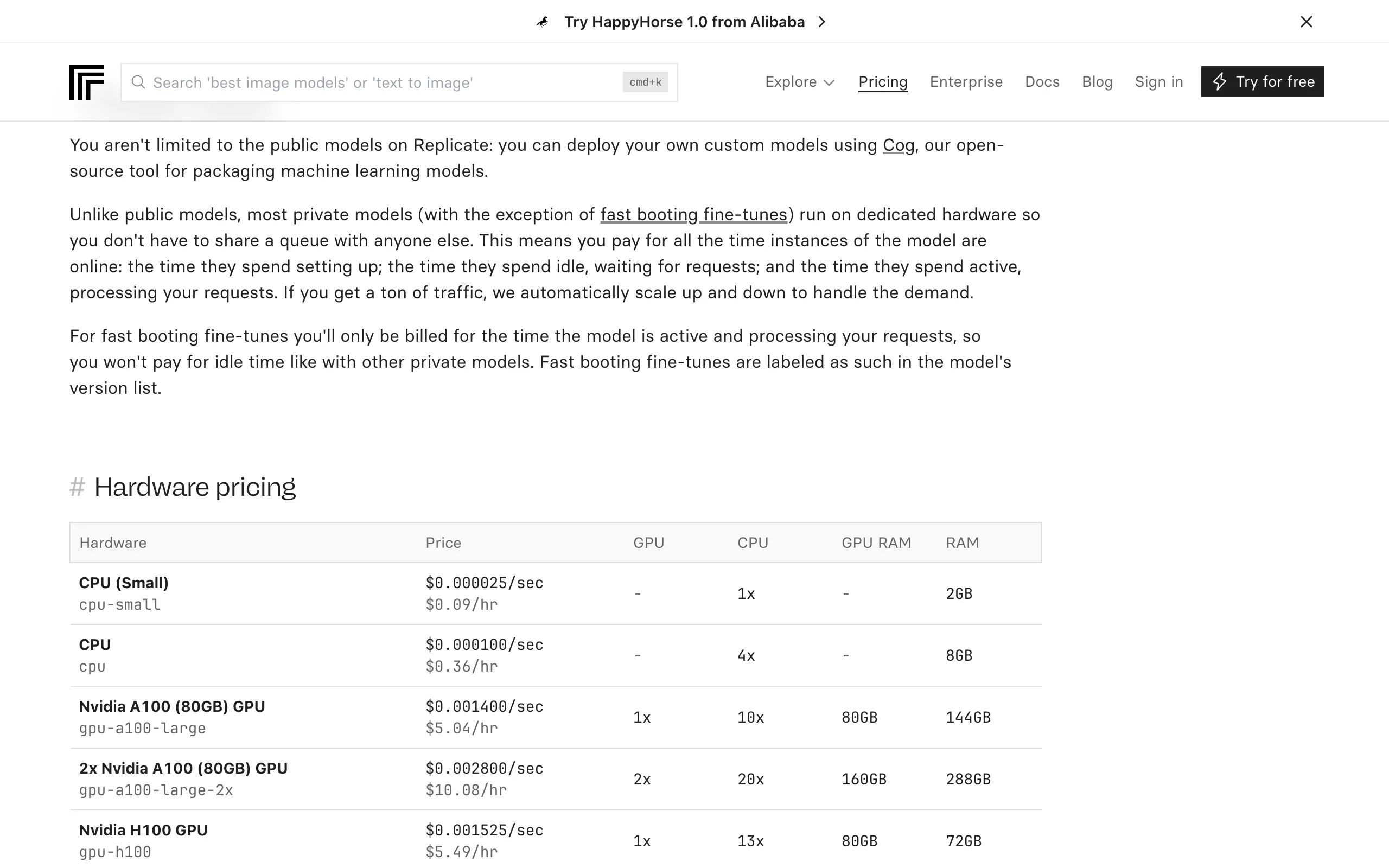
Replicate's hardware pricing table — every GPU billed per second, so cost tracks compute time, not a flat plan.
What this actually costs you
Per-second billing sounds cheap, and for low volume it is. In my own account's prediction log, a flux-kontext-apps/restore-image call costs a flat $0.04 and runs 11–14 seconds, while a lighter birefnet background-removal call comes in at under $0.01. That tracks with the "a few cents per image" rule of thumb.
The catch is predictability. Because different models run on different GPUs at different speeds, and a failed generation still consumes GPU time you pay for, your monthly bill is hard to forecast. Some quick back-of-envelope math at the rates above:
10,000 background removals/month (birefnet, <$0.01 each): roughly $30–$80/month depending on warm-vs-cold runs.
1,000 image edits/month (flux-kontext at $0.04 each): about $40/month, predictable because it's flat per-image.
A custom model on an H100 ($5.49/hr): a 10-second prediction is ~$0.015 — but add a 30-second cold start and that single call jumps ~3×.
That last line is the trap: the compute is cheap; the cold start is what quietly inflates real-world cost.
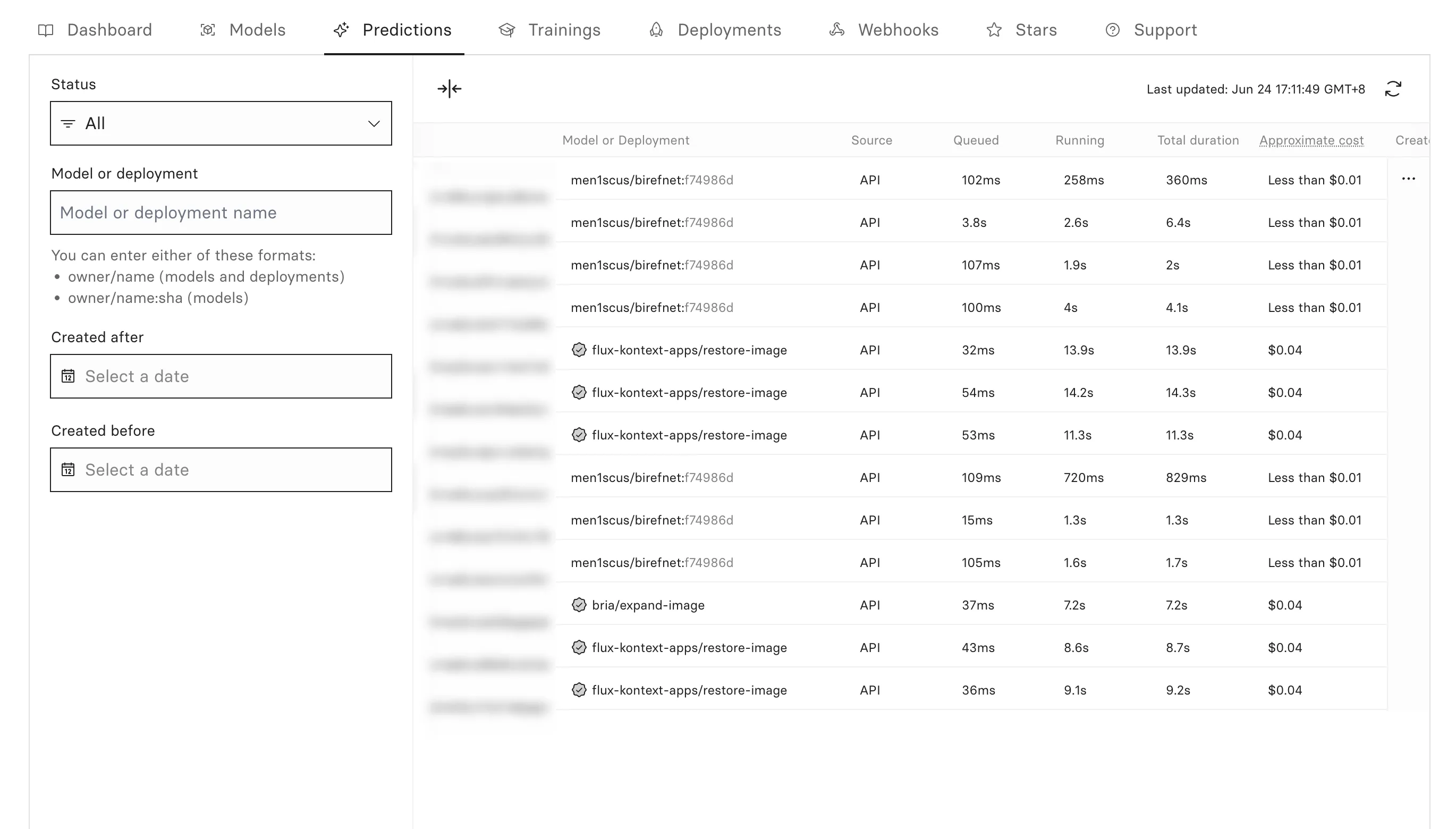
Our own account's prediction log. Note the "Approximate cost" column ($0.04 for flux-kontext restores, <$0.01 for birefnet) and the "Queued" column — mostly milliseconds, but one birefnet call sat at 3.8s.
How we tested: the cost and queue figures here come from running image models —
birefnet(background removal),flux-kontext-apps/restore-image, andbria/expand-image— through Replicate's API on our own account, reading per-call duration and cost straight from the prediction dashboard. The wider cold-start ranges below are from developer reports, not our own benchmark, and are labeled as such.
The real weakness: cold starts
This is the complaint that comes up most. Because Replicate spins up a container per request, a model that isn't already "warm" has to boot first. Cold-start times reported by developers (WaveSpeedAI's teardown documents these in detail, though as a competitor):
Popular official models: ~5–10 seconds
Community models: ~10–30 seconds
Custom / large models: 60+ seconds, with worst cases boot-cycling for 2–3 minutes
You can see this in real usage. Across my own prediction log, the Queued time for a warm model sits at 15–109ms — but the same model spiked to a 3.8-second queue on one call. When the container is cold or capacity is tight, that wait is exactly what your end user feels.
For a batch job or a research notebook, this doesn't matter. For a user-facing product where someone is waiting on a result, a 30-second cold start is a dealbreaker. This single architectural fact — containers per request — is the number-one reason developers go shopping for alternatives in 2026.
The cost side draws the same kind of community feedback. In a long-running r/StableDiffusion thread on whether Replicate's pricing is fair, one user summed up the typical experience: "I use Replicate, and each image generated is typically 1-2c. With hundreds of uses each month, this adds up to a few dollars." Cheap per call, but it adds up — which matches what we saw in our own log.
What the Cloudflare acquisition changes
Cloudflare acquired Replicate in late 2025, closing in early 2026 (press release). For now the practical impact is small: Replicate keeps running as its own brand, your existing API and models stay put, and the public pricing above is unchanged. Moving onto Cloudflare's edge infrastructure could improve reliability and cold starts over time — the upside worth watching. The only caveat for long-lived projects: acquisitions eventually bring pricing and API changes, so keep your integration portable.
Pros and cons
Strengths
Fastest way to try thousands of models with zero infrastructure
Genuinely good web UI for exploring and testing before you write code
Cog makes custom-model deployment straightforward
Pay-as-you-go with no minimum — great for prototyping
Weaknesses
Cold starts (10–30s+) make it weak for real-time, user-facing features
Per-second billing is hard to forecast; failed runs still cost you
Model catalog can lag weeks behind fresh open-source releases
Trust signals are mixed — a low public Trustpilot score (2/5) and recurring pricing-fairness threads on Reddit
Best Replicate alternatives in 2026
Platform | Best for | Edge over Replicate | Rough pricing |
|---|---|---|---|
Latency-sensitive, user-facing apps | Optimized for low cold-start latency; large image/video model catalog (fal's own claims) | Per-image from ~$0.01; Flux ~$0.025–0.05/image | |
Together AI | Open-source LLM inference, batch & fine-tuning | Dedicated GPUs, batch discounts, guaranteed throughput | LLM inference ~$0.10–$0.90 / M tokens by size |
RunPod | Cheap raw GPU, full control | Rent GPUs by the second/hour, no per-model markup | H100 from ~$2–3/hr; serverless per-second |
Baseten | Production model serving with autoscaling | Dedicated deployments, faster warm scaling | Per-minute GPU; H100 ~$0.10+/min |
Modal / Beam | Custom training & inference pipelines | More control over the runtime | Per-second GPU, H100 ~$0.001–$0.002/sec |
aireiter (publisher) | Avoiding lock-in to any single provider | One API key across Replicate, fal, OpenRouter & more; route around price/outage | Pass-through provider rates + gateway layer |
(Competitor pricing is approximate — check each provider's page before committing.)
The cleanest mental model developers use: need speed → fal; need raw cheap GPU → RunPod; need batch/research breadth → Replicate.
The last row is ours: aireiter is an independent gateway that reaches Replicate, fal and OpenRouter through one key — handy if you want to A/B providers or fail over without rewriting code. Judge it on that merit.
If you're shopping API platforms more broadly, we ran the same teardown on Kie AI and on OpenRouter's pricing.
Verdict: should you use Replicate in 2026?
Use it if you're prototyping, running batch or research workloads, or want the widest catalog of open models with the least setup. It's still excellent at that.
Look elsewhere if you're shipping a latency-sensitive, user-facing feature — cold starts will hurt, and fal.ai is the obvious upgrade. Either way, keep your integration portable while the Cloudflare migration settles.
FAQ
Is Replicate free to use?
No. There's no subscription, but it's pay-as-you-go — you're billed for the compute time each prediction uses.
How does Replicate billing work?
You pay per second the model is actively running, at a rate set by the hardware (CPU, T4, A100, H100, etc.). Some official models bill per image, per second of video, or per token instead.
What are Replicate's rate limits?
600 predictions per minute, and 3,000 requests per minute on other endpoints.
Did Cloudflare buy Replicate?
Yes. Cloudflare announced the acquisition in November 2025 and closed it in early 2026. Replicate continues as its own brand on Cloudflare's infrastructure.
What's the best alternative to Replicate?
fal.ai for low-latency, user-facing workloads; Together AI for open-source LLM inference and fine-tuning; Replicate itself for the broadest model catalog.