 AIREITER
OpenAI plans to test visual ads in ChatGPT image generation for U.S. advertisers later in October 2026, labeled and separate from generated images.
What OpenAI actually announced
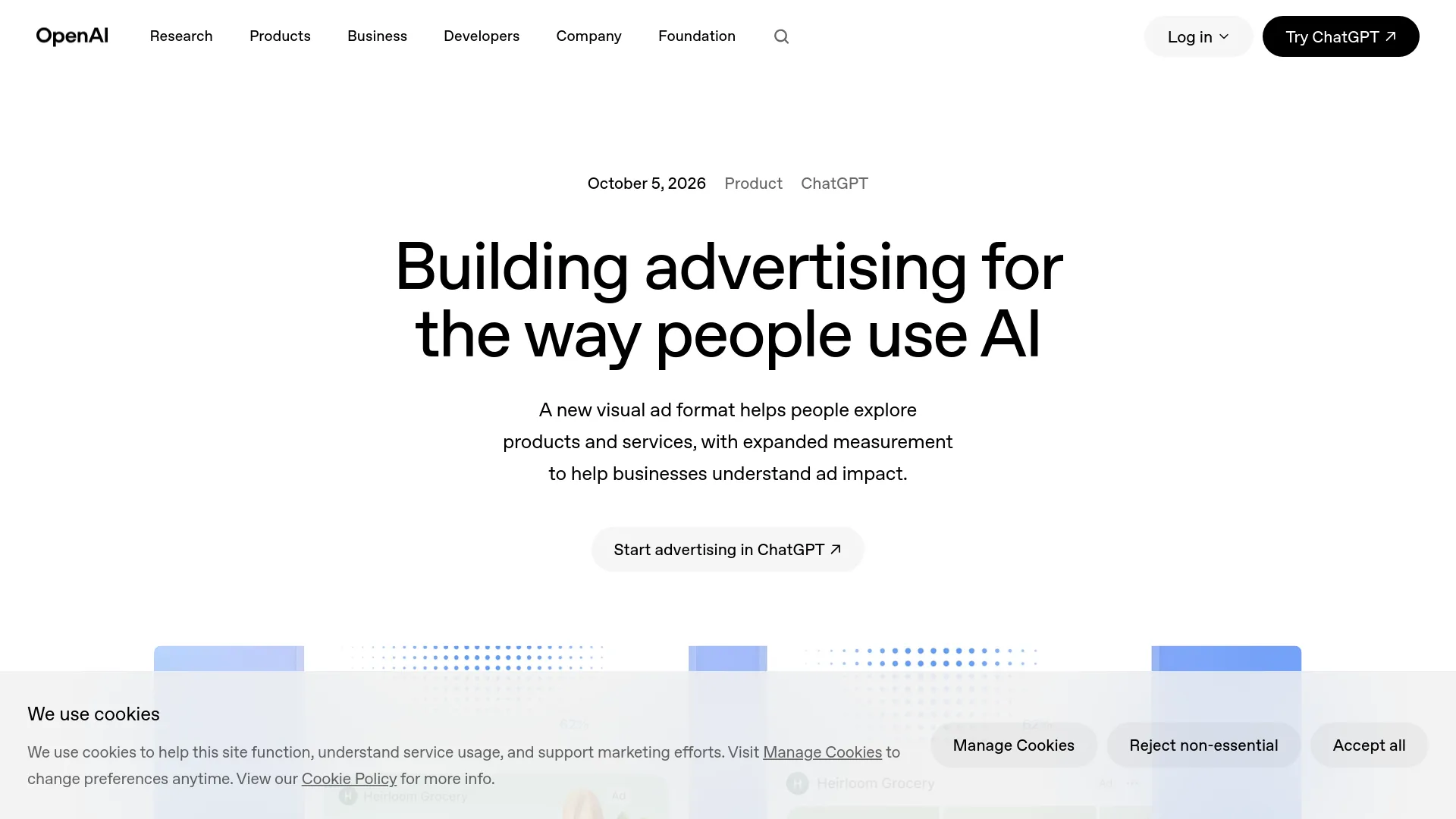
OpenAI’s October 5, 2026 announcement covers a new visual format and expanded measurement.
| Item | Confirmed position |
|---|---|
| Status of visual format | Announced, planned for testing |
| Initial market | United States |
| Initial timing | Later in October 2026 |
| Initial context | ChatGPT image generation |
| Separation | Kept separate from the image ChatGPT generates |
| Labeling | Clearly labeled as advertising |
| Effect on answers | OpenAI says ads will not influence ChatGPT’s answers |
“ChatGPT Ads” is already an operating advertising product; the image-generation format is a new test within it. OpenAI has not published a general-availability date for the visual placement.
How the visual ad format is expected to work
The initial format is a visual ad shown during image generation, separated from the generated image and labeled as advertising rather than embedded in the model’s output.
The announcement does not specify the ad’s dimensions, file formats, character limits, frequency caps, or exact screen position. It also does not say whether the placement will appear to every account tier or how many users will see it during the test.
Advertisers should prepare adaptable creative rather than build around an assumed mockup:
- Keep the product visible without relying on tiny text.
- Write a short benefit that makes sense beside an image-generation task.
- Prepare a destination page that matches the visual promise.
- Produce multiple crops and aspect ratios until OpenAI publishes final specifications.
What advertisers can measure today
The current ChatGPT Ads documentation describes a measurement stack built around Ads Manager reporting, UTM parameters, the OpenAI Pixel, and the Conversions API. OpenAI’s help documentation lists impressions, clicks, spend, CTR, average CPC, average CPM, and conversions among the available reporting concepts.
| Measurement layer | Practical use | Limitation to plan for |
|---|---|---|
| Ads Manager | Monitor delivery and campaign metrics | Reporting can lag and remains platform-specific |
| UTM parameters | Reconcile visits in analytics tools | Referrer and session attribution may differ |
| OpenAI Pixel | Capture browser-side conversion signals | Consent and browser restrictions can reduce matches |
| Conversions API | Send backend events | Requires implementation and event matching |
| Click-through attribution | Connect a click to a later action | OpenAI documents 7-, 14-, or 30-day windows |
| View-through attribution | Track some post-impression outcomes | OpenAI documents a one-day view-through option |
OpenAI also describes integrations and pilots intended to extend measurement beyond last-click reporting. Geo-based incrementality work with Haus, Measured, and WorkMagic is described as early experimentation, not a mature guarantee for every advertiser.
A practical test should define one source of truth before launch. Compare Ads Manager with your analytics and backend order or lead system, then record the attribution window and deduplication rules. Do not call a visual format successful because impressions rose.
What the early evidence does—and does not—show
There is no verified performance dataset for the new visual format yet. The strongest evidence available now is about the maturity of the surrounding ad platform, not about visual-ad conversion rates.
The paper “The Beginning of ChatGPT Ads”, submitted to arXiv on August 5, 2026, collected more than 3,000 ads from 186 advertisers using 335 prompts. The researchers reported that ads were clearly separated from response text and that lower-income accounts were more likely to receive ads in their first study phase. That research examines earlier ChatGPT advertising behavior; it does not measure the new image-generation placement.
Digiday’s October 5 report cited an estimate of roughly 2.5 billion daily ChatGPT prompts versus about 15 billion daily Google searches, while noting that ChatGPT had one ad placement at the time of reporting. Those figures provide market context, not a forecast for an individual campaign.
Real advertisers have raised operational concerns about the existing product. In a Reddit discussion, u/northcountryconsult wrote, “Reporting is DISMAL. There's no equivalent to a search terms report/asset level reporting,” while describing the current reporting environment—not the unlaunched visual test. The original discussion is in r/GoogleAdsDiscussion.
That limitation is useful when setting expectations: the visual test may add a new creative surface before it adds the mature diagnostic reporting that performance teams expect.
Who should prepare for the test
The visual format is most defensible as a controlled experiment for advertisers with a visual product, a clear U.S. audience, and a conversion path that can be reconciled outside Ads Manager.
| Advertiser situation | Recommendation |
|---|---|
| U.S. visual commerce or travel brand | Prepare creative and measurement for a small test |
| Product needs demonstration to be understood | Test visual messaging against a text-led unit when access exists |
| No pixel, backend events, or reliable analytics | Fix measurement before buying reach |
| Non-U.S. advertiser | Wait for eligibility details rather than assume global access |
| Brand requiring large, predictable inventory | Do not use the announced test as a primary channel yet |
The campaign should be able to prove an incremental business outcome with the data OpenAI exposes. If it cannot, more visual inventory will not repair the test design.
ChatGPT visual ads FAQ
Are ChatGPT visual ads available now?
OpenAI has announced the format, but the initial U.S. test is planned for later in October 2026. The announcement is not a promise of general availability.
Will an ad be inserted into the image ChatGPT generates?
OpenAI says the ad will be kept separate from the generated image and clearly labeled. Exact placement details have not been published.
Will ads change ChatGPT’s answers?
OpenAI says advertising will not influence ChatGPT’s answers. That is the company’s stated product rule, not an independent performance finding.
What will visual ads cost?
OpenAI’s announcement does not publish a visual-format CPC, CPM, minimum budget, or bid range. Confirm the commercial terms in the advertiser product before planning spend.
Can advertisers measure conversions?
The existing product supports Ads Manager reporting and documentation for UTMs, the OpenAI Pixel, and Conversions API. Available attribution windows and reporting details should be checked against the campaign’s actual setup.
Are the visual specifications public?
Not in the announcement. Dimensions, accepted file types, copy limits, frequency rules, and account-tier coverage remain open questions.
Should a brand launch a large campaign around this announcement?
No. Prepare a small, measurable U.S. test if the format fits the product, but wait for eligibility, creative specifications, and live reporting details before committing a major budget.
OpenAI is adding a visual surface and a measurement roadmap, but advertisers still face limited inventory, incomplete format specifications, and no independent conversion evidence for the new placement.