 AIREITER
Choosing between Suno v6, v6-wild, and v6-mini is a workflow decision: Suno positions v6 around precision, v6-wild around variation, and v6-mini around speed, while genre and controls can reverse the obvious choice.
The practical answer: route by the job
Use Suno v6 when a genre brief, lyric structure, or arrangement needs to stay controlled. Use v6-wild for short instrumental experiments, riff mining, and unusual branches—not as an automatic replacement for a complete song workflow. Use v6-mini to test melodies, covers, and rough song shapes quickly, then move a promising result into v6 for stabilization.
In Reddit testing, users have reported both restrained and chaotic Wild results, sometimes in the same genre discussion. One user summarized the problem: “Every time we talk about these models on this sub I feel like we're all getting wildly different experiences” (u/ShitFartDoodoo, r/SunoAI).
| If the immediate job is… | Start with… | Why | Main risk |
|---|---|---|---|
| A detailed, structured song | v6 | The official positioning favors precision and control | Polishing a direction that is musically wrong |
| A strange riff, texture, or arrangement idea | v6-wild | It is designed to depart from the obvious interpretation | Useful variation can become noise or late-song drift |
| A fast melody or full draft | v6-mini | It is the faster, more efficient model and is available to all users | Rougher output or less deliberate instruction following |
| A cover or older idea that needs a stable starting point | v6-mini → v6 | Users report that Mini can find a workable draft before v6 adds polish | A transfer can still change vocals, timing, or arrangement |
What Suno officially says about the three models
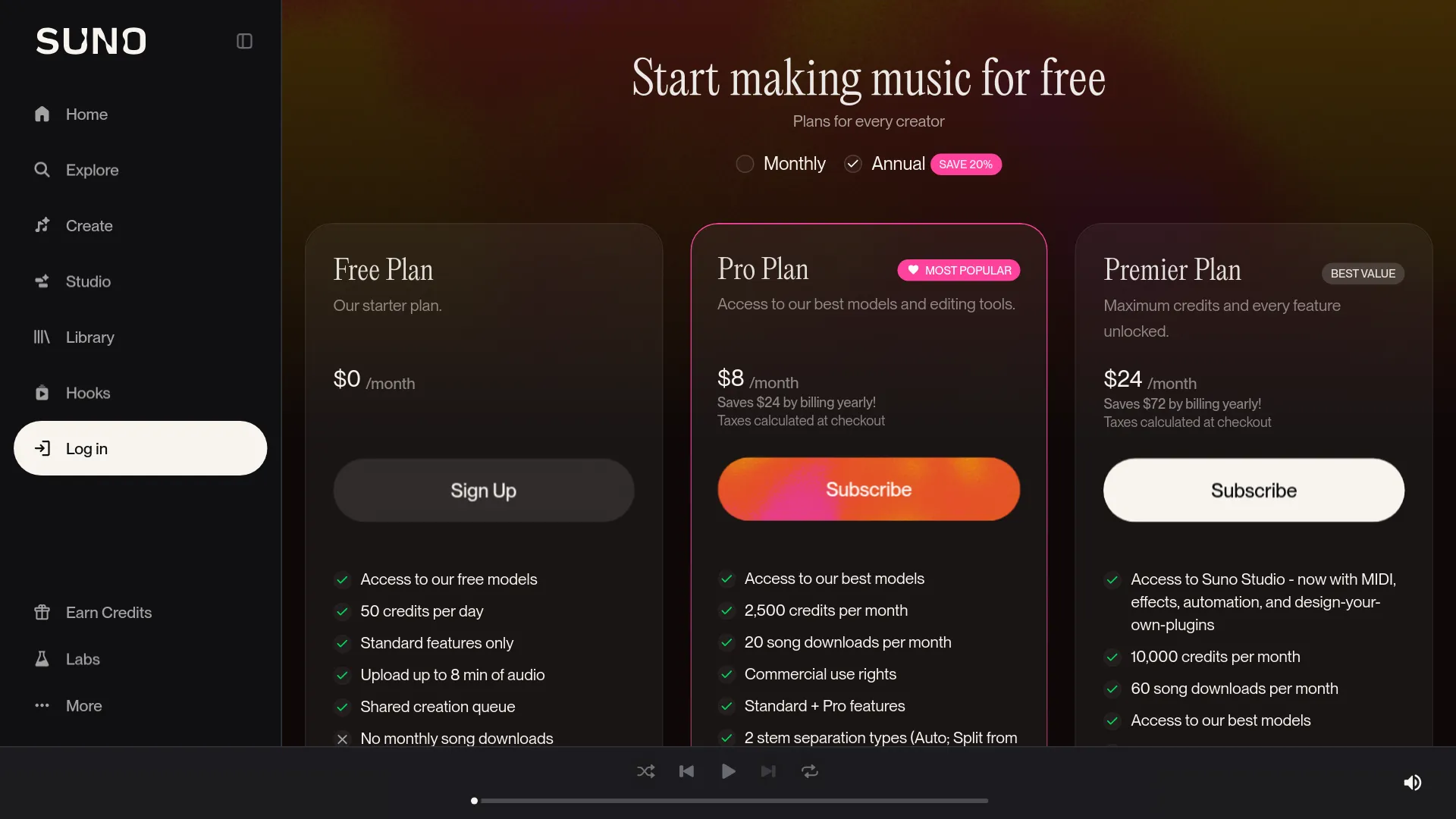
Suno’s v6 FAQ and current-model reference describe three different priorities rather than a simple quality ladder. Suno lists v6 and v6-wild for paid users, while v6-mini is the broadly available fast option. The Suno pricing page is the authority for current plan access and should be checked before subscribing because model availability and download rules can change.
| Model | Official role | Access reported in current references | Practical interpretation |
|---|---|---|---|
| v6 | Reliable precision and polished output | Pro and Premier | The default for a defined musical target |
| v6-wild | Less predictable, more varied experimentation | Paid plans | A discovery branch, especially for short ideas |
| v6-mini | Faster, efficient generation | All users, including Free | A sketchpad and low-commitment first pass |
Suno associates the v6 family with section edits, lyric changes, and text, audio, image, or video inputs, but it does not publish a model-by-model matrix for edit isolation, quality, or latency. Do not assume v6-wild or v6-mini preserves untouched sections as reliably as v6; compare the edited version against the source.
Genre-specific recommendations
Rock, metal, and high-gain guitars: keep Wild short and instrumental
For rock and metal, start with v6 when the prompt specifies guitar role, tuning or mood, vocal delivery, song structure, and a target length. Use v6-wild for riff mining, alternate intros, or texture searches, then discard the weak branches instead of extending them into a seven-minute song.
This recommendation is conservative because early user reports are unusually negative about high-gain material. One X user wrote, “V6 is garbage for rock and metal. Especially high gain Guitars sound worse than 3.5. V6 Wild is halfwhat usable.. But it all still feels like a downgrade” (@DominikWende1). That is one user’s report, not a genre-wide measurement, but it is a useful warning against assuming that a flagship label guarantees better guitar tone.
A Reddit user found a narrower Wild use case: “I’ve used it for riff mining a couple of times in a post metal, punky, hardcore, twangy guitar orientated stuff. It’s bat shit crazy but that’s what I’m after” (u/candeloro1, r/SunoAI). The distinction is important: a chaotic riff can be valuable raw material even when the same behavior is unacceptable in a finished vocal track.
Workflow:
- Draft the core metal or rock brief in v6.
- Use Wild only for a short instrumental section or riff prompt.
- Start Weirdness and Variety low, then raise one control at a time if the result is too predictable.
- Bring the useful idea back into v6 or a cover/remaster workflow.
- Check the final two minutes for distortion, repetition, and buried vocals before spending more credits.
Funk, pop, and structured lyric songs: favor v6, but audition Mini
For pop, funk, and other lyric-led formats, v6 is the safer starting point when the brief includes verse, pre-chorus, chorus, bridge, vocal character, and arrangement. Suno’s official positioning favors v6 for reliable precision, while early independent testing reported stronger results on detailed pop structure than on tightly constrained duration or mood requests (see Jake’s test-based review).
However, Mini can be surprisingly useful for a complete rough draft. In a Reddit comparison, one user reported that “Mini is best for complete draft, hitting all the parts I need with some rough edges,” while using Pro to add gloss and Wild for instrumentation (u/Ok-Acanthaceae-5243, r/SunoAI). That is a production-stage recommendation, not proof that Mini is the higher-quality model.
For vocal work, listen for echo, synthetic coloration, and whether the lead remains above the arrangement. Another user described v6 vocals as sounding like they were “going through a child's karaoke toy with the echoing,” but found the issue absent on v6-mini and improved when remastering to v6 (u/Ok-Acanthaceae-5243, r/SunoAI).
Best route: Mini for a fast melody or full draft, v6 for a deliberate rewrite or stabilization, and Wild only when a specific section needs a more unusual interpretation.
Electronic and experimental music: Wild can help, but define “usable surprise”
Electronic, ambient, industrial, and texture-first work are the strongest candidates for v6-wild because the goal may be a sound that is not fully specified in advance. Ask Wild for a short loop, transition, bass texture, or rhythmic mutation rather than a complete eight-minute narrative.
The failure mode is not merely “bad quality.” It is uncontrolled divergence: a track can become less coherent, repeat itself, or degrade late in the generation. In one discussion, a user said Wild produced “random garbage” unless Weirdness was set to zero, while another used the model precisely for chaotic riff discovery (u/Objective_Mousse7216 and u/candeloro1, r/SunoAI). Different results are plausible across genres and settings, so test the same brief before generalizing.
Use Wild when you can answer this question: If the model departs from my prompt, what kind of departure would still be useful? If the answer is “none,” use v6. If the answer is “a new percussive pattern or harmonic turn,” use Wild on a bounded section.
Covers and remastering: Mini first can be rational
Some users report a Mini-first cover workflow because the goal is preservation and improvement: find a stable draft in v6-mini, then cover or remaster it in v6 Pro or Wild. One Reddit comment says, “You can also take the v6 mini versions and cover them in v6 Pro or Wild, and it really does a good job of stabilizing the sound” (u/New_Lettuce_8778, r/SunoAI). Compare the source and destination section by section because a transfer can alter vocals or arrangement.
Use only lyrics, recordings, images, or videos you own or have permission to use. Check Suno’s terms and rights guidance for the specific track before commercial release; commercial-use permission is not a guarantee of copyright protection.
How to run a fair three-model comparison
A useful comparison needs repeated, controlled generations. There is no published benchmark that makes one model the winner for every genre, and one keeper can be an outlier.
- Freeze the brief and controls. Use the same lyrics, genre description, reference material, target length, Weirdness, Variety, Style Influence, and Audio Influence.
- Change only the model. Run v6, v6-wild, and v6-mini against the same input.
- Listen in sections. Check the opening, first chorus, bridge, and ending for genre fidelity, vocal clarity, groove, structure, coherence, and useful surprise.
- Separate keeper quality from repeatability. A Mini result can be the best individual track without proving Mini is generally better.
If credit limits make repeated testing expensive, use Mini to eliminate weak directions before comparing paid models.
Settings and failure recovery
The model choice sets the broad behavior; controls still shape the result. A practical recovery sequence is:
- Wild sounds random: lower Weirdness first, then reduce Variety; do not change five other variables at the same time.
- Wild is interesting but collapses later: keep the useful section, shorten the next generation, or use it as a source for a cover rather than extending the whole track.
- Vocals are buried: simplify the arrangement brief, reduce competing instrumentation, and test a Mini draft before remastering in v6.
- Lyrics repeat or end early: shorten the structure, make section labels explicit, and avoid asking Wild to carry a long lyric-driven song until the behavior is stable.
- A genre sounds generic: change the musical brief before blaming the model. Specify rhythm, instrumentation, performance character, and what should not be polished away.
Wild changes the model’s behavior and is not a synonym for high Weirdness or Variety settings. Combining Wild with aggressive controls can turn experimentation into wasted credits.
The routing rule for a real project
For most creators, use Mini when the destination is unclear, Wild for bounded surprise, and v6 when the genre, lyrics, arrangement, or vocal treatment needs deliberate control.
| Project situation | Recommended route |
|---|---|
| Clear pop structure or detailed lyrics | v6 first |
| High-gain guitar or metal riff discovery | Wild short instrumental → v6 |
| Fast cover or melody search | v6-mini → v6 remaster/cover |
| Ambient or experimental texture | Wild short section → keep only usable surprises |
| Free-plan exploration | v6-mini |
Questions creators still ask
Is Suno v6-wild better than v6?
Not universally. Suno v6-wild trades predictability for variation, so it can be more useful for experimental fragments and less useful for a tightly specified song.
Is v6-mini only a low-quality version of v6?
Suno positions v6-mini as faster and more efficient, not simply as a broken preview. Individual results can still win for a particular melody, cover, or rough draft, but there is no public benchmark proving consistent parity.
Which Suno model is best for metal?
Start with v6 for controlled full songs and use v6-wild for short riff or texture exploration. Early user reports are mixed and include complaints about high-gain guitar tone, so audition several short generations before committing credits.
Can I use all three models in one song workflow?
Yes, if the current Suno interface and plan expose the required operations. A practical pattern is Mini for sketches, Wild for alternate ideas, and v6 for refinement or stabilization.
How do I compare Suno models fairly?
Keep the lyrics, prompt, source material, controls, and target length fixed. Change only the model, run multiple generations, and evaluate the ending as well as the opening.