AIREITER
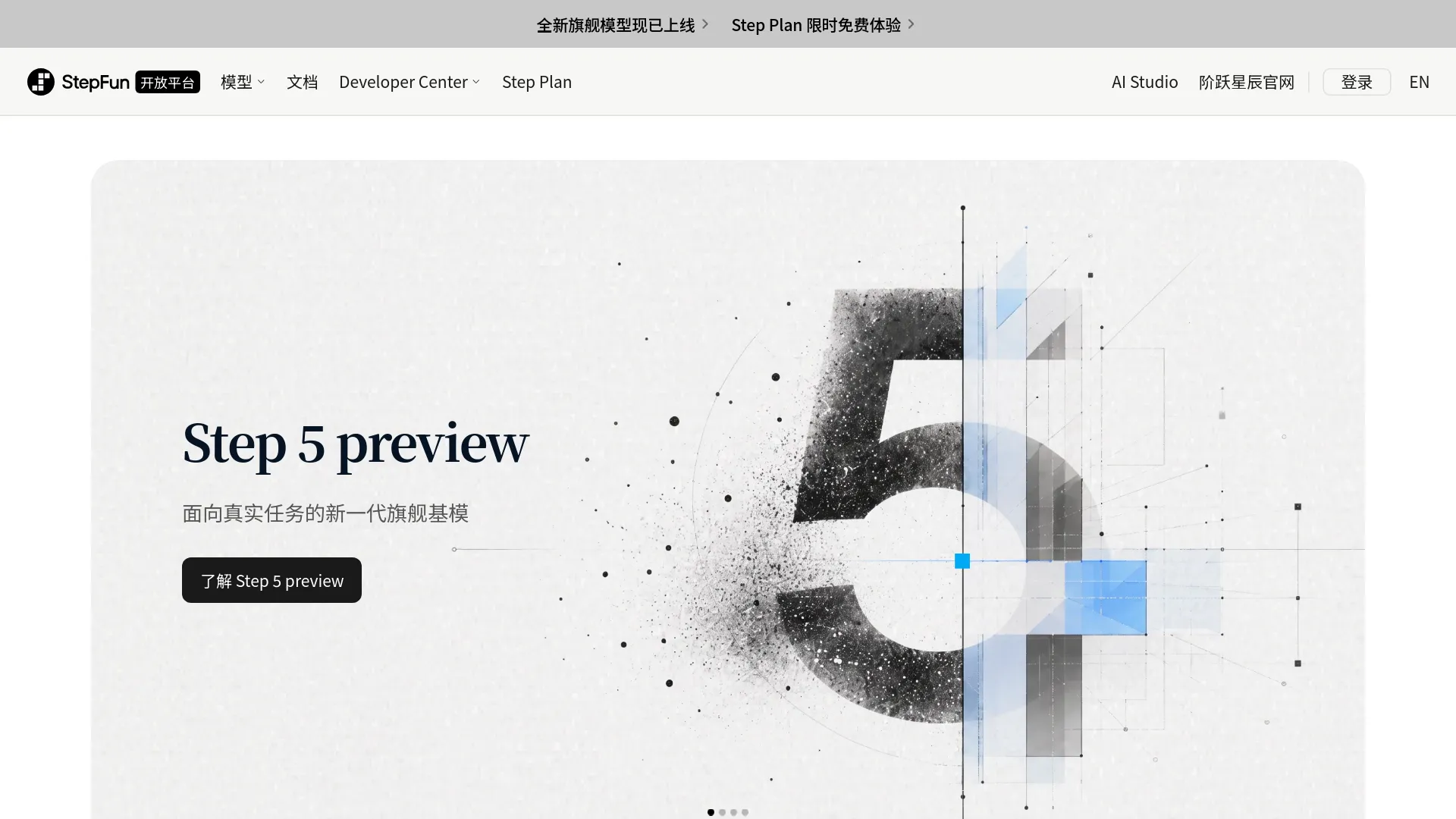
Step 5 Preview looks unusually cheap for a model with a reported Artificial Analysis score of 44, but the buying decision is not as simple as the token price. StepFun has announced the model and an API path, while its public documentation footprint still does not expose a complete model page, billing specification, or production contract. Treat it as a pilot candidate—not a default endpoint—until those pieces are settled.
The answer depends on what “available” means
Step 5 Preview is no longer just a rumor: StepFun’s official account announced it on September 20, 2026, and said that open weights are planned for October 15. However, a Google search of StepFun’s public platform pages still surfaces the general portal and Step 3.7 documentation rather than a clearly indexed step-5-preview reference. The practical distinction is important: announced access is not the same as documented, broadly self-serve production access.
| Question | Current answer | Confidence |
|---|---|---|
| Has StepFun announced it? | Yes, via the official @StepFun_ai announcement | High |
| Is an API model ID reported? | step-5-preview | Medium; verify in your account |
| Are public token rates reported? | $1 input / $2.70 output per 1M tokens | Medium; third-party measurement/listing |
| Are weights downloadable now? | No public weights were found | High as of September 20 |
| Are open weights promised? | October 15, according to StepFun’s announcement | High for the promise; delivery remains future |
What StepFun has confirmed—and what remains unverified
The official announcement describes a 600B-parameter sparse MoE model with 27B active parameters, a 1M-token context window, text and vision input, and strengths in agentic work, software engineering, and finance. Those are vendor claims, not independent proof that every advertised limit is available on every API route.
The official platform search did not return a dedicated Step 5 pricing or API page when checked on September 20, 2026. That leaves several operational questions—rate limits, maximum output, function calling, cache billing, and regional availability—without a first-party citation. Do not copy a third-party model directory into production configuration as if it were StepFun documentation.
A real-user post from @xueyu1125 reported that a simple SVG animation test felt weaker than the Artificial Analysis score, particularly for 3D and reasoning tasks (source). That is one early experience, not a benchmark result, but it is a useful warning against reading the aggregate score as universal capability.
“目前的简单使用体验是对不起Artifical Analysis的44 Index分数,至少在3D和思维能力这方面达不到GLM-5.3-Flash🤣” — @xueyu1125, reporting an early hands-on test (X)
Step 5 Preview API pricing: use the reported rates carefully
The commonly reported Step 5 Preview API price is $1.00 per 1 million input tokens and $2.70 per 1 million output tokens. Artificial Analysis also reports a 95% cache discount and a blended estimate of $0.51 per million tokens under a specific 70% cache-hit, 20% input, and 10% output mix. The blended figure is an assumption, not a universal invoice rate.
| Usage | Reported rate | What to verify before launch |
|---|---|---|
| Input | $1.00 / 1M tokens | Whether the rate is first-party and region-specific |
| Output | $2.70 / 1M tokens | Whether reasoning tokens count as output |
| Cache hit | About $0.05 / 1M under a 95% discount | Cache eligibility and cache-write rules |
| Example: 100k input + 20k output | About $0.154 | Taxes, minimums, retries, and hidden reasoning usage |
The basic estimate is simple: (input tokens ÷ 1,000,000 × 1.00) + (output tokens ÷ 1,000,000 × 2.70). A request with 100,000 input tokens and 20,000 output tokens therefore costs about $0.10 + $0.054 = $0.154 before discounts or provider-specific charges.
The catch is verbosity. Artificial Analysis measured about 160 million output tokens across its Intelligence Index evaluation, compared with a comparable-model median of 92 million. A low output rate can still produce a larger bill if the model spends more tokens on reasoning or answers; one early user also warned that thinking tokens may appear in the output bill (source).
The performance signal is strong, but uneven
Artificial Analysis reports a 44 Intelligence Index score, roughly 100 output tokens per second, and 2.96 seconds to the first answer token. BenchLeader separately lists a 1M-token context, a 100-token-per-second output rate, and a 23-second first-answer figure; the different latency definitions show why raw dashboard numbers should not be treated as interchangeable.
| Signal | Reported result | Reading for a buyer |
|---|---|---|
| Intelligence Index | 44 | Strong aggregate result, not a guarantee for every task |
| Output speed | 99.8 tokens/second | Competitive after generation begins |
| First answer token | 2.96 seconds in Artificial Analysis | Check the measurement definition and your route |
| Context window | 1M tokens | Confirm the deployed API limit, not only the model profile |
| Evaluation output | 160M tokens | Budget for verbosity and reasoning usage |
| Long-context result | 88.3%, rank #2 in BenchLeader’s listing | Encouraging, but benchmark setup matters |
The benchmark picture is not uniformly strong. BenchLeader gives Step 5 Preview a 58.9% SciCode score, ranked #8, but places its MMMU-Pro result at #64 and identifies multimodal performance as its weakest aggregate category. Artificial Analysis reports image input, while CloudPrice’s catalog marks image input and several capabilities as unavailable. Until StepFun publishes the exact API capability matrix, assume the narrowest supported feature set for application design.
A safer pilot than a production migration
The available evidence supports a bounded evaluation, not an unconditional switch. Use a small test budget and make the API prove the properties that third-party pages cannot settle.
- Confirm the endpoint and model ID in the official account. Send a harmless request using
step-5-preview, then record the returned model name, region, status code, and rate-limit headers. - Capture the invoice fields. Compare input, output, cached, and reasoning-token usage. Do not infer the bill from the public
$1/$2.70figures alone. - Test long context in stages. Start at 50K tokens, then 100K, 350K, and higher only if the previous request succeeds. Record time to first token, truncation, and error behavior.
- Test tools separately from text quality. Check function names, argument validity, retries, and whether the model reads the target state before editing it. The Intelligence Index score does not establish reliable tool execution.
- Keep a fallback. Route failed, timed-out, or malformed tool calls to a model already supported by your stack. A preview endpoint should not be the only path for a customer-facing workflow.
For a multi-provider setup, a unified API gateway can make that fallback easier, but it does not remove the need to verify StepFun’s own billing and limits. The useful goal is containment: keep an unproven model behind a budget, logs, and a tested alternate route.
Step 5 Preview API FAQ
Is Step 5 Preview officially released?
StepFun officially announced Step 5 Preview on September 20, 2026. Public documentation and broad production availability are less clear, so “announced” should not be read as “fully documented and stable.”
What is the Step 5 Preview API model ID?
Early reports identify the model as step-5-preview. Verify the exact identifier in the official StepFun account or API response before hard-coding it.
How much does Step 5 Preview cost?
Third-party listings and Artificial Analysis report $1.00 per 1M input tokens and $2.70 per 1M output tokens. Confirm whether reasoning, cache writes, retries, and regional fees are billed differently.
Is Step 5 Preview open source now?
No public weights were available in the sources checked on September 20, 2026. StepFun’s announcement says open weights are planned for October 15, which is a future commitment rather than current availability.
Does it support images and a 1M-token context?
StepFun’s announcement and Artificial Analysis report image input and a 1M-token context. Conflicting catalog data means developers should test the exact API route and avoid assuming that every advertised capability is enabled everywhere.
The decision is therefore straightforward even though the model is not: run a small, instrumented pilot if the price-performance profile fits your workload; do not make Step 5 Preview a production dependency until StepFun publishes the model page, billing rules, capability list, and limits that developers need to operate it safely.