 AIREITER
A 17GB download is not the same thing as a comfortable local agent. Qwen3.8-27B is a capable Apache-2.0 open-weight model, but its default extra-high reasoning can turn a quick task into a long wait unless the quantization, context budget, and serving stack match the machine.
Is Qwen3.8-27B worth running locally?
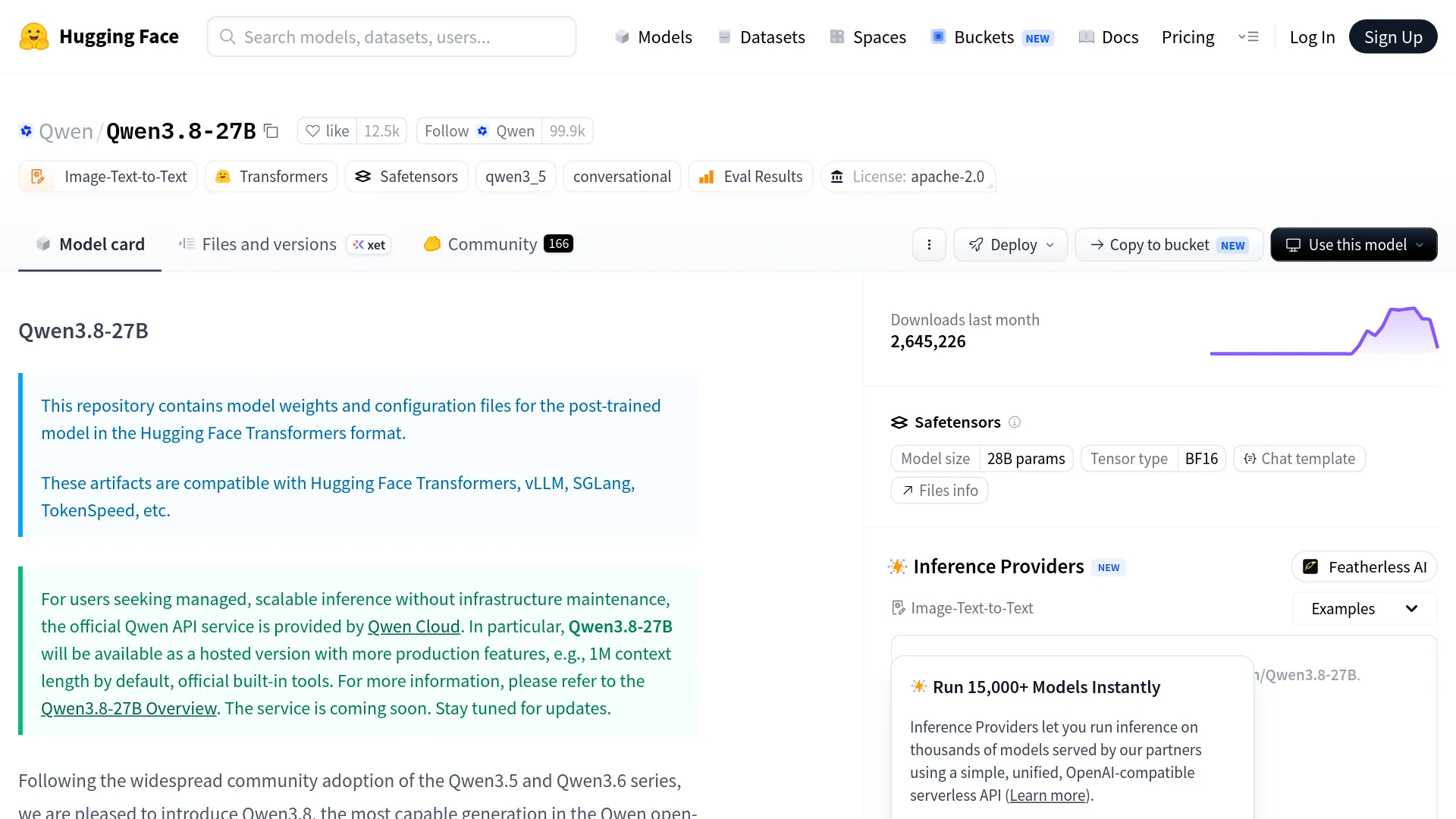
Qwen3.8-27B is worth running locally for developers who have roughly 24GB of GPU or unified memory available, value local data handling, and can accept slower interactive responses than a fast hosted API. The strongest reason to choose it is not a single benchmark: it is an Apache-2.0 dense model with image and video input, a 262,144-token native context, and configurable reasoning in a deployable size. Qwen's official model card lists the model as released on August 14, 2026.
Do not treat it as an automatic replacement for every API model. The official results are vendor-reported, aggressive quants change both quality and speed, and default xhigh reasoning is a poor first setting for many local interactive tasks.
Start with the hardware budget, not the benchmark chart
Qwen3.8-27B is a dense model, so every generated token activates the full model. That makes memory bandwidth, KV cache, quantization, and requested context decisive in a way that a weights-only file size obscures. Qwen's card documents 262K native context, while an actual local session can be configured far below that to preserve usable memory and speed. Qwen's serving examples show the 262,144-token maximum; that is a capability limit, not a sensible default for every consumer machine.
| Available memory | Practical starting point | What to expect | Recommendation |
|---|---|---|---|
| 12GB | Aggressive Q3-class quant plus CPU/RAM offload | Short context and substantial latency tradeoffs | Use a smaller model unless local experimentation is the goal |
| 16GB | Aggressive Q3 or carefully chosen Q4-style quant | Viable for short, supervised tasks; context and speed are constrained | Test before committing an agent workflow |
| 24GB | Q4-class quant | The practical entry point for coding, tools, and modest context | Best fit for most local Qwen3.8-27B users |
| 32GB+ | Higher-quality quant or more context headroom | Fewer compromises around KV cache and long sessions | Prefer this tier for sustained agent work |
These are operating recommendations, not vendor minimums. Independent users report that a 12GB RTX 3060 can run a local build and handle tool calling, while others warn that a dense agent at that VRAM level performs poorly; the disagreement is exactly why “can load” and “works well” should not be conflated. See the real-user discussion in r/LLM.
A 24GB card is a floor for a comfortable 4-bit workflow, not a guarantee of long-context comfort. A deployment-focused assessment estimates 4-bit total memory at 17-19GB, but also warns that KV cache grows quickly during long agent sessions. Neoteric's local-deployment analysis is useful planning evidence, not an official hardware specification.
Why the default settings can make Qwen3.8-27B feel unusable
Qwen3.8-27B enables thinking by default. The official card exposes reasoning_effort values including xhigh, medium, and low, plus enable_thinking=False for non-thinking requests; it also enables preserve_thinking by default. Qwen's best-practices section cautions that lower reasoning effort does not always reduce complete-task time, but a high setting is still an expensive default for trivial work.
Simon Willison's local test illustrates the difference. Running a Q4_K_M build in LM Studio, he reports a first SVG task that used 22,276 reasoning tokens and took 21 minutes at the default setting; disabling reasoning produced a different result in 137 seconds. His measured setup is not a universal benchmark, but it makes the configuration risk concrete. Read the full test and transcripts.
“I was expecting it to be about the same level as 3.6 35b but slower version because of the heavy quantization but then it ended up smoking it everywhere.” u/AltruisticList6000, r/LocalLLaMA, reporting a 16GB RTX 4060 Ti Q3 experiment.
That positive result does not erase the tradeoff. A separate real-user report describes limited 32K context and an agent session that became unreliable, while another recommends clear, atomic instructions for local programming work. The workflow discussion is here.
What Qwen3.8-27B officially ships
Qwen3.8-27B is a dense, native vision-language model, not an MoE model. The official card describes text, image, and video input; 64 layers; a 5,120 hidden dimension; 262,144 native context tokens; and Apache-2.0 licensing. It also documents YaRN-based extension up to 1M tokens, with the explicit warning that static YaRN can hurt short-text performance. Official specifications and context guidance should take precedence over third-party release summaries.
The official repository names Transformers, vLLM, SGLang, TokenSpeed, and quantized local paths such as llama.cpp, Ollama, and LM Studio. Runner support matters because the model uses a hybrid Gated DeltaNet and Gated Attention layout; update the runner before diagnosing a model failure. Qwen's quickstart repository includes OpenAI-compatible serving examples.
What the published benchmarks do and do not establish
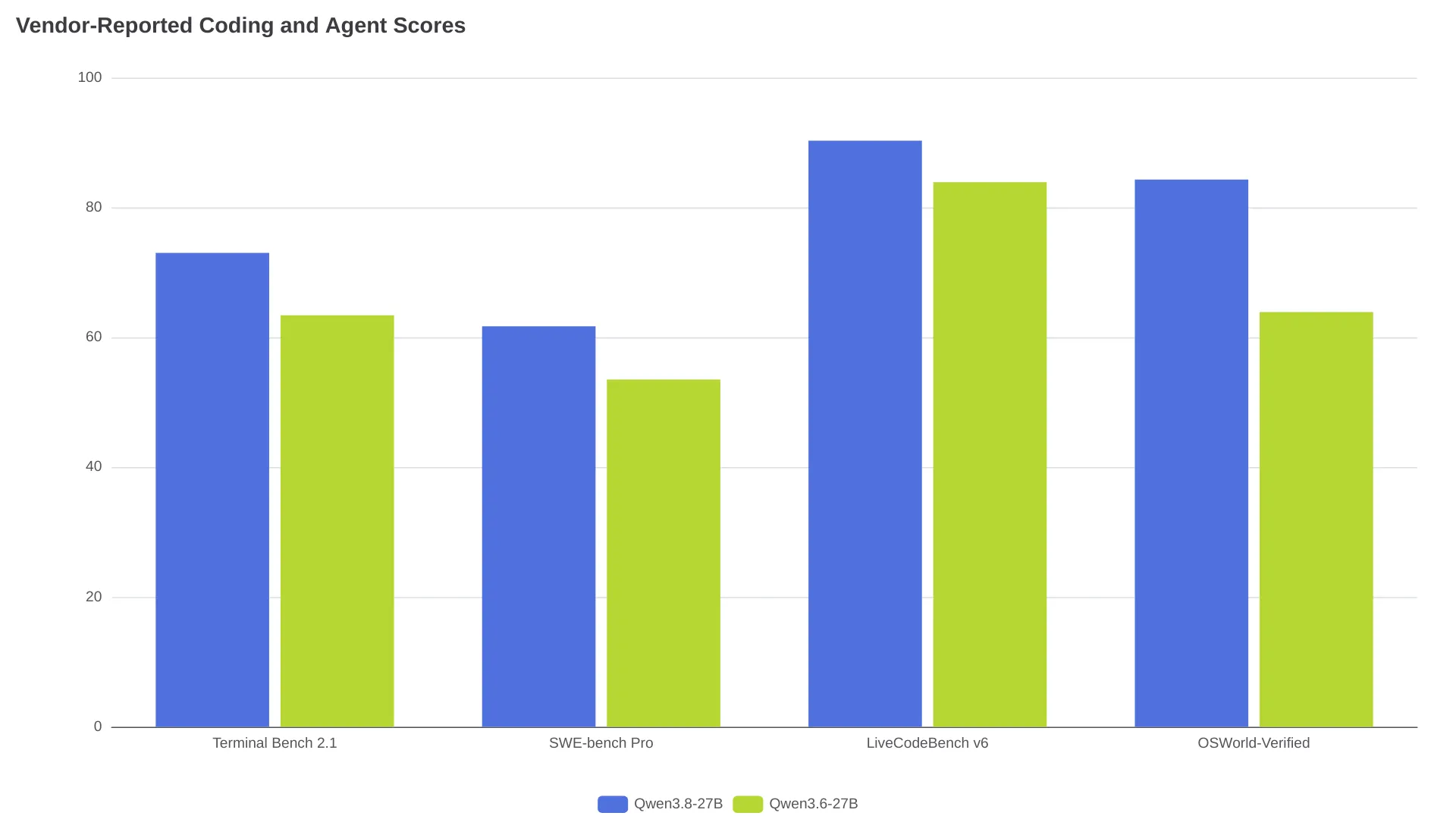
Qwen reports meaningful gains over Qwen3.6-27B in coding and computer-use evaluations. The chart shows four vendor-reported scores from the official model card, not independently reproduced scores.
| Official benchmark | Qwen3.8-27B | Qwen3.6-27B | Useful reading |
|---|---|---|---|
| Terminal Bench 2.1 | 73.0 | 63.4 | Agentic terminal coding signal |
| SWE-bench Pro | 61.7 | 53.5 | Repository issue-resolution signal |
| LiveCodeBench v6 | 90.3 | 83.9 | Coding evaluation signal |
| OSWorld-Verified | 84.3 | 63.9 | Computer-use signal |
The model card publishes the full comparison and methodology. For SWE-bench Pro and DeepSWE 1.1, Qwen says it used a Claude Code harness with temperature=1.0, top_p=0.95, and 256K context; it also includes in-house benchmarks such as QwenSWEBench. Review the methodology before comparing models. These numbers support “a substantial official upgrade over Qwen3.6-27B,” not “a proven universal replacement for a frontier API.”
A sensible first local setup
A first local deployment should prioritize predictable behavior over maximum reasoning. Use a current runner, begin with a Q4-class quant on 24GB-class hardware, set a deliberately modest context limit, and run short agent tasks before allowing long autonomous loops.
- Start an OpenAI-compatible server with a supported engine such as vLLM or SGLang. Qwen publishes examples using
Qwen/Qwen3.8-27B,--reasoning-parser qwen3, and--tool-call-parser qwen3_coder. The official commands are in the repository. - For routine classification, extraction, or fast coding edits, set
enable_thinking=False. Qwen recommends non-thinking sampling values oftemperature=0.7,top_p=0.80, andpresence_penalty=1.5. See the official API example. - For reasoning-heavy debugging, try
lowormediumbeforexhigh, then compare total completion time and tool-call quality on a real task. - Disable preserved thinking when each task is independent. Preserve it only when multi-turn reasoning context is worth the extra KV-cache pressure.
- Test tool calling, output schema compliance, and a context rollover before unattended use. A model that writes good code in one prompt can still fail a long-running agent loop.
Where Qwen3.8-27B is the wrong local choice
Qwen3.8-27B is the wrong first choice when 12GB or less is a hard limit, when response latency matters more than local control, or when an agent must execute unattended with strict format compliance. It can run in constrained setups, but that is not the same as delivering reliable interactive throughput or enough context for repository work.
Independent testing also finds a tendency toward long outputs, high tail latency, and imperfect strict-instruction adherence. One structured evaluation recorded 4 timeouts in 49 tests and a 143.32-second P95 response time on its workstation configuration. Those figures are not portable performance guarantees, but they are a useful warning against treating a local 27B model as a no-review automation component. CrucibleMark's test report provides the configuration and limitations.
Qwen3.8-27B FAQ
Is Qwen3.8-27B officially released?
Yes. Qwen's official repository lists the Qwen3.8-27B release on Hugging Face Hub and ModelScope as August 14, 2026. Qwen's release timeline is the primary source.
Can Qwen3.8-27B run on a 16GB GPU?
A heavily quantized, short-context setup can run, but it is a constrained deployment. Real-user reports range from promising Q3 results on a 16GB RTX 4060 Ti to warnings that low-VRAM dense-agent use has major speed and quality tradeoffs. LocalLLaMA discussion.
Does Qwen3.8-27B have a 1M-token context window?
It has 262,144 native context tokens. The model card describes 1M context through YaRN/RoPE scaling and cautions that static YaRN may reduce short-text performance. Official context documentation.
How do I disable Qwen3.8-27B thinking?
Set enable_thinking=False in the API request as shown in Qwen's model card. For tasks that need reasoning, start with low or medium rather than assuming xhigh is appropriate. Official non-thinking example.
Should Qwen3.6-27B users upgrade?
Upgrade if the existing hardware already runs the same deployment class and the workload benefits from coding, computer-use, or multimodal improvements. Keep Qwen3.6-27B if the current stack is stable and the new runner, quant, or reasoning behavior has not yet been validated on the actual workflow.
Choose by the constraint you cannot change
| Constraint | Best next move |
|---|---|
| Local data handling and 24GB available | Run Qwen3.8-27B at Q4, begin with low or no thinking |
| 12GB to 16GB only | Test a Q3-style build for supervised short tasks, or choose a smaller model |
| Long repository agent sessions | Budget 32GB+ headroom and validate KV-cache behavior before adopting it |
| Fast interactive responses | Use a hosted API or a smaller local model |
| Strict unattended formatting or publishing | Keep a validation layer and human review; do not rely on model compliance alone |
Qwen3.8-27B changes what a locally deployable 27B model can attempt. It does not remove the systems work: pick the quant for the hardware, control reasoning deliberately, and judge the model on a representative workflow rather than the download size.