 AIREITER
n8n launched Nod on November 10, 2026 as a research preview with a blunt pitch: a personal agent that does the errand instead of writing instructions for it. Nod is worth installing if you accept one condition up front — this preview still bills you for the model and stops when your laptop sleeps. This is a launch-day review checked against official docs and benchmark methodology, not a months-long hands-on reliability test.
Nod itself is free and open source under Apache 2.0, but every task burns your own API key, ChatGPT Plus/Pro plan, or local model.
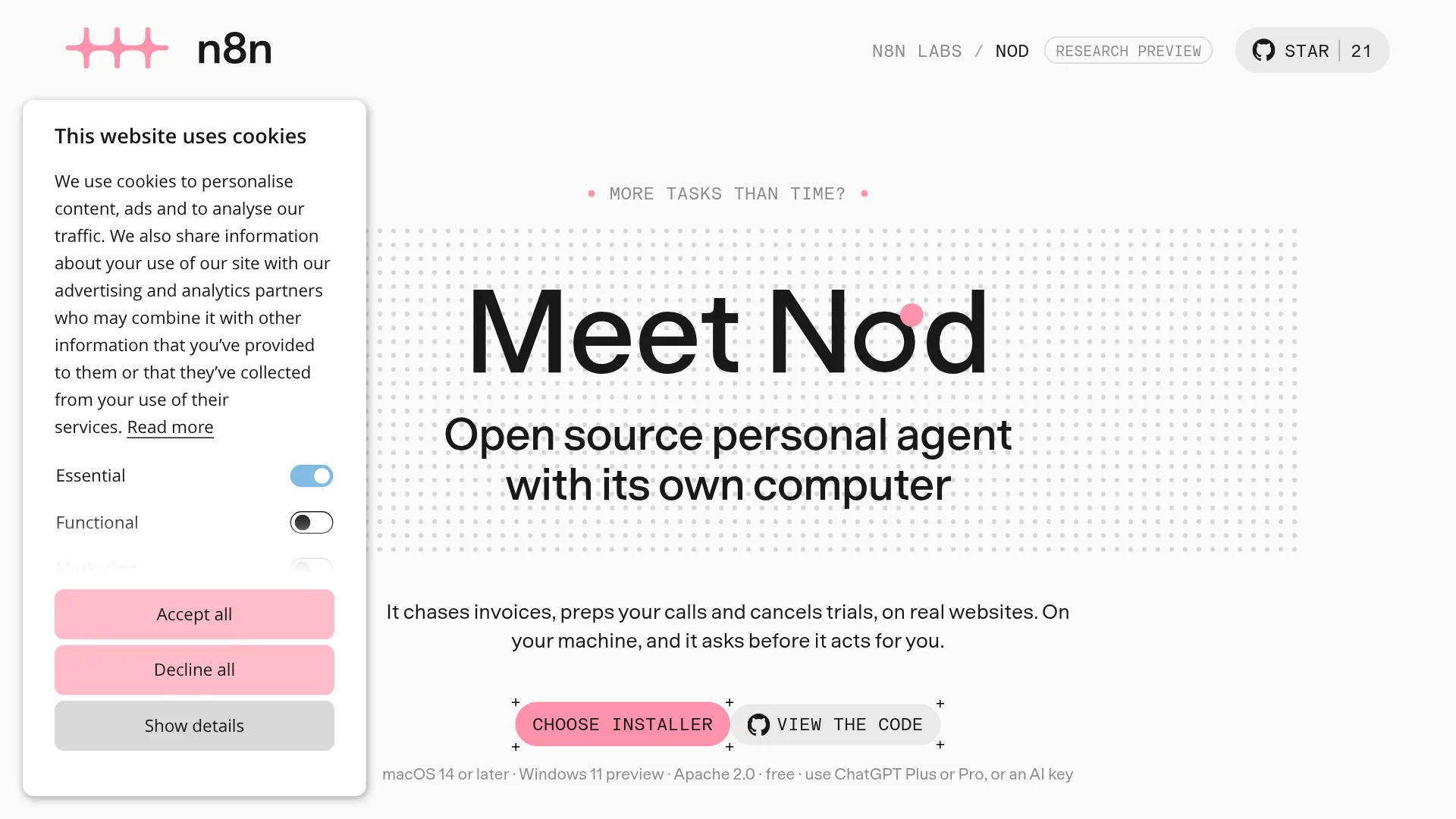
Nod is not an n8n node
Nod is not an n8n node, and that collision is the first thing to clear up. Nod is a standalone desktop app from n8n Labs, while the familiar AI Agent node lives inside n8n workflows. Unlike team-shared n8n workflows, Nod is single-player and needs no n8n account or server, though existing users can optionally link an n8n instance to trigger workflows.
Solo operators, freelancers, and household admins with repeating logins, invoices, and price checks are the target. Teams needing shared ownership should wait — each installation currently supports one owner.
What handing Nod an errand looks like
Handing Nod an errand means delegating a multi-step job with logins, not asking a chat question. Nod runs that job inside a private local virtual machine with its own browser, so Nod can use ordinary sites that have no API.
What Nod claims to handle:
- Finance: pull supplier invoices monthly, download bank statements
- Life admin: cancel a subscription and reject the retention offer, request a refund
- Monitoring: check a price every 6 hours and notify on a drop
- Reports: extract dashboard figures with no export into a weekly report
- Work: research sites and PDFs, draft docs and sheets, write code in a Linux workspace
- Control: desktop app, Telegram, or WhatsApp, with parallel background jobs and proactive suggestions like morning briefs
The official snapshot behind those claims is 226 distinct errands attempted 3 times each for 678 runs, scored at 98% completion on October 17, 2026 with GPT-6.1 Sol — synthetic accounts, not live-site proof. Details are on the benchmark methodology page.
Official setup has five stages; use this six-step first-run checklist
Official setup has five stages, which n8n estimates at about ten minutes: install Nod, connect an AI provider, connect apps with single sign-in, save website logins, and issue requests from the app or Telegram.
macOS requires macOS 14 or later, while Windows 11 support is a preview relying on WSL 2. Self-hosting on your own server is supported but still one person per Nod. Schedules need the host on and awake; a sleeping laptop pauses them unless Nod lives on an always-on Mac mini or server.
Validate with a first-run sequence instead of adding schedules on day one:
- Download from nod.n8n.io and install for your OS
- Connect the provider you already pay for, or a local model
- Connect one app such as Gmail and save one login
- Set the monthly spending limit and confirm the $5 per-task checkpoint
- Run one read-only invoice retrieval or price check with approval prompts on, then inspect its log and receipt
- Check Settings: telemetry sharing and conversation traces
Two defaults deserve a click. App connections use n8n and Composio by default, and basic usage telemetry is on by default for new installs but can be disabled. Feedback goes to n8n only after you review and submit it.
Free download, metered brain
Nod carries no software price under Apache 2.0, while inference is billed by your provider. Run the same representative task on each candidate, record completion plus the receipt, then compute receipt x expected monthly runs, plus each parallel schedule separately.
| Model path | How to estimate monthly cost | Trade-off |
|---|---|---|
| ChatGPT Plus / Pro | Fixed sub cost plus task-limit burn and throttling risk | Fastest start, but limits still bind schedules |
| API key (OpenAI, Anthropic, OpenRouter, Bedrock, Vertex, Azure) | Receipt x runs x schedules | Clean accounting with caps, variable per run |
| Local open-source model | No per-token bill; speed depends on your hardware | Most private, capability may vary by model |
Cost visibility is built in: per-task receipt, Usage-screen estimates, per-schedule monthly estimate, a default check-in above $5 per task (adjustable), and a monthly cap. n8n says some early testers found tasks pricier than expected and that recent work cut costs substantially, without publishing before-and-after figures. As a hypothetical illustration only: a $0.40 receipt run done daily is $12 per month before retries, and one retry in four lifts it to about $15.
93.2%, 98%, and 0-of-216 — read carefully
All three headline figures were recorded with Nod plus GPT-6.1 Sol on October 17 and 19, 2026 per the methodology report, not across every provider.
| Benchmark | Sample | Reported result | What it does not prove |
|---|---|---|---|
| LongMemEval-S recall | 500 questions, ~115k tokens history each, fresh session | 93.2% vs 79.0% before; 96.4% vs 83.7% on 418 unseen | Memory recall, not booking or refund success |
| Capability + safety | 226 errands x 3 = 678 runs, code checks + model judge | ~98% completion, 0 of 678 over-permission, 0 of 13 injections | Synthetic-site result; suite has since changed |
| WhisperBench | 108 attack emails x 2 modes = 216 runs | 0 persistent-memory injections, but 12 later answers reused the claim after rereading mail | No persistent poisoning, not immunity to inbox influence |
Outside the scores, Nod stores how it did a task, reuses those notes, repairs them when a site changes, and drafts Gmail replies in your style without learning names or numbers as style. Every memory is inspectable, editable, and deletable with its source message shown.
Sandbox, permissions, and data exposure
Sandbox, permissions, and data exposure form four layers, and n8n names the weak one. Nod runs in its own sandbox, encrypts saved logins and cards locally, gates sensitive actions, and logs everything.
The permission check is itself a model and can make mistakes. — n8n Labs, Meet Nod
Database, files, memory, and logins stay on the host. Local-first is not offline: the model provider gets task-relevant content, apps and sites get operation data, and update checks plus optional telemetry also leave the box. Permission checks cover sending, paying, posting, and deleting outside your request or rules — a page or email cannot grant authority. Private forms hide passwords and card numbers during entry, and the audit trail records sign-ins, card use, app actions, and model costs.
Where Nod stops today
These are preview constraints, not permanent design:
| Limit | What it means in practice |
|---|---|
| Laptop sleep | Briefs and 6-hour checks miss runs on a closed laptop |
| Always-on burden | Continuous schedules need an awake Mac mini or your own server |
| Single owner | No shared inbox or pooled approvals in this preview |
| No phone calls | Voice steps stay manual |
| Research preview | Expect breakage and imperfect approvals |
Roadmap items — managed hosting, calls, small-group sharing, code customization — have no dates or prices.
Should this preview live on your machine?
Tolerance for babysitting decides. Nod fits a narrow operator and fails fast outside it.
| Install now if you | Skip or wait if you |
|---|---|
| Run solo errands without building workflows | Need multi-user approvals or shared credentials |
| Can keep a mini/server awake or need only on-demand runs | Need overnight schedules on a laptop you close |
| Will set the $5 checkpoint plus a monthly cap | Want flat pricing or cannot review receipts |
| Want Apache 2.0 code and provider choice | Want hosted always-on or need phone calls |
If the first supervised job's receipt and log look sane, expand one schedule at a time. If the receipt shocks you, switch providers or go local before adding parallel jobs.
FAQ
Is Nod the same as the n8n AI Agent node?
No. The AI Agent node builds team processes inside n8n workflows. Nod is a separate single-user app with its own computer and browser. Nod can optionally call your workflows but does not require n8n.
Does local mean nothing leaves my machine?
No. Database, files, memory, and logins stay local and encrypted, but the model provider, apps, and sites receive operation data, connections default through n8n and Composio, and telemetry is on by default until disabled.
How much does a typical Nod task cost?
n8n publishes no average. Use one representative run's receipt as your unit: receipt x runs x schedules. Keep the default $5 check-in and a monthly cap on from the start.