 AIREITER
MiMo-V2.6-Pro is real, public, and unusually cheap for its early benchmark position—but it is not a universal frontier-model replacement. Xiaomi released the open-weight model on September 21, 2026; the strongest case is agent automation and cost-sensitive API work, while local deployment and long-running reliability still need caution.
MiMo-V2.6-Pro review: the decision in one table
| If you need... | Recommendation | Why |
|---|---|---|
| Low-cost agent API experiments | Try MiMo-V2.6-Pro | Artificial Analysis lists $0.435 per 1M input tokens and $0.87 per 1M output tokens, with a 46 Intelligence Index score. |
| Open weights and multimodal input | Shortlist it | Xiaomi and independent model pages describe text, image, audio/speech, and video input, plus a 1M-token context window. |
| A simple local install | Do not start here | OpenLM’s serving example uses 16-way tensor parallelism, expert parallelism, and two nodes for SGLang. |
| The hardest terminal or security work | Benchmark your own workload | Published results show MiMo ahead on some agent tests but behind on Terminal Bench 4.0 and ExploitBench. |
| Long-running autonomous agents today | Pilot with monitoring | Early users reported freezes, verbosity, and delayed actions; the public evidence is still only hours old. |
The independent Artificial Analysis model page records a score of 46, output speed of about 129.7 tokens per second, and an estimated $0.13 cost per Intelligence Index task. Those are useful comparison figures, not a guarantee for your prompts or provider.
What Xiaomi released on September 21, 2026
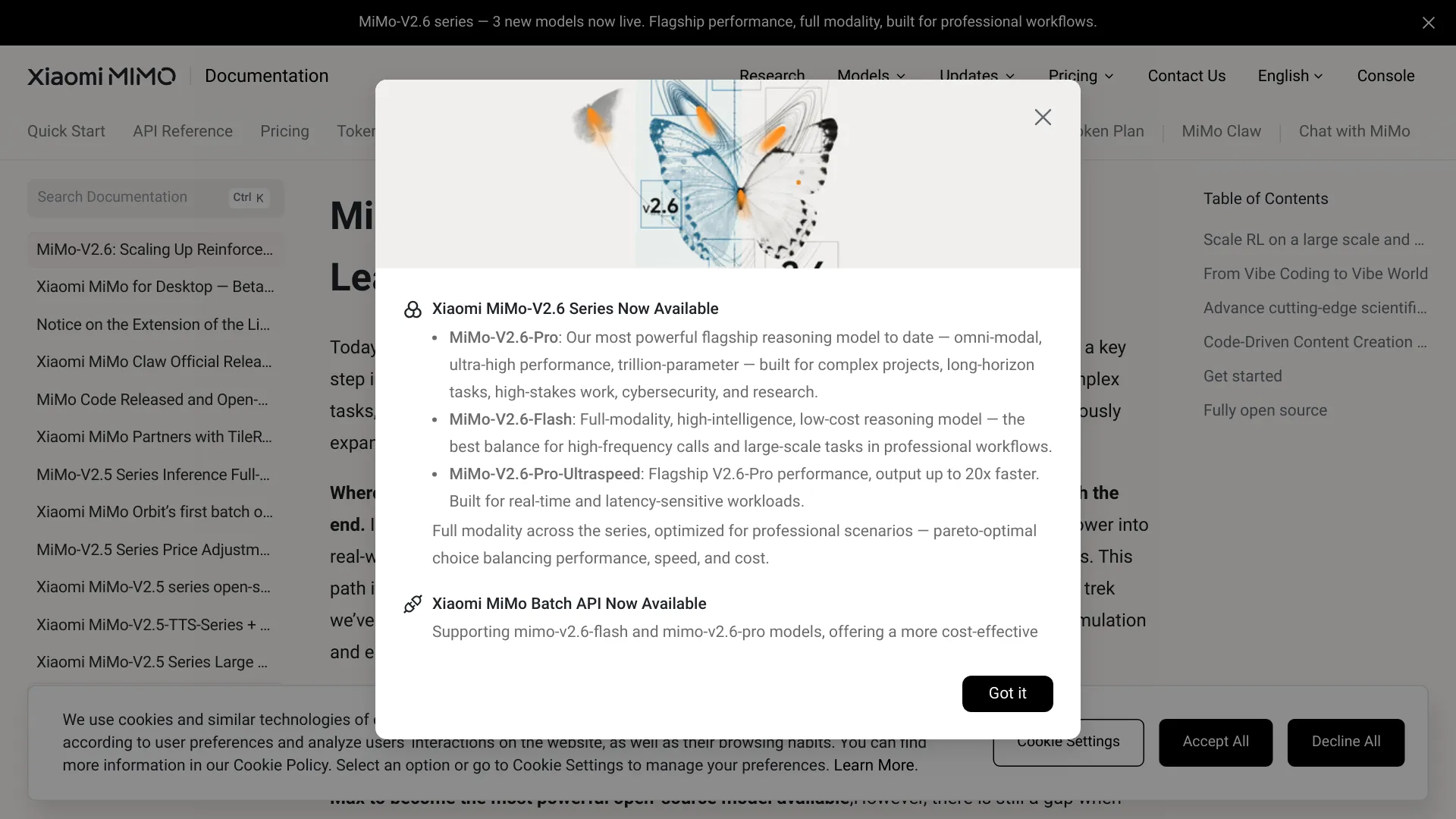
Xiaomi’s official MiMo-V2.6 announcement describes a family rather than a single checkpoint. MiMo-V2.6-Pro is the flagship; MiMo-V2.6-Flash is the smaller efficiency-oriented sibling; and the release also includes a Qwen-based 9B distillation model for reinforcement-learning research.
The Pro checkpoint is an open-weight sparse mixture-of-experts model. The published specifications give it approximately 1.02 trillion total parameters and 42 billion active parameters. Its stated context length is 1 million tokens, and the model is described as natively supporting text, images, video, and audio.
Artificial Analysis lists the Pro license as MIT and says the weights are available for self-hosting. That does not make every hosted API or serving configuration identical: provider limits, implementation details, and operational costs remain separate questions.
The release is also notable for its training story. Xiaomi says one mixed reinforcement-learning process covered coding, general agents, visual tasks, and cybersecurity. OpenLM’s technical summary records Xiaomi’s claims of 1,568 prompts per step and 16 rollouts per prompt, alongside groupwise grading and post-RL distillation.
Where MiMo-V2.6-Pro is genuinely strong
MiMo-V2.6-Pro looks strongest when the job is agentic rather than purely academic coding. In the evaluation table reproduced by OpenLM, Pro scores 53.1 on AutomationBench, compared with 50.3 for Claude Opus 5 and 45.8 for GPT-5.6 Sol. It also scores 89.9 on Terminal Bench 2.1, narrowly above the listed Claude Opus 5 score of 89.1 and GPT-5.6 Sol score of 88.8.
The advantage is not consistent across every test. Pro scores 71.9 on DeepSWE v1.1, below Claude Opus 5 at 74.0 and GPT-5.6 Sol at 73.0. On MiMo VisualCoding it reaches 72.3, behind GPT-5.6 Sol’s 73.4 but ahead of Claude Opus 5’s 70.0.
That pattern supports a specific recommendation: use MiMo-V2.6-Pro as a candidate for tool use, workflow automation, visual coding, and cost-sensitive software agents. Do not describe it as the best model for every coding task when the published ProgramBench score is 26.5 versus Claude Opus 5’s 37.0.
Artificial Analysis adds a practical signal beyond headline benchmarks. Its page reports 129.7 output tokens per second, a 2.17-second time to first token, and a 1M-token context window. Its Model Picker snapshot reports 134 tokens per second and a 20.8-second end-to-end figure, but notes that the snapshot’s index version was not recorded. Treat those numbers as dated measurements, not permanent specifications.
The trade-offs that change the recommendation
The biggest performance warning is unevenness. In the OpenLM table, MiMo-V2.6-Pro scores 34.9 on Terminal Bench 4.0, below Claude Opus 5 at 49.0, GPT-5.6 Sol at 39.9, and Claude Fable 5 at 42.4. On ExploitBench, Pro scores 47.9, far below Claude Opus 5 at 70.0 and GPT-5.6 Sol at 78.5.
Cybersecurity results are especially easy to overread. Pro scores 94.0 on CyberGym, but its ExploitBench score is much lower. A high result on one security suite does not establish broad offensive-security capability.
Early community feedback adds operational caveats that benchmark tables cannot show. The initial X discussion is small because the model launched only hours earlier. One user, @nilansaha, wrote:
“My only complain is its a bit too chatty and takes a good while to take actions.”
Another user, @benjitusk, reported that “mimo-v2.6-pro froze for a good 5 mins.” These are individual early reports, not a measured failure rate, but they are relevant if your agent must act promptly without supervision.
A separate user, @luislucatero21, reported a Pelican SVG test costing $0.05 and taking 6 minutes 9 seconds with MiMo-V2.6-Pro, compared with $1.20 and 14 minutes for Grok 4.7 in that user’s setup. That is a useful cost-and-time anecdote, not a controlled benchmark.
Pricing and deployment: API first, local second
| MiMo-V2.6-Pro API item | Listed price |
|---|---|
| Cache-hit input | $0.0036 per 1M tokens |
| Cache-miss input | $0.435 per 1M tokens |
| Output | $0.87 per 1M tokens |
| Artificial Analysis task estimate | $0.13 per task |
The token prices come from the technical pricing comparison in Brocker’s release analysis, while Artificial Analysis lists the same approximately $0.435/$0.87 standard rates and a 99% cache discount. Cache policy, reasoning-token accounting, and the provider you actually use can change the bill.
The local story is harder. OpenLM’s deployment notes show an SGLang example with --tp 16, --dp 2, --ep 16, a two-node configuration, and a maximum of 128 running requests. The vLLM example uses tensor parallelism of 8 and 95% GPU-memory utilization. Those commands are valuable evidence that self-hosting is possible, but they are not a lightweight consumer setup.
For most teams, the rational order is API pilot first, infrastructure decision second. Measure successful task completion, tool-call delay, output length, retries, and total token cost before buying hardware for a 1.02T-parameter sparse model.
Who should use MiMo-V2.6-Pro now
Choose MiMo-V2.6-Pro for an API pilot when your workload benefits from open-weight availability, multimodal input, long context, or low output pricing. It is particularly attractive for automation-heavy applications where a model can be judged by completed workflows rather than by isolated code puzzles.
Choose it for self-hosting only when you already operate distributed GPU serving and need control over weights or deployment. The MIT license and public checkpoints help, but they do not remove the memory, networking, serving, and observability work shown by the published deployment recipes.
Choose another model—or keep a fallback—when the task is dominated by the hardest terminal environments, offensive-security evaluation, or unattended actions where a five-minute freeze is unacceptable. MiMo-V2.6-Pro’s main unresolved trade-off is clear: its token economics are compelling, but the operational cost of making those savings reliable may be much higher than the API price suggests.
MiMo-V2.6-Pro FAQ
Is MiMo-V2.6-Pro officially released?
Yes. Xiaomi’s MiMo account and official MiMo documentation announced Pro and Flash on September 21, 2026, with open weights and supporting research materials.
Is MiMo-V2.6-Pro open source?
It is distributed as an open-weight model, and Artificial Analysis lists an MIT license. Check the specific checkpoint and provider terms before commercial deployment.
What is MiMo-V2.6-Pro’s context window?
The published specification is up to 1 million tokens. Actual usable context depends on the serving endpoint, prompt structure, and long-context quality on your task.
Is MiMo-V2.6-Pro good for coding?
It is strong for several agentic coding and automation evaluations, including 71.9 on DeepSWE v1.1 and 53.1 on AutomationBench in the published table. It is weaker on ProgramBench and Terminal Bench 4.0 than some closed competitors.
How much does the MiMo-V2.6-Pro API cost?
The listed standard rates are $0.435 per 1M cache-miss input tokens and $0.87 per 1M output tokens, with cache-hit input listed at $0.0036 per 1M tokens. Confirm current provider billing before launch.
Should I use Pro or Flash?
Pro is the higher-capability choice in the published comparison. Flash is positioned as the more efficiency-oriented sibling and costs less in the Brocker pricing table, but you should test latency and task success on your own workload rather than infer the best production choice from the names alone.