 AIREITER
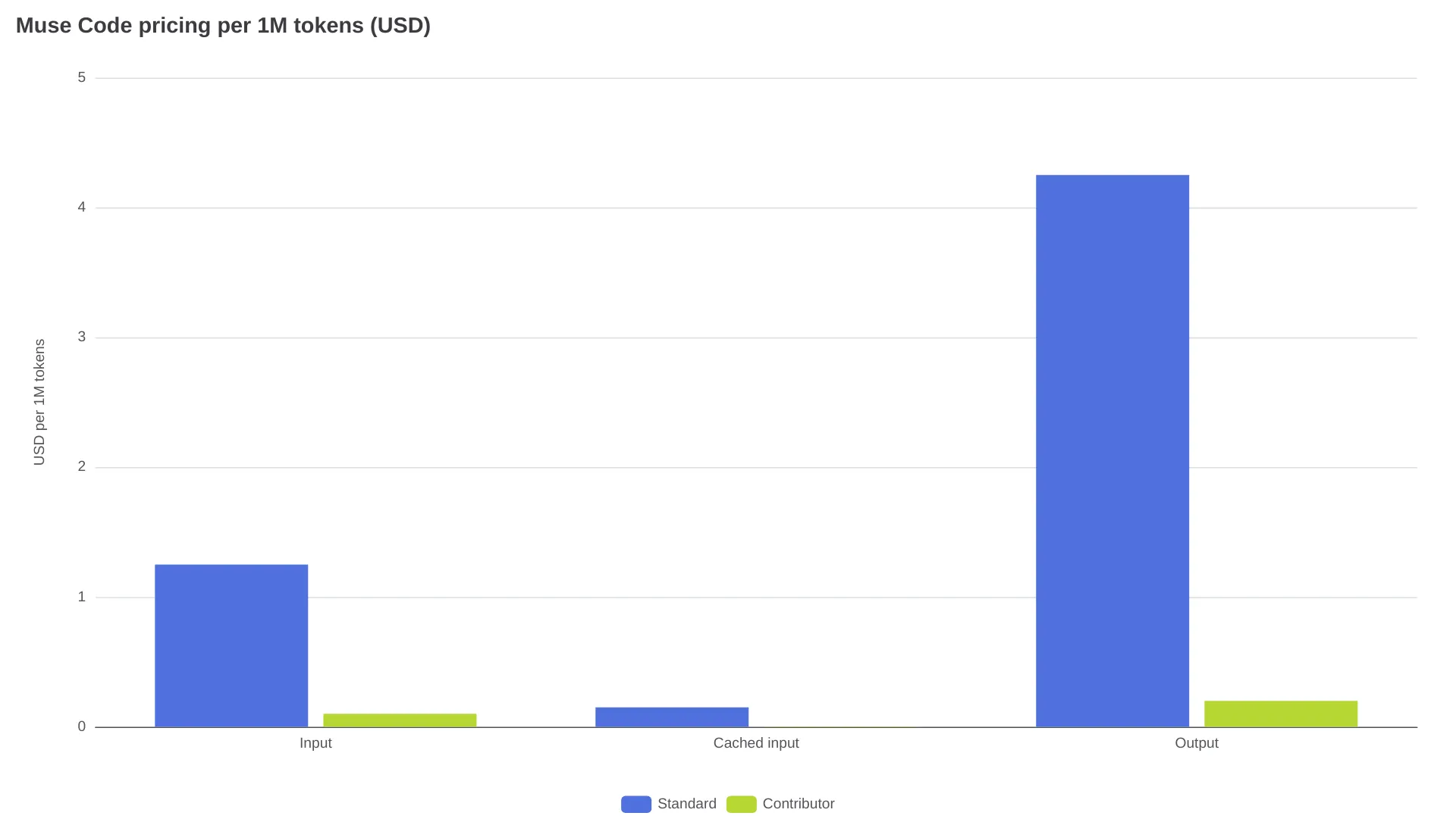
Meta put two price tags on the same model when it shipped Muse Code on August 5, 2026: Contributor tier tokens cost 12.5x less on input and 21.25x less on output than Standard. The catch is not a watermark or a weaker model. It is a data-rights contract plus a throughput ceiling, and the right answer depends on who owns your repository context, not on how much you like discounts. One number frames the whole decision: if your usage would stay under about $20 a month on Standard anyway, the tier choice saves you pocket change; at team scale it becomes a procurement decision.
The two Muse Code tiers, side by side
Muse Code is a beta, terminal-only agent for macOS and Linux, installed with one line (curl -fsSL https://dev.meta.ai/install.sh | bash), and a payment method is required before the first run. There is no dedicated app, no free quota, no monthly plan, and no hard spending cap. Both tiers run the same Muse Spark 1.2 model behind different identifiers (muse-spark-1.2 and muse-spark-1.2-contributor); what changes is price, request throughput, and what Meta may do with your session.
| Per 1M tokens | Standard | Contributor | Gap |
|---|---|---|---|
| Input | $1.25 | $0.10 | 12.5x |
| Cached input | $0.15 | $0.002 | 75x |
| Output | $4.25 | $0.20 | 21.25x |
| Requests per minute | 3,000 | 60 | 50x fewer |
| Tokens per minute | 4M | 2.1M | 47.5% lower |
| Meta data-use label | Not used to improve products | Used to improve products | — |
| Availability | Broad | Some countries | — |
The "up to 20x less" framing in MacRumors' launch coverage is the honest midpoint: per the launch-week rate card, cross-checked by the independent tracker musecode.codes on August 9, Contributor runs 12.5x cheaper on input and 21.25x on output. Beta rates move, so date every estimate. If you need Muse Spark 1.2 through the Meta Model API instead of the CLI, that is a different bill; see our Muse Spark 1.2 API pricing guide.
What the Contributor discount actually buys Meta
Meta's own label is terse: Contributor content is "used to improve products," Standard content is not, and the discount is your payment for that permission — Forbes calls the tier a data-acquisition channel rather than a price cut, since live coding sessions capture builds, test runs, failures, and corrections that scraped public repositories rarely expose.
The scope is wider than "my source code." As wavect's governance analysis documents, the session context can extend beyond source to diffs, terminal output, file maps, background-agent messages, neighboring directories, and commit history. Two first-month field reports show what that looks like in practice:
"I was using muse-contributor to review a coding plan when it suddenly asked to read my secrets .env files." — u/Mission-Salad8835, r/opencodeCLI
"Every time I start a new codebase or make a request after a
compact, the model attempts to read/." — u/lehoang318, r/opencodeCLI
Neither report proves data collection; permission prompts caught the attempts, and one commenter noted other agents do the same exploring. They do show the boundary you are licensing. "An NDA is not consent," as the same wavect guide puts it: Contributor requires that you hold the rights to hand the full session context to a vendor for training use.
The rate limit is the second price
Contributor's 60 requests per minute and 2.1M tokens per minute are the part of the price card that bites teams. Six parallel agents issuing one request every two seconds generate 180 RPM, triple the Contributor ceiling, and ecorpit's analysis expects a single large-repository session to saturate the 2.1M TPM cap on its own.
The irony is structural: persistent parallel subagents are Muse Code's headline feature, and the cheap tier throttles exactly that. Whether you hit the cap depends on your request rate, not your agent count: the six-agent pattern above already triples the request limit, while a single sequential session may stay well below it.
Worked cost math: when the tier choice actually matters
Muse Code's agent loop makes the arithmetic uneven because input dwarfs output and cache absorbs repeats. A cold turn of 60K input and 3K output — the profile Muse Code Guide uses for its cost examples — costs $0.08775 on Standard and $0.0066 on Contributor; cache-warmed, $0.02175 versus roughly $0.0007.
| Workload | Standard | Contributor |
|---|---|---|
| One cold turn (60K in / 3K out) | $0.0878 | $0.0066 |
| 1,000 cold turns | $87.75 | $6.60 |
| Team month, 300M in / 40M out | $545 | $38 |
At 8.8 cents a cold turn, Standard crosses $20 at roughly 230 turns a month, so an intermittent user is choosing between $20 and $1.50. At team scale the workload modeled above saves $507 a month, and the gap widens on cache-heavy loops because Contributor's cached input is 75x cheaper. This arithmetic excludes delivery cost; retries, review time, and regressions are real, which is why agencies piloting the tool track cost per accepted task, not cost per token.
Choosing a tier: a three-question decision table
Price is the last question, not the first. Work through rights, then throughput, then eligibility:
| Your situation | Recommended tier |
|---|---|
| Throwaway prototypes, spikes, hackathon code | Contributor |
| Already-public open source | Contributor (check license and trademarks) |
| Internal tooling, no client or personal data | Contributor, after secrets removal |
| Company product source | Standard by default |
| Client code under NDA | Standard or approved non-training route; written consent required for Contributor |
| Regulated, payments, health, personal-data-adjacent | High-control route; price should not decide |
| Peak request rate above 60 RPM or 2.1M TPM | Standard (the Contributor caps bite first) |
| Contributor not offered in your billing country | Standard, or wait; eligibility is regional and users report confusion about how it is determined |
If you opt into Contributor: four guardrails
- Issue API keys by repository class, not by developer. Permit Contributor keys only for
prototypeandoss; block them forproduct,client, andregulated. Unexpected Contributor-key usage on product code then shows up as a control failure, not a surprise bill. - Enforce boundaries with permissions, not prompts. A "don't read .env" instruction is not access control; deny-rules on secret-bearing paths are. In that same r/opencodeCLI thread, u/e73k ended up having an agent write a plugin that blocks access to
.env, private keys, and cloud credentials. - Cap spend yourself. No hard limit exists on either tier — Muse Code Guide documents no enforced spend ceiling — and account operations are early; one r/ClaudeCode adopter reported "I just keep seeing a billing error" and "there is no way to go into a console and change/fix billing." A low-limit virtual card is the practical brake.
- Verify which tier is active. The two model identifiers are the check:
muse-spark-1.2is Standard,muse-spark-1.2-contributoris the training-permission tier. Log the tier and the date with every cost estimate, because beta rates move.
FAQ
Is there a Muse Code free tier or subscription?
No. Billing is strictly per token on both tiers, a payment method is required before use, and no free quota, monthly plan, or hard spending cap has been published. Light users can stay under a $20 subscription's worth of spend; heavy Standard users can exceed it in days.
Does Muse Code run on Windows?
Not natively. The beta targets macOS and Linux, terminal-only, with no dedicated app. Windows users are currently looking at WSL or waiting.
Is the model different on the Contributor tier?
No. Both tiers run the same Muse Spark 1.2 behind different model identifiers; the differences are price, rate limits, and the training permission. On Meta's published charts the model places second on Terminal-Bench 2.1 at 82.9%, behind Claude Opus 5 — and per the methodology note, each competitor was tested through its own agent product, so read those as system-level results.
How does Muse Code pricing compare with Claude Code or Codex?
Different billing structures. As tracked by Muse Code Guide, Claude Code Pro runs $17–$20/month, OpenAI Codex $8–$20/month depending on plan, Cursor Pro $20, GitHub Copilot Pro $10 (all subscription-based), and the closest per-token comparator is DeepSeek V4-Flash at $0.14 input / $0.28 output per million. Contributor undercuts even that; Standard does not. For a feature-level comparison, see our Codex vs Claude Code breakdown and the current best LLM for coding agents ranking.
How do I check or change which tier I'm on?
Check the model identifier in your config or logs: muse-spark-1.2 versus muse-spark-1.2-contributor is the ground truth, and switching tiers means switching that identifier. Contributor availability varies by country, and an r/opencodeCLI thread shows users outside the US unsure whether eligibility follows IP, account region, or payment country; if the Contributor rates do not appear in your account, confirm eligibility with Meta before planning around them.
Muse Code's Contributor rates sit among the lowest per-token prices in the comparisons above because your session context is the payment: take the discount where you own everything the agent will read, pay Standard where you do not, and set your own spending brake before the first long refactor.