 AIREITER
Most 124-billion-parameter models are slow and costly to serve. Ling 3.0 Flash isn't. It activates only about 5.1B parameters per token, and right now you can run it for free.
inclusionAI shipped it on July 23, 2026 as a hybrid-reasoning Mixture-of-Experts (MoE) model built for agents: coding, tool calling, research, and long-running tasks.
What Ling 3.0 Flash is
Ling 3.0 Flash comes from inclusionAI, the research group behind Ant Group's Ling and Ring model families. (Ant Group is the fintech company behind Alipay.) "Flash" is the fast, cost-efficient tier, sitting below the group's much larger flagship models.
It's a Mixture-of-Experts model: of its 124B total parameters, only ~5.1B fire on any given token. So it runs closer to the speed and cost of a small model.
It's also hybrid-reasoning: it answers directly for simple prompts and switches into a longer thinking mode for hard ones. inclusionAI aims it at "production-scale agents" — workloads that call tools, browse, write and run code, and hold state across many steps.
The efficiency trade that defines it
Line it up against its predecessor, Ling 2.6 Flash. Total parameters went *up* (104B → 124B). Active parameters went *down* (7.4B → 5.1B).
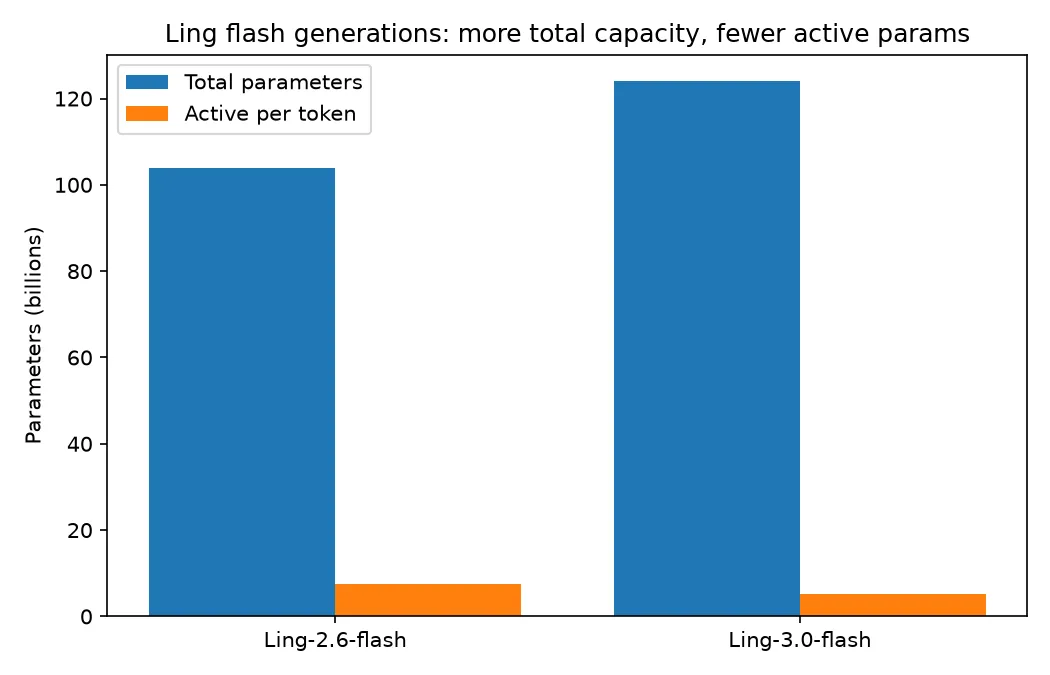
More total parameters means more room to store knowledge. Fewer active parameters means each token costs less to generate. In practice you pay roughly the inference cost of a ~5B model while drawing on 124B of capacity.
That matters most for agents. When a task fires thousands of tokens across many tool calls, per-token cost dominates the bill, so shaving active parameters beats a bigger headline size.
Under the hood is a hybrid linear-attention stack: inclusionAI describes a repeating block of five KDA (linear-attention) layers to one full-attention (MLA) layer. Linear attention keeps long inputs cheap; the periodic full-attention layer preserves the precise recall pure linear models lose. That's what lets Flash run a 256K native context, with headroom toward 1M. (Routers display this as 262K, the exact token count: 262,144.)
What it's built for
Flash is tuned for agentic work, not open-ended chat. inclusionAI's announcement points to higher tool-calling accuracy, steadier long-horizon tasks, and better compatibility with common agent "harness" frameworks. The launch demos fit that: a 3D city in Blender, multi-agent research, Office tasks over MCP, browser apps.
On coding, inclusionAI positions it for spatial and structural reasoning (scene grids, relative positions) on top of standard code generation.
One caveat on benchmarks: the model is days old, so the numbers around are inclusionAI's own claims plus early community tests, not independent evals. inclusionAI says Flash matches or beats its ~1-trillion-parameter flagship on many tasks at a fraction of the active parameters, and its results table lists a SWE-Bench Pro score of 56.63 in thinking mode. Read these as vendor figures until third parties confirm them.
How to try Ling 3.0 Flash free right now
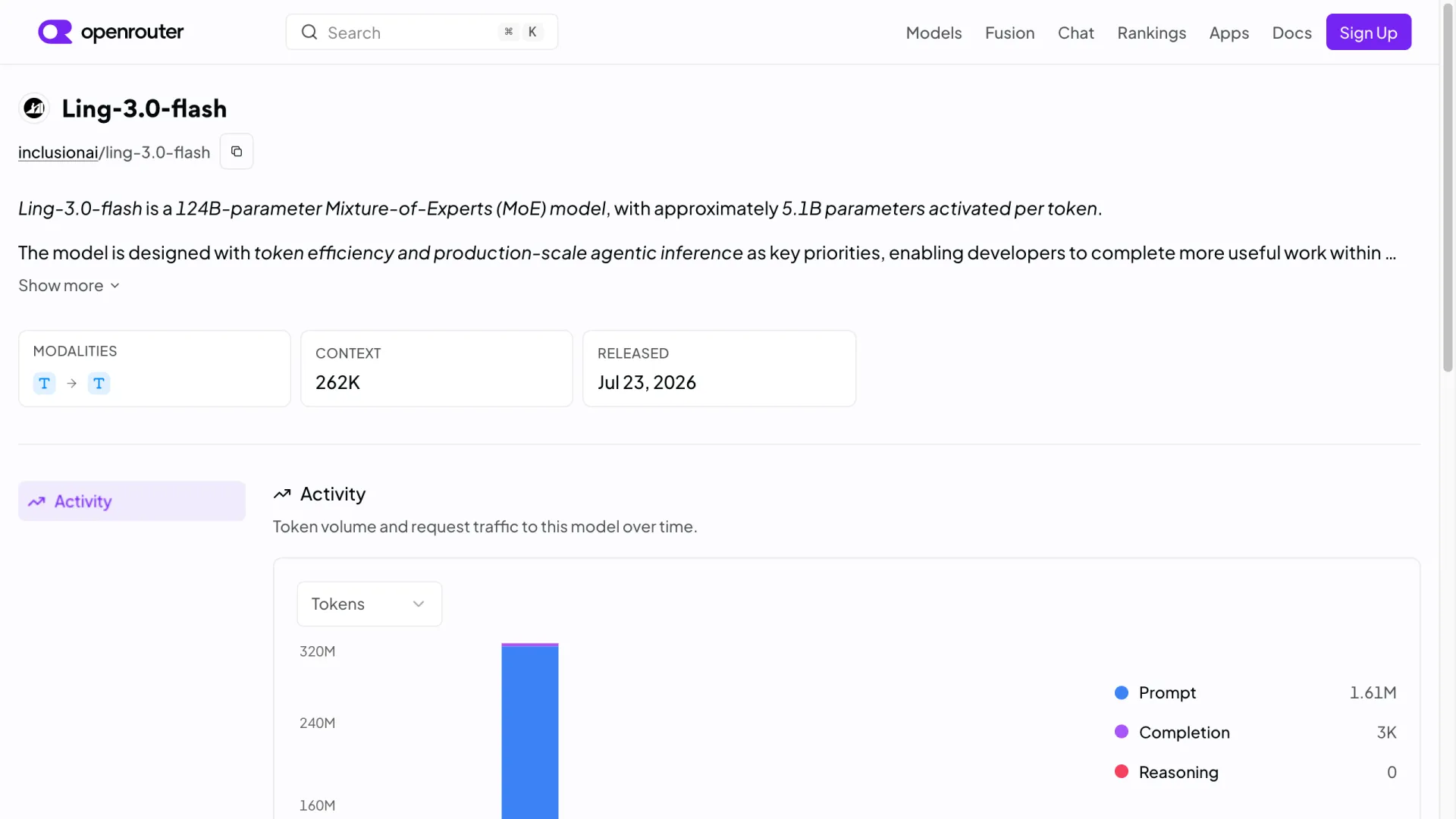
The fastest route is OpenRouter. The model is listed as inclusionai/ling-3.0-flash, priced at launch at $0 in and $0 out, free through August 3, 2026 (pricing checked July 24, 2026). It's also free on ZenMux. Both expose an OpenAI-compatible API.
A minimal call:
curl https://openrouter.ai/api/v1/chat/completions \
  -H "Authorization: Bearer $OPENROUTER_API_KEY" \
  -H "Content-Type: application/json" \
  -d '{
    "model": "inclusionai/ling-3.0-flash",
    "messages": [{"role": "user", "content": "Write a Python function to parse a CSV."}]
  }'
Any client that already talks to chat/completions works after you swap the base URL, key, and model string. A model router also lets you A/B Ling 3.0 Flash against your current model on the same prompts without rewriting anything.
Two things to budget for. The free window is promotional, so expect metered pricing after early August. For reference, the predecessor Ling 2.6 Flash lists at roughly $0.01 in / $0.03 out per million tokens. And at launch a single provider served the model, so throughput and uptime ride on that one backend.
Can you download the weights?
This is where "Ling 3.0 flash download" and "Ling 3.0 flash github" hit a wall. At launch, the weights were not released. Flash is API-only for now.
That's a change from before: Ling 2.6 Flash shipped as open weights on Hugging Face, so you can run it locally today. Flash 3.0, you can't.
If you want to self-host or quantize onto your own hardware, watch the inclusionAI Hugging Face page: the 2.6 weights live there, and a 3.0 drop would land there if the group repeats its pattern. Until then, the API routers above are the only way in.
Ling 3.0 Flash vs Ling 2.6 Flash
| Ling 3.0 Flash | Ling 2.6 Flash | |
|---|---|---|
| Released | Jul 23, 2026 | Apr 21, 2026 |
| Total parameters | 124B | 104B |
| Active per token | ~5.1B | ~7.4B |
| Context window | 256K native (262K on routers) | 256K (262K on routers) |
| Open weights | Not at launch | Yes (Hugging Face) |
| Launch price | Free through Aug 3, 2026 | ~$0.01 in / $0.03 out per 1M |
| Focus | Hybrid-reasoning agents, tool use, coding | Fast instruct model for agents |
Short version: 3.0 Flash trades a slice of active compute for more capacity and a hybrid-reasoning mode, and moves to API-first distribution. If you specifically need local, offline weights, 2.6 Flash is still the one you can download.
FAQ
Is Ling 3.0 Flash free?
Yes, for now. Free on OpenRouter through August 3, 2026, and on ZenMux. Expect metered pricing after the window ends.
Is Ling 3.0 Flash open source? Can I download it or find it on GitHub?
Not at launch. No weights were published, so it's API-only, with no download or repo. Use OpenRouter (inclusionai/ling-3.0-flash) or ZenMux. The older Ling 2.6 Flash is open on Hugging Face, so any 3.0 weights would likely appear there too.
Is Ling 3.0 Flash a Chinese model?
Yes. It's built by inclusionAI, the AI research group tied to Ant Group, the Chinese fintech company behind Alipay.
How big is Ling 3.0 Flash?
124B total parameters, ~5.1B active per token via its MoE design, with a 256K native context that inclusionAI says scales toward 1M.
Ling 3.0 Flash vs Ling 2.6 Flash: which should I use?
Pick 3.0 Flash for hybrid-reasoning agent work and lower per-token cost over the API. Pick 2.6 Flash if you need weights to download and run locally, since 3.0 isn't open yet.