 AIREITER
Fish Audio has the lowest flat public rate for English volume builds in 2026; Inworld can undercut it at committed volume. But neither is the best voice cloning API for live phone agents or governed brand voices. Cartesia wins when sub-100 ms first audio decides whether a caller talks over the bot, and ElevenLabs is the safer pick when a founder or narrator voice must survive months of content — provided you budget for reruns and lock-in. This guide compares eight providers on clone similarity, effective cost, latency, sample needs, and consent controls, using vendor docs, the Hume replication benchmark, and developer production reports. On identity: Fish Audio S2-Pro led the cited short-sample benchmark at 4.03, while ElevenLabs Professional Voice Cloning is the better-documented option for holding identity over months of long-form output.
Cloning fails in production, not in demos
A stock voice only has to sound good; a clone must sound like one specific person across long scripts, agent turns, accents, and phone audio — which is why demos hide reruns and tail latency that only appear at volume. Speaker similarity and voice realism are separate scores. The September 2026 voice-replication benchmark reported by MarkTechPost makes the split concrete — Cartesia Sonic 3.6 Beta scored 4.36 for naturalness but only 3.63 for speaker identity, while Fish Audio S2-Pro led identity at 4.03.
Real deployments add a second split: model latency is not end-to-end delay. ElevenLabs Flash latency is cited near 75 ms model-side in DIY AI's benchmark notes, Cartesia Sonic near 90 ms time-to-first-audio, and Fish Audio around 200–400 ms first byte, but turn detection, STT, LLM time-to-first-token, buffering, and playback can add hundreds of milliseconds. Measure from the end of the user turn to audible playback on the device, not from the vendor dashboard number.
"Eleven labs is the best in terms of speech… Highest cost. Cartesia really good latency but voices are a step behind eleven." — u/jtsaint333 on r/ElevenLabs
Price per accepted minute beats price per character
List prices mislead because billing units differ and failed output still bills. Fish Audio charges $15 per 1 million UTF-8 bytes, which Fish Audio equates to about 12 hours of English speech; English averages one byte per character, while Chinese, Japanese, and Korean average about three, so the same plan costs roughly three times more for CJK scripts. Character plans hide a second tax: reruns. One audiobook builder reported using 20–30% more characters than the book because of pronunciation failures:
"I have probably used 20-30% more characters than the book actually has because their models struggle with pronunciations." — u/gowner_graphics on r/ElevenLabs
Model production cost as effective cost = list cost x language byte multiplier x (1 + rerun rate), plus plan or per-clone fees; stress-test a 20–30% rerun scenario for long-form narration. Do not model production costs from temporary free tiers without an SLA. Clones that cannot be exported add lock-in cost: keep original recordings, consent evidence, and voice-ID logs outside the provider.
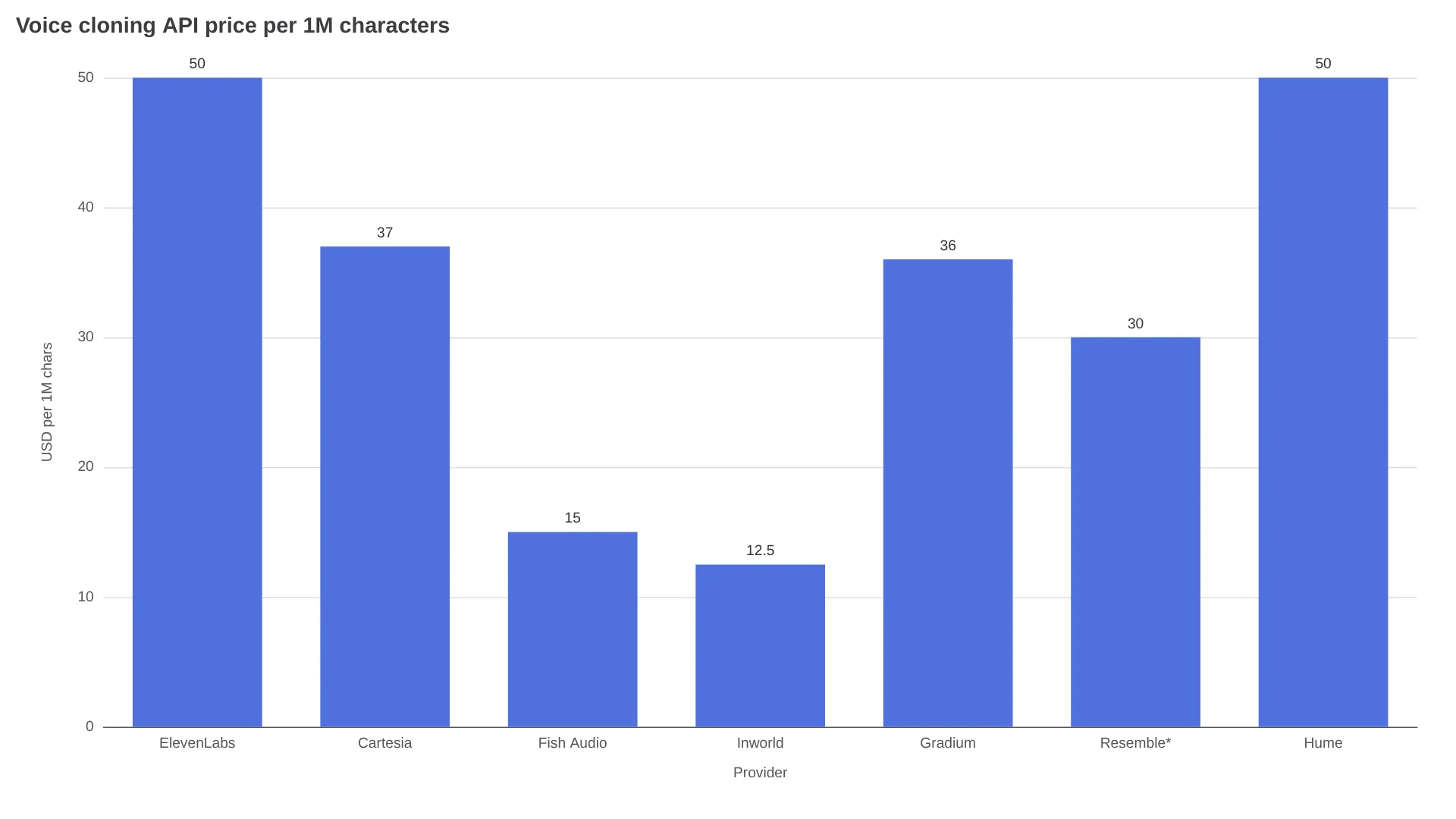
| Provider | Approx. price per 1M characters | Billing note |
|---|---|---|
| Fish Audio | $15 | Per 1M UTF-8 bytes; CJK ~3x English |
| Inworld | $12.50–$25 TTS-2; Flash from $7 at volume | Cloning itself free; volume tiers drop unit price |
| Resemble AI | ~$30 estimated | MarkTechPost converts a $0.0005/sec tracker at ~1,000 chars/min; Business plan gate dominates small apps |
| Cartesia | $37–$50 | $5 for 100K credits to $299 for 8M; 1 credit per character |
| Gradium | ~$58 at XS, less in larger packs | 1 credit per character; XS $13 for 225K credits |
| ElevenLabs | $50 Flash/Turbo to $100 Multilingual v3 | $0.05 per 1K Flash/Turbo; $0.10 per 1K v3 |
| Hume | $50–$150 by plan | $0.15 per 1K Creator down to $0.05 per 1K Business |
| MiniMax | No public per-char rate | Entry from $5/month; check official pricing for volume |
Prices are retail starting-tier rates checked September–October 2026; units differ (bytes/chars/credits/seconds), so treat the ranking as directional.
Best voice cloning API snapshots: same facts, different winners
No single vendor leads similarity, latency, price, languages, and governance at once. OpenAI TTS and Deepgram Aura-2 are omitted because Gradium's 2026 comparison notes neither exposes generally available public voice cloning.
| Provider | Instant sample | Professional clone | Languages | Streaming | Consent / standout control |
|---|---|---|---|---|---|
| ElevenLabs | 1–2 min recommended | 30 min min, 2–3 hr ideal | 70+ | REST + WebSocket | Voice Captcha speaker verification; no clone export |
| Cartesia | 10 sec, up to 60 sec on Sonic 3.6+ | 30+ min training | 44 | REST + WebSocket, <100 ms first byte | Permission required by terms; longer sample retains accents |
| Fish Audio | ~10 sec | 10–180 min + live ownership check | 83 (S2.1 Pro) | WebSocket, 200–400 ms | Live ownership check for pro clones; Apache-2.0 self-host |
| MiniMax | 10 sec | Professional tier available | 50+ | Real-time API | Authorization confirmation on upload; Asian-language fidelity |
| Inworld | 3–30 sec | 10 min beta, English-only | 200+ locales (15 high-quality) | Streaming TTS | Rights confirmation; cheapest at volume |
| Gradium | 10 sec | 30 min min, 2 hr recommended; M plan $340/mo | 5 (EN/FR/DE/ES/PT) | WebSocket multiplexed | Owner consent required by policy; 5 free clones |
| Resemble AI | 10 sec Rapid, <1 min | 10–25+ min, ~40 min training | 23 | HTTP + WebSocket | Verifiable consent; per-output watermarking, on-prem option |
| Hume | 15 sec min | Not documented | 11 | API on Enterprise | Consenting-speaker upload; emotion-directed delivery |
Coqui XTTS, Bark, and Fish S2 weights are a separate self-hosted option outside these eight managed APIs.
ElevenLabs: long-form identity survival
Documented choice when identity must survive audiobooks, dubbing, or branded narration. Instant Voice Cloning needs a short sample, while Professional Voice Cloning adds fine-tuning plus a Voice Captcha where the speaker reads on-screen text. Tradeoff is price, tier-gated pro features, and platform lock-in.
Cartesia: live phone agents
Sub-100 ms first byte matters when callers interrupt, and extending the sample toward 60 seconds on Sonic 3.6+ helps preserve accents. Catalog is narrower at 44 languages, and non-English custom voices draw mixed reports, including Hindi custom-voice issues in a production comparison thread.
Fish Audio: high-volume and self-hosted
S2-Pro led the cited identity benchmark, paid TTS stays flat at the byte rate, and S2 weights under Apache-2.0 run on a single RTX 4090-class GPU for air-gapped deployment. Budget separately for CJK bytes and consent review, since it publishes fewer governance details than ElevenLabs or Resemble.
MiniMax, Inworld, Gradium: the value tier
MiniMax Speech 2.6 suits multilingual video pipelines with strong Mandarin/Japanese/Korean fidelity. Inworld is cheapest at committed volume for agents, with free instant cloning and Flash falling toward $7 per million at higher tiers. Gradium fits European-language agent prototypes needing a free cloning tier and real-time WebSocket multiplexing.
Resemble AI, Hume: governed and emotion-led
Resemble suits governed enterprise systems needing verifiable consent, per-output watermarking, and deployment control, but the cloning API requires Business access or higher. Hume suits emotion-directed delivery, but cloning API access is Enterprise-only and the 15-second minimum breaks strict 10-second flows.
Avoid starting new builds on PlayHT for cloning. Historical benchmarks still circulate with strong scores, but DIY AI's August 2026 availability check reported the PlayAI service as shut down while older docs remain indexed. Treat any PlayHT pricing found in search as migration reference, not availability proof.
Integration checklist before you commit
Audio quality does not predict API completeness. Confirm these seven items in docs and a trial project before pointing production traffic at a clone.
- Clone creation and use are both API-accessible on your plan tier, including instant, professional, and speech-to-speech paths if needed.
- Streaming semantics match the workload: warm WebSocket, word- or clause-level chunking, interruption and cancellation, and documented p50/p95 time-to-first-audio.
- Voice slots, character quotas, concurrency, and rate limits fit user-generated-voice scale; per-clone charges can dominate when every user brings a voice.
- Consent records are storable and auditable: who authorized the clone, when, and for which monetized uses.
- Commercial rights, watermarking, and abuse prevention are explicit; Resemble-style watermarking and ElevenLabs-style speaker verification are the strongest patterns.
- Deletion and retention are tested: what happens to source recordings and trained clones after delete.
- Portability is planned: original clean recordings stay with you because some clones cannot be exported.
A unified voice route through one API key normalizes voice IDs, streaming and cancellation events, fallback behavior, and billing, which cuts switching cost when promotions expire or byte-versus-character math changes.
Test any two APIs with your own voice in one afternoon
Run the same blind protocol on your two finalists instead of trusting cross-vendor leaderboards. Record one 10-second clean WAV clip in a quiet room, plus one 60-second clip for accent testing. Synthesize the same two sentences everywhere: one conversational line and one line with numbers and a proper name. Hide provider labels, have two listeners rank identity match, then retest the winner on a 500-word script and a simulated 16 kHz phone clip. Log clone creation time, time-to-first-audio, full-sentence time, and end-to-end conversational delay with concurrency of at least five streams, and note p95 rather than average. The provider that survives noisy input, long-form drift, and interruption handling is the production winner, even if it loses the single-sentence beauty contest.
FAQ
What is the cheapest voice cloning API in 2026?
Lowest flat public rate is Fish Audio at $15 per 1M UTF-8 bytes; cheapest at committed volume is Inworld Flash toward $7 per million. Add a rerun buffer and check CJK multipliers and plan gates.
Which API has the lowest latency for phone agents?
Cartesia Sonic with sub-100 ms first-byte streaming. Confirm full-pipeline delay with STT and LLM in the loop.
How much audio is needed to clone a voice?
Most instant paths start at 10 seconds (Inworld 3–30, Hume 15). Professional paths range from ~10 minutes to several hours by provider; ElevenLabs, Cartesia, and Gradium need 30 minutes minimum.
What is the difference between instant and professional voice cloning?
Instant cloning adapts immediately from seconds of audio for prototypes and user-generated voices. Professional cloning fine-tunes a dedicated model for flagship voices that must stay consistent for months.
Can a cloned voice be used commercially?
Depends on speaker permission plus provider plan. Fish Audio commercial use starts on Plus, ElevenLabs pro clones need speaker verification, Resemble needs verifiable consent. Verify plan terms: Gradium and Hume both mark free tiers non-commercial.
Final pick by workload
| Workload | Pick | Why |
|---|---|---|
| Audiobooks, dubbing, branded narration | ElevenLabs or Fish Audio | Identity survival and expressiveness; Fish if volume dominates |
| Live phone agents | Cartesia | Sub-100 ms first byte and interruption handling |
| High-volume multilingual agents | Fish Audio or Inworld | Flat byte pricing or volume-tier Flash pricing |
| Asian-market video localization | MiniMax | 10-second cloning and CJK fidelity at $5 entry |
| Governed enterprise voice | Resemble AI | Consent records, watermarking, on-prem control |
| EU 5-language prototype | Gradium | Free cloning tier plus real-time WebSocket |
| Emotion-led characters | Hume | Octave direction controls; verify Enterprise API access first |