 AIREITER
GLM-5.2 sits at #2 on Arena's Code Arena Frontend board (1,595 Elo) and within a point of Claude Opus 4.8 on FrontierSWE, yet it is still the model people are actively trying to leave. The reason is rarely capability. Since the June 2026 launch, the developer threads quoted below keep surfacing the same three walls: coding-plan quotas that evaporate mid-task, peak-hour errors, and an appetite for tokens that makes the $1.40/$4.40 sticker price misleading in long agent loops. The best GLM-5.2 alternative depends entirely on which of those walls you just hit.
Quick picks: the best GLM-5.2 alternative for each reason
Five verdicts up front, with the evidence further down:
- Quota burn / cost per agent loop: DeepSeek V4 Flash, at $0.14/M input, $0.28/M output, 1M context.
- Unstable agent loops: Kimi K2.7 Code, at $0.95/M in, $4.00/M out.
- Ceiling on the hardest tasks: Claude Opus 4.8, with double GLM-5.2's SWE-Marathon score, at closed-model pricing.
- Self-hosting or data control: Qwen3-Coder (Apache 2.0), or GLM-5.2's own MIT weights if you have 372–475 GB of RAM for a 4-bit build.
- Nothing's wrong; you want newer: GLM-5.3 at the same $1.40/$4.40 pricing, confirmed by Z.ai on launch day.
What GLM-5.2 gets right, and what it costs to run
The official Z.ai documentation lists GLM-5.2 as a text-only flagship with a 1M-token context window, 128K max output, and API pricing of $1.40/M input, $4.40/M output, $0.26/M cached input. The weights are MIT-licensed, released June 16, 2026 after a June 13 rollout that initially gated the model behind the GLM Coding Plan. On the model card: Terminal-Bench 2.1 at 81.0 (Opus 4.8: 85.0), SWE-bench Pro at 62.1 (Opus 4.8: 69.2), FrontierSWE at 74.4 vs 75.1.
Those numbers sit at the closed frontier's edge, at open-weight prices. The operational layer is where users report pain. The Coding Plan's Pro tier went from under $35 to $65/month around the 5.2 launch, a jump @bridgemindai documented the day it happened. Quotas inside the plan draw harder complaints than the price tag:
"GLM 5.2 will end your weekly rate limit in a day." — u/intl_spy, r/opencode
"I like GLM-5.2, but my god it is a token muncher." — @atomtanstudio
One developer running self-evolving agents on GLM-5.2 for real work reported burning $500+ in a single weekend, noting that switching models mid-run drops the KV cache and forces re-paying for the same context (@Xianbao_QIAN). Another put the ceiling on the whole value proposition plainly:
"GLM 5.2 is great but my $200/m Codex sub still gets me more usage for $200 of GLM 5.2 API usage. It's a great supplemental model... but not a replacement by any means." — @mweinbach
Add peak-hour capacity problems: @gengdaJ, a plan subscriber since GLM-4.5, describes evening servers "exploding" and falling back to older models. That is the full picture of why "GLM-5.2 alternatives" gets searched by people who like the model.
The alternatives, priced and matched to symptoms
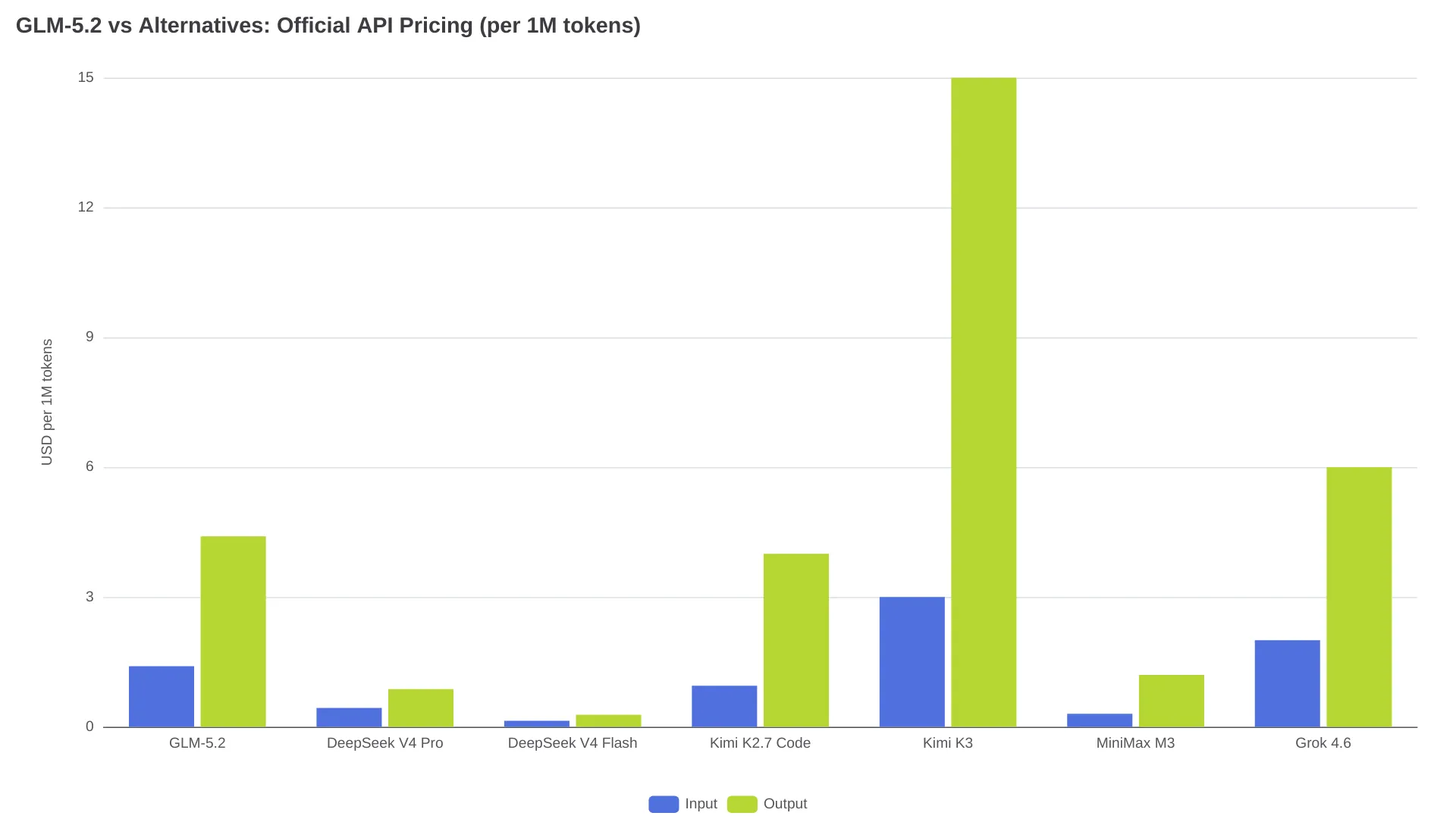
Every price below is from the vendor's own pricing page, pulled August 2026. Kimi K3 and MiniMax M3 prices are cache-miss input; their cache-hit tiers are far cheaper.
| Model | Context | Weights / license | API price ($/1M, in / out) | Switch if… |
|---|---|---|---|---|
| GLM-5.2 (baseline) | 1M | MIT | $1.40 / $4.40 | — |
| DeepSeek V4 Pro | 1M | Open (MIT, per Layer3 Labs) | $0.435 / $0.87 | You want cheaper hard reasoning at the same context size |
| DeepSeek V4 Flash | 1M | Open | $0.14 / $0.28 | Quota burn is the whole problem |
| Kimi K2.7 Code | 256K | Open (Modified MIT) | $0.95 / $4.00 | Agent-loop reliability matters more than context size |
| Kimi K3 | 1M | Closed | $3.00 / $15.00 | You need Kimi stability and 1M context |
| MiniMax M3 | 1M | Closed | $0.30 / $1.20* | Multimodal input or high-volume, price-sensitive work |
| Qwen3.8 Max / Qwen3-Coder | 1M | Apache 2.0 | Weights free; hosted varies | Self-hosting or fine-tuning is the goal |
| Grok 4.6 | 500K | Closed | $2.00 / $6.00 | Speed and a large-but-manageable context |
Beyond these seven, two upgrade paths appear below: Claude Opus 4.8 for teams that keep failing the hardest tasks, and GLM-5.3 for same-price, same-family upgrading.
\* MiniMax M3's tier applies to inputs ≤512K tokens; pricing doubles above that threshold. GLM-5.3 carries identical pricing to GLM-5.2 per Z.ai's launch announcement, so it's omitted from the cost comparison.
Symptom-by-symptom: which model to switch to
Quota burn: route the loop through DeepSeek V4 Flash
The arithmetic is stark. On cache-miss input, GLM-5.2 at $1.40/M costs 10x DeepSeek V4 Flash's $0.14/M; on output, $4.40 vs $0.28 is a 15.7x gap. For the implementation leg of an agent loop (file edits, test fixes, boilerplate) that difference compounds on each turn, and DeepSeek exposes the same 1M-token context with a 384K max output. V4 Pro at $0.435/$0.87 keeps most of the discount while targeting the harder reasoning runs; our GLM-5.2 vs DeepSeek V4 Pro breakdown covers where each wins, and the V4 Flash head-to-head covers the budget tier.
The pattern OpenCode Go subscribers converged on is a split, not a switch: GLM-5.2 for planning and review, a cheaper model for the grind. "I use OpenCode Go GLM 5.2 for planning only," writes u/narkeeso; u/Endoky in the same ecosystem puts it as "only use GLM 5.2 as escalation model or for planning."
Unstable agent loops: Kimi K2.7 Code
When the problem is service rather than capability, Kimi is the alternative named in the threads we reviewed. One user's summary, originally posted in Chinese:
"The model capability is about the same, but the inability to serve it stably is why I chose Kimi over GLM." — @wonjder
Kimi K2.7 Code is the coding-specialist pick: $0.95/M in, $4.00/M out ($0.19/M on cache hits), with a 262,144-token context, a quarter of GLM-5.2's window, and that is the real trade. It accepts text, image, and video input, so it also covers the multimodal gap GLM-5.2 leaves open as a text-only model. If 256K can't hold your repository, Kimi K3 offers the 1M window at $3.00/$15.00. Note that $15 output is 3.4x GLM-5.2's rate, so K3 is a stability purchase, not a savings. The Kimi K2.7 Code vs GLM-5.2 comparison has the benchmark side.
A higher ceiling on the hardest tasks: Claude Opus 4.8
On SWE-Marathon (compiler builds, kernel work, multi-hour autonomous jobs) Opus 4.8 scores 26.0 against GLM-5.2's 13.0; on NL2Repo it's 69.7 vs 48.9, per Z.ai's model card. GLM-5.2 remains the highest-ranked open model on both boards, per the same model card, but the gap widens exactly where tasks get longest. Opus is closed-source, can't be self-hosted, and carries premium pricing; the GLM-5.2 vs Opus comparison details when that premium pays for itself.
Self-hosting or data control: Qwen3-Coder, or GLM's own weights
Qwen3-Coder and Qwen3.8 Max ship under Apache 2.0 with 1M-token context, plus compact variants sized for single-GPU serving; both Layer3 Labs and glm5.app list them as the self-hosting pick. For fine-tuning and private deployment, they are the practical choice among these alternatives; our Qwen 3.8 Max open-weights writeup covers the family.
The counterintuitive option is self-hosting GLM-5.2 itself, since the MIT license permits it. The physics are unfriendly: BF16 weights occupy 1.51 TB, and even a 4-bit quantization from Unsloth's GGUF release needs 372–475 GB of memory to load. In practice, a 4-bit build is multi-GPU-server territory, full BF16 is cluster-scale, and local tooling is young: llama.cpp only gained GLM-5.2's indexer support on July 24, 2026 (PR #25407). Self-hosting GLM-5.2 is a data-sovereignty move, not a convenience move; without the cluster, Qwen's compact variants are the workstation-class alternative.
Multimodal and cheap throughput: MiniMax M3
MiniMax M3 pairs a 1M context with multimodal input at $0.30/M in and $1.20/M out (the ≤512K tier; both figures double past that threshold, so budget accordingly). For team budgeting, MiniMax's token plans run $20/$50/$120 a month across the company's M3, M2.7, image, and speech lineup, with quota metered in 5-hour rolling and weekly windows.
Speed-first: Grok 4.6
Grok 4.6 lists at $2.00/M in, $6.00/M out with a 500K context. xAI's API page claims industry-leading coding and tool-calling without publishing the benchmark table, so treat positioning as positioning. The user-level signal is real though: @bourneliu66 argues GLM's slot in his "big three" was taken by Grok, stronger, faster and cheaper in his words. Verify against your own workload before accepting that ordering.
Nothing is broken; you want the newest GLM: GLM-5.3
GLM-5.3 hit the API on August 18, 2026 at the same price as GLM-5.2, per Z.ai's announcement. If your reason for browsing alternatives is upgrade anxiety rather than pain, the GLM-5.2 vs GLM-5.3 comparison covers what actually changed.
The split-stack pattern: keep GLM-5.2, demote it
A recurring landing spot in the threads above isn't a full migration. It's GLM-5.2 demoted to planner/reviewer while a cheaper model executes. That matches the model's shape: Z.ai positions it for long-running engineering-agent work, and it is the most expensive per token in the budget tier.
Two mechanics make or break the split. First, KV-cache loss: any mid-run switch between models, or between providers of the same model, re-pays the context. Second, provider variance: users in r/opencodeCLI report large speed gaps between Fireworks, NeuralWatt, and OpenCode Go serving the same model.
A single OpenAI-compatible endpoint handles the operational half: you keep one GLM-5.2 API request shape across both legs, reroute when a provider degrades, and settle one bill. It does not make context free; cache reuse never transfers across models or providers, the cost behind the $500 weekend report, so route at task boundaries, not mid-run. If your split lives inside Claude Code, our GLM-5.2 in Claude Code guide covers the harness side.
The 30-second decision table
| Your symptom | Pick | What you give up |
|---|---|---|
| Weekly quota gone in a day | DeepSeek V4 Flash | Some agentic-coding polish vs GLM |
| Agent loops die on provider errors | Kimi K2.7 Code | 1M context (256K instead) |
| Hardest multi-hour tasks fail | Claude Opus 4.8 | Open weights, low pricing, self-host |
| Need weights on your own metal | Qwen3-Coder | GLM's Elo-leading frontend coding |
| Token muncher on general work | MiniMax M3 | Past 512K input, prices double |
| Regulated or procurement-bound | Self-hosted Qwen or GLM weights | Managed convenience |
| You want the newest GLM | GLM-5.3 | Nothing; same price |
FAQ
What is the best GLM-5.2 alternative overall?
DeepSeek V4 Pro is the closest all-around substitute: 1M context, open weights, 3-5x cheaper per token. Kimi K2.7 Code is the better pick when reliability in long agent runs matters more than the benchmark delta.
Is DeepSeek better than GLM-5.2 for coding?
For hard algorithmic reasoning, glm5.app's comparison ranks DeepSeek V4 Pro ahead; for long-horizon, multi-file agentic work, GLM-5.2's 1M context and long-horizon agent training (Z.ai's stated specialization) keep it in front. In practice: DeepSeek executes, GLM plans.
What is the cheapest GLM-5.2 alternative?
DeepSeek V4 Flash at $0.14/M input and $0.28/M output, with cache-hit input at $0.0028/M, effectively free for repeated context.
Which alternatives match GLM-5.2's 1M-token context?
DeepSeek V4 Pro and V4 Flash, Kimi K3, MiniMax M3, and Qwen3.8 Max all list 1M-token windows. Kimi K2.7 Code (256K) and Grok 4.6 (500K) don't.
Can you run GLM-5.2 locally instead of switching?
Technically yes (MIT weights exist), but a 4-bit build needs 372–475 GB of RAM and llama.cpp support only merged on July 24, 2026. For most teams, hosted API access is the only practical route.
What do GLM-5.2 alternatives cost per month on subscription?
MiniMax token plans run $20–$120/month. Kimi's Code CLI starts at $19/month and Z.ai's Coding Plan at $18/month, per Digital Applied's pricing coverage, with the Z.ai Pro tier at $65 since the June increase.