 AIREITER
Can Google's cheapest 3.5-generation model replace a Pro model that costs 6.7x more per input token? I ran the same four prompts through gemini-3.5-flash-lite and gemini-3.1-pro-preview on July 23, 2026: correctness tied, the bill differed 25x, and the one mistake Flash-Lite made is exactly the kind that breaks production pipelines. (Weighing the mid-tier Flash instead? That matchup is in our Gemini 3.5 Flash vs Gemini 3.1 Pro comparison.)
Same four prompts, head to head: what actually happened
Identical prompts, same OpenAI-compatible API route, every answer scored programmatically: 8 local test cases for the code task, a strict schema for the extraction.
| Task | Flash-Lite | 3.1 Pro | Winner |
|---|---|---|---|
| Python ISO-8601 duration parser (8 test cases) | 8/8, 3.7s | 8/8, 38.2s | Tie on correctness |
| Strict JSON extraction from a messy email | Correct fields, wrapped in markdown fences, 1.0s | Correct, bare JSON, 9.8s | Pro |
| Percentage logic trap (answer: 50) | Correct, 1.8s | Correct, 10.6s | Tie |
| Code review with 3 planted flaws | Found 2 of 3 + one unplanted find, 3.7s | Found 2 of 3 + one unplanted find, 30.2s | Tie |
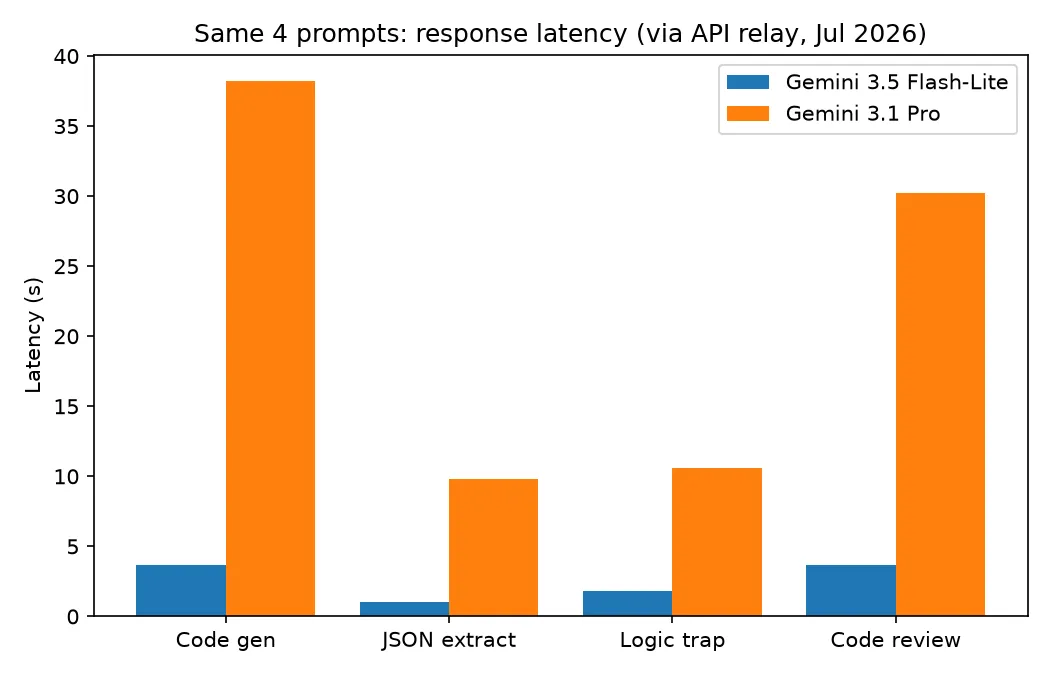
Both models produced a fully correct duration parser. Both caught the SQL injection, the mutable-default-argument cache, and the inefficient filtering in the code review — and both missed the same naive-datetime timezone bug I had planted. On these four everyday tasks, correctness was identical.
Two caveats. This is a spot check plus the 30-call trial below, not a benchmark suite. And one Pro call returned a spurious refusal on the harmless code-review prompt and needed a retry — possibly relay noise rather than the model, but budget for retries either way.
Where Flash-Lite breaks
The format-discipline slip
The extraction prompt said "Return ONLY the JSON object." Pro returned bare JSON. Flash-Lite returned the right data wrapped in ``json fences, which means a downstream json.loads()` call crashes until you add a stripping step.
One slip could be noise, so I measured it: 30 extraction calls per model across 10 distinct support emails, scored programmatically for bare-JSON compliance and schema validity. Flash-Lite passed 29 of 30 (96.7%), with exactly one fenced response; 3.1 Pro passed 30 of 30. Content accuracy was not the issue in the single failure — the fields were right, the packaging was wrong.
Format discipline is precisely what Google is selling this model for: the official Flash-Lite page positions it as "best for low-latency and high throughput agentic tasks." A 3.3% slip rate sounds tolerable until you compound it: an agent loop that calls the model 20 times per job hits at least one bad response in roughly half of all runs (1 − 0.967²⁰ ≈ 0.49). If you route structured-output work to Flash-Lite, wrap it in a validator with one retry: at a 3.3% failure rate, one retry drops the residual to about 0.1% per call, and every failure in my runs was packaging, never content.
What Pro still owns
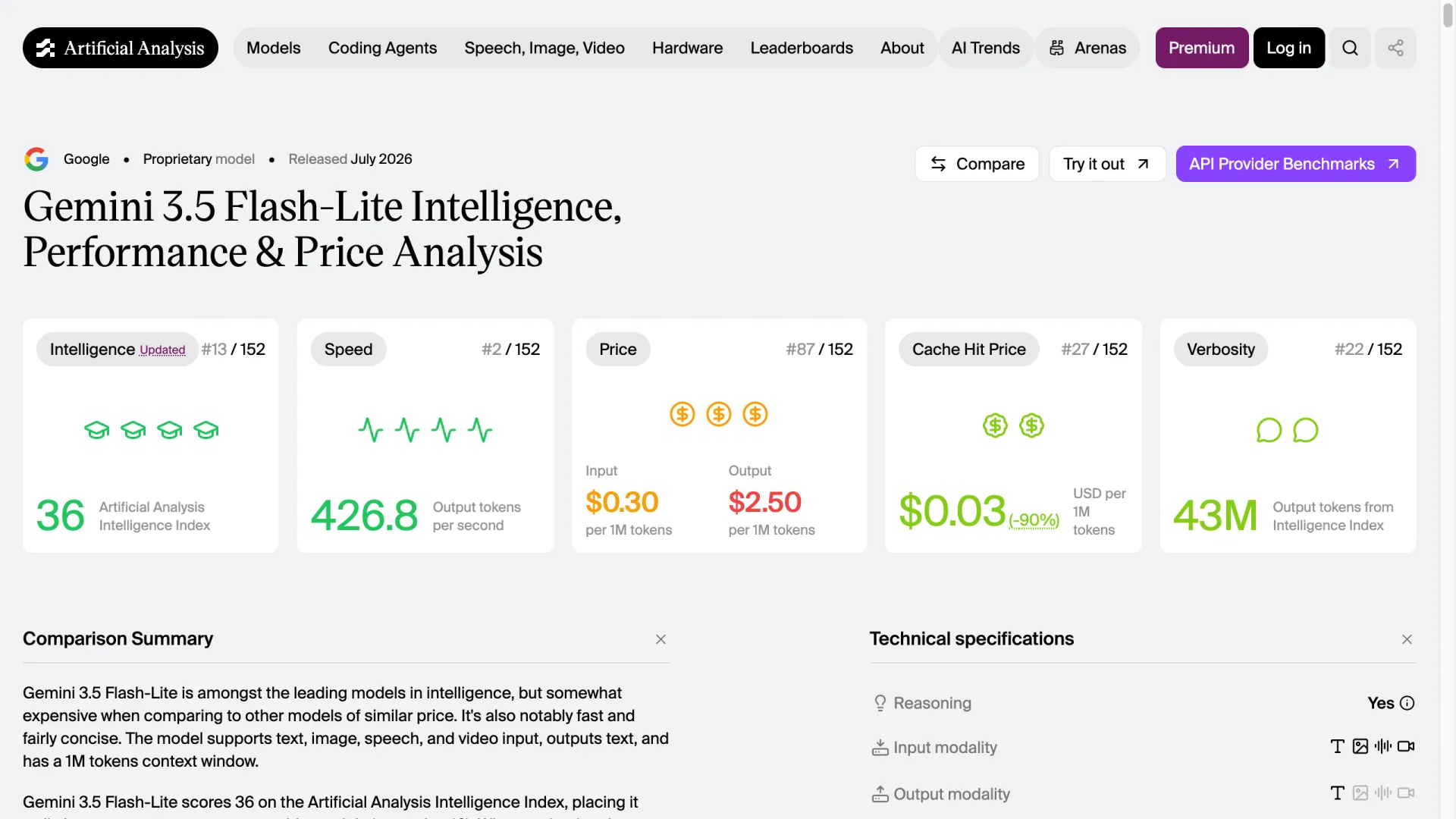
The four tasks above sit inside Flash-Lite's comfort zone: short context, well-specified, single-shot. Community reports from the week since release draw the boundary fairly consistently. Users on r/GeminiAI who work with long documents report Pro holding character and plot consistency where smaller Gemini models drift. Independent index data points the same direction: Artificial Analysis scores 3.1 Pro at 46 on its Intelligence Index versus 36 for Flash-Lite, with the gap concentrated in multi-step reasoning evals rather than in coding or extraction. The same tracker ranks Flash-Lite #2 for output speed among all 152 models it follows, against #13 on intelligence: a profile that says specialist, not general replacement.
My own harder task hinted at the ceiling too: neither model caught the timezone bug. Flash-Lite matching Pro does not mean Flash-Lite is Pro. It means both have blind spots, and you pay 25x for Pro's marginally deeper ones at your own risk.
So the practical boundary: tasks needing a model to re-plan mid-task, hold 50k+ words coherent, or make judgment calls with expensive failure modes still justify Pro. Everything template-shaped does not.
The real bill: 25x, not 4.8x
The pricing pages say Pro output costs 4.8x more than Flash-Lite ($12 vs $2.50 per million tokens). My measured spend across the four tasks: about $0.005 for Flash-Lite and $0.13 for Pro, a 25x gap (Lite billed roughly 570 input / 2,020 output tokens in total; Pro 1,700 / 10,386, at list prices).
The multiplier is thinking tokens. Gemini 3.1 Pro reasons before answering, and Google bills that reasoning as output. On the parser task, Pro emitted 5,125 output tokens, and 4,811 of them (94%) were thinking. Flash-Lite answered the same prompt in 819 tokens flat. Across all four tasks, thinking made up 84% of everything Pro billed me for.
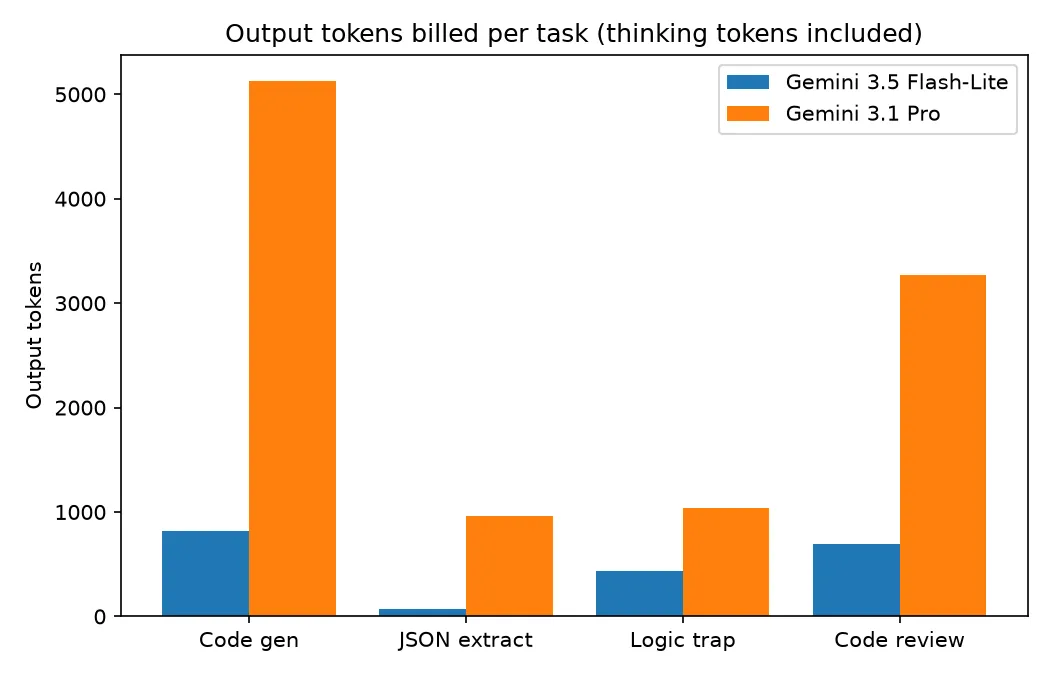
The 30-call extraction trial made the gap wider, not narrower, because short outputs maximize the thinking overhead ratio. Flash-Lite completed all 30 calls on 1,899 output tokens and about $0.006 total; Pro billed 29,468 output tokens — 27,636 of them (94%) thinking — for about $0.38, a 65x gap on this workload. Scaled to a million extraction calls a month, that is the difference between a $190 line item and a $12,500 one.
This is not a quirk of my small sample. The team behind the Tessl coding benchmark ran roughly 3,300 coding-agent tasks and found Gemini 3.1 Pro ending up *cheaper* than the reasoning-heavy Gemini 3.5 Flash despite higher list prices: same mechanism, opposite direction. Artificial Analysis's cost-to-run-index numbers show the same inversion. The rule this teaches: compare models on measured cost per completed task, not on the per-token price sheet.
Specs and pricing, verified July 23, 2026
From Google's official Gemini API pricing page:
| Gemini 3.5 Flash-Lite | Gemini 3.1 Pro (≤200k ctx) | |
|---|---|---|
| Input / 1M tokens | $0.30 | $2.00 ($4.00 above 200k) |
| Output / 1M tokens (incl. thinking) | $2.50 | $12.00 ($18.00 above 200k) |
| Batch tier | $0.15 / $1.25 | $1.00 / $6.00 |
| Context caching | $0.03 | $0.20 |
| Context window | 1M in / 64k out | 1M in / 32k out |
| Output speed (Artificial Analysis) | 426.8 tok/s | 112.2 tok/s |
| Status | GA, gemini-3.5-flash-lite | Preview, gemini-3.1-pro-preview |
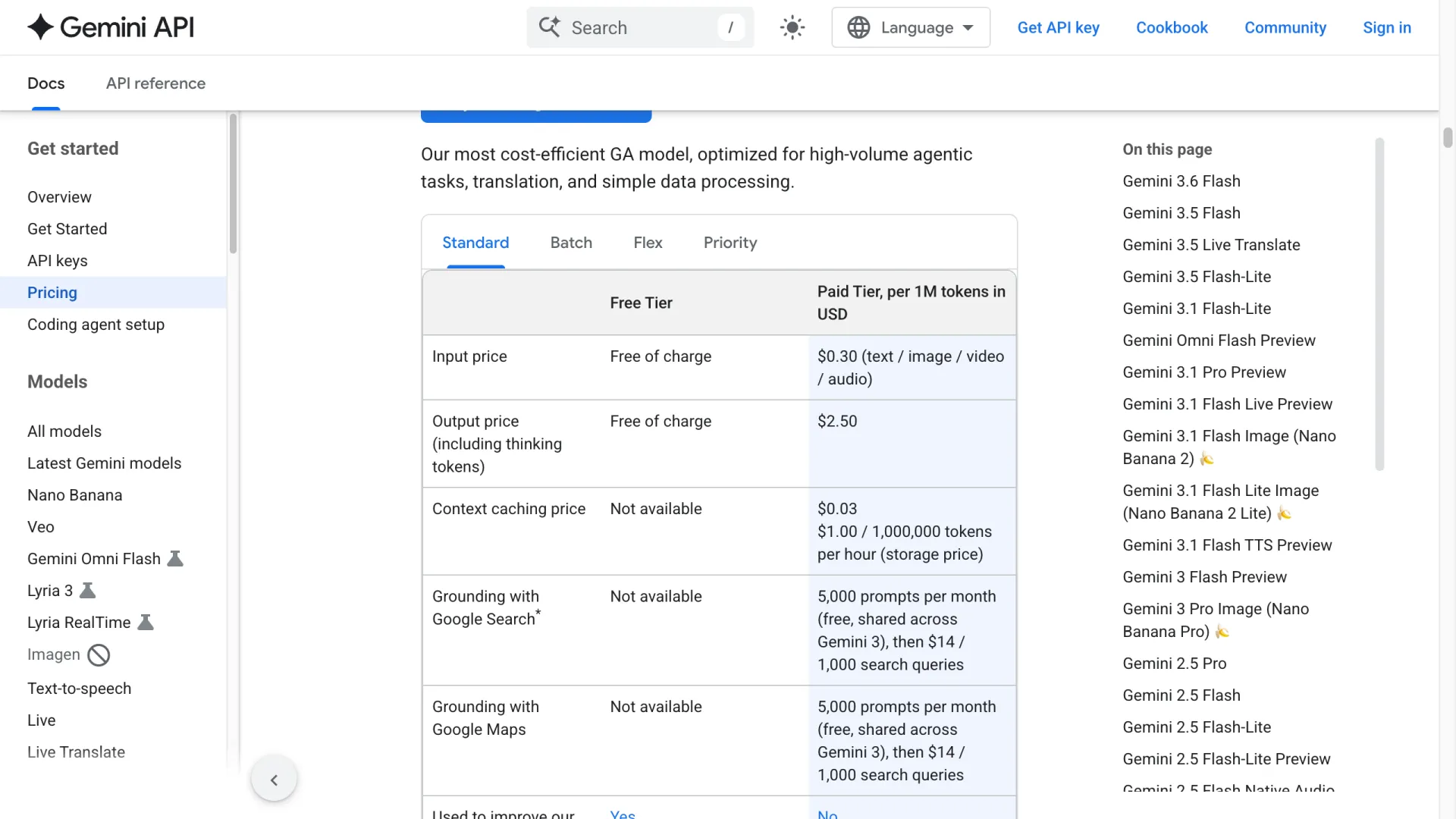
Two details worth flagging. Flash-Lite got a price *increase* over its predecessor: 3.1 Flash-Lite charged $0.25/$1.50, so output is up 67%. Google's justification is capability: the numbers published on its DeepMind model page show 3.5 Flash-Lite jumping from 38.3% to 54.2% on SWE-Bench Pro and from 31% to 54% on Terminal-bench 2.1 versus 3.1 Flash-Lite. And note the asymmetry in output limits: Flash-Lite allows 64k output tokens, double Pro's 32k, so very long single generations are, counterintuitively, the cheap model's territory.
What early adopters are saying
Discussion volume is still thin (the model is two days old at verification time), but the first production reports on X split three ways:
- Pricing skepticism: "Why is 3.5 flash lite 50% more expensive. It is so sneaky," @samarthg1911 posted on July 23. The price hike is the most common complaint.
- Pipeline wins: ML engineer @mrdbourke reported it "very fast and excellent at vision" and said it replaced Gemini 3.5 Flash, a model 3.6x its output price, in some of their pipelines. Another team running content tooling found it a "significant step up" over 3.1 Flash-Lite at parsing internet slang.
- Downgrade reports: one engineer's internal evals concluded the opposite ("3.5 flash lite is a real downgrade") and their team stayed on 3.1 Flash-Lite.
Contradictory early reviews usually mean the model's strength is workload-shaped. That matches my data: excellent inside its lane, quietly sloppy at the edges.
Which one should you route each task to
The Gemini 3.5 Flash-Lite vs Gemini 3.1 Pro decision is not either-or. Based on the measured results plus the community failure reports, here is the split I would deploy:
Route to Flash-Lite ($0.30/$2.50):
- Structured extraction, classification, tagging (with a JSON validator and one retry)
- Template-grade code generation (parsers, converters, CRUD scaffolding)
- High-frequency agent steps: tool-call formatting, summarize-and-pass, routing decisions
- Vision-heavy, high-volume processing, the strongest early-adopter praise cluster
- Anything where you would have used 3.1 Flash-Lite: the same tier now scores 16 points higher on SWE-Bench Pro
Keep on 3.1 Pro ($2/$12):
- Long-document work where consistency across tens of thousands of words is the deliverable (community-reported, not tested here)
- Agent tasks that must re-plan when a tool call returns something unexpected
- Judgment calls where one wrong answer costs more than a month of the price difference
- Work above 200k context, budgeting for the doubled $4/$18 rate there
The pattern that beats picking one model: route by default to Flash-Lite and escalate to Pro on concrete triggers — schema-validation failure after one retry, a tool call returning an error or unexpected shape, input crossing your context comfort zone, or any task tagged high-stakes upstream. With a 25x measured cost gap, keeping the escalation rate around 15% cuts spend by roughly 80% versus running everything on Pro (0.85 + 0.15 × 25 = 4.6x Lite's cost, against 25x).
How to call both models
Flash-Lite is GA as gemini-3.5-flash-lite in the Gemini API, Google AI Studio, and the Gemini app; 3.1 Pro remains in preview as gemini-3.1-pro-preview. Both are also exposed through OpenAI-compatible relay platforms — AIReiter's Google model catalog lists the Gemini line alongside other providers, which is how I ran the head-to-head above without juggling two SDKs. If you replicate the test, log the thinking-token count your endpoint reports per call (usage.completion_tokens_details.reasoning_tokens on OpenAI-compatible routes, thoughtsTokenCount in the native Gemini API): that single field is where the 25x hides.
FAQ
Is Gemini 3.5 Flash-Lite better than Gemini 3.1 Pro?
No. It matched Pro on my four-task spot check (code generation, extraction, logic, code review) while answering 8x faster and billing 25x less, but Pro keeps the edge on long-context consistency, dynamic re-planning, and reasoning depth (46 vs 36 on Artificial Analysis's index).
Is Gemini Flash or Flash-Lite better?
Flash ($1.50/$9.00) is a reasoning model and scores higher on agentic benchmarks; Flash-Lite ($0.30/$2.50) supports adjustable thinking levels but ran with zero thinking tokens in all 34 of my calls, which is why it answers in about a second. For high-volume extraction, classification, and vision pipelines, Flash-Lite's 5-6x price advantage usually wins; for multi-step agent reasoning, pay for Flash.
Why did Gemini 3.5 Flash-Lite get more expensive?
Google raised the tier's price over 3.1 Flash-Lite ($0.25/$1.50 → $0.30/$2.50, a 67% output increase) alongside large published capability jumps — SWE-Bench Pro 38.3% → 54.2%, Terminal-bench 31% → 54%. You are paying more per token for a model that needs fewer attempts.
Is there a Gemini 3.5 Pro?
Not as of July 23, 2026. The 3.5 generation ships Flash-Lite, Flash, and Live Translate tiers, plus the newer 3.6 Flash. The Pro line's latest release is still 3.1 Pro in preview.