
DeepSeek's V4 Pro now costs $0.435 per million input tokens and $0.87 per million output on the official API. The same model on Azure AI Foundry still lists at $1.74 and $3.48, exactly the pre-cut price. That 4x spread, verified on July 14, 2026, is the single most important fact about DeepSeek enterprise AI cost dynamics right now: what your company pays depends less on the model and more on the door you walk through to reach it.
This article puts date-stamped numbers on the direct API and Azure, tests one reseller path, runs the same workload through both V4 models, and ends with a decision framework, plus one deadline: the old deepseek-chat and deepseek-reasoner aliases retire on July 24, 2026.
DeepSeek V4 pricing today: the numbers that matter
Here is the official price list from DeepSeek's API documentation, checked on July 14, 2026:
| Model | Input (cache hit) | Input (cache miss) | Output | Context | Concurrency cap |
|---|---|---|---|---|---|
| deepseek-v4-flash | $0.0028/M | $0.14/M | $0.28/M | 1M tokens | 2,500 |
| deepseek-v4-pro | $0.003625/M | $0.435/M | $0.87/M | 1M tokens | 500 |
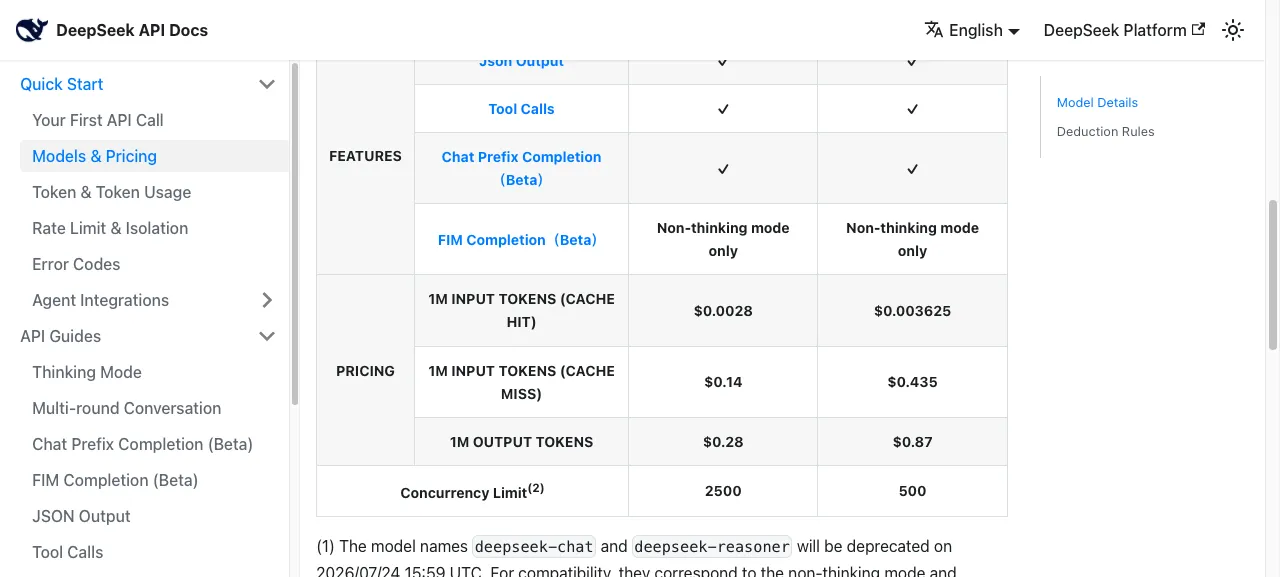
Three details in that table matter more than the headline rates:
- The cache-hit price is the real price for agent workloads. A cache hit on V4 Pro costs $0.003625 per million tokens, 120x cheaper than a cache miss. Agent systems that resend the same system prompt and tool definitions on every call live almost entirely in cache territory, and DeepSeek applies caching automatically, with no configuration.
- There is no promotional asterisk. The 75% reduction that started as a launch promotion is now the list price. The pricing page carries no expiry date. InfoWorld's reporting attributed the permanence to V4 Pro's engineering: roughly a quarter of the per-token compute of its predecessor at long context, so the cut is structural, not a subsidy.
- The alias deadline is real. Model names
deepseek-chatanddeepseek-reasonerare deprecated on July 24, 2026 at 15:59 UTC. Production code still calling those names needs a one-line migration todeepseek-v4-flashordeepseek-v4-pro. Because the new defaults run in thinking mode, output token counts (and bills) will change if you don't set the mode explicitly.
Both models expose a 1M-token context window and up to 384K output tokens, and the API now serves an Anthropic-compatible format at api.deepseek.com/anthropic alongside the OpenAI format, which matters if your team wants to swap DeepSeek into tooling built for Claude.
The 75% cut didn't reach every channel
Azure AI Foundry sells the same DeepSeek-V4 Pro at $1.74 input and $3.48 output per million tokens (Global deployment, Central US, verified July 14, 2026). That is the pre-cut price, unchanged. V4 Flash on Azure runs $0.19/$0.51: a 36% premium on input and an 82% premium on output over the direct API's cache-miss rate.
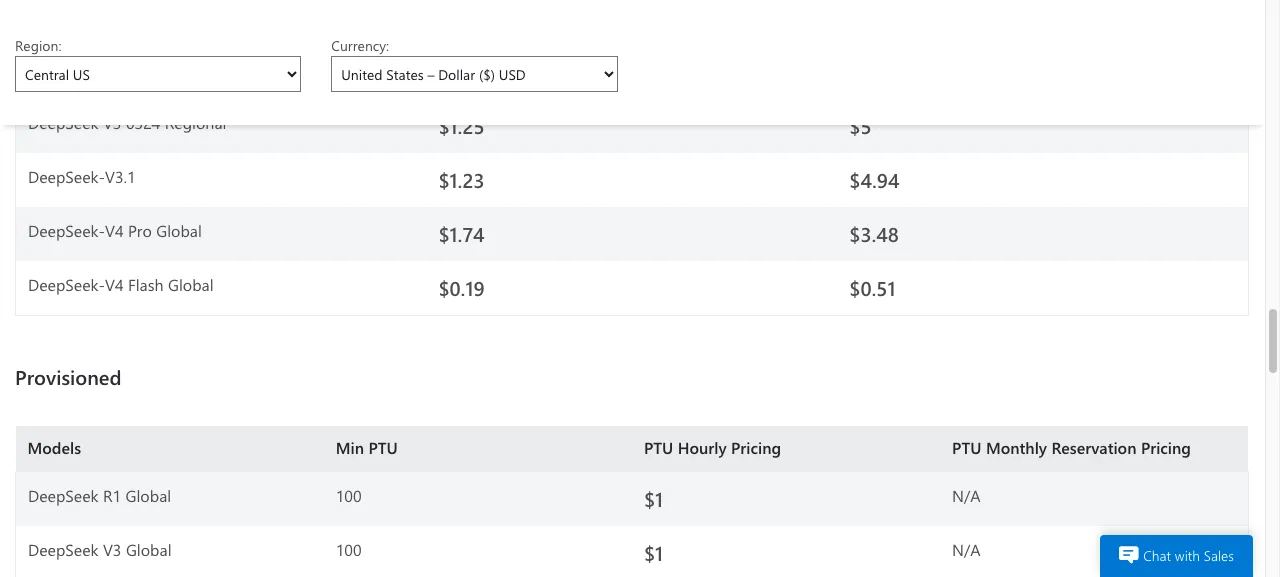
On the Azure pricing page we checked (Global deployment, Central US, July 14, 2026), no cached-input line item appears for any DeepSeek model; confirm with your Microsoft account team, since marketplace pricing can lag vendor pricing. On the direct API, an agent workload with heavy prefix reuse pays fractions of a cent per million input tokens; on Azure, every one of those tokens bills at full rate. For cache-heavy workloads the effective gap is not 4x; it can exceed 100x on the input side.
To be fair to Azure, you are not buying the same thing. Foundry hosting keeps traffic inside Microsoft's cloud, under Microsoft's data-processing terms, with Azure SLAs and no data leaving for servers operated by a Chinese company, which for many compliance teams is the entire point. Microsoft is positioning exactly this way as it wires DeepSeek into Copilot's multi-model routing. But that governance premium is now quantifiable: for the reference workload below, it's the difference between $31 and $209 a month per workload, and procurement teams should price it as a line item, not absorb it as an invisible default.
Aggregators and API resellers sit in between. Platforms like OpenRouter pass through pricing close to the official rate, and community reports note DeepSeek's global cache still applies through them. The catch is visibility; more on that below, because we tested it.
What a real enterprise workload costs
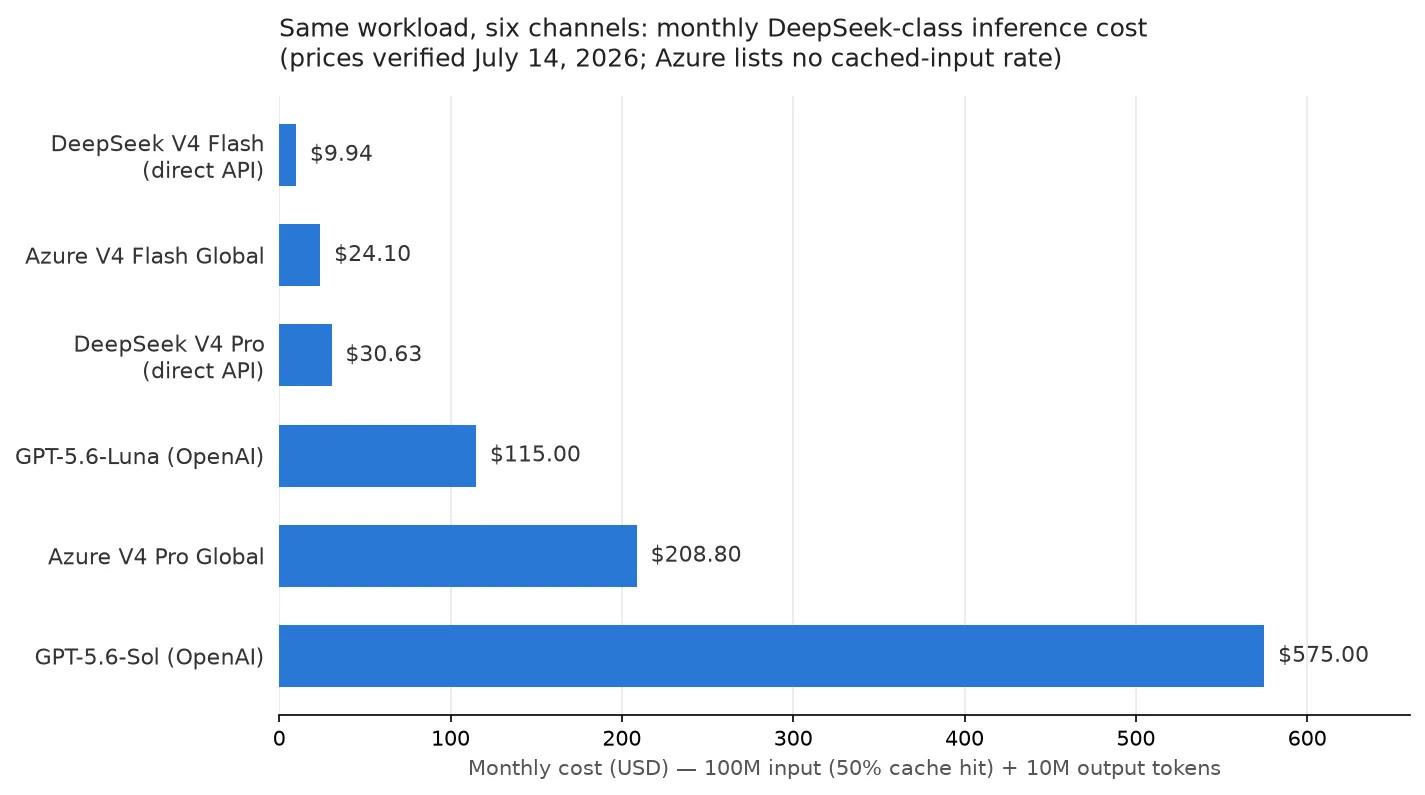
Paper rates only become decisions when you multiply them by a workload. Take a mid-sized enterprise assistant: 100M input tokens a month (50% cache hit, a conservative rate for agent traffic that resends system prompts constantly) plus 10M output tokens. Here is that identical workload priced across six channels, using rates verified on July 14, 2026:
| Channel | Monthly cost |
|---|---|
| DeepSeek V4 Flash, direct API | $9.94 |
| Azure V4 Flash Global | $24.10 |
| DeepSeek V4 Pro, direct API | $30.63 |
| GPT-5.6-Luna (OpenAI) | $115.00 |
| Azure V4 Pro Global | $208.80 |
| GPT-5.6-Sol (OpenAI) | $575.00 |
The math behind the table is reusable: monthly cost = miss_tokens x miss_rate + hit_tokens x hit_rate + output_tokens x output_rate. Cache share dominates it. The same 100M-input workload on V4 Pro direct costs $52.20 a month at 0% cache hit, $30.63 at 50%, and $13.38 at 90% - while on Azure it stays $208.80 in all three cases, because no cache discount is published.
Two readings of that table. First, the cheapest DeepSeek channel and the most expensive frontier channel differ by 58x on identical traffic. Second, and less obvious: Azure's DeepSeek V4 Pro costs more than OpenAI's GPT-5.6-Luna. If your procurement summary says "we standardized on DeepSeek to save money" but the deployment is Azure Global, the saving may be smaller than a mid-tier OpenAI model would deliver.
The multiplier that breaks budgets is agentic amplification. A single-turn chatbot bills roughly one call per user question; a production agent chains planning, retrieval, tool calls, and verification, and the input-to-billed ratio can reach 1:700, a figure VentureBeat's July 2026 analysis of agent economics calls the "100x problem." At that ratio, our 100M-token reference workload is what one moderately busy agent feature generates, not a whole company's traffic. Cheap per-token pricing is not a license to skip cost controls; it's what makes agent products survivable while you build them.
We ran the same job on V4 Flash and V4 Pro
Pricing pages don't answer the question your engineers will ask: what a single request costs and how long does it take? On July 14, 2026 we sent the identical coding task - "Write a Python function that parses an ISO 8601 duration string into total seconds, with 3 test cases" - to both V4 models at default settings (thinking mode on, max 4,000 output tokens) through an OpenAI-compatible reseller endpoint. We leave the reseller unnamed because the point is the category's behavior, not one vendor's; the raw responses carried DeepSeek's reasoning_content field, which is how we confirmed the backing model:
| V4 Flash | V4 Pro | |
|---|---|---|
| Wall-clock time | 15.5s | 35.1s |
| Completion tokens (incl. reasoning) | 1,690 | 1,902 |
| Effective output speed | ~109 tok/s | ~54 tok/s |
| Cost at official rates | ~$0.0005 | ~$0.0017 |
Caveats stated plainly: this is a single sample, and the latency includes relay overhead, so treat the wall-clock numbers as an upper bound rather than a benchmark of the direct API. Both responses returned DeepSeek's signature reasoning_content field: both models run thinking mode by default, and those reasoning tokens bill as output. Flash spent 2,703 characters reasoning about a parsing function before answering. If your workload doesn't need chain-of-thought, switching thinking off is one of the cheapest optimizations available. For a deeper head-to-head on when Pro's extra quality justifies 3x the price, we ran both models through a full comparison in DeepSeek V4 Flash vs V4 Pro.
The test surfaced one finding we haven't seen documented elsewhere: the relay channel's usage reports contained no cache breakdown. We sent the same 824-token prefix twice in a row - a textbook cache hit if the reseller preserves DeepSeek's prefix caching - and the API response reported only prompt_tokens, completion_tokens, and total_tokens, with no prompt_cache_hit_tokens split. On the direct API that field is how you audit whether the 120x cache discount is reaching your bill. Through an intermediary, you may receive the discount without being able to verify it, or not receive it at all. If you buy DeepSeek through any reseller, ask specifically whether cache-hit pricing passes through and how it appears on your invoice.
Direct API, Azure, or an aggregator: how to choose
The channel decision reduces to a short table:
| Direct API | Azure AI Foundry | Aggregator/reseller | |
|---|---|---|---|
| V4 Pro price (in/out per M) | $0.435 / $0.87 | $1.74 / $3.48 | Varies; typically near official |
| Cache-hit discount | Yes, automatic, auditable | Not listed | Sometimes; often not auditable |
| Data residency | DeepSeek's servers | Microsoft cloud, your tenant | Reseller's infrastructure |
| Contract/compliance | Chinese entity | Existing Azure agreement | Reseller's terms |
| Concurrency | 500 (Pro) / 2,500 (Flash) | PTU provisioning available | Pooled, varies |
| Multi-model consolidation | DeepSeek only | Foundry catalog | Broad catalog, one invoice |
In practice: the direct API wins on pure economics: no channel matches cache-hit pricing at $0.003625 per million, and it's the only channel where you can audit that discount. Azure wins when your legal team won't sign off on traffic to DeepSeek's own infrastructure; you're paying roughly 7x the effective rate for governance, and that trade can be entirely rational if you make it consciously. Aggregators win when DeepSeek is one of several models behind a router and consolidated billing is worth a thin margin; verify cache pass-through before committing volume.
Whichever channel you pick, the routing rules that keep DeepSeek bills flat are unglamorous: default classification, extraction, and summarization to Flash; reserve Pro for multi-file code generation and long-context reasoning; turn thinking mode off for deterministic tasks (those reasoning tokens bill as output); and cap agent loop depth per workflow. A well-tuned router matters more than the 3x spread between Flash and Pro.
Why DeepSeek can price this low — and whether it holds
The prices are not a loss-leader stunt. V4's architecture is a mixture-of-experts design with 1.6 trillion total parameters but only about 49 billion active per forward pass: you inference a mid-sized model's worth of compute while getting frontier-class capability (80.6% on SWE-bench Verified, per DeepSeek's published results). The V4 Pro revision specifically attacked long-context cost, which is why the company converted its 75% promotion into the standing price instead of letting it lapse.
The direction of travel favors buyers. Frontier inference unit costs have been falling roughly 3x per year by most industry estimates, and DeepSeek's cut in one year, while context length grew to 1M tokens, outpaces even that curve. OpenAI moved the opposite way over the same period, repositioning its flagship tier upward with GPT-5.6-Sol at $5/$30.
The counterweight is Jevons: cheaper inference reliably produces more inference. New Street Research's observation - quoted since the V3 era - that increased competition rarely reduces total spend has held throughout the AI buildout. Agent adoption multiplies calls per user faster than per-token prices fall, which is why the enterprises that keep budgets flat are the ones treating routing, caching, and prompt discipline as first-class engineering, not the ones that picked the cheapest model. Understanding these cost dynamics, not just the sticker price, is what separates a DeepSeek deployment that stays cheap from one that quietly balloons.
FAQ
How is DeepSeek V4 so cheap?
Mixture-of-experts architecture: 1.6T total parameters, ~49B active per token. The compute cost per token resembles a much smaller model, and V4 Pro's long-context engineering cut per-token compute to roughly a quarter of its predecessor's. The pricing is structural, not promotional.
How much was the DeepSeek V4 Pro price cut?
75%: from $1.74/$3.48 per million tokens (input/output) to $0.435/$0.87. It began as a limited promotion and became the permanent list price.
Does the 75% price cut apply on Azure?
No. As of July 14, 2026, Azure AI Foundry lists DeepSeek-V4 Pro Global at $1.74/$3.48, the pre-cut rate, with no cached-input pricing published. For cache-heavy workloads the effective gap versus the direct API can exceed 4x; check current rates with Microsoft, as marketplace pricing can lag vendor cuts.
Is DeepSeek free for enterprise use?
The API is paid per token, but the model weights are MIT-licensed, so self-hosting is legal for commercial use. At V4's scale you'd need serious GPU infrastructure; for most teams the API's per-token price undercuts self-hosted TCO by a wide margin.
How does DeepSeek's cost compare to ChatGPT?
On API pricing, DeepSeek V4 Pro ($0.435/$0.87) runs about 11x cheaper than GPT-5.6-Sol ($5/$30) on input and 34x on output. ChatGPT subscriptions ($20–$200/month per seat) are a different product; for programmatic workloads the API-to-API comparison is the meaningful one.
What to do before July 24
Three actions, in order of urgency:
1. Migrate model aliases now. deepseek-chat and deepseek-reasoner stop resolving July 24, 2026 at 15:59 UTC. Pin deepseek-v4-flash or deepseek-v4-pro explicitly, and set thinking mode deliberately; the default changed, and reasoning tokens bill as output. 2. Re-price your channel. If you're on Azure for governance reasons, confirm that's still a conscious trade at 4x list and no cache discount. If you're on a reseller, get cache pass-through in writing. 3. Audit your cache hit rate. On the direct API, check prompt_cache_hit_tokens in your usage data. If your agent traffic is below 50% cache hits, restructure prompts so static content leads: at a 120x hit/miss spread, prompt ordering is a budget decision.
The model got cheap. The dynamics of who captures that cheapness (vendor, cloud, reseller, or you) are where enterprise money is won and lost this year.
Related reading: DeepSeek V4 Flash vs V4 Pro · GLM 5.2 vs DeepSeek V4 Pro · OpenRouter Pricing Guide