 AIREITER
For its first two months, Cursor Origin was a tagline and an email box. On August 17, 2026, it became an early beta of Cursor's code hosting. Two caveats frame the rest: repos synced from GitHub keep GitHub as the source of truth, and rollout reports from paying users are already uneven.
Is Cursor Origin live yet?
Cursor Origin is live in early beta as of August 17, 2026, available to users on all paid Cursor plans. Enterprise organizations are the exception: per the same changelog, their administrators can opt out. The product's landing page links the beta from its "Early beta" callout.
What users actually see varies. In the r/cursor launch thread from August 17–18, paying customers reported a gap between the announcement and their accounts:
"I still just see a waitlist signup." — u/NerdyGuy117, r/cursor
"I don't have access to it yet on my Teams plan." — u/Darkoplax, r/cursor
The reports indicate a staged rollout rather than instant availability across every qualifying account: enabled accounts get Origin repos under the Codebase tab, so if your plan qualifies and nothing appears, the beta has not reached the account yet.
| Date | What happened |
|---|---|
| June 16, 2026 | Cursor announces Origin at its Compile conference: splash page and waitlist only |
| August 17, 2026 | Early beta ships: repos, PRs, code browsing, GitHub sync, agents |
At announcement time, one r/cursor commenter called the product page "no information. A splash page with an email box." (u/One-Poet7900)
What the Origin beta actually ships
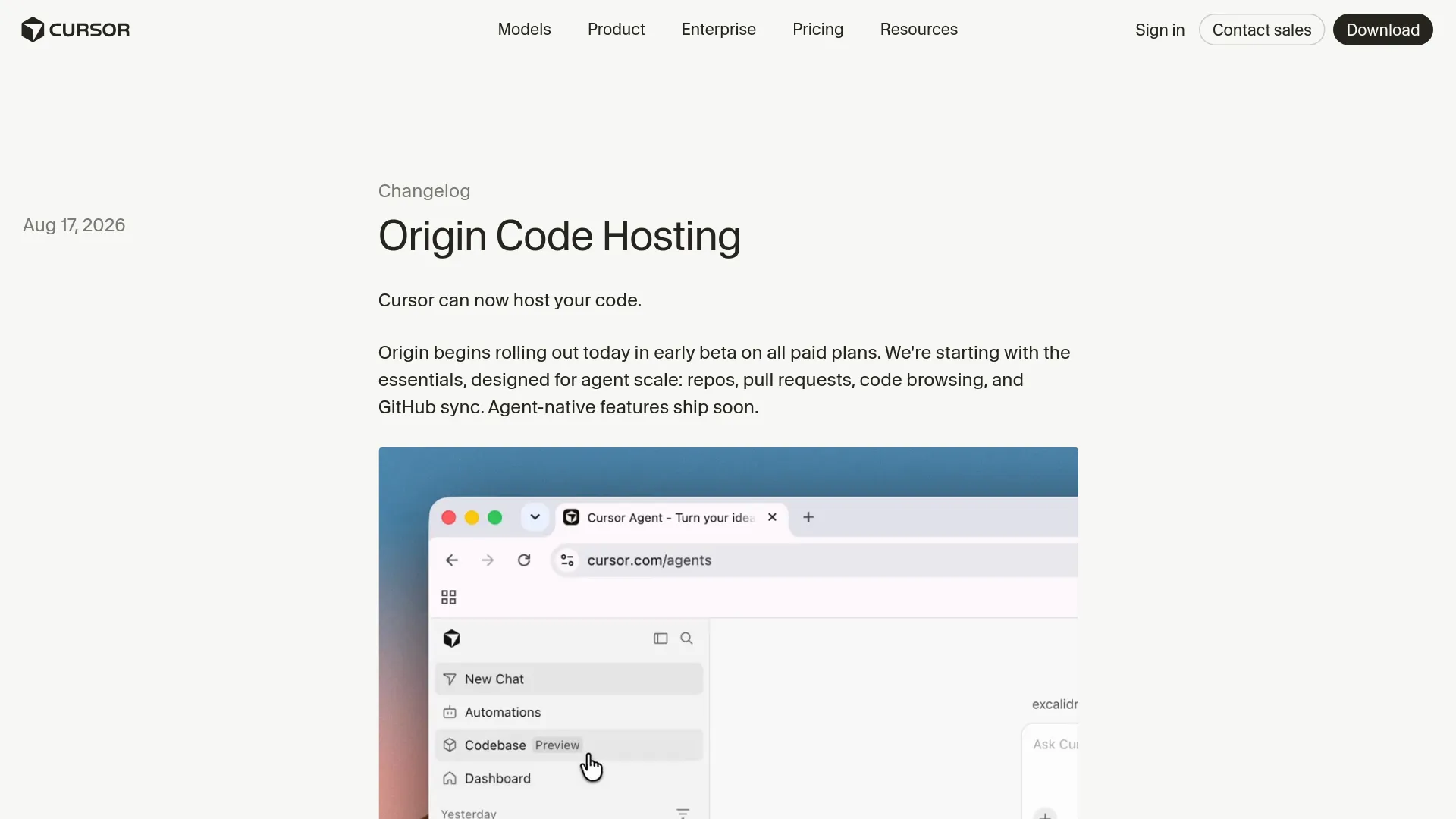
The beta ships four capabilities, detailed in the table below. Per the changelog, repos live in Cursor's new Codebase tab, the repo name becomes part of its URL (cursor.com/codebase/acme-corp in Cursor's example), and creating one means selecting +New, naming it, installing the CLI, then cloning it or pushing an existing local project.
Pull requests show the timeline, commits, checks, and changed files. You can review diffs, comment, and merge without leaving the editor. Icons mark which repos Cursor hosts versus which ones synced in from GitHub.
| Capability | Status in the Aug 17 beta |
|---|---|
| Repos hosted by Cursor | Shipped (Codebase tab) |
| Pull requests: view, comment, merge | Shipped |
| Code browsing and search | Shipped |
| GitHub import with real-time sync | Shipped |
| Agents acting inside repos | Shipped (first set) |
| Vercel, Depot, Buildkite apps | Shipped |
| Agent-native features beyond the basics | "Coming," no dates given |
| Stacked pull requests | Not documented |
| Pricing, limits, SLAs | Not published |
How Origin's GitHub sync really works
Origin's GitHub sync creates a live mirror you can review from, not a second source of truth. Connecting GitHub, picking an organization, and selecting repos gives Cursor a real-time synced copy; anyone with read or write access to the synced repo can view it in Cursor, and you can disconnect a repo later from its settings, per the changelog.
The question Cursor's own community kept asking predates the beta:
"Is Origin a replacement for github or git?" — u/sn2006gy, r/cursor
The beta answers it by architecture. For repos that started on GitHub, pushes keep going to GitHub, and Origin's copy is for browsing, searching, and pulling. Cursor's changelog states it directly: GitHub stays the source of truth.
| Action | Where it happens |
|---|---|
| Push to a synced repo | GitHub; Origin mirrors it |
| Comment on a PR in Cursor | Posted to GitHub |
| GitHub reaction or reply | Appears in Cursor "within seconds," per the changelog |
| Review assigned in GitHub | Can be completed and merged in Cursor |
| Disconnect a synced repo | Supported, per-repo |
Custody only changes hands for repos created natively inside Origin.
Agents and CI inside Origin repos
Per the changelog, agents with access to an Origin repo can answer questions about the code, make changes, update pull requests, and push branches. One r/cursor user put the resulting bottleneck plainly months before launch: "Code reviews have become a bad bottleneck." (u/calloutyourstupidity)
Three apps shipped at launch: Vercel, Depot, and Buildkite. Connecting Vercel through a repo's Apps tab gives every PR a preview deployment for testing and commenting, and merging deploys to production. Depot and Buildkite run existing GitHub Actions workflows; Buildkite also runs its native pipelines. Note the split: repos synced from GitHub keep whatever CI they already have there, while repos hosted natively in Origin can connect to these three apps and nothing else so far.
The changelog is silent on the operational layer around those agents: no authorization controls or audit logs for agent-initiated pushes, no per-repo limits, no cost detail. If you run your own coding agents outside Cursor, the same criteria for choosing a coding-agent LLM apply to whatever pushes into your repos.
What the beta still doesn't tell you
- No published repo size, storage, or concurrency limits, and no SLA or uptime target.
- No Origin-specific pricing. "Included in paid plans" is the entire commercial detail so far, with nothing on surcharges, quotas, or a future free tier.
- No Origin-specific data-handling terms. Cursor's security page carries a SOC 2 certification, but the training-data and retention questions raised at announcement time have no published answer specific to hosted repos.
- The Compile-stage demo numbers (22.6 commits per second in one repo, "hundreds of thousands of clones per hour") remain demo claims: an independent Cursor guide calls them unverified, and the launch coverage notes the widely repeated "296,000+ clones" figure lost its original time unit.
Until Cursor publishes Origin-specific terms, this reaction from June stays a live constraint on adoption:
"zero chance I turn over full Git history to Cursor." — u/fintechbass, r/cursor
Who should try Origin now — and who should wait
| Your situation | Call |
|---|---|
| Paid Cursor plan, agents write much of your code, non-critical repos available | Try it; the beta is already in your plan |
| Repos must stay on GitHub with existing CI | Fine; sync gives you review and search in Cursor, CI keeps running on GitHub |
| Want native Origin hosting with CI beyond Vercel, Depot, Buildkite | Wait; only three apps exist today |
| Considering migrating source-of-truth repos | Wait; sync them instead, because GitHub stays authoritative anyway |
The trade-off that outlasts the beta: moving a repo's host moves its custody. The same stacked-PR comparison warns that non-Git review artifacts such as PR threads "do not travel through git push," which makes Origin the least reversible of the current options. That comparison also records that Cursor announced a definitive agreement to acquire Graphite, the stacked-PR company, on December 19, 2025, that the Graphite team is building Origin inside Cursor, and that Graphite still operates independently at graphite.com with stacking tiers listed at $20–40 per user per month on annual billing.
Is Cursor Origin a GitHub replacement?
No. Repos synced from GitHub keep GitHub as the source of truth, and pushes still land on GitHub. Origin adds a native hosting option plus a review surface on top.
Is Cursor Origin included in Cursor plans?
The early beta is open to all paid Cursor plans. No separate Origin pricing, quotas, or free-tier path has been announced.
Does Cursor Origin support stacked pull requests?
Not documented in the beta. Per the independent comparison, stacked workflows in Origin are an expectation drawn from the Graphite acquisition, not a published feature.
Can you self-host Cursor Origin?
Neither the August 17 changelog nor the Origin product page mentions a self-hosting option. Origin repos are hosted by Cursor, and enterprise admins can only opt out entirely.
Do you need Origin to run coding agents at scale?
No. An independent Cursor guide recommends separate worktrees per agent, small diffs, and first-pass review bots to handle the same review bottleneck on GitHub or GitLab today.
Related reading: Cursor Router explained