 AIREITER
The lowest number is not always the cheapest usable route. On the published entry tiers checked September 27, 2026, Hailuo 2.3 has the lowest five-second equivalent in this four-model comparison, but its fixed six-second billing changes the answer for an actual request.
The answer depends on what you call cheap
The cheapest image to video API among these four model families is Hailuo 2.3 on Runware at $0.28 for six seconds, equivalent to about $0.0467 per output second. For a request that must be exactly five seconds, the bill remains $0.28 because the route uses fixed supported durations rather than pure per-second billing.
The closest alternatives are Seedance 2.0 at $0.07/second for 480p, Wan 3.0 at $0.082513/second for 720p in Alibaba Cloud's US deployment, and Kling 3.0 at $0.084/second for 720p without audio. Those are not quality-equivalent tiers, so price must stay attached to resolution, audio, duration, and provider.
Four model families on one price basis
The table normalizes published image-to-video prices into clip costs. It uses each family's lowest documented configuration that is practical for a general image-to-video request, not promotional credits or consumer subscriptions.
| Model route | Provider and configuration | Published price | Actual 5-second bill | 60 generated seconds* | Key limitation |
|---|---|---|---|---|---|
| Hailuo 2.3 | Runware, 768p, fixed 6s run | $0.28 / 6s | $0.28 | $2.80 for ten 6s runs | Fixed durations; not billed as a literal 5s request |
| Seedance 2.0 | Runware, 480p, image/text-to-video | $0.07/s | $0.35 | $4.20 | Lowest resolution in this comparison |
| Wan 3.0 | Alibaba Cloud US, 720p | $0.082513/s | $0.4126 | $4.9508 | Region-specific price; Singapore is $0.10/s at 720p |
| Kling 3.0 | Direct API equivalent, 720p, no audio | $0.084/s | $0.42 | $5.04 | Audio increases the rate |
\*The 60-second column is cost arithmetic, not a claim that each API can return one continuous 60-second clip. Maximum duration and supported increments vary.
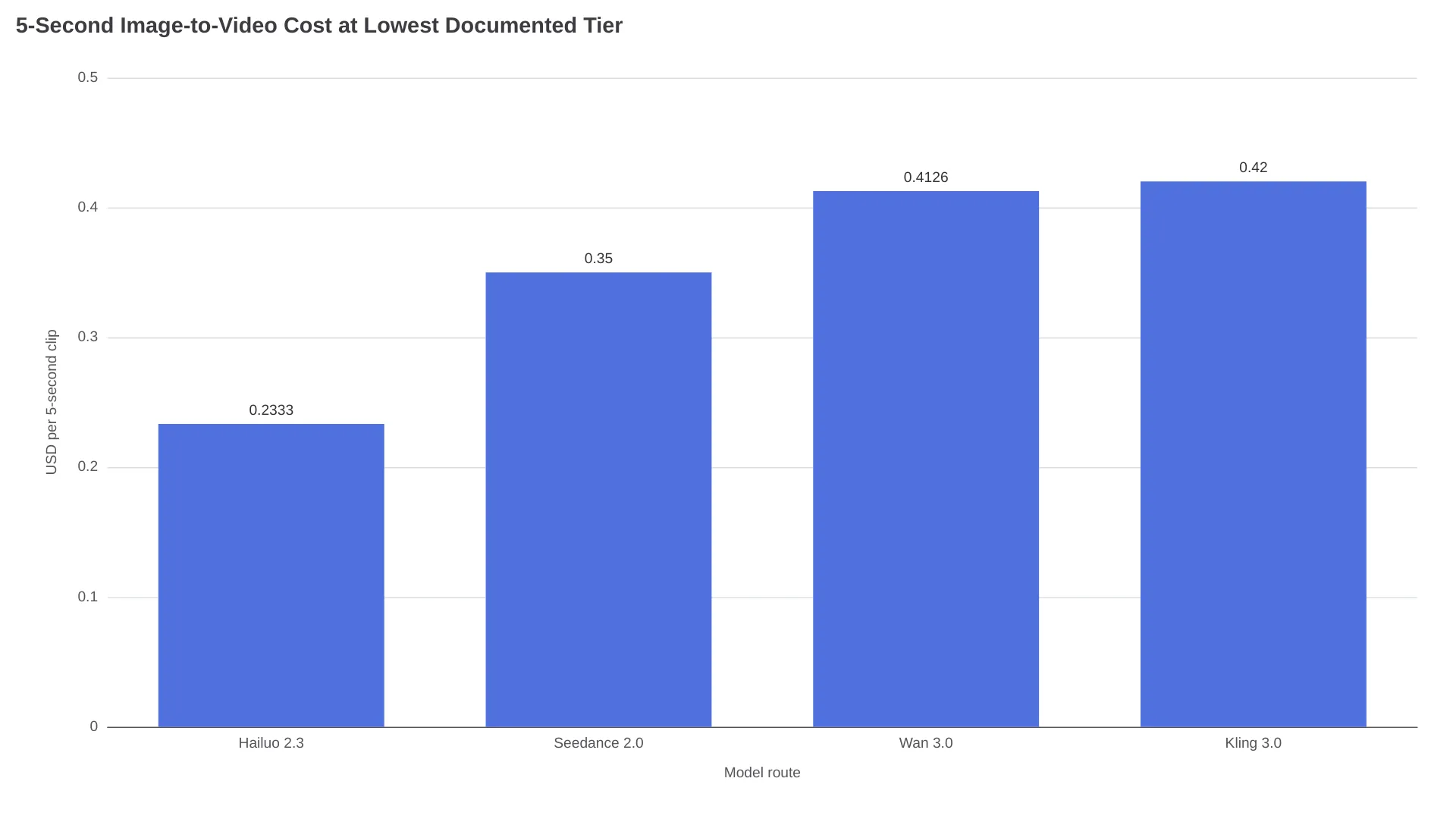
The table's main trap: Hailuo is the lowest bill, Wan narrowly beats Kling at 720p, and Seedance's cheaper-looking clip is only 480p.
Why the cheapest row is not automatically the cheapest API
Resolution is the first correction. Seedance 2.0 rises from $0.07/second at 480p to $0.16/second at 720p on Runware, making a five-second 720p clip $0.80. Alibaba lists Wan 3.0 at $0.041256/second for 480p, $0.082513 for 720p, and $0.165025 for 1080p in its US deployment.
Audio is the second correction. Runware lists Kling 3.0 Omni Standard at $0.084/second for 720p without audio and $0.112/second with audio. If audio will be replaced in post-production, price the silent route first.
Retries change the effective price, but no honest universal multiplier exists. If a five-second Hailuo run costs $0.28 and a usable shot takes three attempts, the generation spend is $0.84. Apply the same arithmetic to your own acceptance rate instead of assuming every first render ships.
Which model should you pick for each brief?
The cheapest selection changes with the output requirement. These four choices avoid comparing a low-resolution draft with a higher-resolution delivery master as if they were interchangeable.
| Production brief | Pick | Cost basis | Why |
|---|---|---|---|
| Lowest entry bill | Hailuo 2.3 via Runware | $0.28 / 6s at 768p | Lowest actual charge in this four-family set |
| Cheapest 480p draft | Wan 3.0 via Alibaba US | $0.041256/s | About $0.2063 for 5s; lower than Seedance 2.0's 480p rate |
| Cheapest 720p silent output | Wan 3.0 via Alibaba US | $0.082513/s | Marginally below Kling 3.0 at $0.084/s |
| Native-audio requirement | Kling 3.0 Omni Standard | $0.112/s at 720p | Published audio-enabled rate; compare against bundled-audio alternatives |
In short: Hailuo is the lowest fixed test run, Wan is the lowest 480p/720p per-second route, Kling is a near-price tie when its motion is preferred, and Seedance is a workflow-specific choice rather than the price winner.
Runware is useful as a common API surface for Kling, Seedance, Hailuo, and multiple Wan versions, but that convenience does not make every model cheapest there. Alibaba's direct regional Wan 3.0 rate can be lower than hosted Wan prices, while Runware exposes multiple families behind one request layer.
Before choosing by price, confirm whether the route supports your required input shape: source image only, first frame, first/last frame, or multiple references. Trial credits lower evaluation spend but do not create a permanently free production API. Regional availability can also determine whether the nominally cheapest direct route is operationally usable.
FAQ
What is the cheapest image to video API?
Among Kling, Wan, Seedance, and Hailuo routes compared here, Hailuo 2.3 via Runware has the lowest actual entry charge at $0.28 for a six-second 768p clip. Wan 3.0 is cheaper on a pure per-second basis at 480p through Alibaba Cloud US, at $0.041256 per second.
Is Kling cheaper than Wan or Seedance?
Kling 3.0 at 720p without audio is $0.084 per second, slightly above Wan 3.0's $0.082513 US-region rate. Kling is cheaper than Seedance 2.0 at 720p, which Runware lists at $0.16 per second.
How much does a 5-second image-to-video clip cost?
At the entry configurations above, the actual bill is $0.28 for Hailuo's fixed six-second run, $0.35 for Seedance 2.0 at 480p, about $0.4126 for Wan 3.0 at 720p, and $0.42 for Kling 3.0 at 720p without audio.
Do audio and reference images add to the bill?
They can. Kling publishes higher rates with audio, and model-specific reference-image rules vary. Check the exact route because providers package these inputs differently.
The practical choice
Start with Wan 3.0 for the lowest per-second draft or 720p price, or Hailuo 2.3 for the lowest fixed test run. Move to Kling or Seedance only when their motion, controls, or output behavior earns back the price difference; calculate cost from delivered clips, not from the first-attempt catalog rate.