 AIREITER
Your thumbnail gets judged at roughly 300 pixels wide in a mobile feed, sharing the screen with a headline you also had to write. I ran one thumbnail brief through GPT Image 2, Nano Banana Pro, and Seedream 5 Pro to see what breaks, and one factor decided most rounds: whether the model spells and places the in-image headline correctly.
GPT Image 2 held the text and cost the least per image - 1 credit on my bill. Nano Banana Pro produced the more convincing face and billed six times more credits for it. Face-led thumbnail channels should read that verdict backwards: for you, Nano Banana Pro wins.
One Prompt, Three Models
I wrote one brief that asks for the three hardest things at once - a spelled-out headline ("I TESTED EVERYTHING"), an exaggerated shocked expression, and a left-text-right-face 16:9 composition - then sent it unchanged to GPT Image 2, Nano Banana Pro, and Seedream 5 Pro through the same image API. All three renders below came from that single prompt.
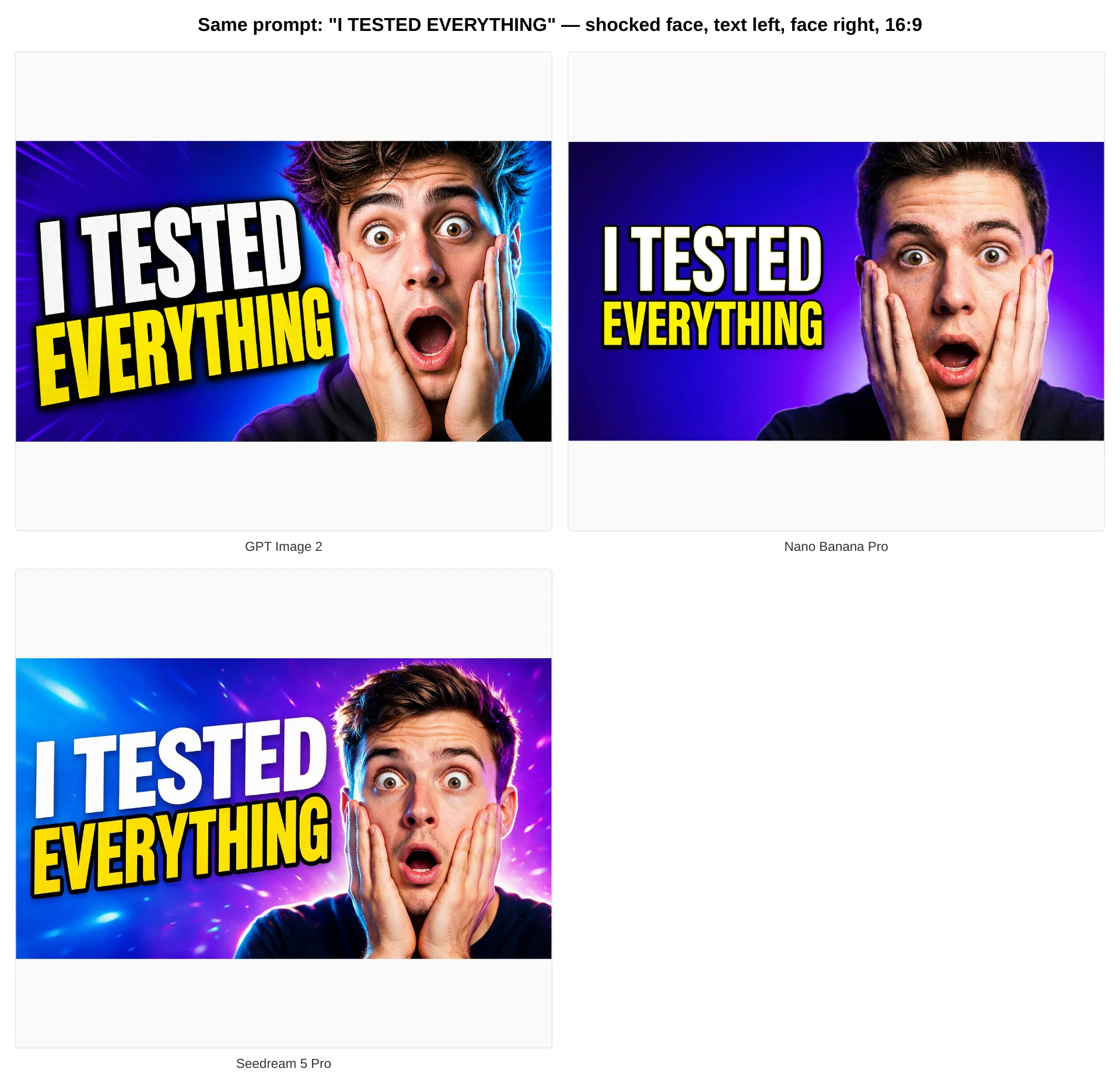
Read the grid the way a subscriber would: shrink it to thumb width and check the headline, the expression, and the face at desktop feed size (~246×138 px) and mobile notification size (~168×94 px), the display dimensions Ropewalk measured. Don't outsource this judgment to a chatbot either - in one community test, LLMs picking the better of 108 thumbnail pairs matched real viewers only 68.5% of the time.
Where Each Model Breaks
Same prompt, same API, three very different bills. The credit spread alone tells part of the story: GPT Image 2 charged 1 credit, Seedream 5 Pro 3.5, and Nano Banana Pro 6 for the identical brief - a 6× difference before you've judged a single pixel.
GPT Image 2: the text holds, the clock doesn't
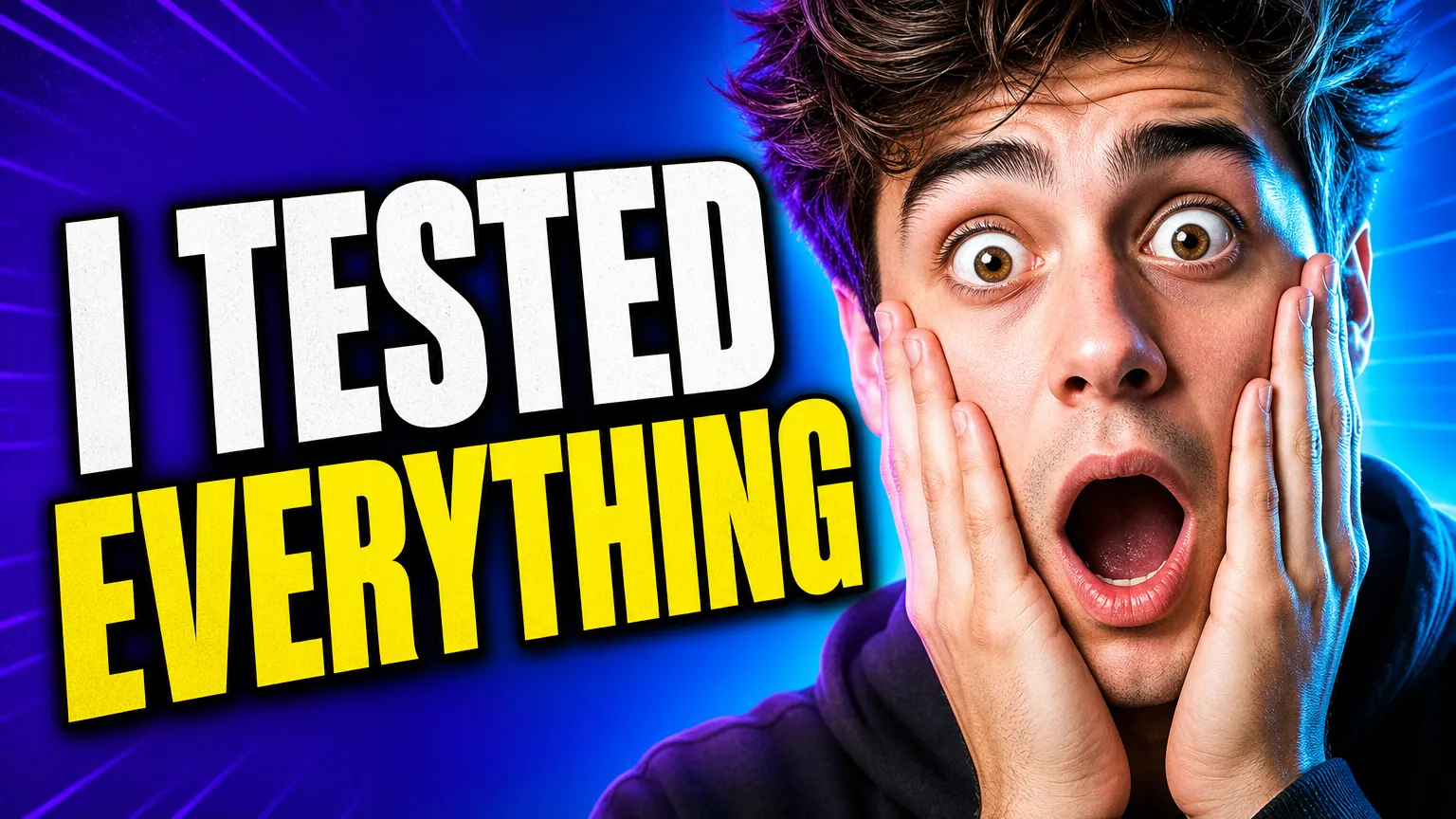
Typography is the job GPT Image 2 keeps winning. In Ropewalk's published 24-prompt test from April 2026, it rendered 21 of 24 five-word headlines legibly - the strongest text score of any model they measured - but took 18–25 seconds per image, while Flux 2 Pro finished in 6–9 and Seedream 4 in about 8.
That trade matters at thumbnail volume. Slower generation is tolerable when you produce two finished thumbnails a week, and expensive when you A/B test in batches of eight.
Nano Banana Pro: faces that survive 300 pixels
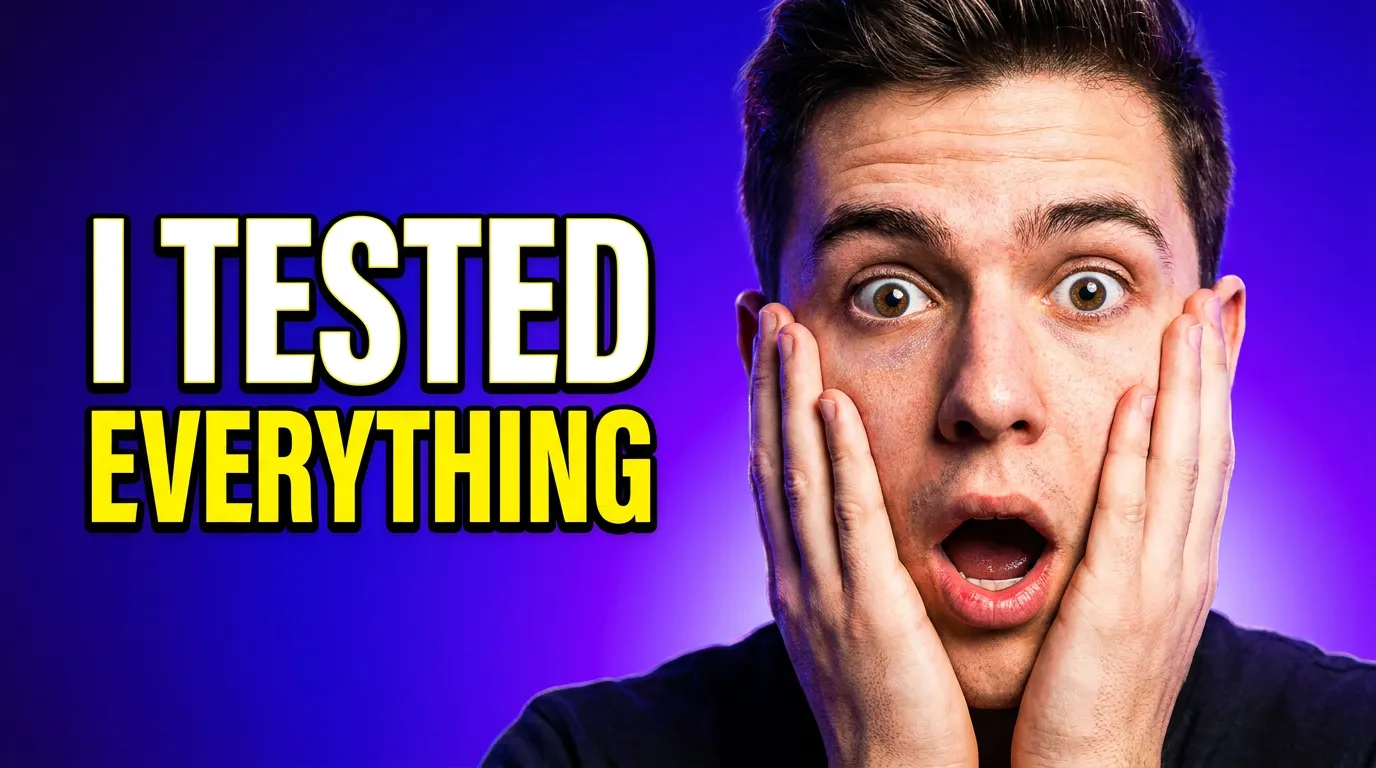
Nano Banana Pro is the model commenters on Reddit's r/aitubers keep recommending for thumbnail image quality, and its strength is exactly the expressive-face job: emotion that still reads when the render is compressed to feed size, plus enough facial stability to reuse one persona across a channel, per Leaxor's assessment.
The catch is cost discipline. At 6 credits per render on my brief versus 1 for GPT Image 2, tuning an expression through multiple rerolls adds up faster than any other model here. One prompt-level fix from Leaxor's testing notes: explicitly ask for natural skin texture, or faces drift toward a waxwork look that viewers read as fake.
Seedream 5 Pro: the balanced middle
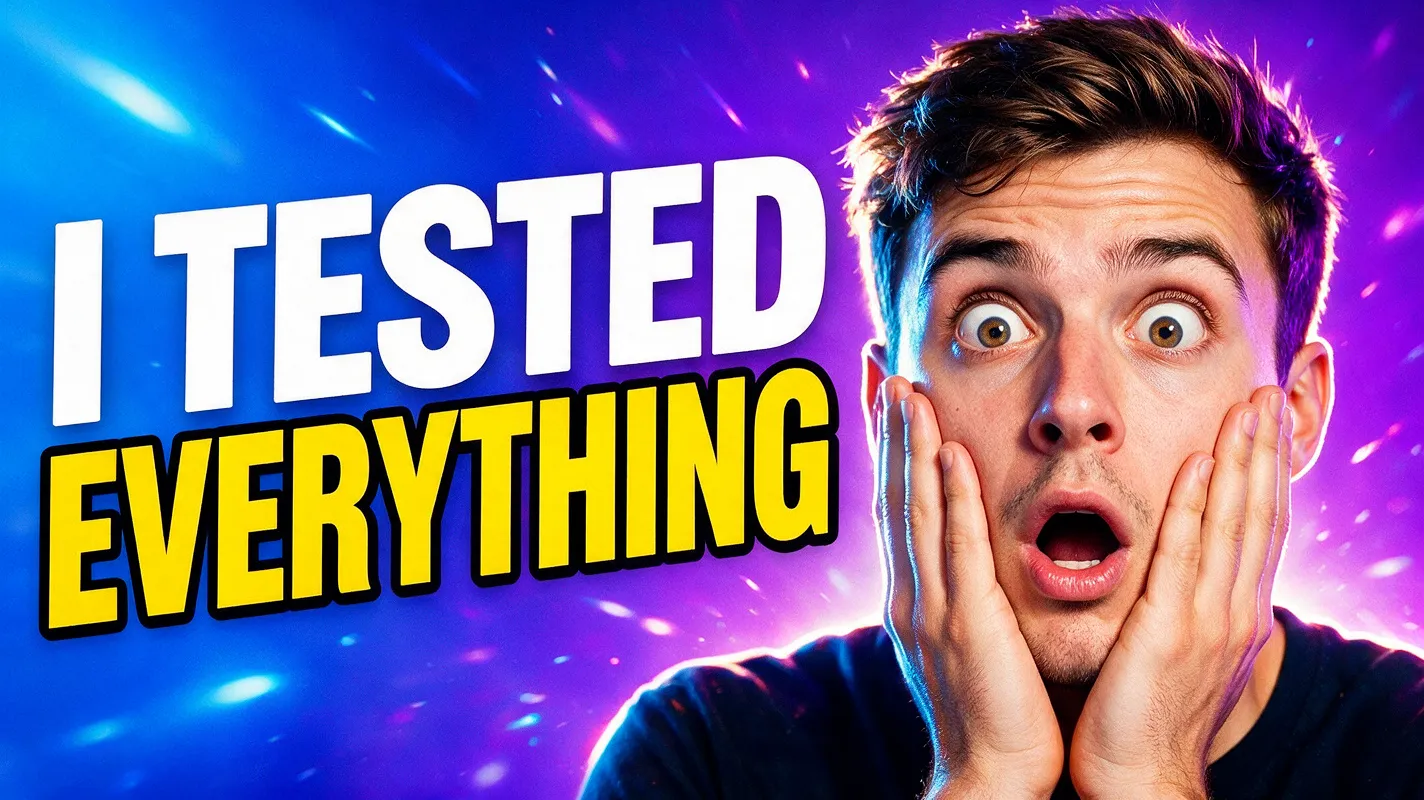
Seedream 5 Pro billed 3.5 credits, the middle of the three, and its headline render in the grid above is the fair basis for judging its text - size it against GPT Image 2's, not against my summary. For speed, the closest published number is Ropewalk's ~8 seconds per image for Seedream 4, the predecessor; I didn't stopwatch Seedream 5 Pro in this run. For one model serving a mixed-content channel rather than a specialist slot, this is it.
The Best AI Model for YouTube Thumbnails Depends on the Job
All five 2026 comparisons I read - TechSifted, Cliprise, Ropewalk, ClickStudio, and Leaxor - converge on the same structure, and my test agrees: there is no single winner, because a thumbnail is three different jobs. Pick by whichever job your channel is worst at.
| Your thumbnail's weak point | First pick | Backup | Entry price |
|---|---|---|---|
| Text gets misspelled or looks pasted-on | GPT Image 2 (API) | Ideogram | Ideogram free tier, paid from ~$8/mo |
| Faces look plastic or expressionless | Nano Banana Pro | Flux 2 Pro | Per-image API pricing |
| Backgrounds look generic | Midjourney | Leonardo AI | Midjourney from $10/mo, no free tier |
The text-led choice splits on layout. Ideogram v3, the typography pick of TechSifted, Cliprise, and Leaxor, suits poster-style graphic layouts where styled type is the design; GPT Image 2 suits headlines that have to sit convincingly inside generated imagery, per Ropewalk's baked-in-typography result. Midjourney stays the stylized-backdrop pick across the same comparisons, with text unreliable enough that those guides still send you to Canva or Photoshop for the headline. One model absent from all five roundups: Qwen Image 3 Pro - adding it to a batch test costs one extra render.
What 100 Thumbnails Cost at Volume
Subscription tools price the promise of unlimited-ish generation; APIs price the render. ClickStudio's May 2026 teardown found Pikzels tiers running $14–80/month with a practical middle tier of $28/month for channels publishing twice weekly - and, critically, iteration that burns 80–100 credits per finished thumbnail. Multiply that by Cliprise's testing math (eight variants to find a winner, 2–5 minutes per AI variant versus 30–90 minutes per hand-built one) and a "two videos a week" channel needs 60–100 generation attempts monthly before it has 4 finished thumbnails.
That's the shape of the decision, not a verdict: bursty A/B testing favors per-image metering where a dud costs 1–6 credits and nothing else, while steady high volume can favor a flat subscription. At my metered rates, 100 attempts bill 100 credits on GPT Image 2 versus 600 on Nano Banana Pro rerolls - a spread no subscription pricing page shows. All three renders above ran through AIReiter's image API.
The Prompt Formula That Survived the Test
The brief I used is reusable as a template. Fill the brackets, keep the order:
YouTube thumbnail, 16:9 widescreen: close-up of [subject] with [one exaggerated emotion], face on the right side of frame. Bold blocky sans-serif headline text reading "[3–5 WORDS]" on the left side, [color] with black outline. [background description], dramatic rim lighting, high contrast, natural skin texture.
Two variants that test well in Ropewalk's formula set: a reaction-face frame with the subject pointing at camera, and a before/after split with a hard vertical divider.
Three placement rules do most of the work:
- Face at 60–70% of frame
- One-third of the width reserved for the headline
- Nothing important in the lower-right corner, where YouTube overlays the duration badge
Generate 3–5 variants minimum, because in Ropewalk's testing the third output won 11 of 24 matchups - nearly double the first output's six.
The community guardrails are blunt about what happens after that. A creator who redesigned 40+ thumbnails in one month put it this way:
"One focal point, three to four words max - and an image that obviously looks AI-generated can hurt how viewers rate the whole video."
A separate month-long verdict on r/NewTubers reached the same conclusion from the other side: AI tools cut production time dramatically, but the thumbnails that performed best still got a manual refinement pass rather than shipping straight from the generator.
The upload specs, and one trap my own test hit:
| Requirement | Value | My test renders |
|---|---|---|
| Resolution | 1280×720 (minimum accepted: 640×360) | All three at 1280×720 |
| Aspect ratio | 16:9 | All three correct |
| File size | Under 2 MB | GPT Image 2 2.1 MB and Seedream 5 Pro 2.1 MB needed recompression; Nano Banana Pro 1.4 MB passed |
| Formats | JPG, PNG, GIF | All PNG |
| Final check | View at ~300 px width | - |
FAQ
Which AI model is best for YouTube thumbnails?
Use the pick-by-job table above; compressed to one line, it's GPT Image 2 or Ideogram for text-led channels, Nano Banana Pro for face-led, Midjourney for stylized backdrops. Qwen Image 3 Pro is the wildcard none of the five 2026 roundups tested - worth one extra render in your batch.
Can AI models render readable text in thumbnails?
GPT Image 2 rendered 21 of 24 five-word headlines legibly in Ropewalk's April 2026 test, and Ideogram v3 is the consensus typography pick of TechSifted, Cliprise, and Leaxor. Most other diffusion models still misspell or smear short headlines often enough that the standard advice - generate the visual, add text in an editor - remains the safe route.
Is an image API cheaper than a thumbnail-tool subscription?
It depends on volume shape. Per-image metering charges 1–6 credits per attempt with no monthly floor, which suits bursty A/B testing; dedicated tools like Pikzels run $14–80/month and can burn 80–100 credits per finished thumbnail during iteration. Below roughly four videos a month, Ideogram's daily free allowance or Leonardo's 150 daily tokens can stretch to cover it.
Do AI-generated thumbnails hurt CTR?
The format itself isn't the risk - execution is. Cliprise's math has a 4%->6% CTR lift producing 50% more views at identical impressions, because cheap variant testing is the whole value. Perception bites instead: creators on r/NewTubers and r/YouTubeCreators report an obvious AI look lowers how viewers rate the video, and the natural-skin-texture prompt line plus a manual polish pass exist for exactly that.
The 10-Second Decision Table
| If your channel is... | Use | Because |
|---|---|---|
| Education, commentary, list-format | GPT Image 2 or Ideogram | The headline is the click, and text accuracy decides it |
| Vlog, reaction, challenge | Nano Banana Pro | Expressions that survive 300 px, reusable personas |
| Gaming, cinematic analysis | Midjourney | Art-directed backdrops, channel-wide style via references |
Next step: take the prompt template above, run it through two of the three models in the image generator, and shrink the results to feed size before choosing. For a deeper dive on the text-rendering axis specifically, see our text-rendering model comparison; for product-shot thumbnails, the product-photo model rundown covers that job.
Related reading: