 AIREITER
If A2E’s low entry price is attractive but a failed render, changing plans, or weak lip-sync is costing you time, the best A2E alternative depends on the output you need. HeyGen is the safest switch for polished business presenters; Hedra is the better fit for expressive talking or singing characters; Higgsfield Lipsync Studio is the most flexible choice for multi-model lip-sync and localization. A2E is still worth keeping for inexpensive experimentation, but its credit rules and output variability deserve a closer look before you build a production workflow around it.
A2E alternative: the short answer
| If you need… | Start with… | Why | Main trade-off |
|---|---|---|---|
| A dependable presenter for marketing or training | HeyGen | Stock and custom avatars, voice options, translation, and a business-oriented workflow | Higher subscription cost than A2E |
| A talking or singing character from an image and audio | Hedra | Hedra Avatar is built around portrait-plus-audio video and sits beside other image, video, and voice models | Credits and model-specific pricing require close tracking |
| Lip-sync, dubbing, and model choice in one workspace | Higgsfield | Lipsync Studio supports several lip-sync/video models and localization workflows | Credit costs vary by model, resolution, and duration |
| Low-cost, broad experimentation | A2E | Free access, avatar tools, image-to-video, and credit top-ups | Quality, moderation, and plan terms can change |
What A2E does well—and why people look elsewhere
A2E is not just a talking-photo app. Its official product pages cover AI-avatar video, avatars made from images, lip-sync, image-to-video, voice cloning, and API access. The platform uses credits rather than a single flat “video price”: its current detailed pricing materials list lip-sync video at 1 credit per second, while an avatar created from an image is listed at 30 credits on the video pricing page.
That breadth is useful when you want to try several workflows without opening multiple accounts. It is less useful when one failed generation forces a rerun, or when the feature you need is hidden behind a different plan or credit rule.
Real-user discussions point to that distinction. In a Reddit thread in r/grok, u/20thcenturyman wrote that A2E’s image-to-video result was “way off 3/4 times I’ve tried” (thread). Another user, u/williwilli6666, said A2E had been “VERY VERY good” before a model change, after which “everything looks just silly” (thread). These are individual reports, not a benchmark, but they identify the switching questions that feature lists usually miss: how often is a result usable, and will the workflow still behave the same next month?
“I liked A2E, which comes with one free clip per day and costs $8 for about 60 clips. But it seems they recently changed the model.” — u/williwilli6666, Reddit
A2E pricing: check the credits before you compare tools
A2E’s official pricing pages currently show Free, Pro, and Ultra options, but the site also contains older pages that refer to Max and different credit amounts. Treat the live billing screen as the operational source of truth.
| A2E item | Current official information | What to watch |
|---|---|---|
| Free access | Signup and daily bonus credits are advertised | Exact offers can vary between pricing and FAQ pages |
| Pro | Listed at $14.90 for one month; pricing materials show 1,500 upfront credits plus daily credits | Confirm the total displayed at checkout |
| Ultra | Listed at $59.90 for one month; pricing materials show 9,000 upfront credits plus daily credits | Confirm the current monthly credit total |
| Lip-sync video | 1 credit per second | A 60-second clip uses about 60 credits at that rate |
| Avatar from an image | 30 credits on the detailed video pricing page | Separate avatar creation from the later video render |
| Top-up credits | Official FAQ examples: $19.90 for 1,800 credits and $80 for 16,000 credits | Purchased top-ups are described as non-expiring |
| Subscription credits | Do not roll over according to the pricing FAQ | A cheap month can be wasteful if credits expire unused |
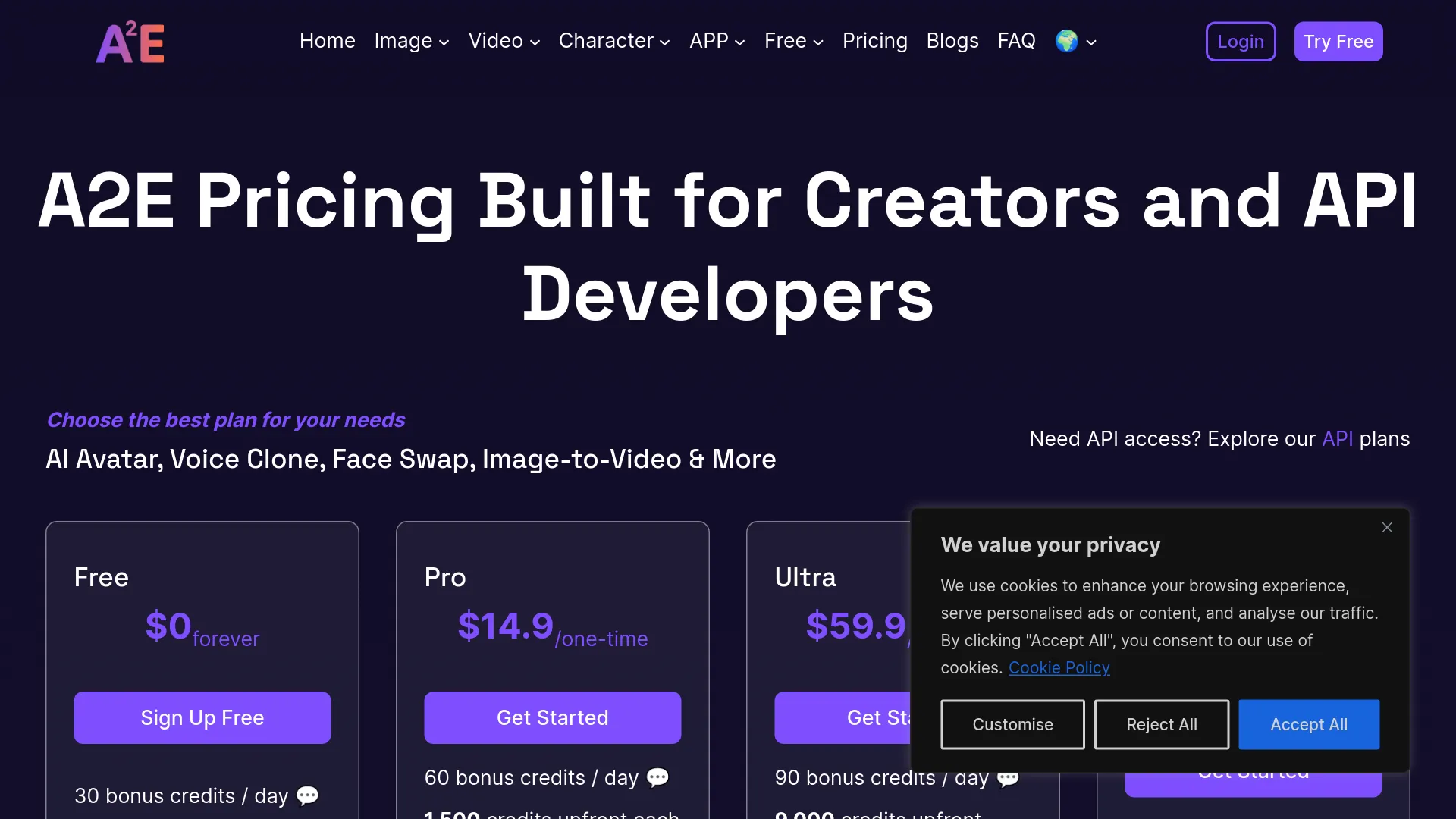
The useful comparison is not “which plan has the lowest monthly price?” It is cost per usable clip. Include failed generations, reruns, clip length, resolution, watermark rules, and whether your credits expire. A2E’s official FAQ says paid-plan content can be used commercially subject to its asset and licensing conditions, so client work should also be checked against the current terms rather than inferred from the free tier.
The three strongest A2E alternatives, matched to the job
HeyGen: the best A2E alternative for business presenters
Choose HeyGen when the deliverable is a training video, product explainer, onboarding lesson, or localized marketing presenter—not an experimental face-swap clip.
HeyGen’s official pricing page lists a free tier, Creator at $29 per month or $24 per month billed annually, Pro from $49 per month, and Business at $149 per month plus additional seats. Its FAQ describes Creator as including 600 credits per month and Pro as starting at 1,000 credits, with 4K export on Pro.
| HeyGen strength | Why it matters against A2E |
|---|---|
| Stock and custom avatars | Less dependence on a one-off portrait workflow |
| Voice and translation features | Better suited to repeatable business localization |
| API access | A clearer path from manual test to application workflow |
| Business plans and workspaces | More appropriate for teams than an informal creator workflow |
The trade-off is cost and specialization. HeyGen is not the obvious choice for rapid, stylized image-to-video experiments. It is the better choice when a recognizable presenter, consistent delivery, and a client-facing export matter more than maximum creative looseness.
Hedra: the best A2E alternative for expressive talking characters
Hedra is the closest match when the input is a portrait or start frame plus audio and the output should talk, sing, or perform. The official Hedra Avatar page says it supports videos up to 10 minutes and lists API rates of $0.025 per second at 540p, $0.05 at 720p, and $0.0625 at 1080p.
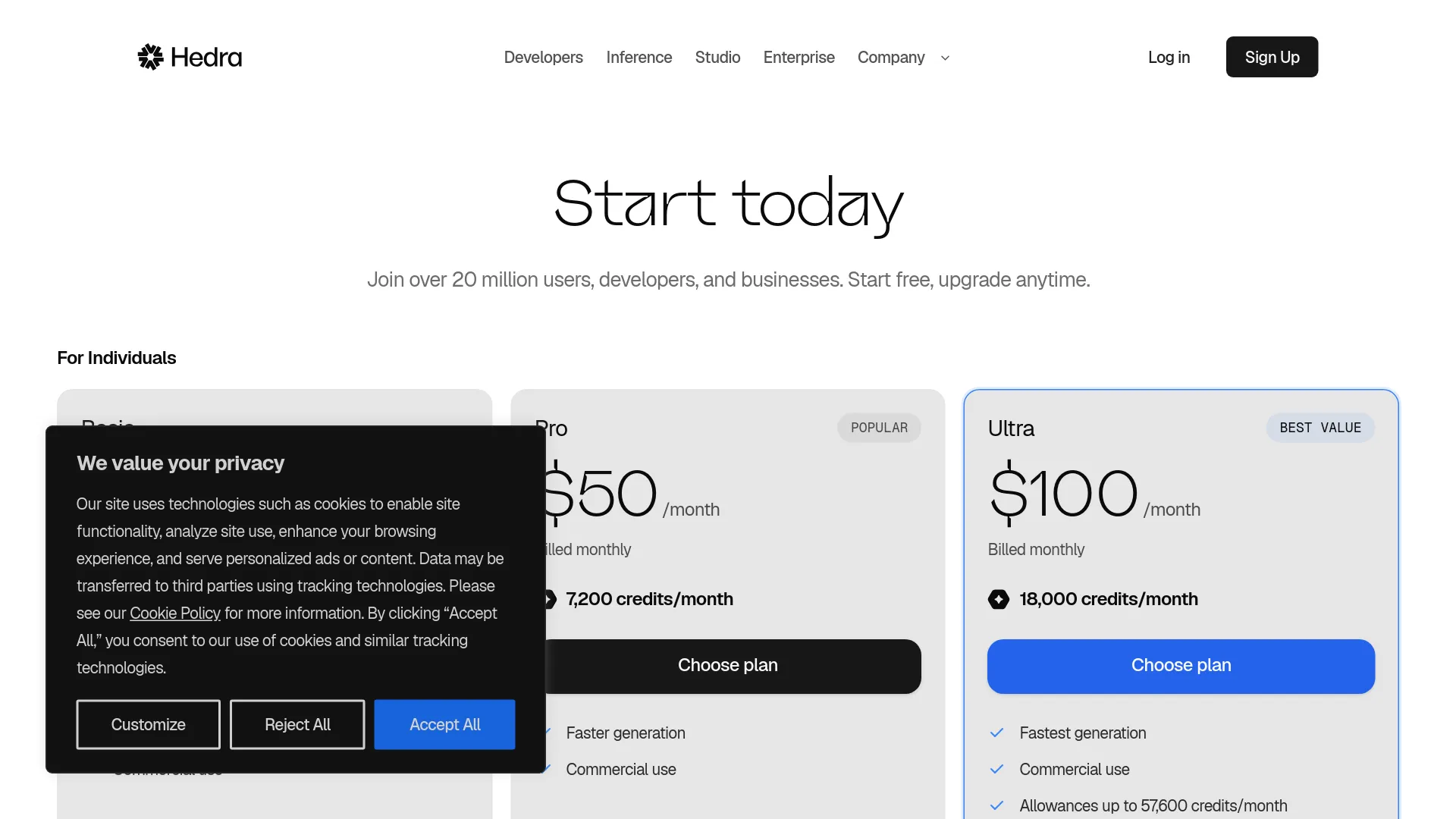
Hedra’s pricing page lists Basic at $15 per month for 1,500 credits, Creator at $30 for 5,400 credits, and Professional/Teams at $75 for 14,400 credits. Those studio subscriptions should not be confused with the direct API rates.
Hedra is a stronger replacement than A2E when:
- The voice performance is central to the clip.
- You want to compare several image, video, and audio models in one studio.
- You need a longer talking-avatar output than a short social clip.
- You prefer explicit per-second API pricing for a programmatic workflow.
It is not automatically cheaper. A credit subscription and a per-second API quote answer different buying questions, so price the exact workflow you will run.
Higgsfield Lipsync Studio: the best A2E alternative for lip-sync and localization
Higgsfield is the better fit when you already have footage or a generated performance and need lip-sync, dubbing, or language adaptation. Higgsfield describes Lipsync Studio as part of its broader subscription rather than a separate product. Its official materials mention models including Google Veo 3, Wan Speak, Kling Avatars, Higgsfield Speak, Infinite Talk, Sync Lipsync, and Kling Lipsync.
The pricing model is credit-based. Higgsfield’s help center says the charge depends on model, resolution, and duration, and subscription credits generally expire at the end of the billing cycle. Official examples put a 15-second 720p Veo 3 lip-sync job at approximately $2.90, and a 20-second performance shot at approximately $3.35, using the company’s example credit conversion.
That makes Higgsfield a practical A2E alternative for localization and model selection, but not a simple flat-price replacement. API billing is also separate from the creator-site subscription. If you need predictable application costs, compare the API product—not the creator plan—to A2E’s API terms.
A safer way to evaluate an A2E replacement
Do not judge a replacement from its best gallery example. Use the same small test pack in each service:
- Use one front-facing portrait with visible eyes and mouth, plus one more difficult angled image.
- Use the same 15–20 second script or audio file.
- Ask for the same delivery: neutral presenter, natural blinking, restrained head movement, and clean lip-sync.
- Record the number of attempts, the credits consumed, the final usable seconds, the watermark, and the export resolution.
- Check whether the result preserves identity, mouth timing, eye direction, hands, and background continuity.
- Confirm commercial-use terms and whether unused credits roll over.
This test exposes the gap between a cheap generation and a cheap usable result. It also protects you from a common mistake: comparing A2E’s broad feature list with a specialist tool’s strongest single feature.
A2E alternatives: the decision table
| Your actual problem | Best choice | Why not simply stay with A2E? |
|---|---|---|
| A presenter must look consistent across training or marketing videos | HeyGen | A2E’s broader toolkit is less important than repeatable presenter production |
| A portrait needs to speak or sing with expressive audio | Hedra | Hedra’s Avatar workflow is more directly centered on portrait-plus-audio performance |
| Existing footage needs dubbing or lip-sync in several languages | Higgsfield Lipsync Studio | The multi-model localization workflow is closer to this job than A2E’s general toolkit |
| You need cheap experiments and can tolerate reruns | A2E | Switching may cost more than the occasional failed generation |
| You need an API with predictable unit economics | Compare Hedra API, HeyGen API, and Higgsfield API separately | Subscription credits are not interchangeable with API billing |
| You need unrestricted or minimally moderated experimentation | Verify A2E’s current policy first | Community reports suggest moderation and access can vary by account and over time |
FAQ
Is HeyGen better than A2E?
HeyGen is better for polished business-avatar videos, localization, and repeatable team workflows. A2E is more suitable for low-cost experimentation across several avatar and video functions.
What is the cheapest A2E alternative?
There is no universal winner because the tools bill differently. A2E has a free tier and low-priced plans; Hedra publishes both subscription credits and API rates; HeyGen starts at $29 monthly for Creator; Higgsfield uses model- and duration-dependent credits. Compare the cost of one usable clip, not the monthly headline.
Is Hedra good for talking avatars?
Yes. Hedra Avatar is designed for talking or singing videos from a portrait or start frame and audio, with official materials describing outputs up to 10 minutes. The exact cost depends on resolution, workflow, and whether you use studio credits or the API.
Is Higgsfield Lipsync Studio separate from its subscription?
Higgsfield describes Lipsync Studio as part of its broader creator subscription. Its API is billed separately, and credit use depends on model, resolution, and duration.
Can I use A2E outputs commercially?
A2E’s FAQ says paid-plan content can be used commercially subject to its licensing conditions and the rights in uploaded assets. Check the current terms for the plan and content type you will use.
Do A2E credits roll over?
A2E’s pricing FAQ says subscription credits do not roll over. Separately purchased top-up credits are described as non-expiring. Because the site has older pricing pages with different plan language, verify the rule in the current billing interface before buying.
The practical choice is straightforward: keep A2E for inexpensive discovery, move to HeyGen for dependable presenters, choose Hedra for expressive avatar performance, and use Higgsfield when lip-sync and localization are the workflow. The unresolved trade-off is not “which tool has the most features”; it is how much you are willing to pay to reduce failed generations and plan uncertainty.