 AIREITER
A production call to deepseek-v4-pro will soon return a different model without requiring a code change. DeepSeek V4.1 Flash is cheaper and now the recommended default, but that alias transition makes validation more important than the headline price cut.
Make the production decision before reading the rate card
New deployments should use deepseek-flash; existing Flash deployments should replace legacy aliases during their next configuration release. Teams relying on the distinct behavior of V4 Pro should run acceptance tests before 12:00 Beijing Time on September 14, 2026, when DeepSeek says deepseek-v4-pro will begin routing to V4.1 Flash until V4.1 Pro arrives.
| Situation | Decision | Reason |
|---|---|---|
| New text, agent, or vision workload | Use deepseek-flash | It is the canonical V4.1 Flash ID and supports vision |
Existing deepseek-v4-flash workload | Test, then rename the ID | The alias already serves V4.1 Flash, so renaming removes ambiguity |
| Existing Vision-Exp workload | Re-test image cases, then rename | deepseek-v4-flash-vision-exp now routes to V4.1 Flash |
| Production V4 Pro dependency | Run a regression set before September 14 | The same ID is scheduled to return V4.1 Flash after the cutoff |
| Requirement for a stable V4-Pro-0813 endpoint | Do not assume the alias remains pinned | DeepSeek's change log announces retirement and gives no V4.1 Pro release date |
DeepSeek's September 10 change log calls V4.1 Flash an official release, not a beta. It also says the older V4 Flash and Vision-Exp models are retired and that their names are temporarily retained for compatibility.
DeepSeek V4.1 Flash API pricing and workload math
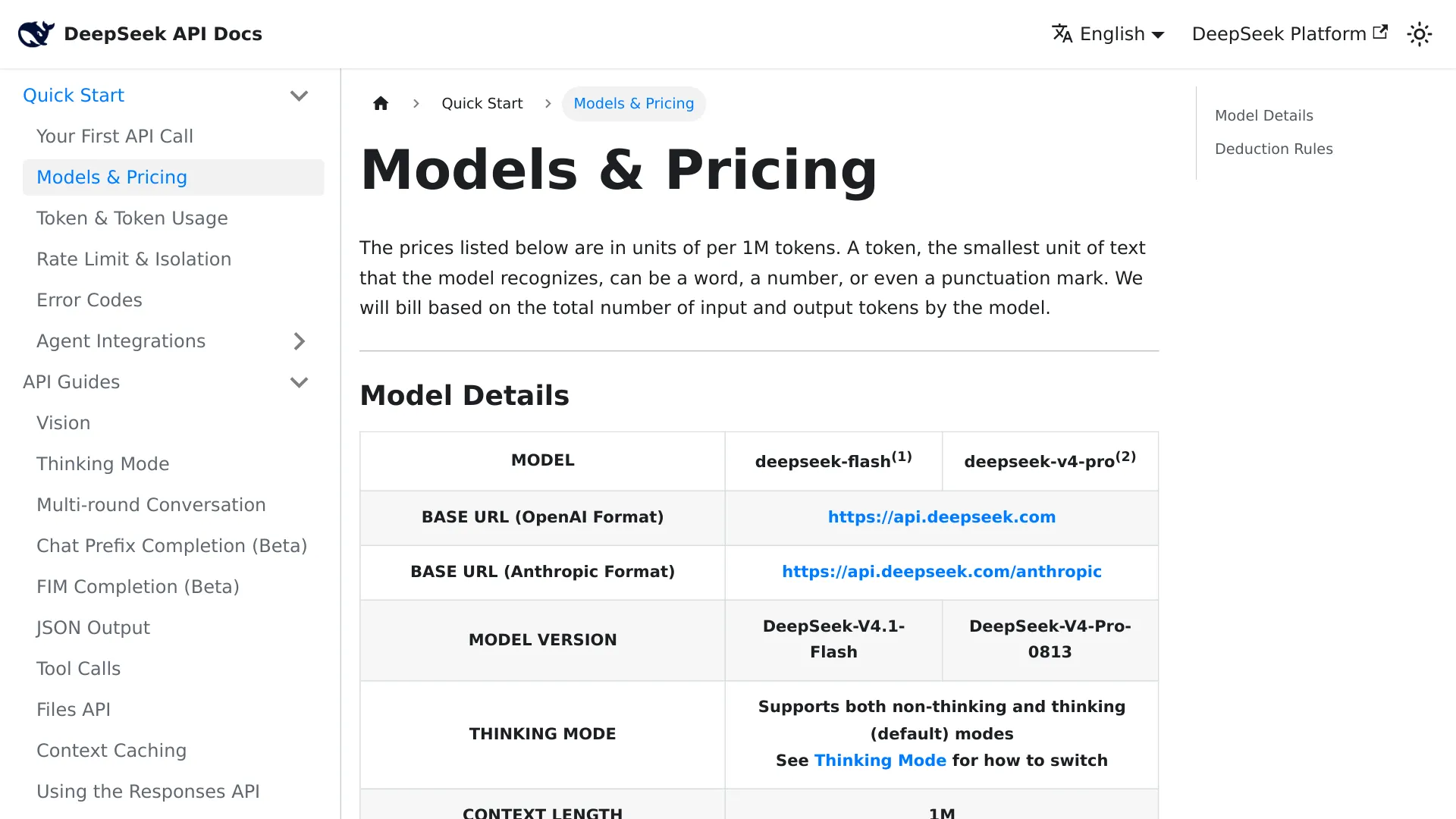
DeepSeek V4.1 Flash API pricing is $0.15 per million uncached input tokens and $0.60 per million output tokens off-peak. Peak rates double to $0.30 and $1.20; cached input costs $0.003 off-peak or $0.006 peak, according to DeepSeek's official pricing page.
Rates as of September 10, 2026
All prices below are USD per 1 million tokens. Peak pricing applies Monday through Friday from 01:00-04:00 UTC and 06:00-10:00 UTC; weekends and every other hour are off-peak.
| Token category | Flash off-peak | Flash peak | V4 Pro off-peak | V4 Pro peak |
|---|---|---|---|---|
| Cache-hit input | $0.003 | $0.006 | $0.022 | $0.044 |
| Cache-miss input | $0.15 | $0.30 | $0.66 | $1.32 |
| Output | $0.60 | $1.20 | $1.98 | $3.96 |
Flash is 77.3% cheaper than Pro for uncached input and 69.7% cheaper for output at either time tier. A Flash cache hit costs 98% less than a cache miss, making prefix stability more valuable than small prompt-trimming gains.
What 10 million input and 1 million output tokens cost
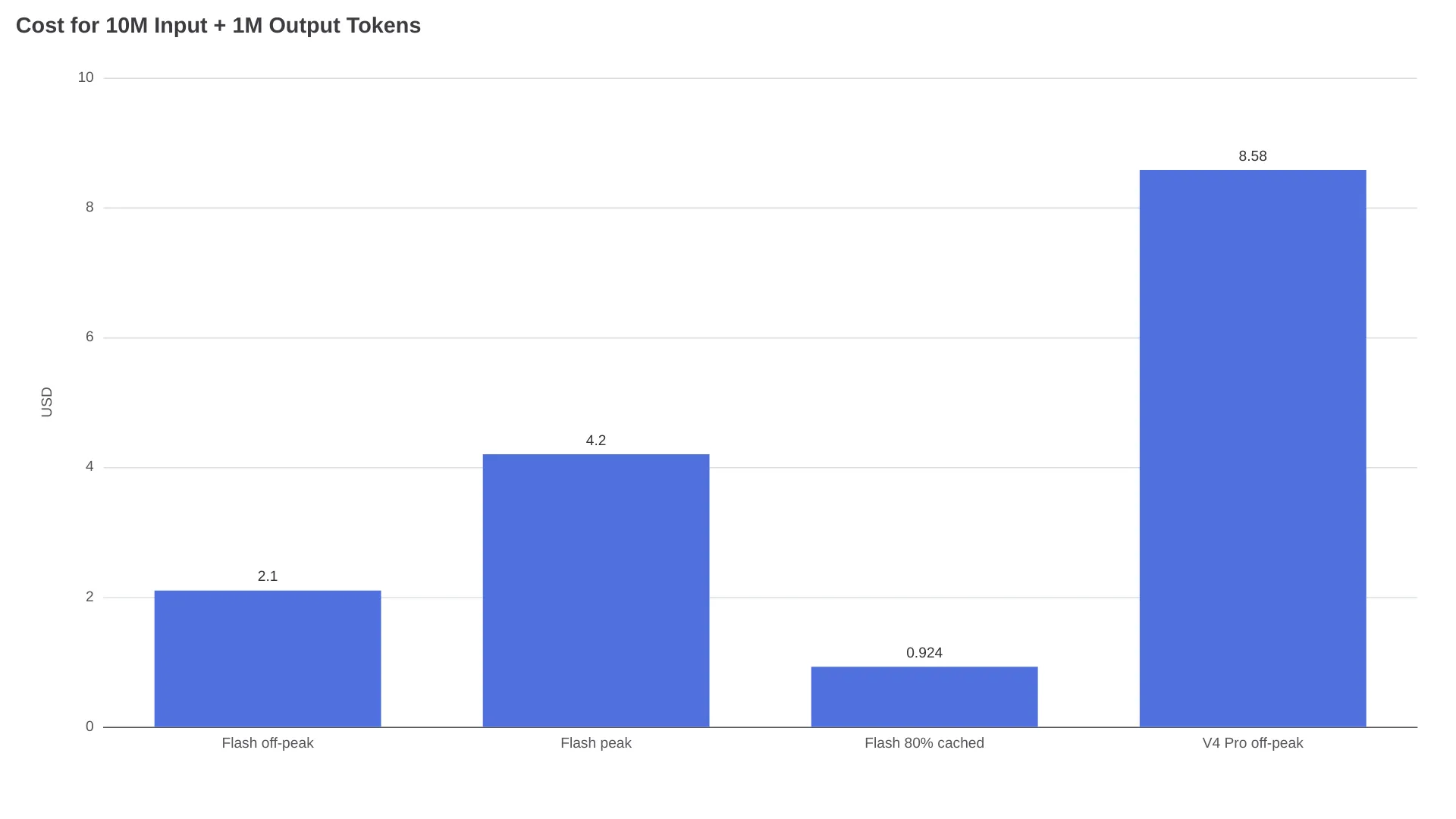
For 10 million input tokens and 1 million output tokens, with no cache hits, Flash costs $2.10 off-peak: (10 x $0.15) + (1 x $0.60). The same workload costs $4.20 at peak, while V4 Pro costs $8.58 off-peak.
If 80% of the Flash input receives cache-hit billing, the off-peak cost falls to $0.924: (8 x $0.003) + (2 x $0.15) + (1 x $0.60). That is arithmetic from the published rates, not a measured invoice; output length, cache eligibility, retries, and reasoning usage determine the actual charge.
There are 35 peak hours in a 168-hour week. Batch jobs that can avoid those windows cut every listed token rate in half, while interactive traffic needs budgeting against the peak column rather than an assumed weekly average.
Model IDs are now routing rules
DeepSeek model IDs no longer identify immutable model versions. The canonical ID selects V4.1 Flash directly, while three older names either already route or are scheduled to route to it.
| Request model ID | Served model on September 10 | Announced behavior |
|---|---|---|
deepseek-flash | DeepSeek-V4.1-Flash | Canonical ID |
deepseek-v4-flash | DeepSeek-V4.1-Flash | Temporary compatibility alias |
deepseek-v4-flash-vision-exp | DeepSeek-V4.1-Flash | Temporary compatibility alias |
deepseek-v4-pro | DeepSeek-V4-Pro-0813 | Routes to V4.1 Flash after 12:00 Beijing Time, September 14 |
The practical risk is silent behavioral change. Logging only the request ID cannot prove which underlying version answered, so preserve response metadata where available and date every evaluation.
A four-step migration check
- Replace legacy Flash names with
deepseek-flashin configuration, not scattered application code. - Replay a fixed set of accepted text, tool-call, JSON, and image cases against V4.1 Flash.
- Compare pass rate, billed input and output tokens, full completion time, and tool-retry count; raw tokens per second does not capture failed work.
- Keep the previous route or another validated provider behind a feature flag until the new results meet the workload's acceptance threshold.
One rollout report illustrates why discovery belongs in the check. A Reddit user, u/yukiaddiction, asked, "why I don't see on my deepseek harness?" The thread's reported workaround was a fresh Harness installation, but that is a user report rather than official support guidance.
Capabilities and operating limits
DeepSeek V4.1 Flash combines text and image input with thinking modes, tool calls, JSON output, and OpenAI-compatible and Anthropic-compatible interfaces. The official table lists a 1 million-token context, a 384,000-token maximum output, and concurrency of 2,500, compared with 500 for V4 Pro.
| Capability | V4.1 Flash | V4 Pro before rerouting |
|---|---|---|
| Vision input | Yes | No |
| Thinking and non-thinking modes | Yes | Yes |
| Tool calls and JSON output | Yes | Yes |
| Responses and Anthropic APIs | Yes | Yes |
| Context window | 1M tokens | 1M tokens |
| Maximum output | 384K tokens | 384K tokens |
| Listed concurrency | 2,500 | 500 |
Vercel's AI Gateway model page showed 211 output tokens per second and 1.3 seconds to first token on September 10. Vercel labels those as P50 measurements from live gateway traffic, so they are operational snapshots, not fixed specifications or quality scores.
DeepSeek reports GPQA Diamond 90.9, Codeforces rating 3471, Terminal-Bench 2.1 at 90.6, and DeepSWE v1.1 at 74.2 for V4.1 Flash. Those are vendor-published launch results; use executable acceptance tests for a production decision. A specific early complaint reinforces that boundary: @sdjn_wgc reported that an OpenCode skill task copied prior file content or confused character subjects, while other users described very high generation speed. One failure report and several speed impressions do not establish a general quality ranking.
Switch now, or wait?
V4.1 Flash is the sensible default for new workloads and the required test target for existing official-API users because DeepSeek is consolidating its routes around the model. The exception is a workflow whose accepted output depends on V4 Pro behavior and cannot complete regression testing before the scheduled alias change.
| Workload | Recommendation |
|---|---|
| High-volume extraction, classification, or routine agent steps | Switch now after a small acceptance run |
| Repeated long system prompts | Switch and monitor cache-hit usage; the off-peak hit rate is $0.003/M |
| Screenshot or document-image processing | Test now; native vision removes the separate Vision-Exp route |
| Tool-heavy coding agent | Gate deployment on executable tests and tool-retry rate |
| Safety-critical or regulated workflow | Wait for internal validation and confirm hosting/data requirements separately |
| Self-hosting | Evaluate infrastructure first; a user inspecting the release reported a checkpoint above 500 GB |
Open weights do not imply laptop-class deployment. @plotarmordev wrote that the "checkpoint is over 500 GB" and described local use as not plug-and-play. Hosted API pricing is therefore the relevant comparison for most teams without multi-GPU infrastructure.
DeepSeek V4.1 Flash API FAQ
Is DeepSeek V4.1 Flash officially released?
Yes. DeepSeek's official API change log dates the release September 10, 2026, and lists deepseek-flash as the current API model name.
What are DeepSeek's peak hours?
Peak hours are 01:00-04:00 UTC and 06:00-10:00 UTC, Monday through Friday. All weekend hours and other weekday hours receive rates that are half the peak price.
Does deepseek-v4-flash still work?
Yes, but it is a temporary compatibility alias that now serves V4.1 Flash. New configurations should use deepseek-flash so the requested product is explicit.
Does V4.1 Flash support image input?
Yes. DeepSeek lists native multimodal visual understanding and vision support; images are billed as input tokens.
Will deepseek-v4-pro keep returning V4 Pro?
Not under the announced schedule. DeepSeek says requests using that ID will route to V4.1 Flash after 12:00 Beijing Time on September 14, 2026, until V4.1 Pro is released.
Is V4.1 Flash cheaper than V4 Pro?
Yes. Off-peak uncached input/output rates are $0.15/$0.60 for Flash versus $0.66/$1.98 for Pro, and the relative difference is the same at peak.
The next action
Change legacy Flash aliases to deepseek-flash, run the same acceptance corpus before and after the change, and budget interactive traffic at peak rates. For Pro users, complete that check before September 14 because leaving the model string untouched is not the same as leaving the model unchanged.
Related reading