 AIREITER
A Kie AI alternative is worth evaluating only for model and task paths it documents. In the public Qwen Image samples checked on August 11, 2026, Kie and AIReiter list the same prices. AIReiter is an option for teams using its documented image and video models, not a blanket replacement for every Kie integration.
When a Kie AI alternative is worth evaluating
The right Kie AI alternative depends on three checks: whether it exposes the models your jobs actually call, whether its asynchronous task lifecycle fits your application, and whether its billing behavior is acceptable when a generation fails. A provider's total catalog count is useful context, but it does not prove that every model, endpoint, or task state matches an existing production workflow.
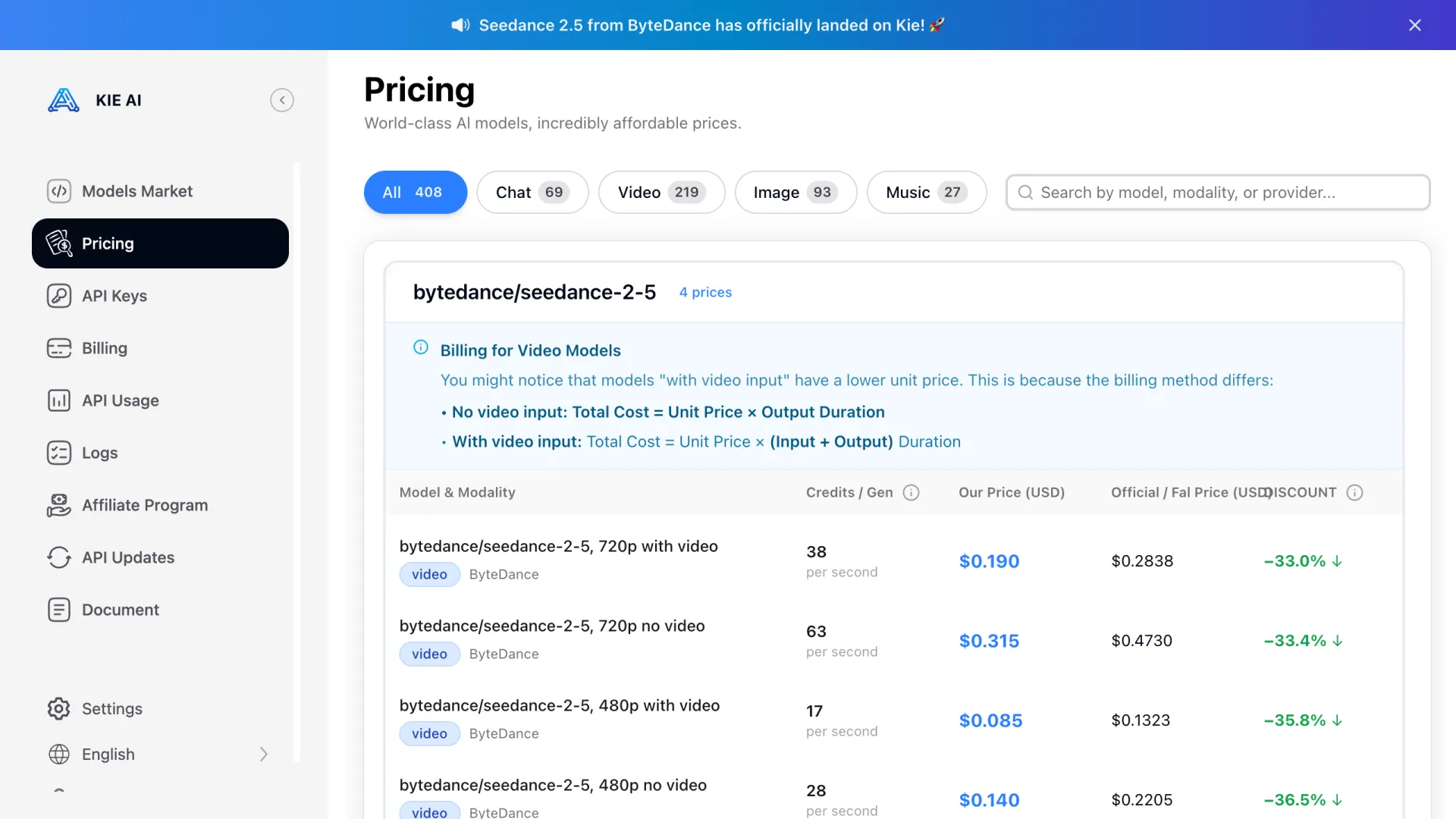
Kie's public pricing page showed 408 listed models on August 11, 2026: 219 video, 93 image, 69 chat, and 27 music entries. A team that relies on Kie's long tail should first identify the exact model IDs and input modes in its logs. For an image or video task that stalls, the operational question is whether the application can inspect its status, retry safely, and account for the failed attempt.
A public pricing check does not show an automatic saving
AIReiter should not be positioned as a cheaper Kie replacement without a matched configuration. Public prices differ by resolution, duration, input type, and output count; credit labels alone are not comparable. The two identical image configurations below are a dated spot check, not a whole-catalog price study.
| Public configuration checked on Aug. 11, 2026 | Kie | AIReiter |
|---|---|---|
| Qwen Image 3.0, 1K output | $0.024 per generation | $0.024 per generation |
| Qwen Image 3.0 Pro, 1K output | $0.032 per generation | $0.032 per generation |
| Qwen Image 3.0 Pro, 2K output | $0.060 per generation | $0.060 per generation |
The useful result is negative as well as positive: price alone is not a reason to move these Qwen Image jobs. Repeat the same like-for-like check for the resolution, duration, reference-input mode, and output count your application sends before treating a provider change as a cost reduction.
Check model overlap before you switch
AIReiter is most relevant as a Kie AI alternative when the required workflow is already covered by a named AIReiter model page and documented API path. The public evidence below confirms overlap for three current examples; it does not imply that the providers expose every variant or feature in the same way.
| Workflow to verify | Public Kie evidence | Public AIReiter evidence |
|---|---|---|
| Qwen Image 3.0 | Listed on Kie's public pricing table | Qwen Image 3.0 API page |
| Qwen Image 3.0 Pro | Listed on Kie's public pricing table | Qwen Image 3.0 Pro API page |
| Seedance 2.5 video | Listed on Kie's public pricing table | Seedance 2.5 API page |
Choose AIReiter when those are the models your product needs and you want to work from a focused set of image and video model pages, backed by the AIReiter pricing list and API documentation. Do not switch solely because a provider has a more attractive catalog headline. If your Kie integration depends on an unlisted model, a particular reference-media option, or a provider-specific endpoint, keep Kie in place until that exact path is verified.
The API task flow is the migration boundary
Both platforms document asynchronous work, but documentation parity is not drop-in API compatibility. Kie's getting-started guide has dedicated sections for asynchronous tasks, task details, rate limits, and concurrency. AIReiter's public API documentation describes submitting a generation task, retrieving task status, and retrieving results for image and video work.
| Documented lifecycle item | Kie documentation reviewed | AIReiter documentation reviewed |
|---|---|---|
| Asynchronous task handling | Dedicated asynchronous-task section | Submit a task, query its status, then retrieve a result |
| Task tracking | Logs and task-details sections | Query by the caller-supplied out_task_id |
| Failed-task billing | No matched public statement verified in this review | Only successful generations are billed; failed tasks are not charged |
| Callback or webhook behavior | Not verified in this review | Not verified in this review |
The table establishes documented controls, not identical request bodies, response schemas, status values, callback behavior, or latency. Treat those as integration questions to test.
Validate these six items before moving live jobs
No live Kie-to-AIReiter migration test was run for this guide. Before moving a production image or video workflow, validate these items in a small isolated pilot:
- Map the model ID, input fields, resolution, duration, and reference-media options for one real task.
- Save and compare each provider's task identifier and all observed status values.
- Confirm where result URLs appear, how long they remain available, and how the application stores them.
- Trigger a controlled retry and confirm whether duplicate output or duplicate billing can occur.
- Check cancellation, timeout, and failed-task billing rules for the exact model configuration.
- Move a limited traffic slice only after the results, task states, and charges match the expected behavior.
Choose by the job you need to run
| If your team needs... | Better decision |
|---|---|
| One of the verified Qwen Image or Seedance workflows, with a documented AIReiter task flow | Evaluate AIReiter's image and video API catalog in a small pilot. |
| A Kie-specific model, configuration, or API behavior that has not been matched | Keep the current Kie workflow until that exact requirement is verified. |
| A lower cost claim | Run a like-for-like price comparison first; the public Qwen samples here did not show a difference. |
| A production migration | Pilot task states, results, retries, cancellations, and billing before shifting live traffic. |