 AIREITER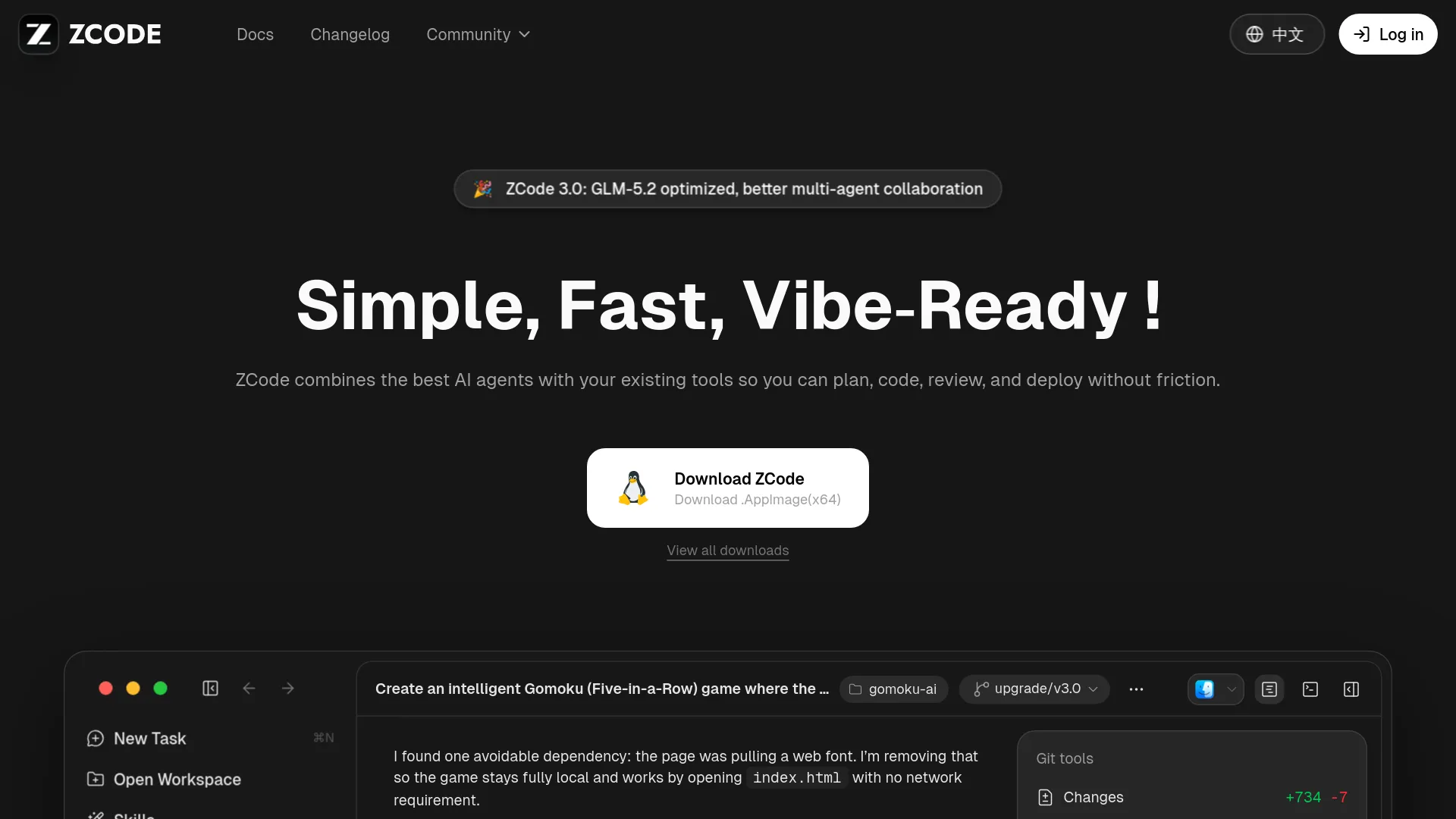
ZCode launched on July 1, 2026 as Z.ai's desktop coding agent for GLM-5.2. Five weeks and fifteen releases later, it has scheduled tasks, custom-model subagents, and project-scoped memory - features that materially narrow the gap with Claude Code. But ZCode still can't match Claude Code's composable hooks, five-level subagent nesting, or terminal-first CI integration.
Two Products, Two Centers of Gravity
ZCode and Claude Code are architecturally distinct tools built around different developer habits.
| Dimension | ZCode | Claude Code |
|---|---|---|
| Core interface | Electron desktop app (GUI) | Terminal CLI, plus VS Code, JetBrains, desktop, web, iOS |
| Default model | GLM-5.2 (744B MoE, MIT weights) | Claude Opus 4.8 / Sonnet 5 (closed weights) |
| BYOK providers | Z.ai, Anthropic, OpenAI, OpenRouter, Moonshot, MiniMax, DeepSeek, Xiaomi MiMo | Anthropic models only (session provider) |
| Permission modes | 5 (Default, Confirm, Auto Edit, Plan, Full Access) | 6 (default, acceptEdits, plan, auto, dontAsk, bypassPermissions) |
| Autonomy | /goal with built-in verification | Hooks at 25 lifecycle points + classifier-backed auto mode |
| Remote control | QR pairing (one phone), WeChat/Feishu bots | QR pairing (32 server sessions), Telegram/Discord/iMessage |
| Platforms | macOS, Windows, Linux (beta) | macOS, Windows, Linux, iOS, web |
| Openness | Closed harness, MIT-licensed model weights | Closed harness, closed weights |
ZCode bundles file management, terminal, Git, and browser preview in one desktop window. Claude Code defaults to terminal, sharing config across IDE and web via CLAUDE.md.
The Models: GLM-5.2 vs Claude Opus 4.8
The model comparison matters because each harness defaults to a different one, though neither locks you in.
| Benchmark | GLM-5.2 | Opus 4.8 | Source |
|---|---|---|---|
| SWE-bench Pro | 62.1% | 69.2% | Z.ai / aggregator |
| Terminal-Bench 2.1 | 81.0 | 85.0 | Vendor-stated |
| NL2Repo (long-horizon) | 48.9 | 69.7 | Independent eval via aggregator |
| SWE-Marathon | 13.0 | 26.0 | Independent eval via aggregator |
GLM-5.2 reaches 95–99% of Opus 4.8 on short-horizon, single-shot coding tasks, but the gap widens dramatically on sustained multi-step agent work. On SWE-Marathon, which measures long-running task completion, GLM-5.2 scores half of Opus 4.8's result.
Speed favors GLM-5.2 heavily. GLM-5.2's maximum-speed median hits roughly 206 tokens per second per Artificial Analysis data, reaching 457 tok/s on some infrastructure. Opus 4.8 maxes out around 63.5 tok/s on the Anthropic API.
The trade-off is token verbosity. GLM-5.2 consumes approximately 43,000 output tokens per Artificial Analysis Intelligence Index task, including about 37,000 reasoning tokens - up from 26,000 for GLM 5.1. Opus 4.8 is less verbose per task, which partially offsets its higher per-token price.
API pricing tells the cost story directly: GLM-5.2 charges $1.40 per million input tokens and $4.40 per million output on Z.ai's API, while Opus 4.8 charges $5/$25 per million on Anthropic's API. On Braintrust's exact-retrieval benchmark, GLM-5.2 landed within 3.5 accuracy points of Opus at roughly one-quarter the cost per trace at 25K context; the ratio held at 50K.
What ZCode Added Since Launch
ZCode has shipped fifteen releases since launch, reaching v3.7.5 on August 10, 2026 per the official changelog. The features added in that window close several gaps that the initial v3.2.x version lacked.
Scheduled and idle tasks (v3.4.2, July 22). Tasks can now execute on configurable schedules with recurrence rules, due dates, and per-task model and reasoning-intensity settings. Task cards appear directly in chat, and scheduled-task history is viewable.
Idle tasks with custom-model subagents (v3.7.5, August 10). The newest release lets idle tasks spawn subagents configured with custom models. Automation tasks support custom intervals measured in minutes rather than fixed windows. Subagents also received a configurable reasoning-effort setting - a feature Claude Code has at the session level but not per-subagent.
Project-scoped memory (v3.6.5, August 3). Memory is now organized by project and browsable from Settings. The @ mention system can reference plugins, files, and conversations, making cross-references within a workspace faster.
Kimi K3 support (v3.4.2 + v3.6.5). ZCode added Kimi K3 in July and Kimi K3 256K in August, expanding its multi-model roster beyond the GLM family. Officially supported models from other providers can now be added directly.
Global anti-sleep switch (v3.6.5). Prevents the desktop app from suspending during long-running Goal Mode iterations.
Pricing and Quota Economics
Monthly subscription prices favor ZCode at every tier, but the headline numbers mask how quickly GLM-5.2 burns through quota.
| Tier | ZCode / GLM Coding Plan | Claude Code |
|---|---|---|
| Entry | Lite: $18/month ($12.60 annual) | Pro: $20/month |
| Mid | Pro: $72/month ($50.40 annual) | Max 5x: $100/month |
| Top | Max: $160/month ($112 annual) | Max 20x: $200/month |
The GLM Coding Plan page currently displays discounted prices: Lite at $12.60, Pro at $56, and Max at $117.60 per month. Discounted annual billing and a new-account 10% first-subscription discount can lower ZCode's effective cost further. ZCode subscribers also get roughly 1.5x usage quota compared to using the same plan through raw API access or third-party harnesses.
The catch is GLM-5.2's token consumption under agent loops. GLM Coding Plan quota draws down at 3x during peak hours and 2x off-peak. One user on r/ZaiGLM reported that MCP and web-search allowances deplete unusually quickly compared to Claude Code, and another thread documented a single Goal Mode task consuming 27% of a weekly quota - approximately 55 million tokens. Treat these as single-user anecdotes, but they align with GLM-5.2's higher token-per-task consumption.
Z.ai is running an off-peak 1x promotion through September 2026 that effectively removes the drawdown multiplier outside peak hours. For developers who can shift heavy autonomous runs to off-peak windows, this roughly halves effective token cost.
Anthropic's plan pricing is simpler to predict: Claude Pro includes standard Claude Code usage, Max 5x and Max 20x multiply the allowance, and Dynamic Workflows (long-running autonomous tasks) require Max, Team, or Enterprise plans.
Autonomy: Goal Mode vs Hooks
Both tools address "keep working until it's done," but from opposite directions.
ZCode's Goal Mode is a packaged solution. You type /goal fix all TypeScript compiler errors and the agent iterates: it attempts fixes, runs an independent verification step, and either marks the goal complete or starts another round. Subcommands include /goal pause, /goal resume, /goal replace, and /goal clear. The verification mechanism is not publicly documented, so it should be treated as an automated check rather than a proven test-suite gate.
Claude Code's hook system is composable infrastructure. Hooks can be shell commands, HTTP calls, MCP tools, prompts, or agents, attached at 25 lifecycle points including PreToolUse, PostToolUse, Stop, and SubagentStop. A Stop hook could run your test suite and prevent the agent from halting until tests pass, giving you deterministic verification instead of trusting the model's self-assessment.
Claude Code's auto mode adds another layer: a server-side classifier evaluates tool calls before execution, blocking destructive actions, data exfiltration attempts, and suspected prompt-injection-driven commands. This is opt-in and requires recent Anthropic API models. ZCode has no equivalent classifier-based safety layer.
Subagents: Provider Mixing vs Nesting Depth
Both tools support subagents, but their strengths point in different directions.
ZCode subagents (beta since v3.2.0, June 29 per the docs) are user-level and foreground-only. The standout feature is per-subagent provider mixing: one subagent can use GLM-5.2, another can call an Anthropic model, and a third can use DeepSeek - all within the same session. As of v3.7.5, idle tasks can spawn subagents configured with custom models, and each subagent gets its own reasoning-effort setting. Built-in roles include general-purpose and Explore (read-only).
Claude Code subagents are more mature structurally. They support project-level definitions (.claude/agents/) and user-level definitions (~/.claude/agents/), are defined as Markdown files with YAML frontmatter, and can nest five levels deep per Claude Code docs. Background execution is supported by default since v2.1.198. Per-agent model selection works within the Claude family (sonnet, opus, haiku, fable, or full model IDs).
If your workflow needs different model vendors collaborating on different subtasks, ZCode's BYOK approach is the clear advantage. If you need deep delegation chains with project-scoped agent definitions that your whole team can version-control, Claude Code is stronger.
Data Governance and Stability
Z.ai operates under JINGSHENG HENGXING TECHNOLOGY PTE. LTD., registered in Singapore, with API data processing stated to occur in Singapore per Z.ai's documentation. The underlying model lab is Zhipu AI. Consumer ZCode privacy terms permit collection of conversations, files, code, shell commands, and generated output, while API terms state inputs are processed in real time and not stored.
Anthropic processes data under US law. Commercial API usage and Claude Code under commercial terms are not trained on by default. Zero Data Retention is available to qualified organizations, though safety classifier results are retained regardless.
GLM-5.2's MIT-licensed weights provide a self-hosting path that Anthropic's closed weights do not - though full-precision GLM-5.2 requires approximately 1.57 TB of VRAM (per Z.ai model card), making practical self-hosting an enterprise-only proposition.
On stability, ZCode's rapid release cadence means features land fast but break too. The v3.7.5 changelog alone fixes issues in memory navigation, preview rendering, message reordering, remote-workspace reconnection, and model-state persistence across runtime switches. A former Claude Code user on r/ZaiGLM reported persistent OAuth and CAPTCHA failures when signing into ZCode, and community replies suggested using an API token or OpenCode with Z.ai's endpoint as a more reliable alternative.
Which Harness Should You Use?
| If you... | Pick |
|---|---|
| Prefer a visual desktop workspace with files, terminal, Git, and preview in one window | ZCode |
| Work primarily in the terminal or CI pipelines | Claude Code |
| Need multi-vendor subagents in one session | ZCode |
| Need deep subagent nesting and project-scoped agent definitions | Claude Code |
| Want autonomous iteration with minimal setup | ZCode (Goal Mode) |
| Need composable verification via hooks and deterministic gates | Claude Code |
| Are cost-sensitive on per-token spending | ZCode / GLM-5.2 |
| Subject to policy restricting China-affiliated providers | Claude Code |
| Want GLM-5.2 economics with Claude Code's harness | Hybrid: Claude Code + GLM-5.2 via API |
The hybrid path: configure Claude Code to call GLM-5.2 through Z.ai's Anthropic-compatible endpoint by setting ANTHROPIC_BASE_URL and ANTHROPIC_AUTH_TOKEN. This gives you Claude Code's hooks, subagents, and CI integration at GLM-5.2's token prices. For a detailed walkthrough, see our GLM-5.2 in Claude Code guide. The trade-off is losing ZCode's Goal Mode, desktop UI, and provider-mixing subagents, plus occasional connectivity issues when Z.ai's API experiences load.
Can ZCode replace Claude Code?
ZCode is a viable daily driver for GUI-first solo work on scoped, short-horizon tasks. Claude Code remains stronger for CI-integrated, team-based, and long-horizon workflows where Opus 4.8 outperforms by 2x on sustained benchmarks.
Can I use GLM-5.2 inside Claude Code?
Yes. Set ANTHROPIC_BASE_URL to Z.ai's endpoint and ANTHROPIC_AUTH_TOKEN to your Z.ai API key. The GLM Coding Plan supports 20+ coding tools including Claude Code, so your subscription quota applies.
Is ZCode stable enough for daily use?
ZCode's v3.7.5 release fixed significant issues in memory navigation, preview rendering, and remote-workspace reconnection, but the breadth of fixes in each release indicates active fragility. The OAuth and CAPTCHA failures reported on r/ZaiGLM suggest that authentication reliability remains a concern. If your workflow cannot tolerate downtime, keep Claude Code or OpenCode as a fallback.