 AIREITER
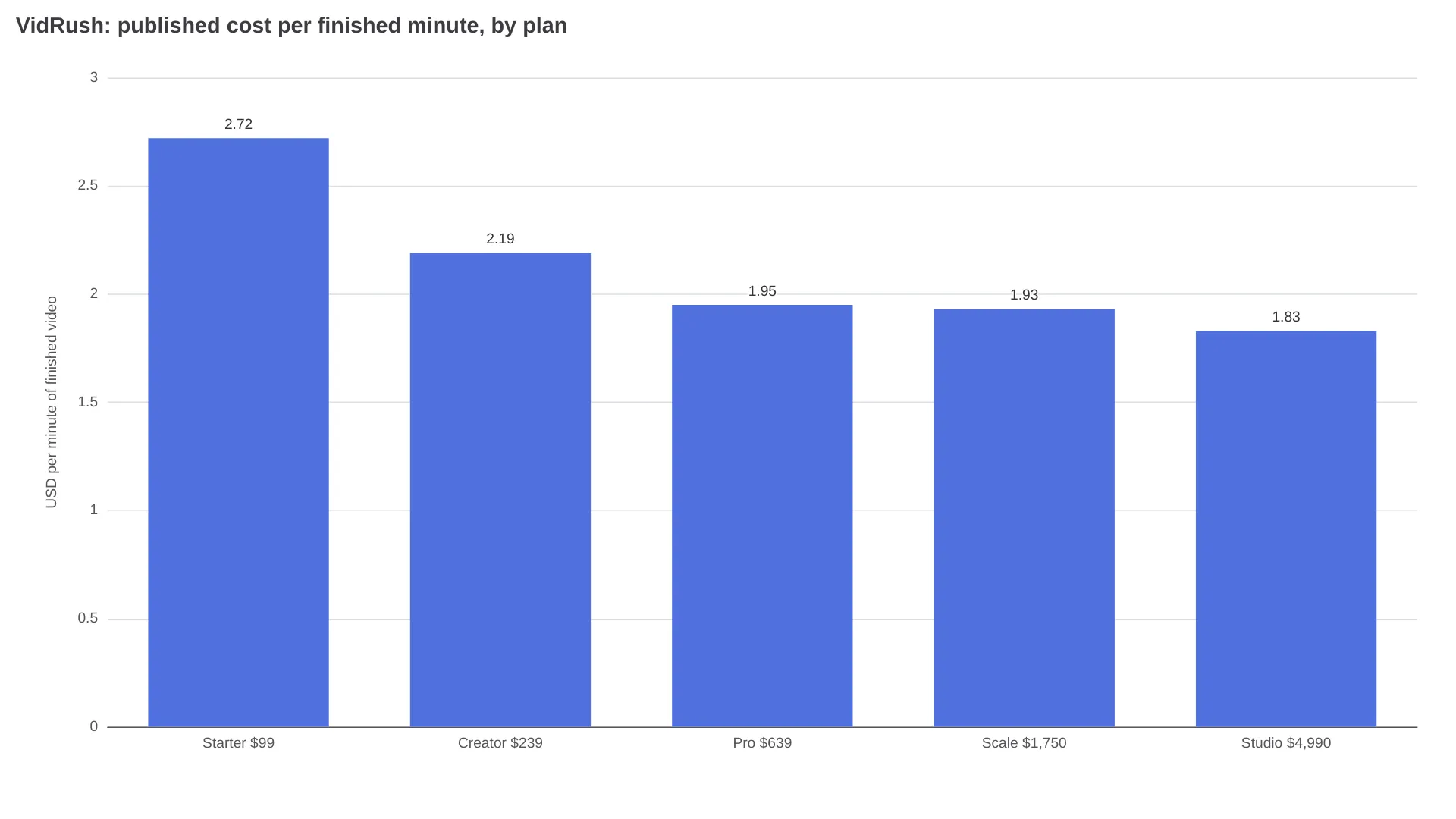
VidRush prices a finished minute at $1.83 to $2.72 in its own documentation, so a 20-minute documentary costs $37 to $54 before you re-render anything. Cost, not a missing feature, is what the paying users quoted below keep coming back to.
What VidRush actually is, and who it is not for
VidRush is a long-form video generator aimed at faceless YouTube channels. You submit a brief, a full script, a voiceover or a talking-head recording, and five agents (researcher, scriptwriter, motion designer, editor, sound designer) return a finished documentary, explainer, breakdown or Top 10 video, typically in the 6 to 40 minute range.
It is not a general-purpose video tool, and the official docs are unusually blunt about the walls:
- No compilation videos. VidRush cannot aggregate clips while preserving their original audio. It only does narration over B-roll.
- Talking-head uploads must be a single presenter, in English. Podcasts and two-person interviews are rejected, and a recording cannot be cut down into shorts.
- Avatar or your own footage, never both in one generation.
- No per-segment voice regeneration. Fix a typo after generation and the documented workaround is to export the transcript, regenerate that sentence in an external tool such as ElevenLabs, and upload the audio back in.
The input validator also scales list length to duration: a 6-8 minute Top 10 allows 3-10 items, while an 18-20 minute video allows up to 26. If your channel is shorts-first, multi-presenter, or built on clip compilations, no amount of price comparison helps. VidRush was never the tool.
What a VidRush video really costs
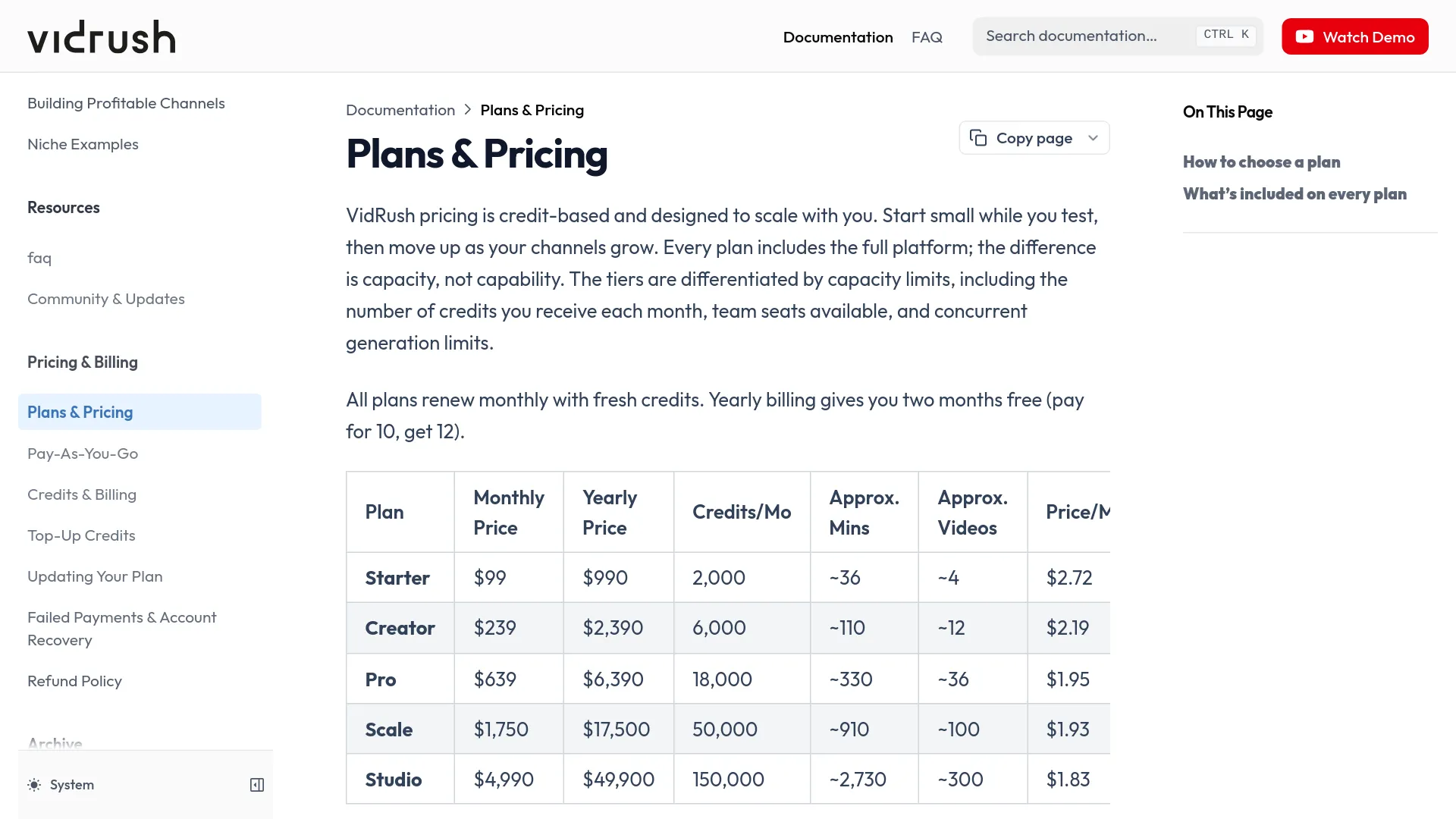
VidRush bills credits, not videos, and deducts roughly 55 credits per minute of finished video. Every plan carries the same features; what a higher tier buys is capacity and a lower unit rate.
| Plan | Monthly | Credits/mo | Approx. minutes | Per minute | Seats | Concurrent |
|---|---|---|---|---|---|---|
| Starter | $99 | 2,000 | ~36 | $2.72 | 0 | 1 |
| Creator | $239 | 6,000 | ~110 | $2.19 | 1 | 2 |
| Pro | $639 | 18,000 | ~330 | $1.95 | 3 | 3 |
| Scale | $1,750 | 50,000 | ~910 | $1.93 | 10 | 5 |
| Studio | $4,990 | 150,000 | ~2,730 | $1.83 | 15 | 10 |
Annual billing is ten monthly payments for twelve months of access, about 16.7% off. Credits still refresh monthly rather than arriving as one pool, and the quoted minute counts assume the Pro visual model at Medium reasoning.
Four clauses that move the real number
That table is the best case. Four documented rules push the cost per usable minute higher:
- Credits do not roll over. They are valid only during the active billing cycle; if your plan resets on the 5th, unused credits expire at midnight on the 4th.
- Re-rendering costs about 10% of a fresh generation. Cheap per pass, but retakes are not free.
- Uploading your own voiceover saves nothing. The credit price covers research, scripting, visual sourcing and rendering, so bringing your own narration costs the same as generating one.
- Pay-As-You-Go auto-charges in $100 steps once plan credits run out, and PAYG must be switched off before you are allowed to change subscription tier.
Credits are deducted on completion rather than at the start, so a job that finishes after your reset draws from the new month's balance. The docs flag that as normal behaviour and explicitly non-refundable. Metering mismatches like this recur across video generation API billing.
Can you even sign up right now?
VidRush has no free trial, and access is still gated. Founder Noah Morris announced a public release on 16 July 2026 with a code to skip the waitlist, but the queue did not disappear. In September 2026, users were still posting things like @brokidak's "and im still in waitlist for 4 months."
That gate explains the volume of "VidRush referral code" searches. The product account also advertises an affiliate programme paying "up to $2,245 per referred user", so assume an invite code posted by a stranger carries someone's commission.
Why paying users leave, in their words
Price comes up more often than any other issue in the public VidRush threads, and the vendor has said on the record that it will not move. Morris wrote on 15 September 2026 that "we will and we could release cheaper and slightly lower quality models but that shit just quite frankly bores me." Treat the current rate card as the durable one.
Underneath price sit three recurring operational failures reported by people who paid. On r/YT_Faceless, u/Inevitable-Error5777 described the worst version:
most videos the audio starts going crazy are literally unusable ... they still get your credits
The second pattern is throughput. On r/NewTubers, u/achakez reported: "I tried VidRush for like 2 weeks and it was okay but the editor felt clunky," adding "I got capped mid-week once and that was annoying." In the same r/YT_Faceless thread, u/sfoxten put the entry barrier bluntly: "$100 minimum just to try it out seems steep."
The third is platform risk. One user, @Tanishk_Grox, replied to the product account with "I used your software, I get demonitized." VidRush's own docs tell you to toggle YouTube's "altered or synthetic content" disclosure on upload, and warn that a long source blacklist starves the footage agent into repeating generic clips.
Five distinct reasons to switch, then: the $99 floor, the waitlist, editing friction, credits burned on unusable output, and format limits. The right alternative depends on which one you hit.
The alternatives, matched to why you are leaving
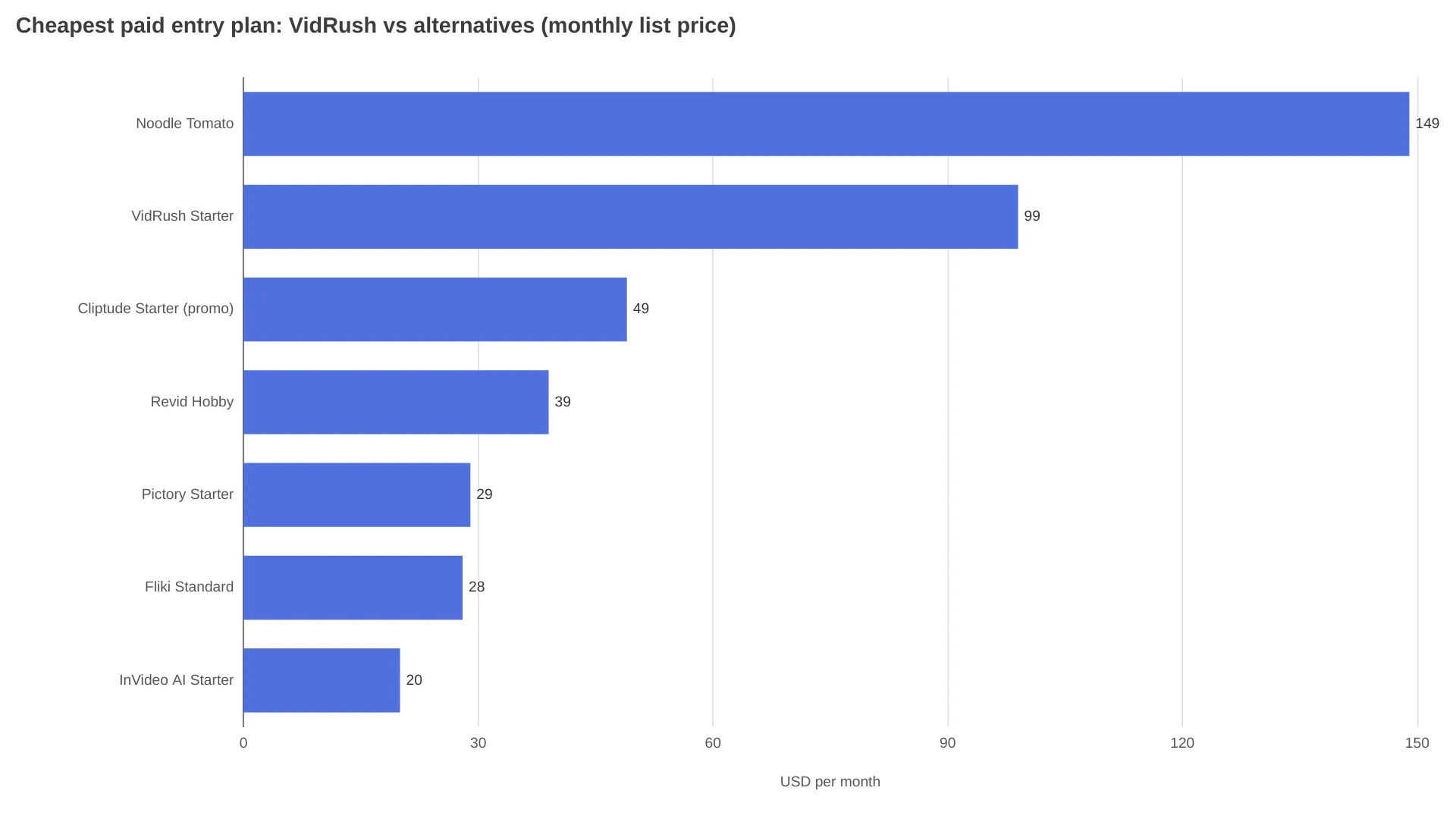
| Tool | Entry price | Free option | Long-form ceiling | Signup | Fixes |
|---|---|---|---|---|---|
| Cliptude | $49/mo (promo, was $98) | Free first project | Credit-based, 40-55/min | Open | Waitlist, price, editor lock-in |
| InVideo AI | $20/seat/mo | No | Credit-based | Open | Price floor, model choice |
| Pictory | $25/mo annual | 14-day trial | 30 min per video | Open | Volume per dollar |
| Fliki | $28/mo | Yes, 3 credits/mo | 15 min (40 on Premium) | Open | Language coverage, free testing |
| Revid AI | $39/mo | No | Short-form focus | Open | Shorts, automation, API |
| Noodle Tomato | $149/mo | No | 10-60 min | Open | Running many channels at once |
Cliptude — the closest like-for-like, without the gate
Cliptude targets the same documentary and video-essay niche and mirrors VidRush's credit model at 40-55 credits per minute, with a published ladder of $49 / $119 / $319 / $875 under a current 50%-off promotion. Its Pro tier quotes roughly 330 minutes for $319, against $639 for the same minutes on VidRush Pro.
Two structural differences matter more than the discount. Signup is open, with no invite and no waitlist, and it exports a ZIP containing an FCP7 XML timeline that opens in DaVinci Resolve, Premiere Pro or Final Cut, so you are not locked into the AI's final cut. Native 9:16 vertical with 21 caption styles is included, which VidRush does not offer.
InVideo AI — the cheapest seat, with model choice
InVideo's published plans run $20, $60 and $150 per seat per month for 400, 2,000 and 5,000 credits. Generative models are billed at their original API pricing, so you pick the engine: Seedance 2.0 Fast at roughly 30 credits per 5 seconds on Starter, Seedance 2.5 from the Plus tier up. The timeline editor, multiplayer editing and colour/audio tools sit on every plan, including the $20 one.
Two caveats. Unused credits do not roll over, and clip-level generation is a different job from assembling a 25-minute documentary. For where it holds up in practice, see our InVideo AI review.
Pictory — the most exported minutes per dollar
Pictory sells video minutes rather than generation credits: 200 minutes a month on Starter ($25 billed annually, $29 monthly), 600 on Professional ($35 annually, $59 monthly), 1,800 on Team. Previewing and editing do not touch the allowance, only exports do, and annual plans front-load the entire year's minutes.
The blocker for VidRush refugees is the hard 30-minute cap per video, plus ElevenLabs voices metered separately at 60 minutes a month on Starter. Pictory also states it does not refund paid subscriptions. Use the 14-day trial.
Fliki — free testing and language coverage, with an export cap
Fliki is the only tool here with a genuinely free tier: 3 credits a month, 720p, a watermark and a one-minute export ceiling. Standard is $28 a month ($21 billed yearly) for 180 credits; Premium is $88 ($66 yearly) for 600 credits plus API access. Read the export limits before switching, because Standard caps exports at 15 minutes, which rules out most documentary-length work, and you need Premium's 40-minute ceiling to match VidRush's range. Fliki's own pricing FAQ is candid that 180 credits typically yields 60-90 finished minutes rather than 180, since editing text or changing a voice re-charges the audio.
Revid AI — for shorts and scheduled posting
Revid runs $39 (Hobby), $99 (Growth, frequently discounted to $39) and $199 (Ultra, 12,000 credits) per month, and publishes directly to TikTok, Instagram and YouTube. Growth includes three Auto-Mode workers plus full API, MCP and CLI access, the cleanest automation story in this group. This is a format switch rather than a cheaper VidRush: Revid is built around short vertical output and remixing, not the 10-to-40-minute runtimes VidRush targets.
Noodle Tomato — more expensive on purpose
At $149 a month, Noodle Tomato is the only option here priced above VidRush's entry plan. It sells a portfolio dashboard and per-channel memory for operators running several faceless channels at once, and generates scenes rather than assembling licensed stock. If you are on channel one, this is the wrong shelf.
How to test a replacement without burning a month
These tools bill in monthly blocks and most credits expire, so a bad first month costs real money. Compress the evaluation into a weekend:
- Run one script you already know. Use a topic you have published, so you can judge B-roll matching and pacing against a known-good version rather than a blank slate.
- Push the length you publish. Check the export ceiling first, since Fliki Standard stops at 15 minutes and Pictory at 30, then generate at your real runtime rather than a 3-minute demo.
- Break it on purpose. Request a hyper-specific topic with thin stock coverage. Repetition and generic footage surface here, which is exactly the failure users report on long documentaries.
- Time one full re-render and price it. Retakes are where credit systems quietly diverge from the rate card.
- Read the credit-expiry and refund clause before you pay. Pictory publishes a no-refund policy on subscriptions; VidRush documents that completion-time deductions against a new month's balance are not refundable.
- If two tools survive, keep the one with open signup and a project export. Those are your insurance against paying for a queue position, or for an edit you cannot take with you.
FAQ
Is VidRush free?
No. VidRush's documentation states there is no free trial, and paid plans start at $99 a month on the Starter tier, which covers roughly 36 minutes or about four videos.
Do you need an invite code for VidRush?
Access comes through a direct email invite, the homepage waitlist, or an invitation to an existing team workspace. A public release was announced in July 2026, but users reported waits of several months well into September.
Do unused VidRush credits roll over?
No. Credits are valid only during the active billing cycle and expire at the end of it. Top-up credits, bought separately, do survive a monthly renewal.
What is the cheapest VidRush alternative for long-form video?
InVideo AI at $20 per seat per month is the lowest published entry price, and Pictory Professional at $35 billed annually gives the most exported minutes per dollar within a 30-minute-per-video cap. For a direct documentary-style substitute, Cliptude's $49 promotional tier is the nearest match.
Which VidRush alternative has a free plan?
Fliki has an ongoing free tier at 3 credits a month with a watermark and a one-minute export limit. Pictory offers a 14-day trial rather than a free plan. Our roundup of free AI video generators we tested covers the wider set.
Does VidRush make YouTube Shorts?
No. Talking Head produces one long-form video per recording and does not cut shorts or highlights, and VidRush does not offer a native vertical format. Cliptude and Revid AI both handle 9:16 output.