 AIREITER
Searching for an OpenRouter promo code? As of September 5, 2026, there is no standing public code I can verify. The real savings are less flashy: free-model quotas, automatic provider discounts, occasional official event coupons, and BYOK when your usage justifies separate provider billing.
The short answer: there is no standing public OpenRouter promo code
OpenRouter’s pricing page, FAQ, and Terms of Service do not list a universal coupon for new or existing users. The Terms do say OpenRouter may issue discretionary promotional credits through programs, trials, or similar offers, but that is not the same as a public code that anyone can paste into an account.
There is an important exception: OpenRouter does run limited, event-specific promotions. For example, the official @OpenRouter announcement on X described a $5 coupon distributed through the #ori Discord channel, redeemable at openrouter.ai/redeem, with only 200 coupons available. That is a real promotion, but it is limited by event, channel, quantity, and expiry, not a permanent OpenRouter promo code.
“It’s just a temporary offer, it goes away next week. But it’s great to double the work with the same price.” — @MaziyarPanahi on X, describing a temporary OpenRouter model discount
Do not wait for a generic 50%-off code. Check OpenRouter’s own announcements and account pages, then use the cost controls below.
What counts as a real OpenRouter offer
The word “promo” covers several different things on OpenRouter. Mixing them together is why coupon searches produce misleading results.
Automatic model discounts are not coupon codes
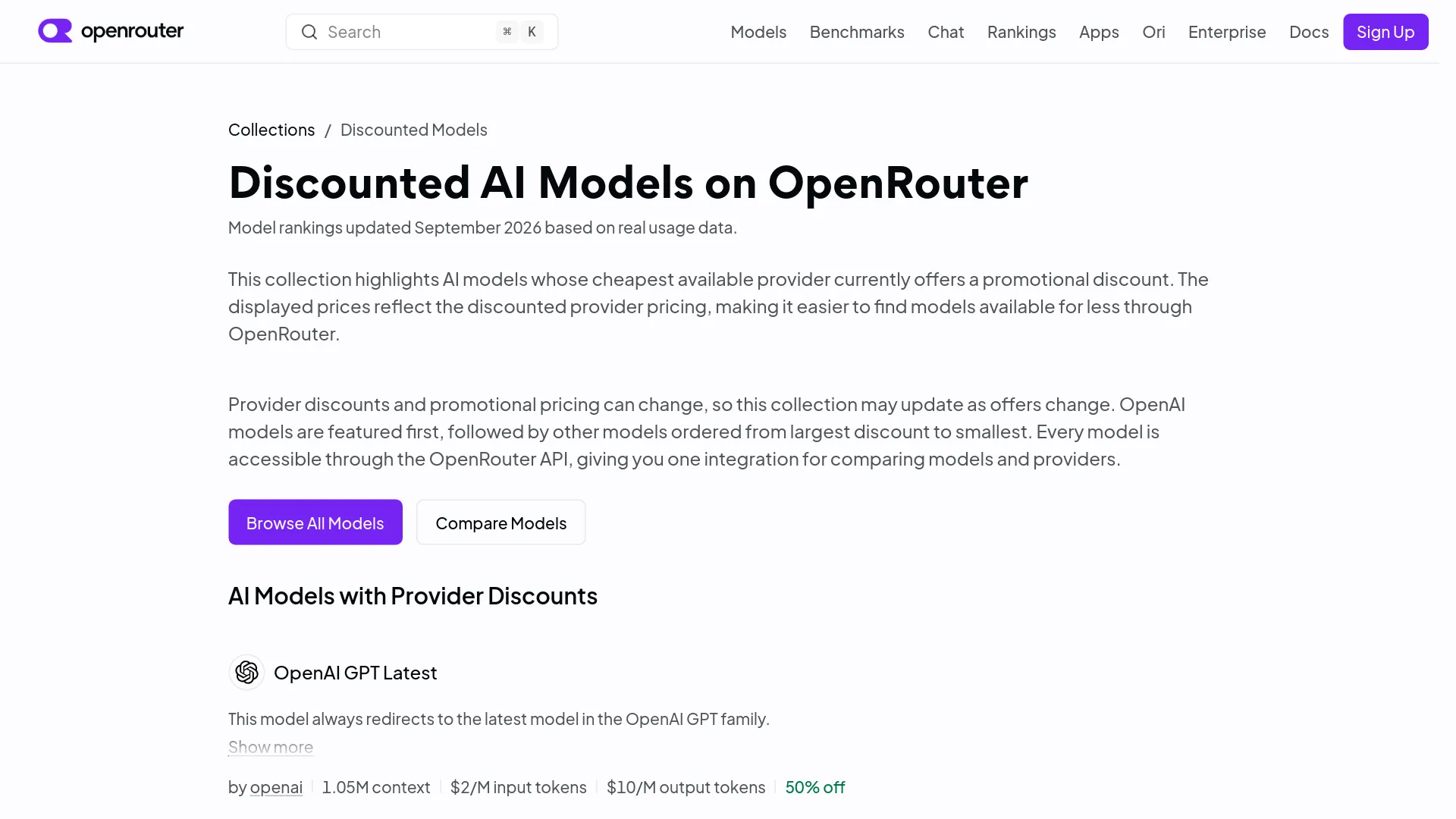
OpenRouter has an official Discounted AI Models collection. It lists model/provider combinations whose current provider price includes a promotion. No code is required, and the discount applies to the qualifying route, not automatically to every model in your account.
When checked in September 2026, the collection displayed examples such as these:
| Model or route | Displayed discount | Displayed price | What it means |
|---|---|---|---|
| OpenAI GPT-5.6 Sol | 50% | $2/M input, $10/M output | Provider-specific model pricing, not an account coupon |
| Upstage Solar Pro 4 | 90% | $0.03/M input, $0.12/M output | Discount can change when the provider offer changes |
| Inception Mercury 2.5 Preview | 80% | $0.04/M input, $0.15/M output | Applies to this listed route, not unrelated models |
| Qwen3 235B A22B Instruct 2507 | 75% | $0.0875/M input, $0.35/M output | Check the live model page before building around it |
| Z.ai GLM 5.2 | 71% | $0.4032/M input, $1.267/M output | A live provider promotion can expire or be revised |
These are route-level savings, not an account-wide coupon; verify the live model ID, provider, and price before budgeting.
Limited coupons and promotional credits are event offers
A legitimate OpenRouter coupon should have a traceable announcement and precise terms. In the official event example above, the source identified the value, redemption page, Discord location, and a 200-coupon limit. Other promotions may be tied to a startup program, an event, a specific model, or a product such as Ori.
OpenRouter’s Terms say promotional credits are non-transferable, may expire, and can be modified or revoked, so treat them as conditional credit rather than cash.
A quick test for coupon claims
Coupon pages may list unsupported percentage-off codes, signup credits, referral bonuses, or top-up rewards. None should be treated as verified merely because a page labels the offer “active” or “manually checked.” Use this four-part test instead:
- Source: Is the offer announced on
openrouter.ai, OpenRouter’s official X account, or an official OpenRouter Discord channel? - Scope: Does it state the eligible model, product, account type, region, and expiry date?
- Redemption: Does it send you to an OpenRouter page such as
openrouter.ai/redeem, rather than asking for your API key or a browser extension? - Balance: After redemption, does the credit or discount appear in your OpenRouter account before you send paid requests?
If a coupon page cannot answer those questions, it is an unverified lead, not a saving. Never enter an OpenRouter password, API key, or payment details into a third-party “claim” form.
The free route: free models are not free dollars
OpenRouter’s free access is a request allowance attached to zero-priced model routes. It is not a wallet of free dollars that you can spend on GPT, Claude, or any other paid model.
The 50-versus-1,000 request rule
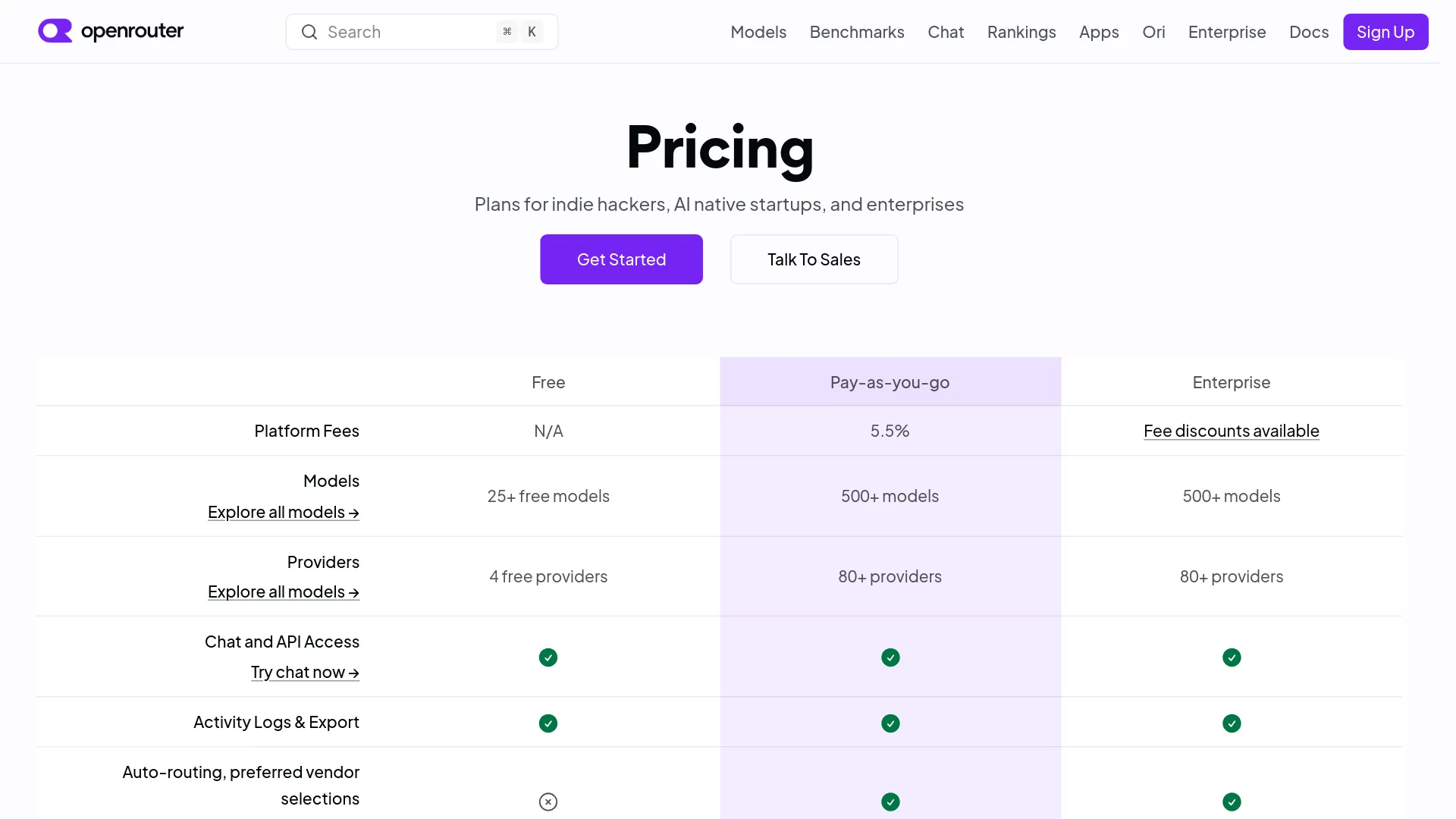
OpenRouter’s FAQ and pricing page describe the current structure like this:
| Account condition | Free-model requests per day | Free-model requests per minute | What changes |
|---|---|---|---|
| No qualifying $10 credit purchase | 50 | 20 (rate-limit guidance) | Basic testing allowance |
| At least $10 in purchased credits | 1,000 | 20 (rate-limit guidance) | Higher daily allowance; same burst ceiling |
The $10 purchase is paid credit that raises the free-model allowance to 1,000 requests per day, but does not remove the 20 RPM limit or guarantee availability.
The daily allowance is shared across eligible free-model use. Switching from one :free model to another does not create a fresh bucket for each model. OpenRouter also warns that free models have low limits and are generally unsuitable for production workloads.
Pick the right free-only route
These model identifiers are easy to confuse:
| Route | Free-only guarantee? | Best use |
|---|---|---|
provider/model:free | Yes, for that named free variant while available | Repeatable testing when model identity matters |
openrouter/free | Yes, selects from the eligible free pool | Testing when availability matters more than a fixed model |
openrouter/auto | No | General routing when paid models are acceptable |
openrouter/auto:free | See OpenRouter’s billing guidance; do not treat it as a zero-cost safeguard | Avoid if an unexpected paid route would be a billing problem |
OpenRouter’s billing guidance specifically distinguishes the free-only router from Auto Router behavior. After a request, inspect the actual model and cost in the Activity page. A model name containing “auto” is not a substitute for checking the billed route.
Free access still has capacity and privacy limits
Free requests can fail because of the account quota, the per-minute limit, or upstream provider capacity. Privacy is separate: check the exact provider’s data policy in the OpenRouter FAQ before sending sensitive material through a free route.
The savings stack that actually changes your bill
A cheaper OpenRouter account usually comes from combining the right model, route, and billing method, not from finding a magic code.
Use model discounts and cache pricing deliberately
Start with the discounted-models collection when your workload can tolerate changing models or providers. For a stable application, pin the exact model and check its live pricing rather than assuming the collection discount will remain.
For repeated long prompts, inspect the model’s pricing details for input_cache_read and input_cache_write. OpenRouter’s Models API documentation exposes those fields because cache pricing is model- and provider-dependent. A cached-input discount applies only when the provider actually records a cache hit; it is not a universal discount on all input tokens.
A 1% usage discount is also documented for users who opt into prompt logging. That trade-off is meaningful: the FAQ says the discount is connected to logging, so do not enable it for sensitive workloads just to save a small amount.
BYOK: when does it beat ordinary credits?
BYOK means adding your own provider key while retaining OpenRouter’s routing layer. Under the current pricing page, pay-as-you-go accounts get a BYOK fee-free allowance based on $25,000 per month of list-price inference. After that allowance, OpenRouter charges a 5% BYOK fee. Enterprise gets a $200,000 monthly allowance before the same 5% fee applies.
That is different from ordinary credit purchases, where OpenRouter currently lists a 5.5% platform fee. The fee is added when you buy credits; if you want $100 of spendable credit, the charge is normally $105.50, subject to the minimum-fee rule.
| Monthly list-price inference | Ordinary credit platform fee at 5.5% | BYOK platform fee under current allowance | Simple reading |
|---|---|---|---|
| $1,000 | $55 | $0 | BYOK saves the platform fee if you already manage the provider account |
| $25,000 | $1,375 | $0 | The allowance is large enough for many teams |
| $30,000 | $1,650 | $250 on the $5,000 above allowance | BYOK still has a lower platform fee, but requires separate provider billing |
BYOK is fee-free up to the list-price allowance and 5% after it, versus the 5.5% credit-purchase fee; choose it for lower fees when you can manage separate provider billing, and choose ordinary credits for simpler fallback.
A valid provider key can still fall back to OpenRouter shared capacity, as OpenRouter’s BYOK documentation explains; use provider restrictions only when you prefer a failed request to paid fallback, and see OpenRouter BYOK fees and fallback rules.
Small purchases, expiry, refunds, and Auto Recharge
Use a small initial top-up if you are still testing. OpenRouter’s Terms currently state a $5 minimum and $25,000 maximum credit purchase per transaction. Unused purchased credits may be refundable within 24 hours, but platform fees are non-refundable and cryptocurrency payments are never refundable.
OpenRouter also reserves the right to expire unused credits 365 days after purchase. That conflicts with coupon pages claiming credits “never expire,” so the official Terms should win when the two statements disagree.
Standard accounts are pay-as-you-go rather than a recurring subscription. However, Auto Recharge can create repeat charges when the balance falls below the threshold you configure. Turn it off if you are testing a code, a new model, or an experimental agent and do not want an automatic top-up.
A decision path for your next OpenRouter request
| Your situation | Cheapest sensible path | Main limitation |
|---|---|---|
| Occasional experiments | Use provider/model:free or openrouter/free | 50 requests/day and provider capacity limits |
| You need more free-model requests | Buy at least $10 of normal credits | The purchase is not free credit; 20 RPM remains |
| You need a model currently on promotion | Use the exact discounted model/provider route | The provider discount can expire or change |
| You already pay a provider directly | Consider BYOK | Separate billing, keys, quotas, and fallback decisions |
| You run a paid production workload | Choose by model price, cache behavior, and reliability, not coupons | OpenRouter’s 5.5% credit fee still affects top-ups |
| You manage high volume or need contracts | Ask OpenRouter about Enterprise pricing | Terms depend on the sales discussion |
Choose free models for minimum spend, BYOK for lower platform fees, and ordinary credits for simpler fallback. Verify the serving provider and balance in Activity before scaling up.
OpenRouter promo code FAQ
Does OpenRouter offer a signup or referral code, and are coupon websites safe?
I could not verify a standing public signup or referral code in OpenRouter’s current pricing, FAQ, or Terms. Treat coupon pages as unverified until an offer appears in an official announcement and redeems on OpenRouter; never provide a password, API key, or payment details to a coupon site.
Does a provider’s free promotion work through OpenRouter?
Not automatically. OpenRouter’s support guidance says a provider promotion elsewhere does not necessarily apply when the same model is accessed through OpenRouter. Check the OpenRouter model page and Activity record rather than assuming a provider’s direct-API deal transfers to the gateway.
Is the $10 purchase free credit, and do credits expire?
No. It is a normal credit purchase that raises the free-model allowance; OpenRouter’s Terms also reserve the right to expire unused credits after 365 days. Promotional credits can have separate expiry terms.
Is OpenRouter a subscription?
The standard account is pay-as-you-go, not recurring. Auto Recharge is optional but can create repeat charges when the balance crosses your threshold.