
Muse Image is Meta Superintelligence Labs' first in-house image generation model, released July 7, 2026. It is free inside the Meta AI app, Instagram, and WhatsApp, and Meta reports it ranks No. 2 on the Arena image leaderboard, behind OpenAI but ahead of Google's Nano Banana 2. Unlike most image generators, it is agentic: instead of turning a prompt straight into pixels, it writes code, searches the web, and revises its own work before producing an image.
One catch matters if you build software. Muse Image has no public API. It runs only inside Meta's consumer apps, and even the companion text model's developer API has been delayed for months. For anyone who needs to generate images programmatically, the practical question is what to use instead.
What Is Muse Image?
Muse Image is the first image generation and editing model built by Meta Superintelligence Labs (MSL), the AI division Mark Zuckerberg stood up after Meta fell behind Google, OpenAI, and Anthropic. Meta announced it on July 7, 2026, alongside a preview of Muse Video.
It is rolling out inside the Meta AI app and on meta.ai, in Instagram Stories in the US, and in WhatsApp direct messages in a limited set of countries, with Facebook and Messenger to follow. Rather than ship a standalone app, Meta embedded the model into products billions of people already use. Techweez reports that the launch also ends Meta's previous image-generation partnerships with Midjourney and Black Forest Labs.
One disambiguation: this is not the same "Muse" as Google's 2023 research model of that name, a masked generative transformer whose project page still ranks for the term. Same word, different company, different year, different architecture.
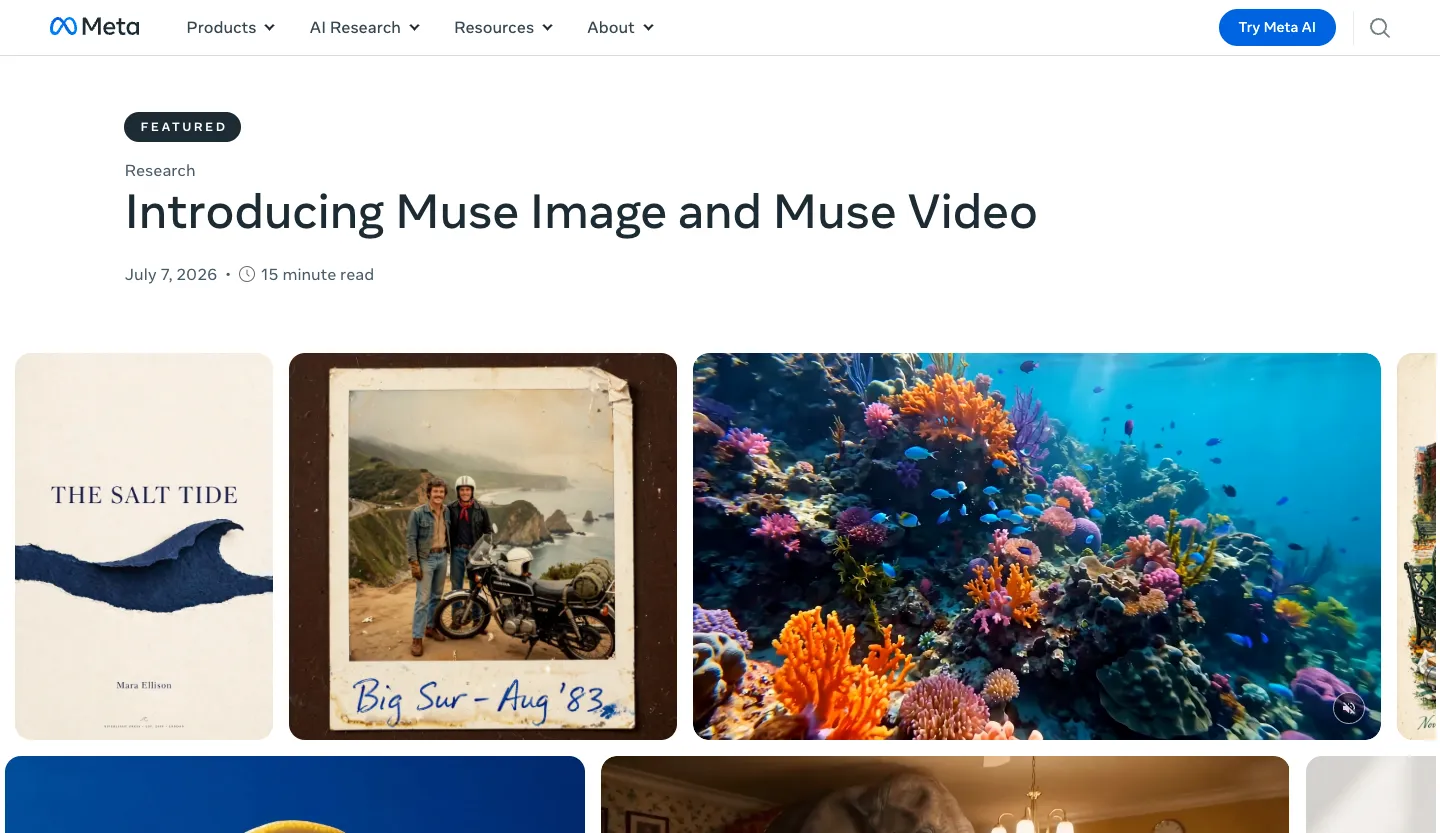
What Makes Muse Image Different: It Is Agentic
Most image models do one thing: map a text prompt to an image. Muse Image works more like a reasoning agent. Before it draws anything, it can think through the request, call tools, and revise its own output. Meta describes three moving parts.
Tool use, coding. During training, the model learned to write and run code to produce things that are hard to get right by painting pixels alone: accurate charts, plots, and working QR codes. It can also condition a generated image on a rendered figure so the numbers line up with the picture.
Tool use, search. It can search the web to ground an image in factual or current information, which helps on knowledge-heavy prompts: current events, real products, recent facts.
Self-refinement. The model looks at its own draft and fixes it: a small local edit when a detail is off, a full regeneration when larger parts are wrong, or a switch to tool use when accuracy is the problem. Meta says this behavior was not hand-designed; it emerged during reinforcement learning because revising produced better images and higher reward.
There is also a scaling story familiar from language models: the more the model thinks at inference time, the better the image, with an approximately log-linear relationship between test-time compute and quality. Muse Image integrates with Muse Spark, Meta's reasoning model launched in April 2026, so the two can share tools and plan jointly.
In practice, that means Muse Image is built for tasks where "generate a pretty picture" is not enough: infographics with correct text, scannable QR codes, multi-step edits, and factually grounded images.
What Muse Image Can Do
Conversational generation. Plain descriptions, no prompt engineering. Describe a scene from scratch, or hand the model a photo to edit.
Precise editing. Remove people or objects, change specific text (a price tag, a phone number), swap a background, or restyle part of an image without regenerating the whole thing. Meta's demo edits include clearing fog to reveal a valley, turning flower petals into a rainbow gradient, and rewriting a parking sign's text and phone number.
Multi-reference composition. Combine people, objects, clothing, styles, and environments from several input photos into one image, with text and images interleaved in the prompt, such as "this person, riding this bike, wearing this, passing this bench."
QR codes and infographics. A direct payoff of the coding tool: scannable QR codes and readable text in infographics, which most image models still fumble.
Meta AI Shopping. Snap a photo of a messy room and Muse Image visualizes a redesigned space filled with real items pulled from Facebook Marketplace listings.
Instagram integration. More than 30 new AI effects for Stories, plus the ability to @-mention an Instagram account to pull that account's public photos into a generation.
Markup tool. Sketch or circle directly on an image to request a change; the model keeps the full editing conversation so you can keep refining without starting over.
How Good Is It? Benchmarks and Early Feedback
Meta's own, self-reported numbers put Muse Image at No. 2 on Arena for text-to-image, single-image editing, and multi-image editing, measured by human-preference Elo rankings as of July 5, 2026, behind OpenAI's image model and ahead of Google's Nano Banana 2 on the benchmarks Meta cites. No independent benchmark has confirmed these results yet. Meta is upfront that it still trails OpenAI's latest tool in overall quality.
Early hands-on reactions on X, dated July 8, 2026, skew positive on quality. Users called it "an agentic image model with great world understanding and very good text rendering" (@modomango) and reported "unlimited edits with zero quality loss" (@itxabdullaa) — anecdotal early reactions, not independent benchmarks. It climbed to No. 2 on Arena's text-to-image leaderboard within a day of release (@thetigerintel).
A quieter feature deserves more attention: Content Seal. Every image Muse Image produces in the Meta AI app carries an invisible provenance watermark that survives cropping, compression, resizing, and screenshots. Meta is previewing a detection tool so anyone can check whether an image carries the seal. For brands and creators worried about AI imagery being passed off as real, that provenance signal is one of the more concrete things in the launch.
Meta also previewed Muse Video, built on the same base, with native audio. It ranks No. 3 on Arena for text-to-video and is coming soon to creators and Meta AI.
The Privacy Backlash
The feature drawing the most heated reactions is not image quality. It is the Instagram @-mention integration. Tagging a username lets Muse Image pull that account's public photos into a generation, including for edits and face-containing compositions. The control lives in settings, and it is opt-out, not opt-in: by default, public photos can be used, with no notification to the person being tagged.
Within hours of launch, the backlash on X was loud. @coinbureau (July 8) called it a recipe for non-consensual AI-altered images. @Mia_SideChat warned it enables face synthesis without consent and with no notification to the people affected. @13F_Pro framed the default as "opt-out, not opt-in" amid broader privacy outrage. The concern is less about Muse Image's output than about defaults that turn every public Instagram account into raw material for AI remixing and potential deepfakes.
If you are a creator, the practical step is to check the privacy and data-use sections of your Instagram settings and turn off the relevant toggle before the feature reaches your region. Meta has not publicly documented the exact setting path. Meta says account holders can opt out; critics argue the default is the actual problem.
Is There a Muse Image API? The Developer Reality
For consumers, Muse Image is free with limits; heavier use needs a paid Meta One subscription tier. For developers, the short answer is that there is no public Muse Image API. The model runs only inside Meta's apps, and no developer endpoint has been announced.
The picture is not much better for Muse Spark, the reasoning model Muse Image integrates with. According to reporting from The Next Web and Wavespeed, Meta has repeatedly delayed the Muse Spark developer API since April 2026; it remains in private preview with select partners, with no public signup, no waitlist, and no fixed launch date.
For advertisers, Meta is opening Muse Image through its Advantage+ ad suite in the coming weeks, but that is campaign automation inside Meta's walled garden, not a developer API you can call from your own product. If you need to generate images programmatically for an app, a content pipeline, or an e-commerce workflow, Muse Image is not an option today, and no timeline for one has been announced.
API-Accessible Alternatives to Muse Image
The capabilities Muse Image is built around (strong text rendering, precise editing, multi-image composition) are available right now through image models that ship a public API. If you are evaluating what to call from your own code, these are the practical options.
Nano Banana 2 / Pro (Google). The model Meta benchmarks Muse Image against, built on Gemini 3.1 Flash Image. It is fast, renders text reliably, and handles character consistency across multiple subjects. Callable via API on the Nano Banana Pro and Nano Banana 2 model pages.
GPT-image-2 (OpenAI). The overall quality leader that Muse Image still trails, by Meta's own admission. Strong all-round generation and editing. Callable via API on the GPT-image-2 model page.
Seedream 5 (ByteDance). A unified generation-and-editing model with a cinematic look and strong multi-image editing; the 5.0 Lite variant adds multimodal "deep thinking" and online search. Callable via API on the Seedream v5 Lite model page.
Midjourney. Meta's former image partner, now dropped. Still the default for aesthetic, artistic styling, though its API story is thinner than the models above. Official site: midjourney.com.
Model | Maker | Where to use | Public API? | Best for |
|---|---|---|---|---|
Meta | Meta AI / Instagram / WhatsApp | No | Agentic generation, QR codes, infographics | |
Gemini app + API | Yes | Fast generation, text, character consistency | ||
OpenAI | ChatGPT + API | Yes | Overall image quality | |
ByteDance | API | Yes | Cinematic look, multi-image editing | |
Midjourney | Discord / app | Limited | Artistic styling |
Muse Image is free and capable but locked inside Meta's apps. Nano Banana 2, GPT-image-2, and Seedream 5 are callable today on a pay-per-generation, credit-based basis. The image you get from those APIs will not replicate Muse Image's agentic tool-use loop, but for most production image tasks (product shots, marketing assets, edits at scale), they are what you can integrate. For deeper comparisons, see our GPT-image-2 vs Nano Banana Pro breakdown, the Nano Banana 2 vs Seedream 5 head-to-head, or the broader best AI image generators for 2026 roundup.
FAQ
Is Muse Image free?
Yes. Muse Image is free for everyday use in the Meta AI app, on meta.ai, in Instagram Stories, and in WhatsApp, with rate limits. Heavier use requires a paid Meta One subscription tier.
How do I use Muse Image?
Open the Meta AI app or meta.ai and describe what you want, or use it inside Instagram Stories and WhatsApp chats where it has rolled out. Conversational descriptions work, and no prompt engineering is needed.
Is there a Muse Image API?
No public API exists for Muse Image. The companion Muse Spark API has been delayed since April 2026 and remains in private preview. For programmatic image generation, use an API-accessible model such as Nano Banana 2, GPT-image-2, or Seedream 5.
How does Muse Image compare to Nano Banana 2?
Meta says Muse Image beats Nano Banana 2 on several image generation and editing benchmarks and ranks No. 2 on Arena, behind OpenAI. Meta also says it still trails OpenAI's latest image tool in overall quality.
Is Muse Image the same as Google's Muse?
No. Google's Muse was a 2023 research model using masked generative transformers. Meta's Muse Image is a 2026 agentic image model from Meta Superintelligence Labs. They share a name but are unrelated.
Can Muse Image make QR codes and infographics?
Yes. Muse Image writes and runs code to produce scannable QR codes and infographics with readable, accurate text, a direct benefit of its agentic coding tool.
Does Muse Image watermark its images?
Yes. Images produced in the Meta AI app carry Content Seal, an invisible watermark that survives cropping, compression, resizing, and screenshots. Meta is previewing a detection tool to verify whether an image carries the seal.