
If you only remember one line: in three same-prompt tests I ran on one platform in July 2026, Nano Banana 2 won all three — cleaner Chinese-text design, more accurate real-world scenes, and more complete layouts. Seedream 5 stayed competitive on one thing: perfectly clean glyphs in simple, minimal designs. One clarification up front, because almost every comparison online glosses over it: the "Seedream 5" you can actually use today is Seedream 5.0 Lite. ByteDance has not released a separate full 5.0 model as of July 2026, so every real test — including this one — is really Nano Banana 2 vs Seedream 5.0 Lite.
Quick verdict: who should pick which
Pick Nano Banana 2 for almost everything: photorealism, complex scenes, real-world accuracy (landmarks, brands, products), rich marketing layouts, and — surprisingly — Chinese-text designs.
Pick Seedream 5 when you want dead-simple, text-forward layouts with flawless glyphs and no design clutter, or you're on a platform where it's meaningfully cheaper for your volume.
What Nano Banana 2 and Seedream 5 actually are
Nano Banana 2 is Google's model, reported by multiple third-party platforms (fal.ai, ImagineArt) to be Gemini 3.1 Flash Image — Google has not published that name in its own docs, so treat it as the widely-cited label rather than an official one. It is search-grounded (it can pull real-world visual references), Google says it embeds a SynthID watermark, and platforms list support for up to 4K (~4096px on the long edge), extreme aspect ratios (1:8, 8:1), and reference locking for multiple characters.
Seedream 5 (5.0 Lite) is ByteDance's unified multimodal model. Per ByteDance's own model page, its headline features are Deep Thinking (chain-of-thought planning before it draws) and online search; it combines generation and editing in one model and leans toward clean typography. It does not publicly document watermarking. Remember the version caveat above: this is the Lite variant, the only Seedream 5 currently available.
Pricing: list price vs what it actually costs
Third-party price lists usually show Seedream well below Nano Banana 2 — often quoting ~$0.03 for Seedream 5 Lite against ~$0.08 for Nano Banana 2 at 2K. That's the headline you'll see repeated everywhere.
But list prices depend on resolution tiers and platform. When I ran both on AIReiter on 2026-07-03, the real cost per image was 3.0 credits for Nano Banana 2 vs 3.2 credits for Seedream 5 Lite. On AIReiter, credits convert at 500 credits = $5 (1 credit = $0.01), so that's ~$0.030 vs ~$0.032 per image — essentially the same, with Nano Banana 2 marginally cheaper. On one credit system the "Seedream is half the price" narrative simply didn't hold.
Nano Banana 2 | Seedream 5 (Lite) | |
|---|---|---|
Typical third-party list (2K) | ~$0.08 | ~$0.03 |
Actual cost on AIReiter (2026-07-03) | 3.0 credits (~$0.030) | 3.2 credits (~$0.032) |
Watermark | SynthID (per Google) | Not documented |
The takeaway: don't assume Seedream is cheaper — check your actual platform. Running both through one API on the same credits (as I did here) is the only way to compare apples to apples; AIReiter exposes both Nano Banana 2 and Seedream 5 Lite that way.
Capability matrix
Capability | Nano Banana 2 | Seedream 5 (Lite) |
|---|---|---|
Max resolution | 4K (~4096px) | 3072×3072 (9MP)* |
Speed (this test) | Comparable, not faster | Comparable |
Chinese/CJK text | Clean on headings; minor glitches in small text | Perfectly clean glyphs |
Design completeness | Rich, full compositions | Simpler, sometimes sparse |
Real-world accuracy | Strong (search-grounded) | Weaker (made factual errors) |
Watermark | SynthID | None documented |
*Sources conflict — some list Seedream 5 Lite at 4K, ByteDance's own page and fal.ai put the ceiling at 3072/9MP. Treat 4K as Nano Banana 2's clear edge until ByteDance documents otherwise. Note: competitor articles claim Nano Banana 2 renders in "under 5 seconds" and beats Seedream on speed — in my runs the two were comparable and Nano Banana 2 was not consistently faster, so treat speed claims as workload-dependent.
Hands-on duel: same prompt, both models
How I tested: On 2026-07-03 I sent three identical prompts to each model through AIReiter's API (nano_banana_v2 and seedream_v5_lite), at each model's default resolution. Each image below is the first output for that prompt — no cherry-picking, no best-of-N, one generation per model. Prompts were designed to probe each model's reputed weak spot. Credit cost is recorded on each image.
Round 1 — Chinese text rendering
Prompt: a modern infographic poster with the Chinese headline "人工智能的未来", three sections titled 效率 / 创造力 / 成本, flat icons, blue-and-white scheme.
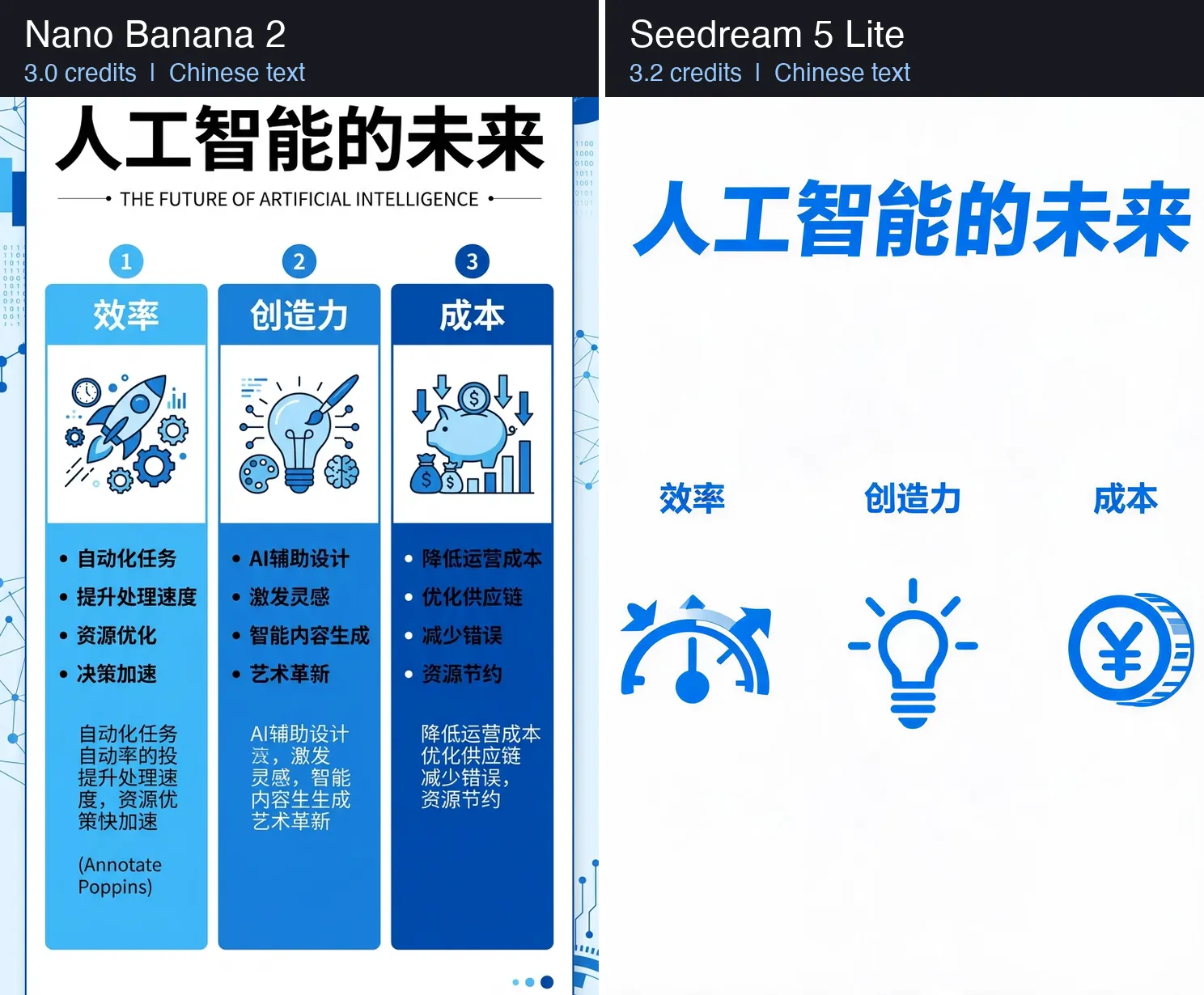
This is the round competitors said Seedream would win — and it went the other way. Nano Banana 2 rendered the headline (人工智能的未来), all three section titles and every bullet correctly and produced a complete, designed infographic; only the tiny secondary paragraphs showed garbled characters. Seedream's glyphs were flawless but it returned a sparse layout — just the headline, three labels and three icons — correct text, far less usable design. Winner: Nano Banana 2 on overall output; Seedream only wins pure small-text glyph accuracy.
Round 2 — Real-world street scene
Prompt: a photorealistic Singapore street with an MRT station sign, HDB blocks, hawker-stall signage, local taxis, overcast daylight.
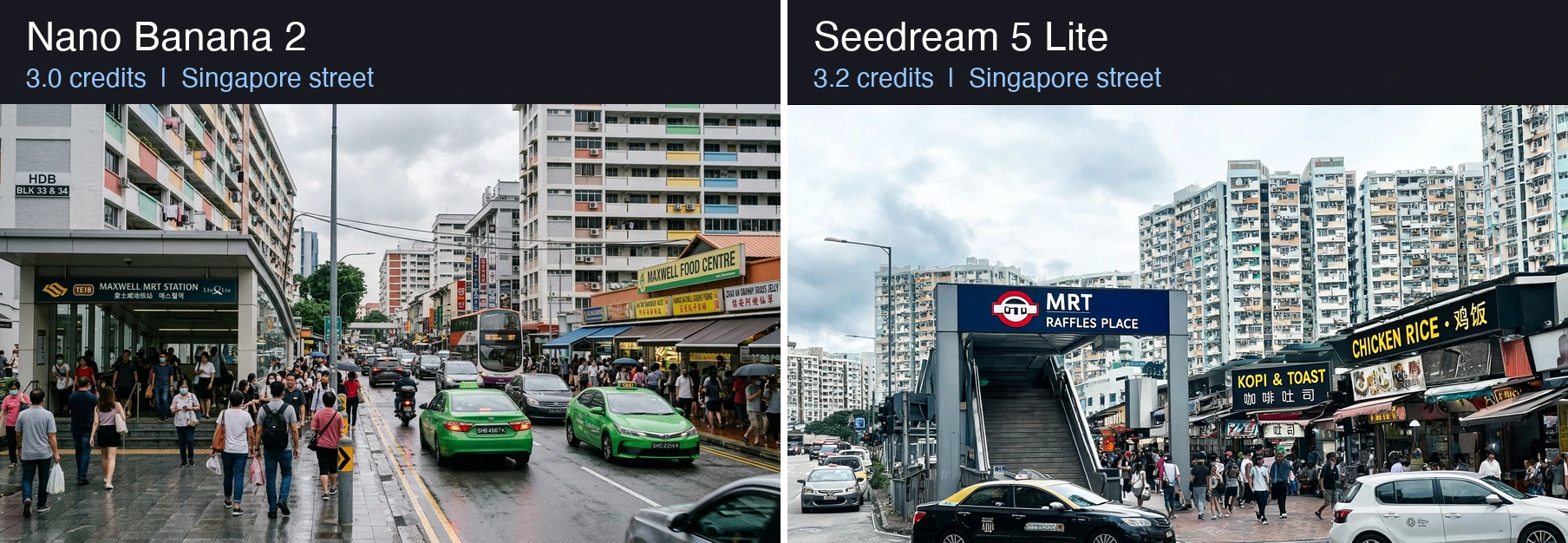
Here Nano Banana 2's search grounding showed. It produced an accurate "Maxwell MRT Station" sign with the SMRT logo, correct HDB block labels ("BLK 33 & 34"), a "Maxwell Food Centre" sign and Singapore's green-and-white taxis. Seedream placed a London Underground roundel on an "MRT Raffles Place" sign and rendered apartment blocks closer to Hong Kong tenements than Singapore HDBs — a clear factual miss. Winner: Nano Banana 2, decisively.
Round 3 — Design & layout
Prompt: a premium e-commerce poster for wireless headphones, "50% OFF" headline, price tag, feature bullets, clean grid layout.
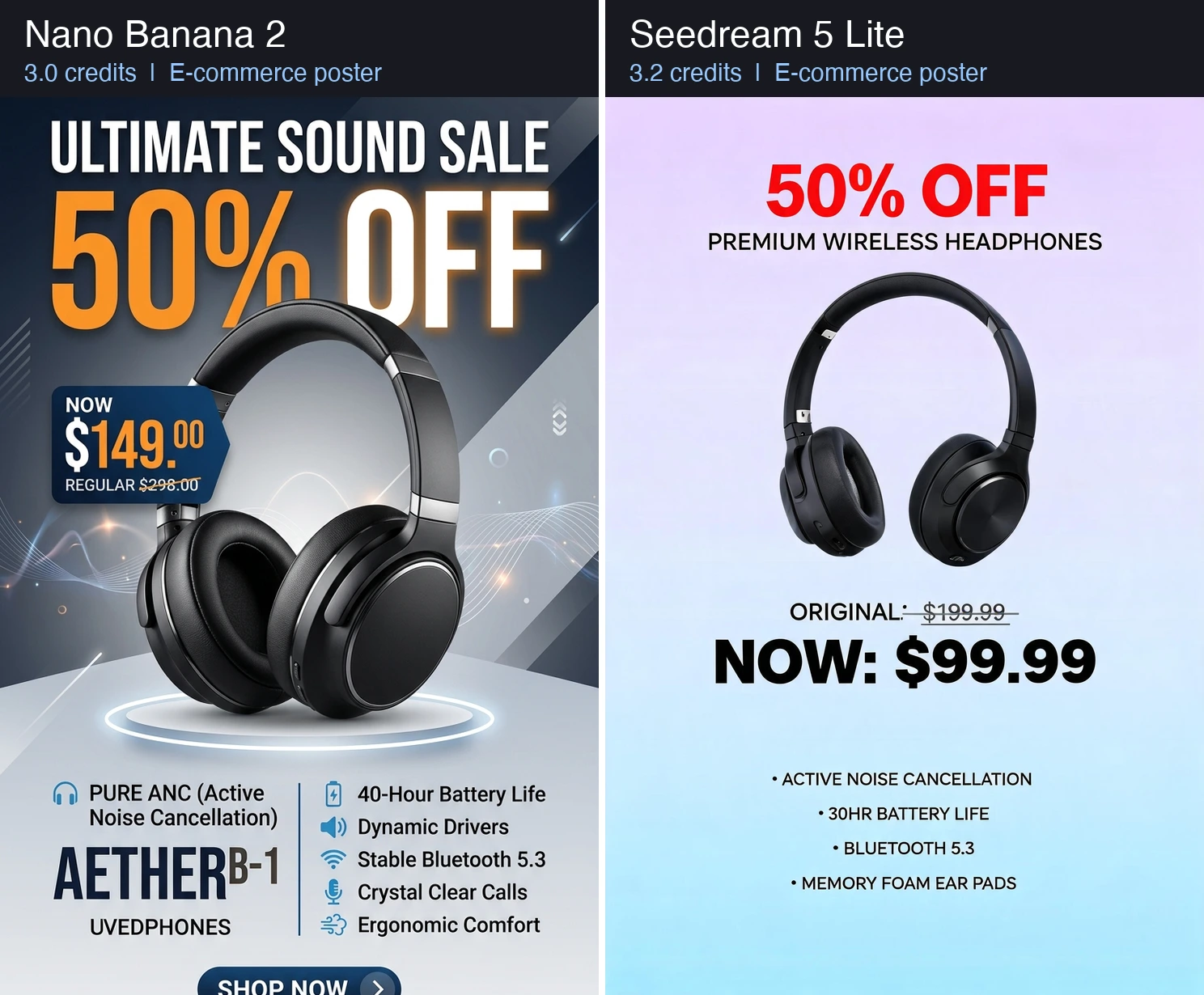
The closest round. Nano Banana 2 built a fuller poster — brand mark, struck-through original price, six icon-led feature bullets and a CTA button — but with a couple of small text glitches ("UVEDPHONES"). Seedream's poster had cleaner text but far fewer elements: headline, price, four plain bullets, closer to a template. Winner: Nano Banana 2 on completeness; Seedream if you want minimal and error-free.
So which should you choose?
The quick verdict up top holds — Nano Banana 2 for most work, Seedream 5 for narrow text-first jobs. Here's how to apply it to a real pipeline rather than a one-off:
One-off assets that must be right (a landmark scene, a client poster, anything with brand facts): Nano Banana 2. Its search grounding and completeness are worth the near-identical price.
High-volume, template-like output where each image is simple and text must be flawless: test Seedream 5 first — its clean glyphs and lower list price on some platforms may win at scale, even though it wasn't cheaper on AIReiter.
Chinese-language work: don't take the common "Seedream wins Chinese" advice at face value — Nano Banana 2 handled headings better in my test. Run both before deciding.
Caveat worth repeating: these are three single-shot tests, not a benchmark suite. Treat them as directional and run your own prompts before committing a pipeline.
If you want to A/B them yourself, running both on one platform (like AIReiter) keeps the comparison on the same credits. For deeper single-model guides, see our Nano Banana 2 overview and Seedream 5 guide, or the related Seedream 5 vs Nano Banana Pro comparison if you're weighing the Pro tier instead.
FAQ
Is Seedream 5 the same as Seedream 5.0 Lite?
As of July 2026, yes. ByteDance has only released Seedream 5.0 Lite; there's no separate full 5.0 yet, so "Seedream 5" in practice means the Lite version.
Is Nano Banana 2 more expensive than Seedream 5?
Not necessarily. Third-party lists often show Seedream cheaper, but on AIReiter my 2026-07-03 test cost 3.0 credits for Nano Banana 2 vs 3.2 for Seedream — essentially the same. Check your actual platform before assuming.
Which is better for Chinese or CJK text?
It's closer than most articles claim. In my test Nano Banana 2 rendered clean Chinese headings and a more complete design; Seedream had flawless glyphs but a sparse layout. For finished Chinese designs I'd lean Nano Banana 2.
What's the difference between Seedance and Seedream?
Seedream is ByteDance's image model; Seedance is its video model. Different products, same company.
Is Nano Banana 2 the same as Nano Banana Pro?
No. They're separate Google models — Nano Banana 2 is faster and cheaper; Nano Banana Pro targets complex compositions and fine typography at a higher price.