 AIREITER
Liquid AI LFM3 packs text, vision, audio and omni interaction into six models around 2 billion parameters, yet Liquid's own pricing page lists no LFM3 rate as of October 27, 2026. That gap decides whether LFM3 is a cheap edge specialist or only a download-and-host release for now.
LFM3 in one line: six 2B specialists with no API price tag yet
LFM3 is Liquid AI's third-generation foundation-model family for specialized on-device intelligence, not a single checkpoint. The family shares the LFM3-1.7B-Base backbone pretrained on 22 trillion tokens and spans six releases: LFM3-1.7B, LFM3-VL-2B, LFM3-Audio-2B, LFM3-Omni-2B, d1-2B and d1-Omni-2B (announcement).
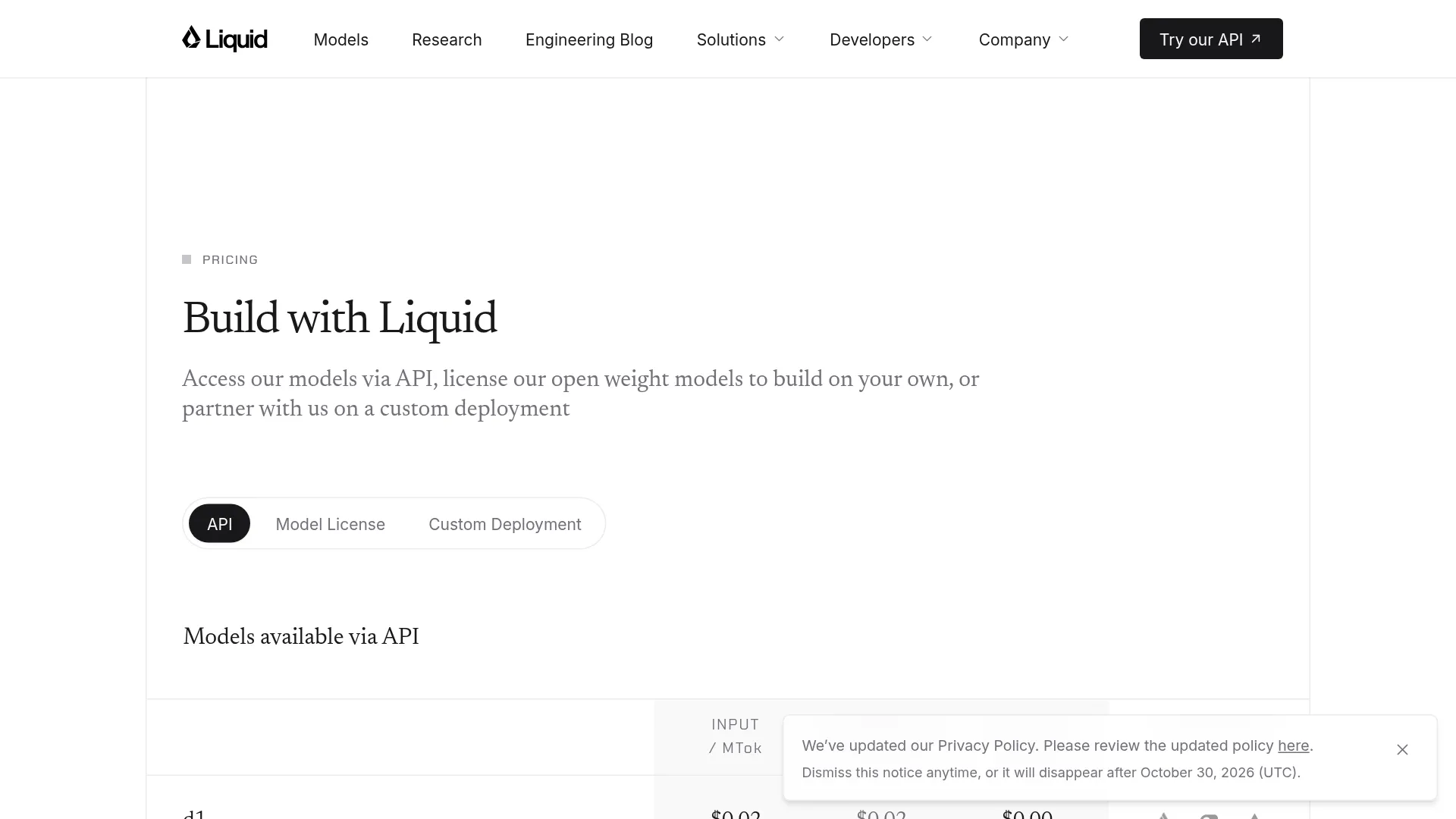
I checked Liquid AI's pricing page on October 27: no LFM3 entry, only the d1, d1-ultra and LFM2.5 rates tabled below. The LFM3 announcement says weights are available through Hugging Face, the Liquid Playground and the Liquid API, but only the first two are directly checkable today. New organizations still get $2 in free Liquid Console credit (pricing).
The six models, and which one you need for each job
The six LFM3 checkpoints share one backbone but accept different inputs and return different outputs.
| Model | Approx. size | Inputs | Outputs | Use it for |
|---|---|---|---|---|
| LFM3-1.7B | 1.7B | Text | Text | Local agents, tool calls, structured output |
| LFM3-VL-2B | 1.9B | Text, images, video | Text | Image and video understanding, visual agents |
| LFM3-Audio-2B | 2B | Text, audio | Text, speech | Voice chat, recognition, synthesis, translation in 18 languages |
| LFM3-Omni-2B | 2B | Text, images, video, audio | Text, speech | Unified multimodal assistant |
| d1-2B | 2B | Text, images, video | Calibrated answers | Classification, extraction, single-pass decisions |
| d1-Omni-2B | 2B | Text, images, video, audio | Calibrated answers | Multimodal sensing with confidence scores |
LFM3-1.7B carries a 256K-token context window and a tri-hybrid stack of 24 layers: 13 gated short-convolution layers, 5 sliding-window attention layers with a 256-token window, and 6 global-attention layers (announcement). The final 3.5 trillion-token mid-training stage added agent trajectories and tool calls, which explains why Liquid positions the text model for Hermes Agent, Pi and OpenClaw-style harnesses (announcement). LFM3-VL-2B is Liquid's first vision model with video input, and LFM3-Omni-2B is its first omni-modal model handling soundtrack plus frames together (announcement).
The decision models work differently from the rest. d1-2B and d1-Omni-2B skip autoregressive generation and return calibrated answers with probabilities in one forward pass (announcement). Vendor-reported decision latency is 5.7 ms on an NVIDIA H100 and 3.8 ms on an AMD MI325X for d1-2B, rising to 12.4 ms and 8.2 ms respectively for d1-Omni-2B with a 10-second audio clip (announcement).
What Liquid claims, and what is independently visible
Liquid AI's benchmark figures are vendor-reported; treat them as vendor claims until independent tests appear. All figures below come from Liquid's announcement.
| Model | Vendor-reported metric | LFM3 figure | Prior / rival figure |
|---|---|---|---|
| LFM3-1.7B | WebArena-Verified | 38.42 | 3.02 (LFM2.5-2.6B) |
| LFM3-1.7B | Size / speed | 35% fewer params, ~25% faster per param at 8K vs LFM2-1.2B | — |
| LFM3-VL-2B | 62 vision avg / encoder | 71.4 avg; 164M encoder at 2.2x fewer FLOPs | 57.6 avg; Qwen3.5-2B encoder parity claimed |
| LFM3-Audio-2B | UTMOSv2 / latency | 3.83; 50 ms min first token; 87x real-time on M4 Max CPU | 3.22 (LFM2.5-Audio-1.5B) |
| d1-2B | ImajevBench | 75.5 | 64.0 (d1-3B) |
What I verified directly: the LiquidAI LFM3 collection on Hugging Face lists all six builds with quantized, MLX and ONNX variants, and LM Studio's catalog already surfaces LFM3 variants for desktop. Treat the scores as direction, not guarantees. Aggregate averages hide OCR, grounding and video splits, and the 4-bit 1GB figure excludes KV cache and app overhead.
"crazy how fast you can make things nowadays." — @Nklockiewicz, running LFM3 on iPhone in airplane mode via MLX/ExecuTorch at 40 tok/s (source)
"They typically hit above their weight in terms of speed and intelligence but they've not yet been smart enough for 'real work' in my experience." — u/spaceman_, r/LocalLLaMA (source)
The $10M license line to read before shipping
Liquid AI's open-weight license is free until company revenue crosses $10 million per year (pricing). Developers, researchers, nonprofits and businesses under $10M in annual revenue can download, run, fine-tune and ship every open LFM in production, keep fine-tunes private, and deploy on mobile, edge or on-premises with no copyleft requirement (pricing).
Companies above $10M need a paid enterprise license with pricing set by deployment scale through sales. Research, education and nonprofit use stays free without a revenue cap (pricing). The LFM Open License ends its free commercial grant at that threshold; confirm attribution, redistribution and export terms with counsel before embedding weights in a commercial app.
Running it locally: what 1GB needs in practice
LFM3-1.7B needs about 1GB in 4-bit form, but that number covers weights only (announcement). The running process also loads the runtime, KV cache for long context, and any vision or audio encoders, so budget extra RAM on top, especially for VL and Omni builds processing video frames or audio clips.
Start with LFM3-1.7B; add VL, Audio, or Omni only when required, and check each model card's extra dependencies before benchmarking. Ollama, LM Studio, llama.cpp, MLX and ONNX paths are listed for LFM3 via the Hugging Face collection and LM Studio catalog.
When a model card example requires trust_remote_code=True, pin a commit hash, review the repo code, or run first in an isolated environment, because that flag executes code shipped in the repository. Liquid says 18 audio languages in its announcement without a per-language quality table there, so verify non-English output on your own data.
API access right now: where to call it and what it bills
API access for LFM3 is announced but not separately priced on Liquid's public page, which routes calls through Liquid Console, OpenRouter and Vercel AI Gateway (pricing).
| API model listed Oct 27 | Input / MTok | Cached input / MTok | Output / MTok |
|---|---|---|---|
| d1 | $0.02 | $0.02 | $0.00 |
| d1-ultra | $0.042 | $0.042 | $0.00 |
| LFM2.5-24B-A2B | $0.05 | $0.025 | $0.70 |
| LFM3-1.7B / VL / Audio / Omni text rates | Not listed | Not listed | Not listed |
That absence is the pricing answer for now: budget LFM3 as self-hosted compute plus engineering time, not as a per-token line item. If a provider quotes LFM3 tokens today, compare it against the listed d1 and LFM2.5 baselines and confirm whether it proxies Liquid Console or serves its own weights. The listed d1 output at $0.00 per million tokens makes d1 potentially attractive for high-volume inspection pipelines.
LFM3 FAQ
How much does the LFM3 API cost?
Liquid AI lists no separate LFM3 per-token price as of October 27, 2026; the public page shows only d1, d1-ultra and LFM2.5-24B-A2B rates.
Is LFM3 free for commercial use?
Commercial production is free for businesses under $10M in annual revenue under the LFM Open License; larger businesses need a paid enterprise license.
Can LFM3 run on a phone or laptop?
Yes for the text build at about 1GB in 4-bit plus runtime overhead, with Ollama, LM Studio, llama.cpp, MLX and ONNX paths; VL, Audio and Omni builds need more memory for encoders and media.
Is LFM3 better than Qwen or Gemma for edge agents?
I found no independent comparison in the launch-day results I checked; Liquid's claimed wins over Qwen3.5-2B and Qwen2.5-Omni-7B are vendor-reported (announcement), so test LFM3 against Gemma and Qwen on your own harness before switching.
Can I fine-tune LFM3 on one GPU?
Liquid provides notebooks for SFT, DPO, GRPO and continued pretraining and says every model fine-tunes on a single GPU (announcement), without publishing VRAM or dataset-size requirements.
Cheap private specialist or small generalist that needs your harness
LFM3 fits when data stays on device, media must stay local, or decision volume makes per-token cloud bills painful. It falls short for broad knowledge, long creative reasoning, or drop-in quality without harness tuning. Download one variant, measure it on your prompts and hardware, and let that result, not the launch chart, decide.