 AIREITER
OpenAI launched GPT-6.1 Terra on October 26, 2026 as the workhorse of the GPT-6.1 family: GPT-6.1 Terra API pricing undercuts GPT-6.1 Sol by exactly half, yet early Codex users cannot agree whether it replaces Sol or just renames it. The catch is output tokens and long prompts, not the headline $1 rate.
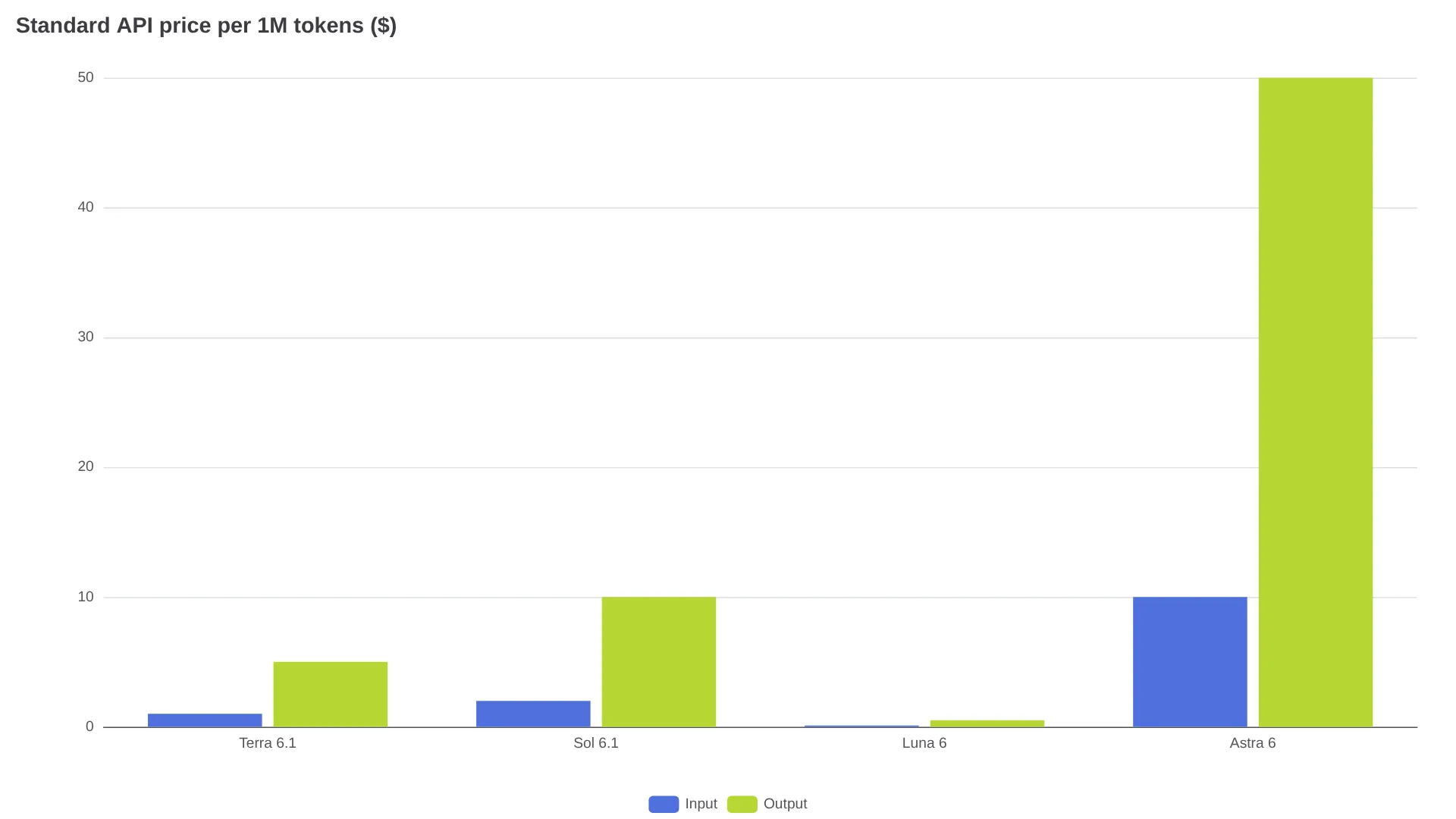
The short answer: half of Sol's price, but output tokens decide the bill
GPT-6.1 Terra API pricing is $1.00 per 1M input tokens, $0.05 per 1M cached input, and $5.00 per 1M output on Standard short-context processing. Flex and Batch cut those rates to $0.50 / $0.025 / $2.50, while Fast doubles them to $2.00 / $0.10 / $10.00.
Output tokens cost 5x input tokens on GPT-6.1 Terra, so agent runs that emit long reasoning traces or reports dominate the invoice. An illustrative 3,000-input / 1,000-output call costs $0.008 on Standard ($0.003 input + $0.005 output) and $0.004 on Flex. Scale that to 1 million such tasks and the gap is $8,000 versus $4,000 before caching.
The model identifier is gpt-6.1-terra, with a 1,050,000-token context window, a 128,000-token maximum output, and a June 1, 2026 knowledge cutoff, according to OpenAI's model documentation.
What the API actually charges, and where you can call it
GPT-6.1 Terra is available from October 26, 2026 to ChatGPT Plus, Pro, Enterprise, and Edu users inside ChatGPT Work and Codex, plus the OpenAI API as gpt-6.1-terra, per OpenAI's launch post. The Free tier is not supported for API use.
| Price component | Standard rate per 1M tokens |
|---|---|
| Input, up to 272,000 tokens | $1.00 |
| Cached input | $0.05 |
| Cache write, 30-min retention | $1.25 |
| Cache write, 12-hour retention | $2.50 |
| Output, up to 272,000 input tokens | $5.00 |
The full rate card lives on OpenAI's API pricing page. Cached input is 5% of the uncached input rate, which rewards repeated system prompts and file prefixes. Automatic caching applies to prompts of 1,024 tokens or more, but every cached prompt incurs a cache-write charge even when the prefix is never reused.
Three modifiers change the headline rate:
- Long context over 272,000 input tokens: input and cache rates double to $2.00 / $0.10, output rises 1.5x to $7.50, and the multiplier applies to the whole request, not just tokens above the threshold.
- Batch and Flex: both cost 50% of Standard. Flex showed 1.79s P50 latency and 194 tokens/s throughput on OpenRouter's live telemetry on October 26, 2026, versus 1.89s and 63 tokens/s on Standard routing, though Flex is excluded from Standard routing.
- Fast and regional: Fast mode costs 2x Standard ($2.00 / $10.00), and eligible regional processing adds a 10% surcharge. Paid tool calls such as web search carry separate per-call fees.
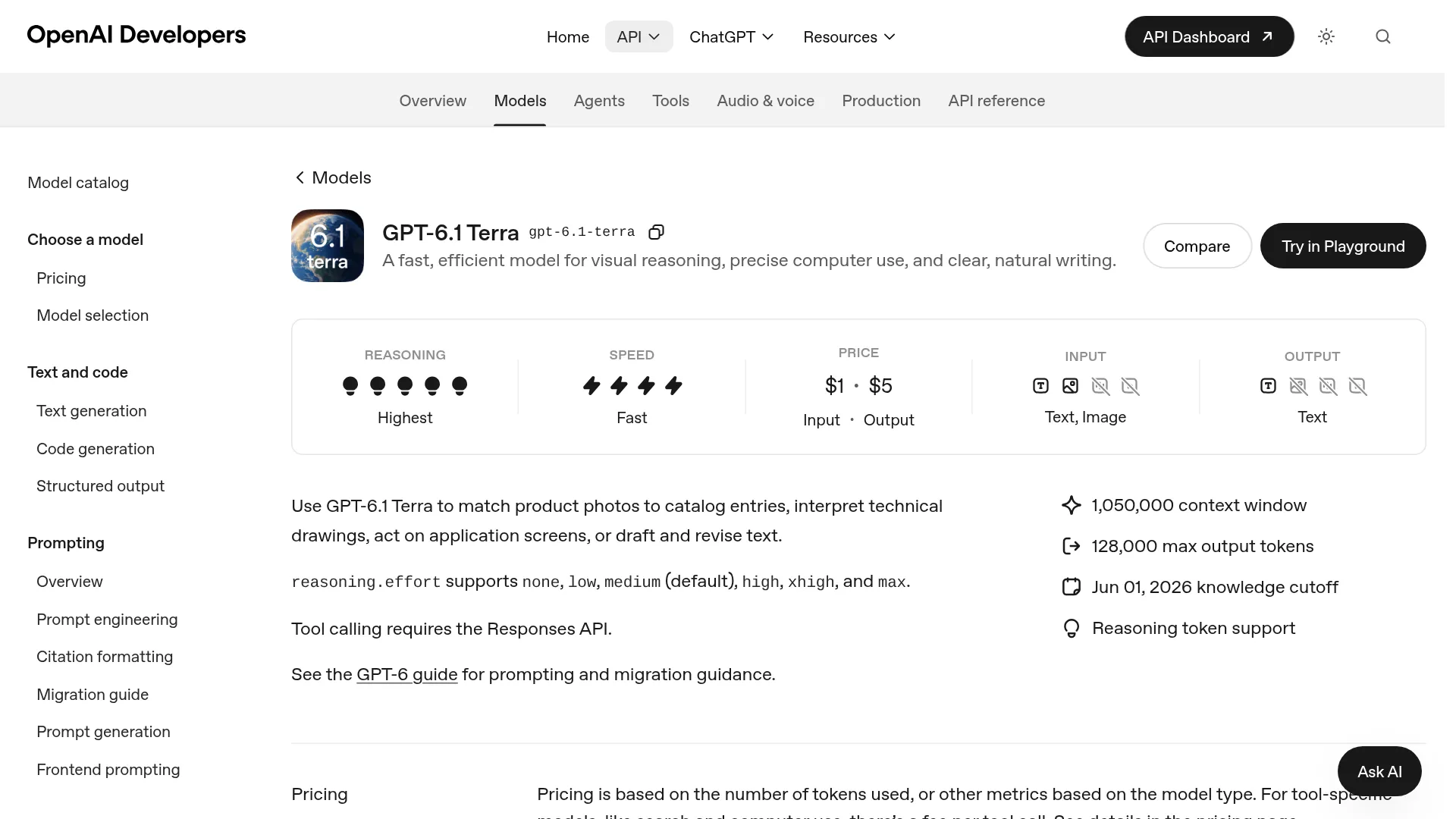
Function calling and structured outputs are supported, but tool calling requires the Responses API. Streaming is supported. Fine-tuning is not supported, and audio or video input/output is not supported; GPT-6.1 Terra accepts text and image input (including PDFs as files) and produces text only. Reasoning effort is configurable across none, low, medium, high, xhigh, and max, with medium as the default, which makes reasoning depth the main cost lever after output length.
What Terra is built for, in OpenAI's own numbers
GPT-6.1 Terra targets visual reasoning, precise computer use, and natural writing for high-volume professional work. Example tasks in OpenAI's launch post include drafting proposals, interpreting technical drawings, filling forms, reading invoices, and entering invoice data into accounting software.
Benchmark claims from OpenAI, all dated October 26, 2026, need the effort setting attached because results move with reasoning depth:
- Agents' Last Exam: at medium effort, GPT-6.1 Terra scores 15 points higher than GPT-5.6 Terra at roughly one-third the cost, lands near GPT-6 Astra at one-tenth the per-token price, and at max effort is over 3x as token-efficient as Claude Opus 5.5 at one-fourth the per-token price, for about 9x lower cost per completed task.
- MMMU-Pro visual reasoning: GPT-6.1 Terra beats GPT-5.6 Terra at every effort setting and nearly matches GPT-6 Astra and GPT-6.1 Sol at lower cost.
- OSWorld 2.1 desktop use: at medium effort, GPT-6.1 Terra exceeds GPT-5.6 Terra's best score at a fraction of the per-task cost.
- Factuality on error-inducing prompts: error rate falls from 53.6% to 16.7% at low effort and reaches 4.3% at max effort, near GPT-6 Astra and GPT-6.1 Sol. OpenAI scopes this to an internal adversarial set, not a general production hallucination rate.
- Terminal-Bench 4.0 coding: tasks solved rise from 21.5% to 50.3% at max effort, more than double the predecessor. Terminal-Bench-Science 0.1 beats GPT-6.1 Sol and lands within five points of Claude Opus 5.5 at under one-fifth the estimated cost.
OpenAI still routes the hardest coding to Sol and Astra, so independent Codex latency data matters more than launch charts.
Terra vs Sol vs Luna vs Astra: which bills less for your job
Standard short-context rates per 1M tokens frame the choice: GPT-6.1 Terra $1.00 / $5.00, GPT-6.1 Sol $2.00 / $10.00, GPT-6 Luna $0.10 / $0.50, GPT-6 Astra $10.00 / $50.00, per OpenAI's pricing page. GPT-6.1 Terra halves Sol and the old GPT-5.6 Terra list rates; Luna remains 10x cheaper than Terra; Astra costs 10x Terra.
| Workload | Cheapest sensible pick | Why |
|---|---|---|
| Bulk computer use, form filling, invoice-to-accounting, browser ops | GPT-6.1 Terra, preferably Flex | Near-Astra visual/agent scores at one-tenth the token price; Flex halves the bill again |
| Bounded code edits, research agents, subagent executors | GPT-6.1 Terra at medium effort | Terminal-Bench 50.3% at max effort suits scoped tasks; reserve Sol/Astra for the hardest repos |
| Hardest coding, long-horizon engineering | GPT-6.1 Sol or GPT-6 Astra | OpenAI explicitly keeps Sol/Astra ahead on complex code despite Terra's price |
| High-volume chat, classification, lightweight agents | GPT-6 Luna | $0.10 / $0.50 list rate beats Terra by 10x when vision and desktop control are unnecessary |
Do the blended math before assuming the cheapest input rate wins. At 2,000 input tokens with a 40% cache-hit rate plus 1,000 output tokens, excluding one-time cache-write charges, one GPT-6.1 Terra Standard request costs about $0.00624: $0.0012 uncached input + $0.00004 cached input + $0.005 output. Output is 80% of that request. The same shape on GPT-6 Luna costs roughly $0.00062, while GPT-6.1 Sol costs about $0.01248. Crossing 272,000 input tokens brings Flex input back to the short-context Standard input rate, although Flex remains 50% below long-context Standard, so chunk retrieval before crossing that line.
For background on the sibling tier, see GPT-6.1 Sol API pricing and review and the GPT-6 Sol and Luna API cost guide.
What early users get wrong about Terra
The launch-day argument is about product overlap: Codex users cannot place GPT-6.1 Terra between Luna and Sol.
"So, judging by benchmarks, it looks awfully similar to 6.1 Sol?" — u/Frosty-Wing6704 on r/codex
"We already have 6.1 Terra. It's called 6.1 Sol." — u/comradepipi on r/codex
That confusion is understandable because OpenAI's own framing puts GPT-6.1 Terra near Sol on MMMU-Pro and Terminal-Bench-Science while charging half. Early hands-on notes point to a narrower role: Terra as the executor, Sol as the orchestrator. X early-access user @petergostev wrote that GPT-6.1 Terra is "probably first non-frontier model that crosses the threshold of something that I actually don't mind using" and "a solid workhorse" for long-running computer-use tasks or tight allowances, "at half the price." Reddit user u/panix199 put the same point in cost terms on r/singularity: "the price per task got lowered quite well compared to 5.6 terra."
Two open questions remain unanswered by launch material: how fast ChatGPT Work and Codex allowances burn on GPT-6.1 Terra versus Sol, and whether older instruction-following complaints persist. A pre-launch r/codex thread captures both sides, with one user calling 5.6 Terra "notorious for completely ignoring critical instructions" and another calling Terra "perfectly usable and predictable." Until allowance metering and long-session failure rates are published, treat GPT-6.1 Terra as a bounded-task executor rather than a drop-in Sol replacement.
GPT-6.1 Terra API FAQ
How much does the GPT-6.1 Terra API cost per 1M tokens?
GPT-6.1 Terra costs $1.00 input, $0.05 cached input, and $5.00 output per 1M tokens on Standard short-context requests. Batch and Flex cost half; Fast costs double.
Is GPT-6.1 Terra cheaper than GPT-6.1 Sol?
Yes. GPT-6.1 Terra's Standard rates are 50% below GPT-6.1 Sol's $2.00 / $10.00, and Flex Terra at $0.50 / $2.50 costs half as much as Sol Batch ($1.00 / $5.00) while staying interactive.
How does GPT-6.1 Terra compare with GPT-5.6 Terra?
GPT-6.1 Terra halves GPT-5.6 Terra's list rates and beats it by 15 points on Agents' Last Exam at medium effort, more than doubles Terminal-Bench 4.0 from 21.5% to 50.3%, and cuts low-effort factuality errors from 53.6% to 16.7%.
Are Batch and Flex really 50% cheaper?
Yes, both are 50% of Standard for GPT-6.1 Terra, but Batch is asynchronous while Flex trades latency guarantees for the discount and is excluded from Standard routing.
What happens over 272,000 input tokens?
GPT-6.1 Terra reprices the entire request: input and cache rates double and output rises 1.5x to $7.50 per 1M. Chunk retrieval or compress context before crossing that line.
Do tools need the Responses API?
Yes. Tool calling on GPT-6.1 Terra requires the Responses API, including computer use, web search, file search, code interpreter, hosted shell, MCP, and patch application.
Can GPT-6.1 Terra be fine-tuned?
No. OpenAI's model page marks fine-tuning as unsupported, alongside no audio or video support.
What I would run on Terra with $20
$20 buys 20M Standard input tokens or 4M Standard output tokens on GPT-6.1 Terra, double on Flex. I would spend it on three metered batches: invoice-to-ledger computer-use runs at medium effort, a Sol-orchestrated research pipeline with Terra as the file-search executor, and a form-filling regression set that measures allowance burn per completed task. If Terra holds an acceptable scoped-edit completion rate at medium effort on my own regression set near one-third of GPT-5.6 Terra's per-task cost, it keeps the bulk workload.