 AIREITER
Kling API pricing uses generated seconds and prepaid units, while aggregators often charge cash per generation. Compare the exact output, upfront commitment, and attempts per accepted clip—not only the lowest headline rate.
What Kling API pricing means in practice
Kling’s official developer pricing varies by resolution, audio, video input, and duration. Aggregators wrap the model family in pay-as-you-go or reseller credits, changing both the unit price and the amount a buyer must fund upfront.
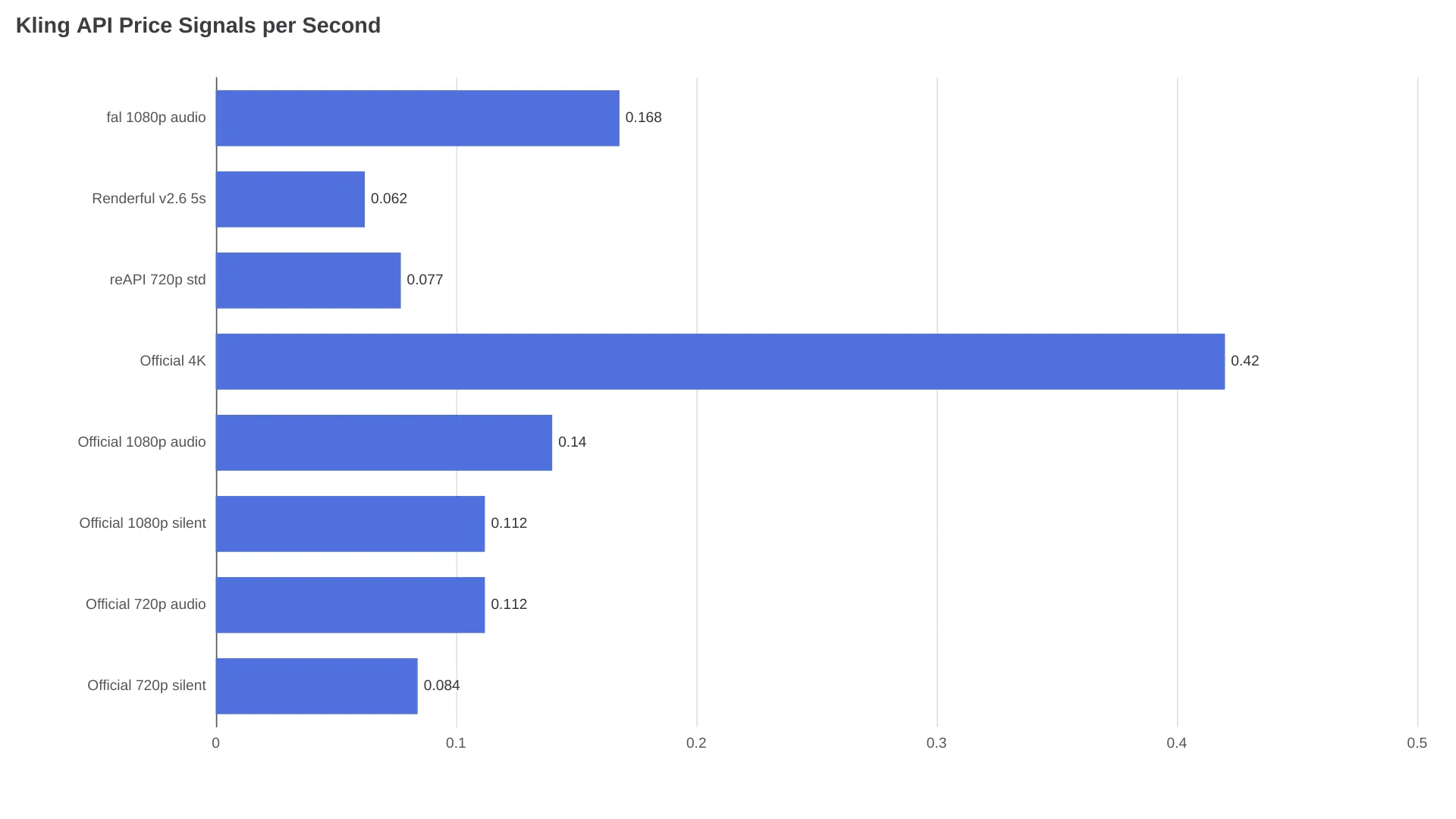
The official Kling developer pricing page lists a $0.084 per generated second baseline for 720p Kling 3.0 without native audio. A five-second clip is $0.42 and a 10-second clip is $0.84 before tax, package minimums, or retries. These are usage-rate equivalents, not guaranteed checkout totals.
Official Kling API pricing: convert units into video cost
The official rate card prices generated seconds rather than finished or accepted videos. The examples below convert its public USD-equivalent rates into common durations.
| Official configuration | Rate per second | 5 seconds | 10 seconds | 15 seconds |
|---|---|---|---|---|
| 720p, no native audio | $0.084 | $0.42 | $0.84 | $1.26 |
| 720p, native audio | $0.112 | $0.56 | $1.12 | $1.68 |
| 1080p, no native audio | $0.112 | $0.56 | $1.12 | $1.68 |
| 1080p, native audio | $0.140 | $0.70 | $1.40 | $2.10 |
| 4K | $0.420 | $2.10 | $4.20 | $6.30 |
The arithmetic is generated seconds × rate per second. A 10-second 1080p clip with native audio costs 10 × $0.140 = $1.40; a 10-second 4K clip costs $4.20.
Model-specific rows still matter. The official pricing page separates Kling 3.0, 3.0 Omni, Turbo, video-input, avatar, and motion-control rates; Turbo can use one audio-inclusive rate instead of separate silent and audio prices. Verify the model ID and payload before funding a large balance.
The official prepaid-package catch
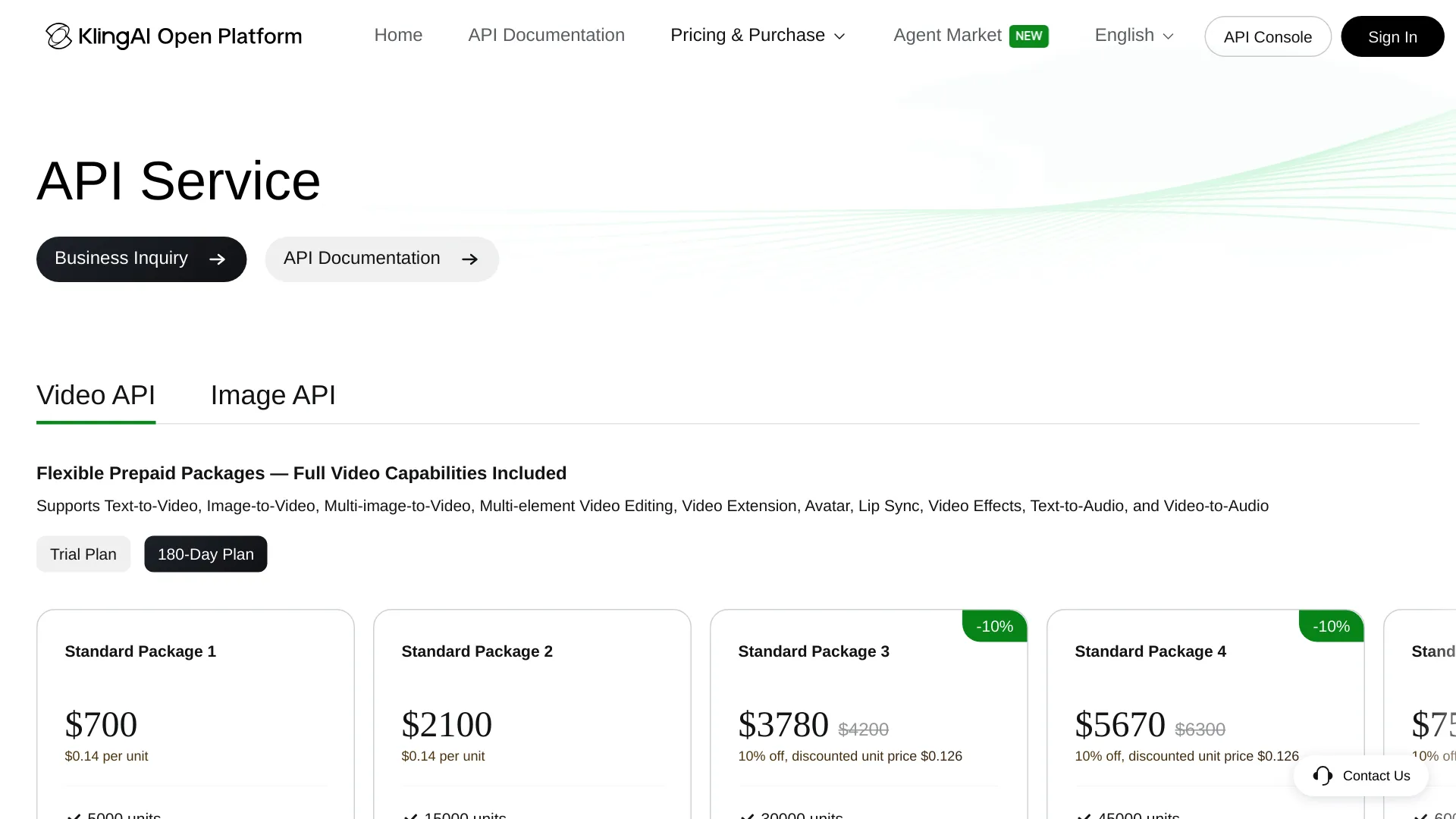
Direct Kling API units, consumer subscription credits, and aggregator credits are separate billing systems, as Kling’s usage and billing documentation explains. Direct access uses resource packages, so a nominal $0.42 clip does not imply that $0.42 is the minimum card charge.
CostBench’s Kling pricing record, last verified August 18, 2026, lists packages at $700 for 5,000 units, $2,100 for 15,000 units, and $3,780 for 30,000 units, with 180-day validity. It reports $0.14 per unit for the smaller packages and $0.126 per unit at 30,000 units. Verify these package terms in Kling checkout because the official page can change.
Published per-second USD equivalents and prepaid unit prices describe different stages of billing. Package economics cannot be converted into a reliable cash cost per video unless the checkout also confirms the unit consumption for the exact model, resolution, audio, and input mode. Small workloads therefore need to compare the package floor with a gateway’s smaller pay-as-you-go purchase.
Aggregator Kling API pricing compared
Aggregator prices can reduce the payment unit, but the routes below are not identical products. The table preserves each provider’s published model and billing basis instead of forcing non-comparable figures into one ranking.
| Route | Published comparison point | Approx. cost | Billing shape | Best interpretation |
|---|---|---|---|---|
| Official Kling 3.0 | 720p silent | $0.084/sec | Units / packages | Direct silent baseline |
| reAPI Kling 3.0 | 720p Standard, silent | $0.077/sec | Credits at $0.001 each | Slightly below official list rate |
| Renderful Kling v2.5 Turbo / v2.6 | 5-second generation | $0.31 | Pay per generation | Lower-cost older route |
| Renderful Kling v3 Standard | 5-second generation | $0.42 | Pay per generation | Newer fixed short-clip quote |
| fal route shown by AI API Cost | 5-second 1080p audio | $0.70 | Pay as you go | Simple cash billing, different route |
| Route Key v2.5 Turbo / v2.6 | Per request | $1.50 | Request-priced signal | Duration basis not exposed |
reAPI lists Kling 3.0 Standard at $0.077/sec and values its credits at $0.001 each. Renderful quotes $0.31 per five seconds for Kling v2.5 Turbo and v2.6, and $0.42 for Kling v3 Standard. AI API Cost shows a five-second 1080p native-audio example at $0.70 through fal. Route Key reports $1.50 per request for v2.5 Turbo and v2.6, but does not expose an equivalent duration and resolution basis.
What “cheaper” actually means
Compare four variables before selecting a route:
- Output: normalize model, resolution, audio, input type, and duration.
- Billing unit: convert per-request or per-five-second quotes only when duration is known.
- Cash commitment: include package minimums, expiry, and unused balance.
- Failure policy: verify whether provider failures, moderation failures, and user-requested retries receive refunds.
Choose direct Kling access for current models, a direct vendor relationship, or enterprise volume terms. Choose a gateway for small tests, pay-as-you-go billing, or one API across several model vendors. For native audio and 4K, use the matching table row rather than extrapolating from the 720p silent price.
Calculate your real Kling API cost per usable video
A production budget must include attempts that generate valid but unusable footage. Use:
usable-video cost = seconds × rate × attempts per accepted clip
For a 10-second 1080p clip with native audio at $0.140/sec:
| Workflow | Calculation | Generation cost |
|---|---|---|
| One attempt | 10 × $0.140 | $1.40 |
| Two attempts per keeper | 10 × $0.140 × 2 | $2.80 |
| Four attempts per keeper | 10 × $0.140 × 4 | $5.60 |
“Each one costs about 100 credits for 5 seconds, or roughly 100,000 credits in total.” — @alainastruc, estimating a 90-second project with roughly 100 shots and a one-in-ten keeper rate.
That post is a production anecdote, not a rate benchmark, but it identifies the cost variable that list prices omit: keeper rate. For a cheaper prompt-development pass, 20 five-second attempts at the official 720p silent baseline cost 20 × 5 × $0.084 = $8.40. Increase resolution or add audio after the prompt and input frame work reliably.
Kling API pricing FAQ
How much does Kling API cost per second?
Common official Kling 3.0 video rates start at $0.084/sec for 720p silent output and rise to $0.112/sec for 720p audio or 1080p silent, $0.140/sec for 1080p audio, and $0.420/sec for 4K. Video-input, Turbo, avatar, and motion-control routes have separate rows on the official page.
How much is a 5-second Kling API video?
A five-second official-equivalent clip costs $0.42 at 720p silent, $0.56 at 720p audio or 1080p silent, $0.70 at 1080p audio, and $2.10 at 4K. Aggregator quotes can represent different Kling models.
Is Kling API cheaper than a Kling subscription?
The products use separate billing currencies and serve different workflows. Compare accepted outputs, retries, expiry, and the API package minimum rather than comparing raw credit balances.
Is there a free Kling API tier?
Consumer promotional credits are not a permanent developer API tier. Check Kling’s developer billing page for a current trial and treat aggregator promotions as separate offers.
Does native audio increase Kling API pricing?
Yes for configurations with separate silent and native-audio rates. Turbo and Omni can use different pricing structures, so verify the exact model and audio parameter.
Do retries cost money?
A valid generation that is visually unusable remains part of production cost. Refund rules differ by route; verify them instead of assuming all failed or moderated tasks are free.
What should I verify before buying credits?
Confirm the model ID, units consumed by the exact payload, resolution, audio, input type, duration, package minimum, expiry, concurrency, refund rules, and tax treatment. Run a small batch and record settled usage before committing to a larger package.
Make the purchase decision
Test the deployment payload through the intended route, measure attempts per accepted clip, and multiply the settled charge—not a neighboring model’s headline rate—by that keeper ratio.