
If you want the short answer: Kimi K3 vs Claude Fable 5 comes down to price versus polish. Kimi K3 topped the human-voted WebDev Arena on July 16, 2026, and costs roughly a third of Fable 5 per token, so if you ship a lot of frontend or coding output and watch your API bill, K3 is the value pick. Claude Fable 5 still edges ahead on general reasoning, instruction-following, and one-pass output quality, so it stays the safer choice for complex agentic runs where a clean first attempt matters more than the invoice. The rest of this guide breaks that call apart across benchmarks, price, real coding output, and deployment.
What just happened: Kimi K3's July upset
Moonshot AI released Kimi K3 on July 16, 2026, a 2.8-trillion-parameter open-weight model about 4.2× the size of DeepSeek R1, according to R&D World. On release day it took first place on the WebDev Arena human-voted leaderboard with an Elo of 1679, ahead of Claude Fable 5 at 1631 and GPT-5.6 Sol at 1618. Fable 5 had held that top spot earlier in July before K3 overtook it.
Two facts raised the stakes. K3's open weights are scheduled for a free public release on July 27, 2026, meaning a frontier-class coding model you can download. And demand spiked hard enough that Moonshot paused new subscriptions and expanded capacity in the first days. But winning a blind coding vote is not the same as being better everywhere, and the intelligence numbers tell a more balanced story.
The benchmark gap is narrower than the headlines
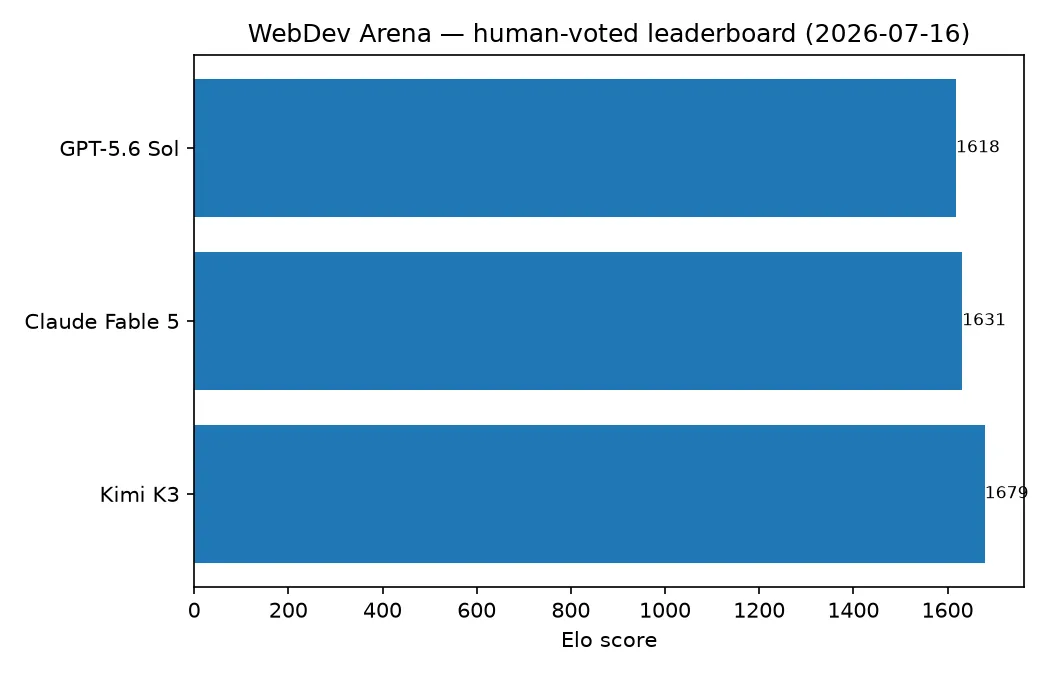
On the WebDev Arena, K3 leads by 48 Elo points, real but not a blowout. On broader intelligence it flips: Artificial Analysis scores Fable 5 at 60 on its Intelligence Index versus 57 for K3. On the coding-specific suites Moonshot cited at launch, Terminal-Bench 2.1 and SWE-Marathon, K3 matches or slightly beats Fable 5. Net: K3 is at parity-to-ahead on frontend and terminal coding, and a step behind on general reasoning. For non-coding work such as long-form reasoning, analysis, and writing, that Intelligence Index edge (60 vs 57) and community reports of stronger output quality still favor Fable 5.
When a leaderboard says one model "beats" another, three things decide whether that applies to you:
- Blind human votes (like WebDev Arena) track first-impression UI quality, not correctness on your specific stack.
- Single-task benchmarks (SWE, Terminal-Bench) track a narrow skill that may or may not match your workload.
- Your own eval on ten real prompts from your codebase beats both, because the 3-to-5-point spreads here sit inside the noise for most teams.
Both models ship a roughly 1-million-token context window (K3 at 1,049k, Fable 5 at 1,000k), so long-context capacity is not a deciding factor either way.
Price: where Kimi K3 makes its real case
Cost is the widest measurable gap between the two.
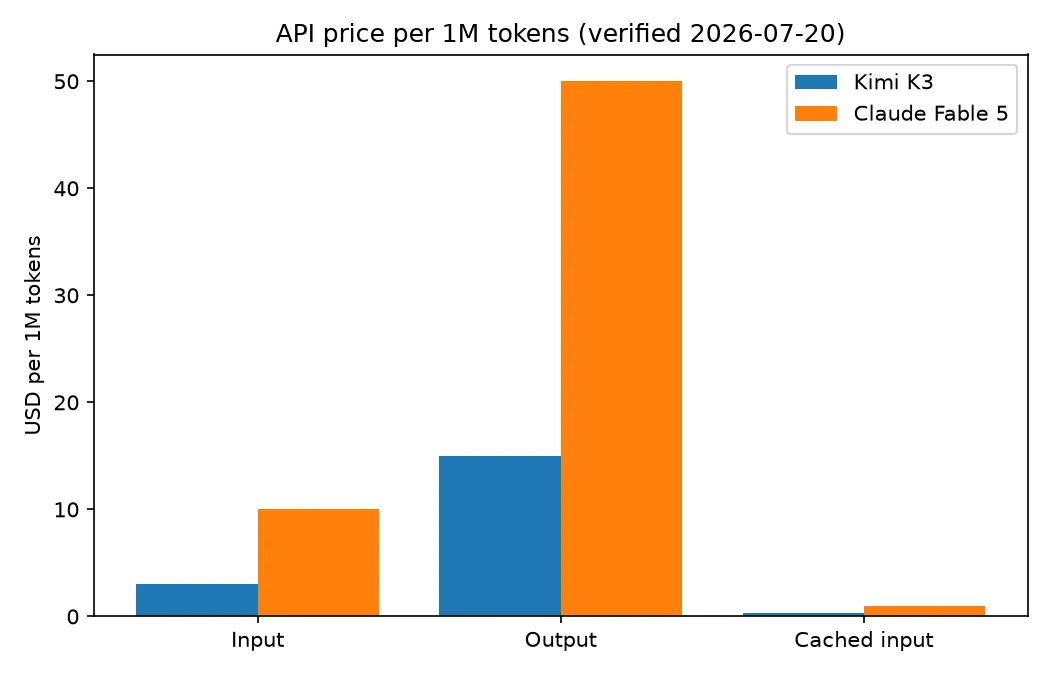
Kimi K3's API runs $3 per million input tokens and $15 per million output, with cached input at $0.30. Claude Fable 5 lists $10 input, $50 output, and $1.00 cached input. Blended at a typical usage mix, Artificial Analysis puts K3 at $2.31 per million tokens against $7.70 for Fable 5, about a third of the cost.
Put a number on it: an app burning 50 million output tokens a month pays roughly $750 on K3 versus $2,500 on Fable 5 (output tokens only; your actual bill also depends on your input and cache mix). A gap that size is enough to move budgets, and some developers are acting on it. One publicly canceled a $200/month Claude Code subscription after switching to K3. For the cost math on the Anthropic side, Fable 5 is also sold through Anthropic-compatible proxies at a discount: AIReiter, for instance, lists the Claude family at about 20% of Anthropic's rates ($2/$10 per million for Fable 5), which narrows the gap if you're committed to Claude. Even so, K3's raw rate stays lower.
Coding output: a Fable 5 baseline, and what K3's results show
A same-prompt head-to-head is the cleanest test. But K3's public weights don't land until July 27 and its hosted capacity was rate-limited in the first days, so the reproducible half of this comparison is the Fable 5 baseline below; K3's side is read from the blind WebDev Arena and named developer runs.
I ran Claude Fable 5 on a concrete frontend build: a self-contained responsive pricing component with three tiers, a monthly/yearly toggle in vanilla JS, hover elevation, and a highlighted plan. It returned a working single-file result in one pass: 33.9 seconds, 3,554 output tokens, 330 lines, no fixes needed.
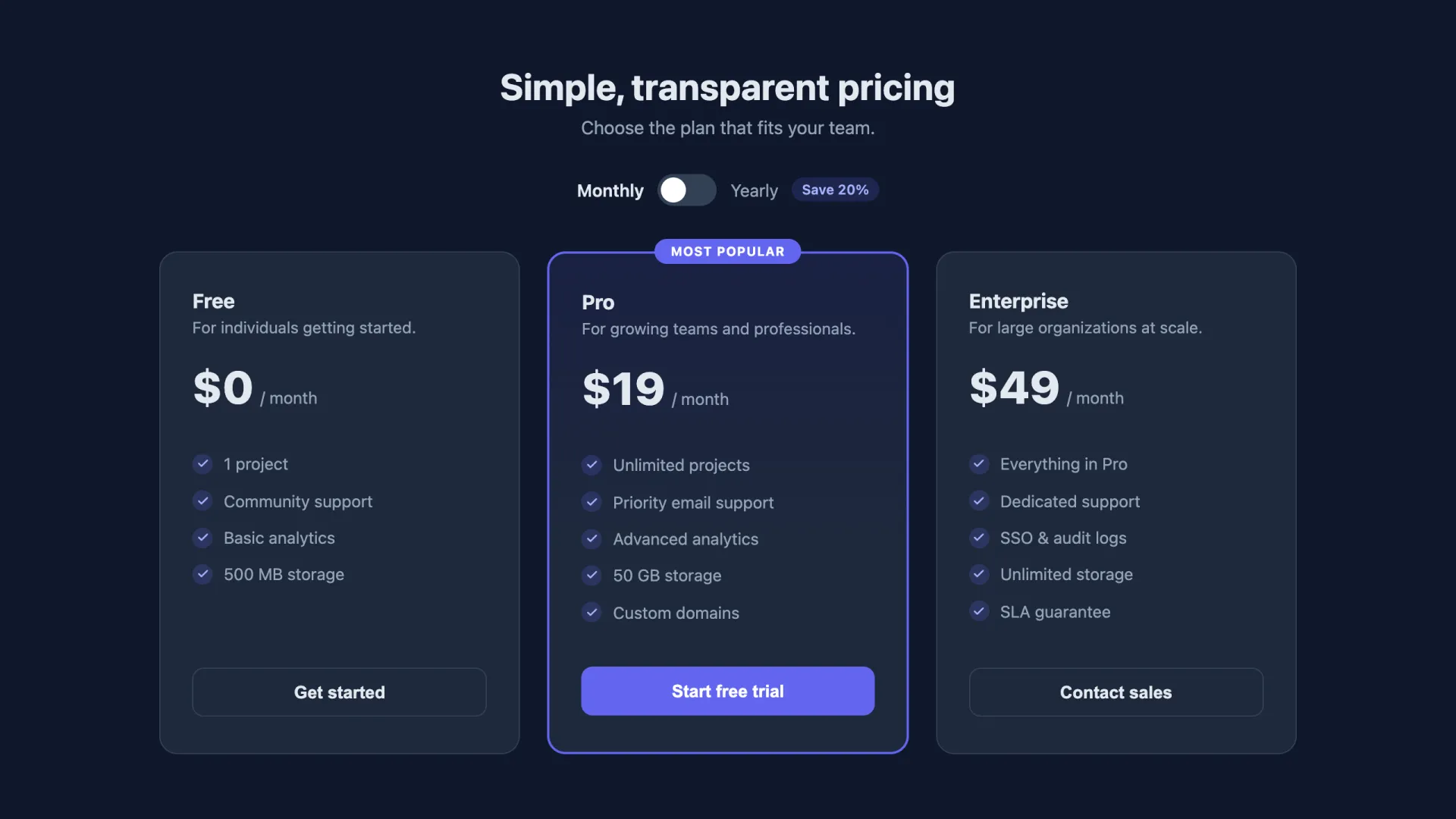
The tell is the unprompted detail: a dark theme, a "Most Popular" badge, a working Save-20% toggle, and semantic spacing the prompt never asked for. That default-to-sensible behavior is where Fable 5 separates itself on first-pass work.
On the K3 side, developers report comparable one-shot wins. One built a Texas Hold'em simulator in Go with six AI personalities over 1,000 hands in a single pass, noting only Fable 5 and Grok 4.5 had done it before. Reviewer Theo Browne, quoted by R&D World, called K3's 3D and visual coding the most capable he had seen from an open-weight model while rating its UI polish slightly behind Claude's. On this evidence, blind-vote and single-model runs rather than a controlled dual test, K3 produces strong working frontend code at low cost, and Fable 5 holds a narrow lead on refinement and complex instruction-following.
Deployment: open weights, self-hosting, and access
"Open weights" sounds like "run it free on your own hardware." For K3, that is mostly not true for individuals. Even compressed with MXFP4 four-bit weights, K3's parameters occupy roughly 1.4 terabytes before runtime overhead, and Moonshot recommends a "supernode" cluster of at least 64 high-end accelerators to serve it. That is a data-center deployment, not a workstation. For nearly everyone, using K3 will mean calling a hosted API, the same operational model as Fable 5, only cheaper per token.
Where to call each one today:
- Kimi K3 runs through Moonshot's platform and via OpenRouter now; downloadable weights for self-hosting arrive July 27, 2026.
- Claude Fable 5 runs through the Anthropic API and Anthropic-compatible proxies. It uses the standard Messages API, so switching a base URL and key is usually all it takes.
One early caveat on K3: in its first days, hosted capacity was tight enough that testers hit rate limits on OpenRouter and Moonshot throttled signups. Fable 5, as a mature Anthropic release, doesn't have that constraint, so if you need guaranteed throughput this week the gap is real. Because both models sit near 1M tokens of context, moving a prompt between them rarely requires restructuring, which makes it cheap to run your own A/B before committing.
Which should you pick
- Pick Kimi K3 if you generate high volumes of frontend or coding output, cost is a top constraint, or you specifically want open weights you can eventually self-host or audit.
- Pick Claude Fable 5 if you're running complex, long-horizon agentic workflows, need the strongest general reasoning and instruction-following, or want the most polished first-pass output with guaranteed throughput.
For teams shipping a lot of code, K3's price makes it a strong default, and on current benchmarks the quality gap is small enough for many to absorb. When a single wrong pass is expensive, such as deep agentic chains or nuanced multi-step instructions, Fable 5 still earns its premium. Either way, both switch cheaply, so a short A/B on your own prompts settles it faster than any leaderboard.
FAQ
Is Kimi K3 better than Claude Fable 5?
It depends on the task. K3 leads on blind frontend coding (WebDev Arena, 1679 vs 1631) and price; Fable 5 leads on general reasoning (Intelligence Index, 60 vs 57) and first-pass polish. Neither dominates across the board.
How much does Kimi K3 save versus Fable 5?
At about a third of the per-token cost, a workload spending $2,500/month on Fable 5 API drops to roughly $750 on K3, near $1,750/month saved. The blended rates are $2.31 vs $7.70 per million tokens.
Are Kimi K3's weights open, and is self-hosting free?
The weights become downloadable on July 27, 2026 under Moonshot's model license, but that is weight-available, not fully open-source (training data and code aren't part of the release). Running them isn't free either: at 4-bit they're around 1.4 TB and Moonshot recommends 64+ accelerators, so a workstation can't serve K3 and most teams will use the hosted API.
Which is better for non-coding tasks?
For writing, analysis, and long-form reasoning, Fable 5 has the edge, reflected in its higher Intelligence Index (60 vs 57) and stronger reported output quality. K3's advantage is concentrated in frontend and coding work.
Is Kimi K3 reliable enough for production right now?
Its capability is production-grade, but early hosted capacity was tight, with rate limits on OpenRouter and paused signups at Moonshot. If you need guaranteed throughput today, Fable 5 is the safer bet; K3's supply should ease as capacity expands.