 AIREITER
If your workload is a coding agent that stays under roughly 150K tokens of context, Hy3 is the smarter model and costs about the same per input token. If your sessions run long, your repo is large, or you need high concurrency in production, DeepSeek V4 Flash wins on three numbers Hy3 can't match: a 1M-token context window, a documented $0.0028 cache-hit price, and a 2,500-request concurrency ceiling. That's the short version of the hy3 vs deepseek v4 flash decision. The evidence behind it: pricing checked on July 14, 2026 against DeepSeek's official docs and OpenRouter's live listings, third-party benchmark data, and what developers on Hacker News and Reddit report after running both daily.
Two models, two different bets
Tencent released the final Hy3 on July 6, 2026, upgrading the preview version that had been live since April 23. Per that announcement, it's a Mixture-of-Experts model with 295B total parameters and 21B active, built around what Tencent calls hybrid fast-and-slow thinking: the model decides per request how much reasoning to spend. Context tops out at 256K tokens. The weights are open under Apache 2.0, and the API runs on Tencent Cloud TokenHub.
DeepSeek V4 Flash shipped in April 2026 as the fast tier of the V4 family. It's also an open-weights MoE (284B total, 13B active, per Artificial Analysis) but MIT-licensed and tuned for a different goal: serving 1M tokens of context cheaply. It supports both thinking and non-thinking modes (thinking is the default), with a maximum output of 384K tokens.
The parameter counts look similar. The design targets aren't. Hy3 spends its budget on reasoning quality per token; Flash spends it on context length, cache efficiency, and throughput. Most of the practical differences below trace back to that split.
| Spec (verified 2026-07-14) | Hy3 | DeepSeek V4 Flash |
|---|---|---|
| Parameters | 295B total / 21B active | 284B total / 13B active |
| Context window | 256K | 1M (384K max output) |
| Reasoning | Hybrid fast/slow thinking | Thinking + non-thinking modes |
| License | Apache 2.0 | MIT |
| Released | July 6, 2026 (preview Apr 23) | April 2026 |
| Official API | Tencent Cloud TokenHub | api.deepseek.com (OpenAI + Anthropic formats) |
What the benchmarks actually show
On the Artificial Analysis Intelligence Index v4.1, Hy3 scores 41 against 37 for DeepSeek V4 Flash in reasoning mode at high effort. Four points on that index is a real gap, roughly the distance between Flash and the models one tier below it, but it's not a class difference. Both models sit in the "very capable, not frontier" band.
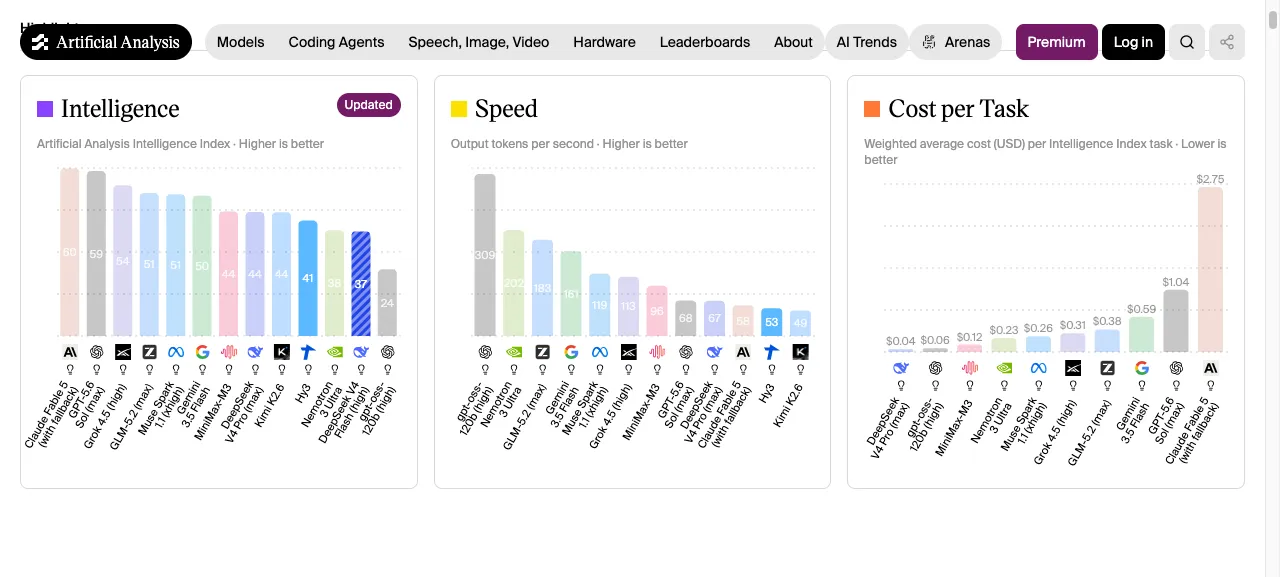
Two caveats before you weight that score too heavily.
First, agentic coding benchmarks tell a harsher story about both models. A commenter in the Hacker News launch thread dug up Hy3's DeepSWE result: 28%, against 52% for GPT-5.4 at maximum effort. Neither Chinese model is close to frontier agentic coding; they compete with each other, not with the top of the leaderboard.
Second, treat vendor-published benchmark tables from either company with standard skepticism. Hy3's launch numbers drew immediate "benchmaxxed" accusations in the HN thread, and DeepSeek's own tables only cover the evals it chose to run. The third-party numbers above are the ones I'd anchor on, and they say: Hy3 is somewhat smarter, and the gap is small enough that price and context can flip the decision.
Pricing: the sticker price is a distraction
Two price sheets, checked on July 14, 2026, and worth keeping separate. DeepSeek publishes exact first-party per-token prices on its API docs. Tencent doesn't publish an equivalent English rate card for the final Hy3 — its press release puts Hy3 preview input at roughly $0.18 per million tokens on TokenHub — so the Hy3 column below uses OpenRouter's listed rates, a marketplace price rather than a first-party one.
| Per 1M tokens | Hy3 (OpenRouter marketplace) | DeepSeek V4 Flash (first-party API) |
|---|---|---|
| Input | $0.14 | $0.14 (cache miss) |
| Input, cached | $0.035 | $0.0028 (cache hit) |
| Output | $0.58 | $0.28 |
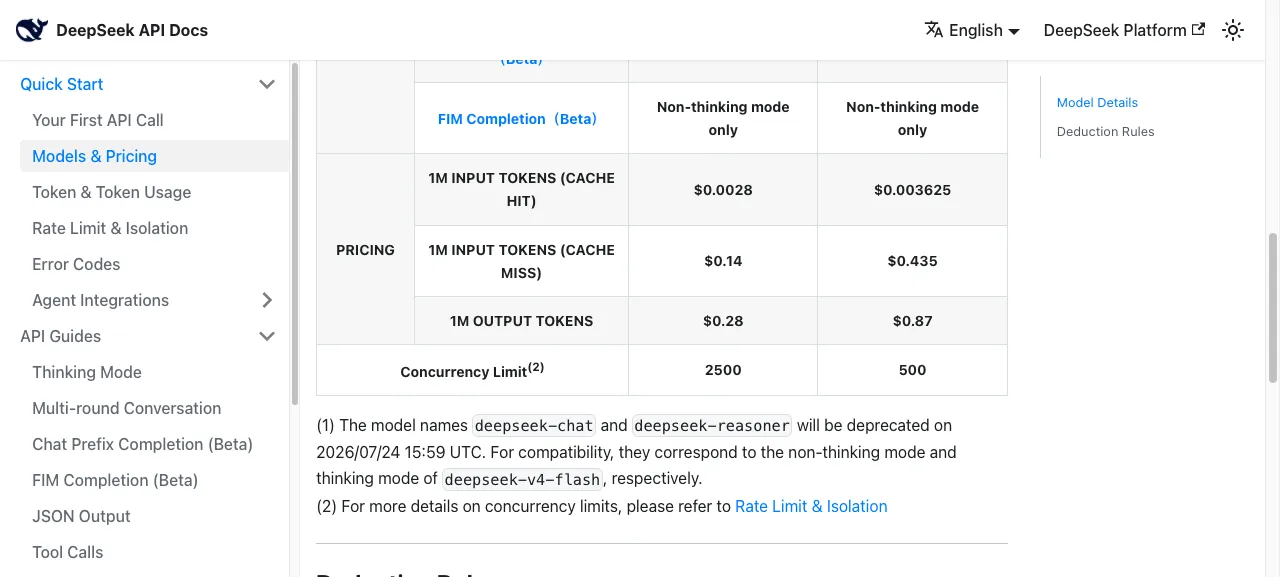
Input prices are identical. The decision lives in the other two rows.
The cache-hit multiplier
DeepSeek's cache-hit price is 50x cheaper than its cache-miss price, and 12.5x cheaper than Hy3's cached rate on OpenRouter. (Note the two cache rates aren't strictly equivalent — DeepSeek's is a first-party API price, Hy3's is whatever OpenRouter's underlying providers charge for cache reads — but they're the rates you'd actually pay today.) This matters more than any other number on this page if you run agents. An agent loop resends the same growing context every turn — system prompt, tool definitions, file contents, conversation history. In a 40-turn session, the vast majority of your input tokens are repeats. At a 90% cache-hit rate, Flash's effective input price drops from $0.14 to about $0.017 per million tokens. Hy3's drops to about $0.045 — still cheap, but nearly 3x more, and the gap widens the longer your sessions run.
Output tokens are where Hy3 gets expensive
Both are reasoning models, which means both bill their thinking tokens as output. Hy3's $0.58 output rate is more than double Flash's $0.28, so each extended reasoning chain costs Hy3 users roughly twice as much. Flash also has an escape valve Hy3 lacks: switch to non-thinking mode for mechanical tasks (formatting, extraction, simple edits) and stop paying for reasoning you don't need. The deepseek-v4-flash-vs-deepseek-v4-pro breakdown covers how that mode switch works in practice.
The free tier
One genuine Hy3 advantage: OpenRouter lists a tencent/hy3:free variant at zero cost, rate-limited but real. For evaluating the model before committing, that beats Flash, which has no free API tier. Hy3 preview also remains listed at $0.063/$0.21 — below the final release's price — if you can live with the April checkpoint.
The context window tax
Hy3's 256K context sounds like plenty until you run an agent against a real codebase. A Reddit user in r/hermesagent, running both models in the same harness, called Hy3 "nearly identical except for the context size, so frequent compaction." Compaction is more than an inconvenience: each compaction cycle burns output tokens to summarize, throws away detail, and invalidates your prompt cache, which means you pay the cache-miss rate to rebuild it.
The gap gets structural if you self-host. The V4 architecture's sparse-attention design (DeepSeek calls the mechanism a lightning indexer) makes its KV cache dramatically lighter than Hy3's conventional attention. These are single-user reports rather than benchmarks, but the numbers in the HN thread are stark: one commenter running both on a pair of DGX Sparks reported fitting 3M tokens of KV cache alongside DeepSeek V4 Flash, versus roughly 130K tokens with Hy3 quantized to FP4. Another estimated that once llama.cpp fully supports the indexer, Flash's full 1M context should need only about 6GB of RAM. Flash also has a track record of surviving aggressive quantization: several users in the same thread report it stays coherent even at 2-bit, a result not yet demonstrated for Hy3.
If your use case stays well under 200K tokens, this whole section costs you nothing, and Hy3's four extra intelligence points are free. If it does, the context tax compounds: more compaction, more cache invalidation, more memory per session.
Field reports since launch
The most useful signal I found isn't in any benchmark table. It's the character difference developers describe when they run both models inside coding agents.
A user in the same Hacker News thread, who switched to DeepSeek V4 Flash and Pro as daily drivers after canceling their Anthropic subscription and then tried Hy3, described Flash this way: the speed is great, but it "often builds a completely wrong mental model and charges off down the wrong path," needing regular correction and history compaction. Hy3, in their experience, "isn't as fast, but so far it seems to stay on track much more reliably" and degrades less as context grows. Others in the same thread praised Hy3's world knowledge and prose quality as better than Flash's for the size.
The Reddit picture leans the other way for raw coding output. A same-task comparison in r/LLMDevs ranked "DeepSeek V4 Flash > Hy3 > GLM" while still calling Hy3 "promising for practical coding workflows." In r/opencode, the recurring sentiment is that Flash is "more than enough" for everyday agent work.
There's also an operational track record to weigh. Hy3's launch demand exceeded Tencent's serving capacity: users in the HN thread reported heavy rate limiting, and one who tracks OpenRouter's public usage rankings noted the model fell from the top to 8th–9th within a month, attributing the drop directly to those limits. DeepSeek, by contrast, documents a 2,500-request concurrency ceiling for Flash on its official API — five times what it allows for V4 Pro. For production traffic, one of these vendors has published capacity guarantees and the other has a congestion history.
How to choose
- Agent coding, sessions under ~150K tokens: Hy3. Higher reasoning quality, stays on task better, and input costs match Flash's sticker price. (150K rather than the full 256K because agent context grows fast, and you want headroom before compaction kicks in.)
- Long sessions, large repos, RAG over big documents: Flash is usually the better fit. The 1M window plus 50x cache discount is a different cost class, and Hy3's compaction overhead eats its intelligence edge.
- High-volume production APIs: Flash. Documented 2,500 concurrency, stable serving history, and non-thinking mode for cheap bulk calls.
- Writing, research, world-knowledge tasks: Hy3. Community reports and the AA knowledge evals both favor it at this size.
- Local deployment: Flash for most hardware. Its KV cache efficiency and quantization resilience have far more field evidence; Tencent's own serving guidance for Hy3, quoted in the launch thread, is eight H20-class GPUs.
- Evaluating before committing: Hy3's free OpenRouter tier costs nothing to try. Run your own tasks through it before believing anyone's benchmark table, including this one.
Where to run them
DeepSeek V4 Flash: the official API serves both OpenAI-format (api.deepseek.com) and Anthropic-format (api.deepseek.com/anthropic) endpoints, which means it drops into Claude-compatible tooling with a base-URL change. Note the migration deadline on that same pricing page: the old deepseek-chat and deepseek-reasoner model names are deprecated on July 24, 2026, mapping to Flash's non-thinking and thinking modes respectively. OpenRouter carries it at $0.09/$0.18, slightly below the official rate, though without the official API's cache-hit pricing.
Hy3: Tencent Cloud TokenHub is the first-party route. OpenRouter carries the final release, the cheaper preview checkpoint, and the free tier. SiliconFlow has offered launch promotions. Self-hosting works under Apache 2.0 if you have the GPUs. The Hy3 API setup guide walks through getting a key and making the first call.
FAQ
Is Hy3 free to use?
Partially. OpenRouter lists a rate-limited tencent/hy3:free tier at zero cost, and Tencent's consumer products (Yuanbao, ima) use Hy3 at no charge. Production API access through TokenHub or OpenRouter's paid tier is metered per token.
Is Hy3 the same as Tencent Hunyuan?
Yes — Hy3 is the third generation of Tencent's Hunyuan model line, which Tencent now brands as "Tencent Hy." The preview launched April 23, 2026, and the final release on July 6, 2026.
Which is better for coding, Hy3 or DeepSeek V4 Flash?
Community results split by task shape. Same-task Reddit comparisons ranked Flash's raw output above Hy3's, while long-session agent users report Hy3 stays on track more reliably. Short, well-scoped tasks favor Flash's speed; multi-hour agent sessions where derailment costs you favor Hy3, as long as your context stays comfortably inside its 256K window.
Can I run DeepSeek V4 Flash locally?
Yes, and more practically than Hy3. The weights are MIT-licensed, the architecture's KV cache is unusually light, and users report usable quality even at 2-bit quantization on machines with ~96GB of RAM.
Why is the hy3 vs deepseek v4 flash price comparison so confusing?
Because there are at least four price sheets: Tencent TokenHub, OpenRouter's Hy3 final and preview listings, and DeepSeek's official API with its separate cache-hit rate. Compare the effective price for your own traffic pattern: cached input dominates agent workloads, and that's where DeepSeek's $0.0028 rate is hard to beat.
Bottom line
Hy3 is the stronger model on the available third-party evidence; DeepSeek V4 Flash is the stronger service. For production API workloads, Flash is my default: its cache economics, context window, and published concurrency compound in ways a four-point benchmark lead can't offset. Reach for Hy3 when reasoning quality per prompt matters more than scale — and try its free tier first, since it costs nothing to check against your own tasks.