 AIREITER
On August 7, 2025, Elon Musk posted that Grok 5 would arrive "before the end of this year and it will be crushingly good." That deadline came and went. Then Q1 2026 passed. Then Q2 2026. What xAI has actually confirmed is narrower than the headlines suggest: Grok 5 exists, it's training on the Colossus 2 supercluster, and that's about it. Prediction markets currently price an 82% chance of release by December 31, 2026 - but every prior target looked plausible too, right up until it expired.
Every Grok 5 Release Target That's Come and Gone
The gap between Musk's promises and shipped product is the single most useful data point for anyone trying to time a Grok 5 launch. The full track record:
| Target | Source | Outcome |
|---|---|---|
| "Before end of 2025" | Musk on X, Aug 7, 2025 | Missed - no release in 2025 |
| Q1 2026 | Reportedly discussed at funding round | Missed - Q1 ended March 31 |
| Q2 2026 / by June 30 | Grok's X account, Feb 25, 2026 | Missed - Polymarket contract expired at 0.8% |
| Q3 2026 or later | Current analyst consensus | Pending |
Each missed window was followed by an interim release rather than silence. Grok 4.3 shipped April 30, 2026 with a 1 million-token context window. Grok 4.5 launched July 8–9, 2026 at roughly 1.5T parameters - the model xAI calls "V9-Medium," reportedly trained partly on Cursor developer data. Grok 4.6 followed. These incremental drops kept the product line moving, but none of them is Grok 5.
The missed dates suggest treating xAI's timing statements as optimistic targets, not commitments.
Confirmed vs Rumored: What We Actually Know
Separating verified facts from the rumor pile matters because community accounts and xAI's own messaging frequently blur the line. The verified facts:
| Claim | Status | Evidence |
|---|---|---|
| Grok 5 exists and is training | Confirmed | xAI's $20B Series E announcement, Jan 6, 2026 ($230B valuation; investors include NVIDIA, Cisco, Fidelity) |
| Training on Colossus 2 in Memphis, TN | Confirmed | Same announcement; cluster operational Jan 2026 |
| 6 trillion parameters (MoE) | Unconfirmed | Community reporting via @grok account; no model card |
| 10 trillion-parameter variant | Unconfirmed | Secondary rumor; attributed to community sources |
| ~1.5M-token context window | Unconfirmed | Speculation based on Grok 4's 2M and Grok 4.5's 500K |
| Expansion to 16+ parallel agents | Unconfirmed | Grok 4.20 ran 4 agents; scaling to 16 is inference |
| "Reality Engine" real-time fact-checker | Unconfirmed | No official product name; rumor only |
| Cursor developer data in training | Unconfirmed | Plausible given Grok 4.5 already used Cursor data; not confirmed for Grok 5 |
| Musk's "10% and rising" AGI probability | Musk's claim | Stated Oct 2025; no operational AGI definition provided |
That last row deserves a closer look. Musk estimated a 10% and rising probability that Grok 5 achieves AGI, but the claim came with no benchmark, no testable threshold, and no peer alignment. GEO Toolbox's analysis called it "a posture, not a finding." Treat it as a marketing signal, not a technical assessment.
Colossus 2: The One Thing Everyone Agrees On
If there's a single piece of evidence that Grok 5 is substantial and real, it's Colossus 2.
Confirmed specs: Colossus 2 is a gigawatt-scale training cluster in Memphis, Tennessee, operational since January 2026. Per reporting from Fello AI, the cluster uses roughly 550,000 NVIDIA GB200 and GB300 GPUs - not the older H100s that earlier coverage cited. The cluster was reportedly running seven major training jobs simultaneously as of July 2026, including models at 1T, 1.5T, 6T, and 10T parameter scales. SpaceX acquired xAI on February 2, 2026, folding the compute into a broader corporate structure.
What this tells us: A cluster this size is not built for incremental updates. The 6T and 10T parameter training runs are the strongest non-official signal that xAI is pursuing a genuine generational leap, not just another point release. The investment only makes economic sense if Grok 5 materially outperforms Grok 4.5.
The efficiency counter-argument: Scale alone doesn't guarantee quality. Per ZBuild's reporting, DeepSeek V4 scored 81% on SWE-Bench Verified using an MoE-plus-Engram architecture at a fraction of the training cost. Grok 5 could prove brute-force scaling still works, or prove it doesn't.
Prediction Markets: What Traders Are Actually Betting
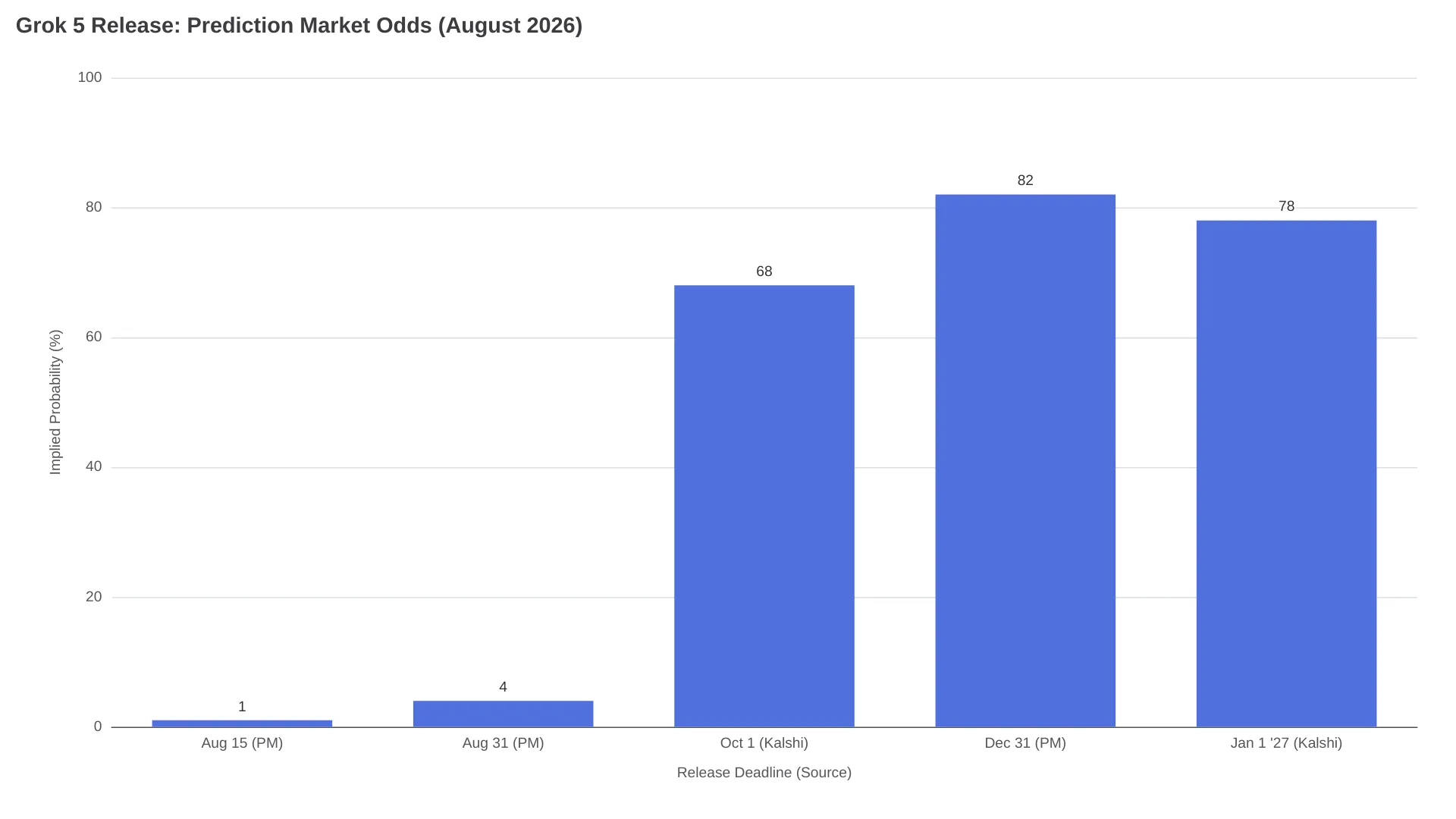
Prediction markets - real money from traders who've been consistently more conservative than xAI's own timelines - offer a useful counterweight to hype.
| Deadline | Platform | Implied Probability |
|---|---|---|
| August 15, 2026 | Polymarket | 1% |
| August 31, 2026 | Polymarket | 4% |
| October 1, 2026 | Kalshi | 68% |
| December 31, 2026 | Polymarket | 82% |
| January 1, 2027 | Kalshi | 78% |
In April 2026, Polymarket priced a 33% chance of release by June 30. That contract expired at 0.8%. The current odds tell you something xAI's announcements won't: a release before October is unlikely, but the year-end probability is high enough to plan around.
Two caveats: prediction-market resolution criteria vary ("released" could mean anything from a limited preview to full API access), and these are indexed snapshots, not live quotes.
What Grok 5 Would Need to Overtake
Grok 5 won't launch into an empty field. The current frontier sets a high bar across benchmarks, pricing, and developer experience:
| Model | Context | API Price (Input/Output per M tokens) | Key Strength |
|---|---|---|---|
| GPT-5.6 Sol | 1M | $5 / $30 | 52.7% Agents' Last Exam; multi-agent tooling |
| Claude Opus 5 | 1M | $5 / $25 | Top GDPval-AA v2 score; deep reasoning |
| Grok 4.5 | 500K | $2 / $6 | 83.3% Terminal Bench; cheapest frontier API |
| Gemini 3.5 Pro | 2M | Not publicly listed | Longest context; strong multimodality |
GEO Toolbox estimates Grok 5 API pricing at roughly $5–8 per million input tokens and $20–30 per million output tokens - a significant step up from Grok 4.5's $2/$6, reflecting the larger model size. Consumer access would likely follow xAI's existing tiers: SuperGrok at about $30/month, a higher tier near $300/month, and X Premium+ at $40/month.
For Grok 5 to be more than a parameter-count headline, it needs to deliver measurable gains in areas where xAI's current models lag: broad reasoning depth (where Claude Opus 5 leads), autonomous multi-step agent reliability (where GPT-5.6 Sol leads), and context length (where Gemini 3.5 Pro leads). Grok's unique moat - real-time access to the X data firehose - could differentiate it on current-events reasoning, but that advantage is narrower than general intelligence.
Models Worth Using Today
Waiting for Grok 5 means choosing the right stopgap. The current options break down cleanly by use case:
- Hard coding and agentic tasks: Grok 4.5 is xAI's current flagship for this workload, with 64.7% SWE-Bench Pro (vendor-reported) and 4.2x fewer output tokens than Claude Opus 4.8 on the same benchmark. At $2/$6 per million tokens, it's also the cheapest frontier API.
- Long-context workloads: Gemini 3.5 Pro's 2 million-token context window handles documents that Grok 4.5's 500K can't fit in a single call.
- Cost-sensitive API work: Grok 4.3 remains the budget option at $1.25/$2.50 per million tokens with 1M context - less capable for the hardest coding tasks, but adequate for general reasoning.
- Top-tier reasoning: Claude Opus 5 and GPT-5.6 Sol are the current benchmark leaders. For a direct comparison, see our GPT-5.6 Sol vs Grok 4.5 breakdown.
One caution from the community: Grok's benchmark performance has not always matched real-world experience. A Reddit user in r/singularity captured the sentiment: "Grok 4 benchmaxxes. Let's see if Grok 5 can actually deliver." Another described using Grok for research when they could wait 2–3 minutes, but preferring ChatGPT for speed and coding. These are individual opinions, but the pattern of strong benchmarks with mixed real-world results is worth tracking as Grok 5 launch data arrives.
The key uncertainty isn't whether Grok 5 will ship, but whether 6 trillion parameters on a gigawatt cluster will translate into a model that beats more efficient architectures, or produce another benchmark leader that underdelivers in practice.
FAQ
Is Grok 5 released yet?
No. As of August 2026, Grok 5 has not been released. xAI confirmed it is training on the Colossus 2 supercluster in its January 2026 Series E announcement, but no public model, API endpoint, or model card exists. Grok 4.5, launched July 8, 2026, is xAI's current flagship.
When will Grok 5 come out?
No official date exists. Prediction markets price a 68% chance of release by October 1, 2026 (Kalshi) and 82% by December 31, 2026 (Polymarket). Every prior target - late 2025, Q1 2026, Q2 2026 - has been missed.
How many parameters will Grok 5 have?
The leading community estimate is 6 trillion parameters using a Mixture-of-Experts architecture, with a secondary rumor of a 10 trillion-parameter variant. Neither figure is confirmed by xAI. For context, Grok 4.5 is approximately 1.5T parameters.
Will Grok 5 be free?
No pricing has been announced. Analysts estimate API costs at $5–8 per million input tokens and $20–30 per million output tokens. Consumer access would likely follow existing tiers: limited free use on X, full access via SuperGrok ($30/month), and a premium tier near $300/month.
Is Grok V9-Medium the same as Grok 5?
No. Grok V9-Medium is the internal designation for the model released as Grok 4.5 - a 1.5T-parameter coding model trained partly on Cursor data. Grok 5 is a separate, larger model still in training. Conflating the two has been a persistent source of false "Grok 5 is out" headlines.