 AIREITER
If you are choosing between GPT-5.6 Sol vs Grok 4.5 and wondering where GPT-5.6 Terra fits, the short answer is a price ladder. Grok 4.5 is the cheapest for high-volume coding, GPT-5.6 Terra is the value middle that gives you Sol's 1M-token context at half the price, and GPT-5.6 Sol is the premium tier for the hardest reasoning. To ground it, I ran the same coding task on both GPT variants: Terra and Sol each one-shotted a thread-safe LRU cache that passed all four unit tests, in 23 and 26 seconds respectively. This guide walks through the real cost math and where each model earns its price.
Why the sticker price is misleading
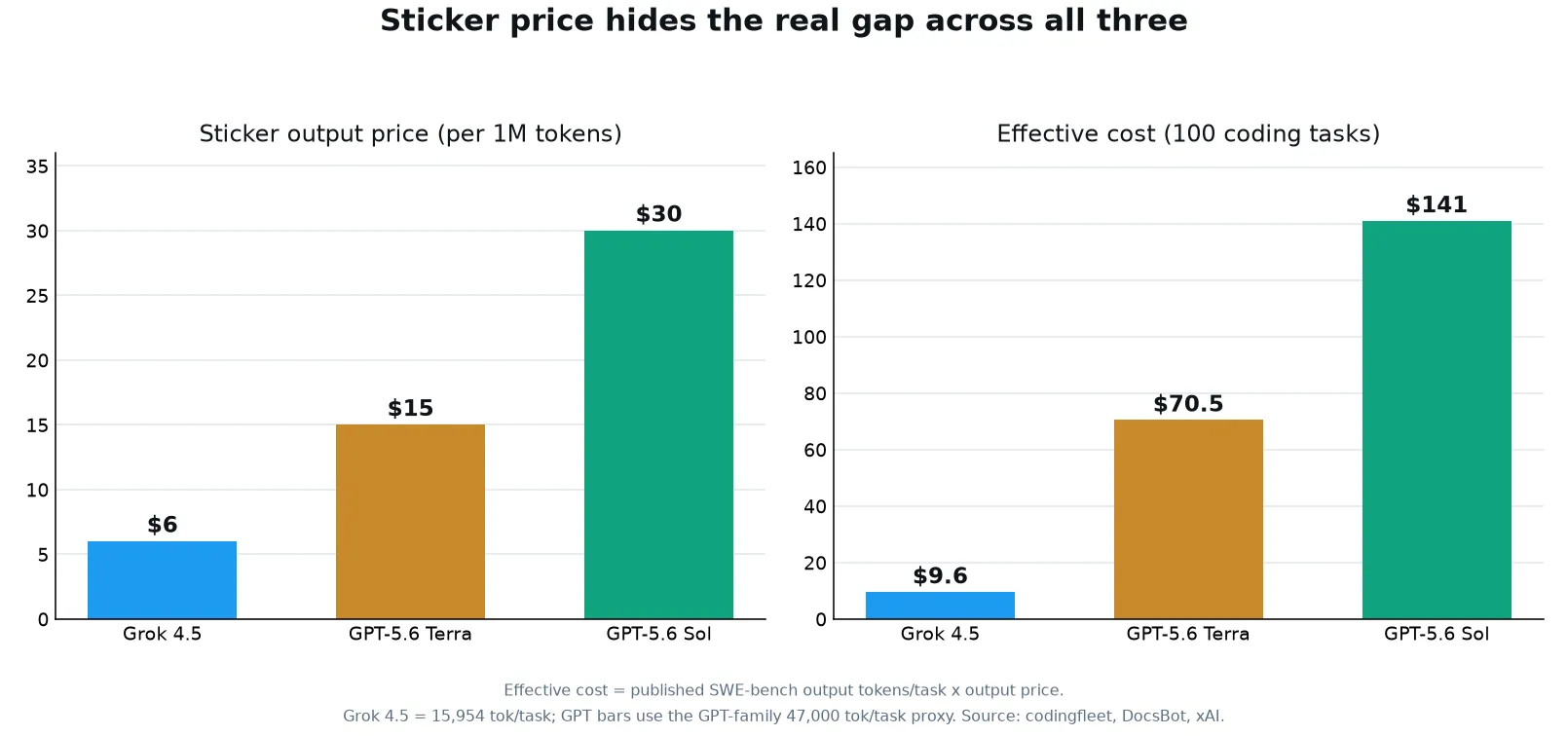
On paper the ladder looks simple. Grok 4.5 from xAI lists at $2 per million input tokens and $6 output. GPT-5.6 Terra lists at $2.50 input and $15 output, half of Sol across the GPT-5.6 pricing tiers. GPT-5.6 Sol lists at $5 input and $30 output. Most comparison pages stop at those numbers.
The problem is that price per token is not price per task. Grok 4.5 is tuned to be terse: on published SWE-bench coding runs from xAI and independent testers, it emits around 15,954 output tokens to close a task, while GPT-5-class models in the same suite spend roughly 47,000, about 3x more. Multiply the token gap by the price gap and the spread widens well past the headline.
What "effective cost" means for your monthly bill
The formula is simple: output tokens per task × output price × number of tasks. Priced over 100 coding tasks (output tokens only, before input and retries): Grok 4.5 lands near $9.60 (15,954 × $6/M × 100), GPT-5.6 Terra near $70.50 (47,000 × $15/M × 100), and GPT-5.6 Sol near $141 (47,000 × $30/M × 100). Treat the GPT figures as a same-family proxy, not model-measured token counts, until OpenAI publishes SWE-bench numbers specific to Sol and Terra. Even so, the ordering is stable: Terra roughly halves Sol's bill for the same context window, and Grok undercuts both by a wide margin.
Hands-on: what the GPT-5.6 variants actually did
I gave GPT-5.6 Sol and GPT-5.6 Terra the same prompt with default parameters: "Implement a thread-safe LRU cache in Python with O(1) get and put, capacity eviction, a lock, and four unit tests." Then I ran each generated file without edits.
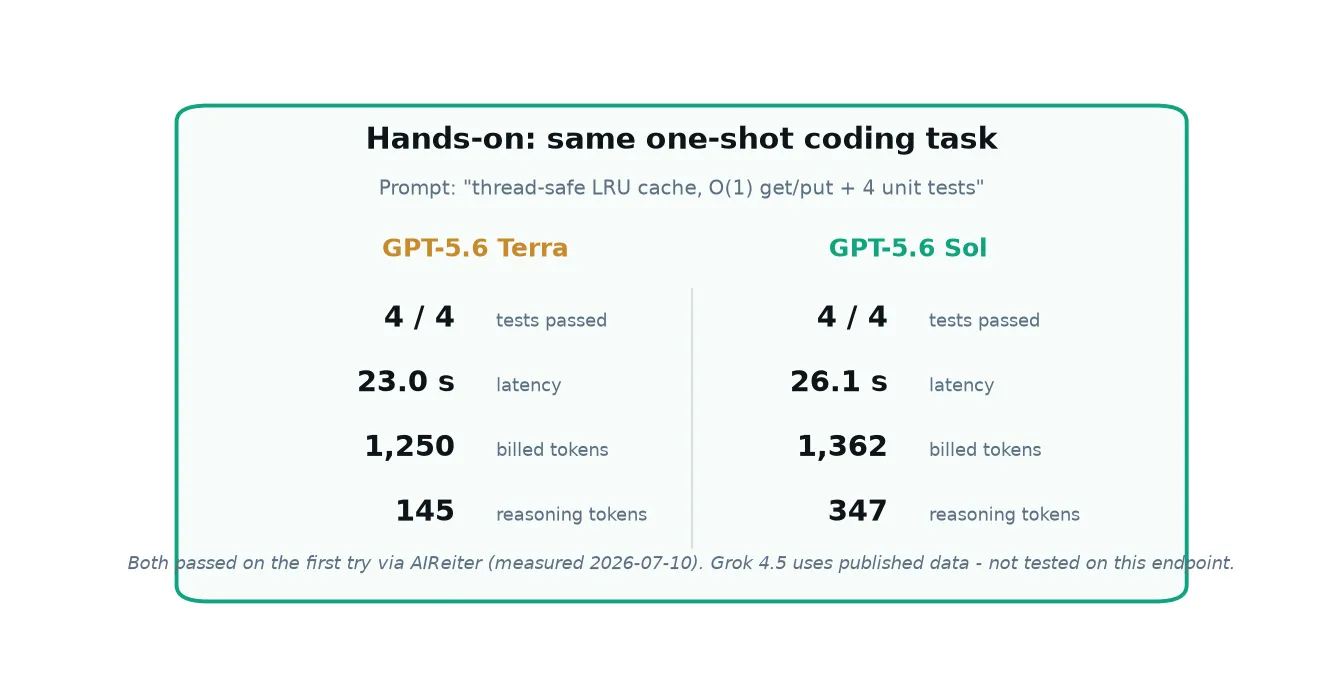
Both passed on the first attempt. All four tests, covering basic get/put, eviction on overflow, recency refresh, and concurrent writes, ran green for each model, and both produced the textbook structure: a doubly linked list with sentinel nodes, a dictionary index, and a reentrant lock. The difference was efficiency. Terra finished in 23.0 seconds and billed 1,250 tokens with only 145 hidden reasoning tokens; Sol took 26.1 seconds and billed 1,362 tokens with 347 reasoning tokens, more than double Terra's reasoning overhead. On a task both models nailed, Terra's lighter reasoning budget is exactly the kind of thing that compounds across thousands of calls.
I could not run the same test against Grok 4.5 on the same endpoint, so I am not going to pretend I did. The Grok 4.5 figures here come from xAI's published benchmarks and developer reports, not my own run, worth stating plainly given how much unverified benchmark noise floats around these launches. If you want the fuller picture, here is what is confirmed about Grok 4.5.
Where each model wins
No single model wins everywhere. Here is how the verified specs line up.
Spec | Grok 4.5 | GPT-5.6 Terra | GPT-5.6 Sol |
|---|---|---|---|
Input price / 1M | $2 | $2.50 | $5 |
Output price / 1M | $6 | $15 | $30 |
Context window | 500K | 1M | 1M |
Max output | Not published | 128K | 128K |
Terminal-Bench 2.1 | 83.3% | 87.4%* | 91.9% |
SWE-Bench Pro | 64.7% | 63.4% | Not published |
Released | 2026-07-08 | 2026-07-09 | 2026-06-26 |
*Terra's 87.4% is reported with maximum reasoning effort.
GPT-5.6 Sol takes the top of the reasoning curve at 91.9% on Terminal-Bench 2.1. GPT-5.6 Terra is the balanced tier: the same 1M context and 128K output as Sol, a strong 87.4% on Terminal-Bench, and a reported 92.9% on GPQA Diamond, all at half Sol's output price. Grok 4.5 answers with the lowest price, a solid 64.7% on SWE-Bench Pro (narrowly ahead of Terra's 63.4%), and throughput around 80 tokens per second, at the cost of a smaller 500K context.
The benchmark transparency gap
One caveat: xAI publishes only a handful of scores for Grok 4.5, and OpenAI reports Terra's headline Terminal-Bench figure at maximum reasoning effort, which costs more tokens than a default run. When a number comes with an asterisk or a vendor shows four benchmarks instead of fifteen, treat the gaps as unknown rather than parity. For a buying decision, weight the benchmarks that match your work, Terminal-Bench for agentic tool use and SWE-Bench Pro for repo-scale coding, over headline averages.
How to choose: match the model to the workload
Skip the "which is smartest" framing and route by task.
High-volume coding, agent loops, or cost-sensitive teams choose Grok 4.5. When you fire thousands of bounded completions, Grok's token thrift and $6 output price compound into real savings. It is the price-per-performance pick for Cursor-style workflows, as long as 500K context is enough.
Production-scale work that needs big context on a budget chooses GPT-5.6 Terra. It is the sweet spot for most teams: Sol's 1M window and 128K output, near-Sol benchmarks, and my hands-on run showed lighter reasoning overhead, all at half Sol's price.
The hardest single problems choose GPT-5.6 Sol. When a prompt genuinely needs the top of the reasoning curve and you run fewer of them, Sol's higher Terminal-Bench score justifies the premium.
Mixed workloads route dynamically. Send bulk jobs to Grok 4.5, everyday production to Terra, and escalate only the toughest prompts to Sol.
Using all three through one API
You do not have to pick permanently. GPT-5.6 Sol and Terra are available directly from OpenAI and through OpenAI-compatible relays; the hands-on tests above ran through AIReiter's gpt-5.6-sol and gpt-5.6-terra endpoints, which reach several models from one API key and one credit balance. Grok 4.5 is served by xAI's own API, and model availability through any relay varies by provider, so confirm the catalog before you wire it into production. Consolidating access changes your billing and integration surface, not what the models output.
FAQ
Which is cheapest: GPT-5.6 Sol, Terra, or Grok 4.5?
Grok 4.5 is cheapest on sticker price at $2/$6 per million tokens, and cheapest per task thanks to its token efficiency. Among the GPT variants, Terra ($2.50/$15) is half the output price of Sol ($5/$30).
What is the difference between GPT-5.6 Sol and Terra?
Same 1M context and 128K output, but different tiers. Sol is the premium reasoning model (91.9% on Terminal-Bench 2.1); Terra is the balanced, production-focused tier at half the price, and in my test it used far fewer reasoning tokens (145 vs 347) to solve the same problem.
Does hidden reasoning change the bill?
Yes. Sol billed 347 reasoning tokens and Terra 145 on the same task, on top of the visible answer, so a short-looking reply still costs more than the output suggests. Budget for reasoning tokens, and note that lower tiers like Terra tend to spend fewer of them.
Which has the bigger context window?
Both GPT-5.6 Sol and Terra offer 1M tokens, double Grok 4.5's 500K. Both GPT variants also document a 128K max output; Grok 4.5 does not publish its output ceiling.
Which is better for coding?
For bulk or agentic coding, Grok 4.5 gives the best cost-to-performance ratio (64.7% on SWE-Bench Pro cheaply). For big-context or reasoning-heavy coding, Terra covers most needs and Sol tops the reasoning benchmarks.
When were GPT-5.6 Sol, Terra, and Grok 4.5 released?
GPT-5.6 Sol shipped on 2026-06-26, GPT-5.6 Terra on 2026-07-09, and Grok 4.5 on 2026-07-08.
The bottom line
Grok 4.5 wins your monthly bill, GPT-5.6 Terra wins on value for big-context production work, and GPT-5.6 Sol wins the hardest reasoning tasks. Before you commit, run a short eval on your own representative prompts: the cost figures here rest on published token counts and a GPT-only hands-on test, and your workload's token profile is what actually sets your bill. For most teams, Terra is the pragmatic default among the GPT-5.6 tier, Grok 4.5 is the budget pick for high volume, and Sol is the one you reach for when nothing cheaper is good enough.