 AIREITER
A coding agent can look cheap until its context crosses a billing boundary or its reasoning budget consumes the output ceiling. In this Grok 4.6 vs Opus 5 decision, choose Grok 4.6 for cost-sensitive work below 200K prompt tokens; choose Claude Opus 5 when a 1M-token window, 128K output, or its documented agent controls are actual requirements.
The decision starts with the workload envelope
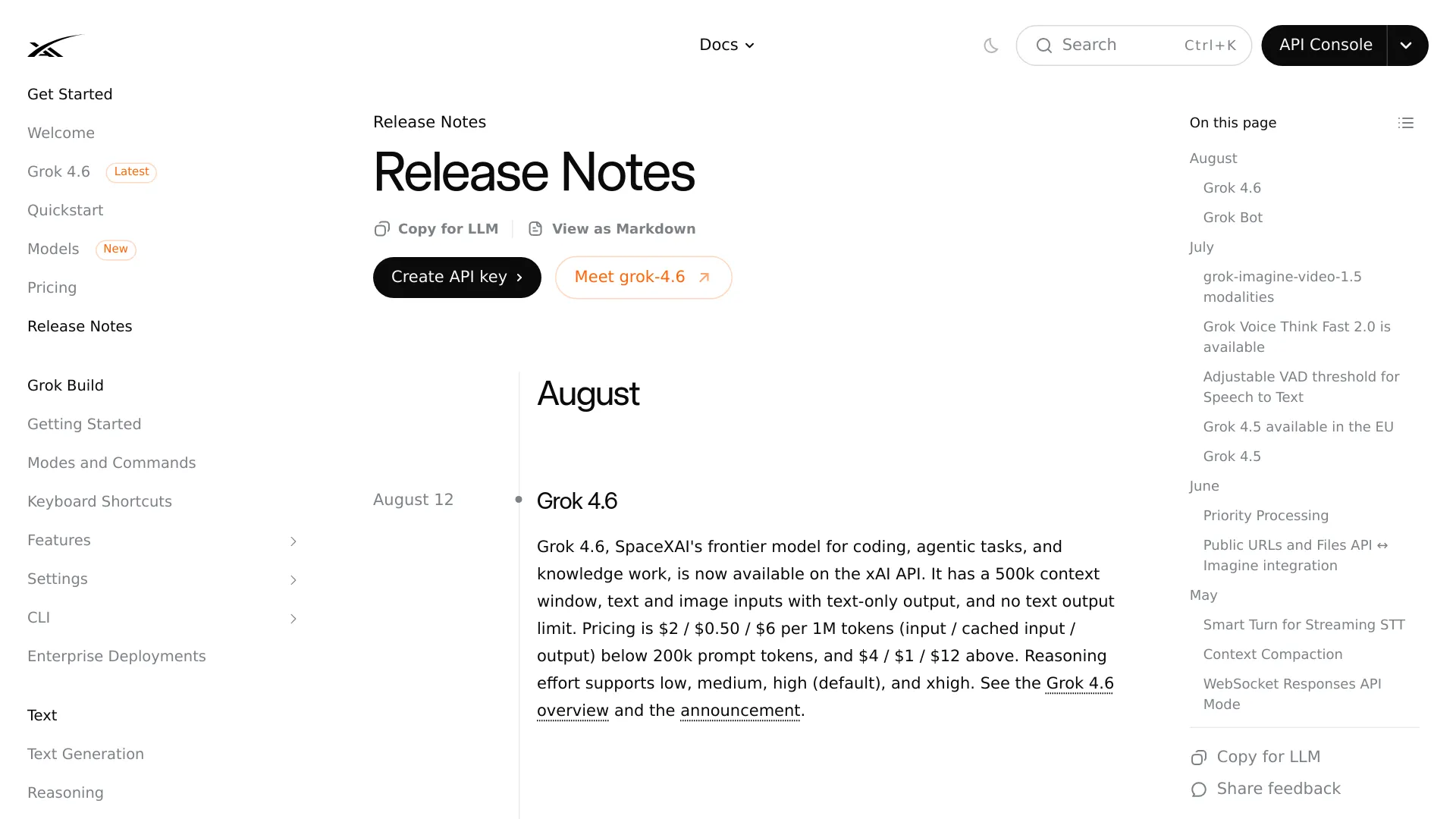
Grok 4.6 is the practical default when a text-producing coding or knowledge-work agent stays below xAI's 200K-prompt-token pricing threshold. xAI lists a 500K context window, text and image inputs, text output, and four effort settings from low through xhigh in its August 12, 2026 release notes. xAI's developer release notes are the primary specification source.
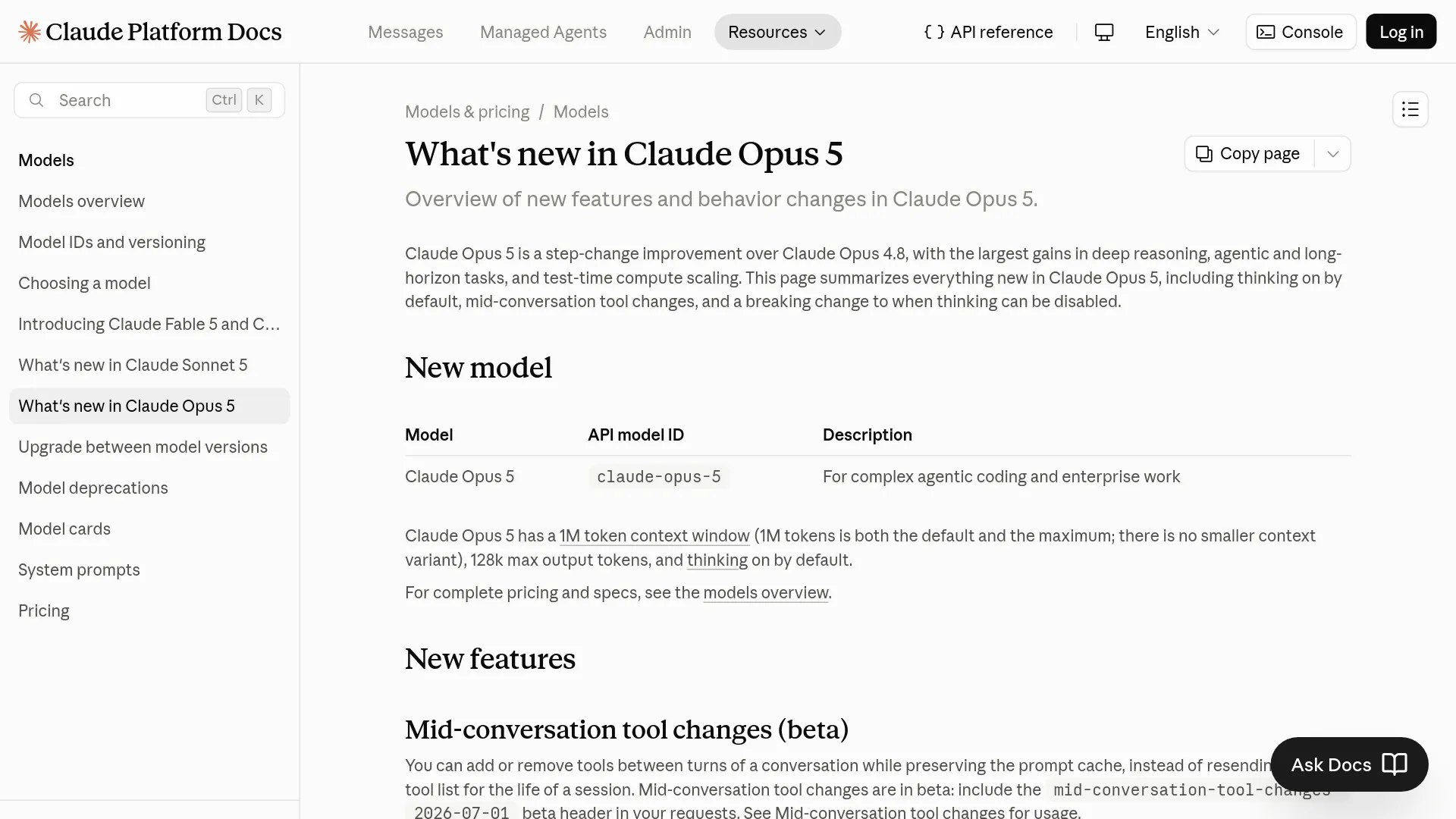
Claude Opus 5 is the better fit when 500K tokens is not enough, when a workflow needs up to 128K output tokens, or when the integration depends on Anthropic's fallbacks and dynamic tool-list features. Anthropic documents a 1M-token default-and-maximum context window, default-on thinking, and claude-opus-5 availability in its API and major cloud partners. Claude Platform's Opus 5 documentation is more consequential here than a small leaderboard gap.
The sources cited here do not provide one shared benchmark that settles every coding task. Start with the maximum prompt size, required output length, tool contract, and completed-task cost in your own harness.
Put the API constraints on one page before comparing scores
Grok 4.6 and Claude Opus 5 both accept text and images and generate text. Their important differences are context capacity, long-context billing, output contract, and integration controls.
| API property | Grok 4.6 | Claude Opus 5 |
|---|---|---|
| Context window | 500K tokens | 1M tokens |
| Input modalities | Text, image | Text, image, PDF/document workflows described by Anthropic |
| Output modality | Text | Text |
| Maximum text output | No numeric limit stated in xAI release notes | 128K tokens |
| Effort settings | low, medium, high, xhigh | low, medium, high, xhigh, max |
| Default effort | high | high |
| Standard input price | $2/M tokens | $5/M tokens |
| Standard output price | $6/M tokens | $25/M tokens |
| Long-prompt rule | $4/M input and $12/M output above 200K prompt tokens | No equivalent threshold stated in the Opus 5 release documentation |
| Cached input | $0.50/M below 200K; $1/M above 200K | 512-token minimum cacheable prompt, with cache pricing documented separately |
Grok 4.6 has lower listed unit rates but doubles above 200K prompt tokens; Opus 5 costs more but its 1M context can avoid chunking or retrieval overhead in a workflow that needs it.
Where Grok 4.6 changes the cost model
Grok 4.6 lists $2 per million input tokens and $6 per million output tokens below 200K prompt tokens. Once a prompt exceeds 200K tokens, xAI lists $4/M input and $12/M output; cached input is $0.50/M and $1/M respectively. That boundary matters more than quoting the low-tier headline rate. xAI's release notes specify both tiers.
At listed rates, 100K uncached input tokens plus 20K output tokens costs $0.32; 250K input plus 20K output costs $1.24 after the higher tier applies. These are request calculations, not agent-run estimates, because retries, tool calls, cached prefixes, and accumulated context can dominate the bill.
A recent r/grok discussion reports configuration-specific CursorBench 3.2 figures of $2.81 per task and 46 steps for Grok 4.6 Extra High versus $8.23 and 78 steps for Opus 5 Max. Treat its figures as the author's reported harness results, not a vendor-neutral guarantee: the same post reports Grok 4.6 at 26.0% on Terminal-Bench 3.0, behind other named models.
Where Opus 5 changes the integration design
Claude Opus 5 enables thinking by default. max_tokens is a hard cap shared by hidden thinking and visible output, so a migration from non-thinking Opus 4.8 requests may require a larger output budget. Anthropic also says thinking: {"type":"disabled"} combined with xhigh or max returns HTTP 400. The migration notes give the two choices: lower effort while disabling thinking, or remove the disabled-thinking setting.
Claude Opus 5 also lowers the minimum cacheable prompt from 1,024 tokens in Opus 4.8 to 512 tokens. Its beta controls allow mid-conversation tool changes without invalidating the prompt cache and offer a managed fallbacks: "default" mode. These are meaningful if your agent has changing permissions or tool sets; they are irrelevant to a simple stateless completion endpoint.
Fast mode is an API-only research preview at $10/M input and $50/M output, twice the standard Opus 5 rate. Anthropic says it is not available through Amazon Bedrock, Google Cloud, or Microsoft Foundry, so portability and speed cannot both be assumed. Anthropic's launch announcement lists standard pricing at $5/M input and $25/M output.
Coding-agent evidence is directional, not a universal winner
Anthropic reports that Opus 5 at maximum effort reaches about 70.0% on CursorBench 3.2 at roughly $8.50 per task, within 0.5 percentage points of Fable 5's reported best score at about half its cost. Those are Anthropic's plotted results and should be read as vendor evaluation evidence, not a cross-provider audit. The Opus 5 announcement describes its Frontier-Bench method as five attempts per task using Anthropic's internal run.
An independent-looking but narrower measurement is more actionable for code review. CodeRabbit tested roughly 100 verified error patterns from real open-source pull requests, ran each configuration three times, and evaluated post-filtered review comments. At xhigh effort, its Opus 5 configuration caught 55.2% of known issues versus 61.1% for its production baseline, while actionable precision was 39.3% versus 35.2%; it also produced 92 nitpicks versus 23. CodeRabbit's Opus 5 evaluation recommends a specific precision-focused role rather than using Opus 5 as the only safety net.
That evidence supports a concrete rule: evaluate Opus 5 at more than one effort level and measure recall, precision, token use, and review noise on your own pull requests. For Grok 4.6, xAI's current release notes provide the API contract and pricing, but do not publish a directly comparable code-review study. Do not infer a code-review win from a coding-agent score.
Pick a model with this deployment matrix
Grok 4.6 is the recommendation for agents whose normal prompt remains under 200K tokens and whose priority is lower listed API cost. Set an evaluation budget around the boundary, because a repository agent can cross it after tool output and retries even when its first prompt is small.
Claude Opus 5 is the recommendation for a repository, document, or agent session that needs more than 500K tokens of active context, up to 128K output, or Anthropic's documented tool-change and fallback controls. Start at high, then test lower effort before assuming max pays for itself.
For automated code review, do not select either model from a general coding leaderboard. Run a labeled pull-request set, record issue recall and false-positive load, and retain a second review path for concurrency, API-use, and validation defects. CodeRabbit found these to be weaker categories for its tested Opus 5 configurations. Its category findings are a reason to test task fit, not a claim about all Claude deployments.
| Deployment situation | Default choice | Decision trigger |
|---|---|---|
| Cost-sensitive coding agent below 200K prompt tokens | Grok 4.6 | Its listed $2/M input and $6/M output rates |
| Long repository or document session above 500K context | Claude Opus 5 | 1M context window and 128K output cap |
| Agent with dynamically changing tools | Claude Opus 5 | Beta mid-conversation tool changes preserve cache |
| Task with frequent prompts above 200K tokens | Evaluate both | Grok 4.6 doubles listed token rates at the threshold |
| Code-review pipeline | Evaluate both on labeled PRs | Recall, precision, retries, and review noise matter more than a headline score |
FAQ
Is Grok 4.6 cheaper than Opus 5?
Below 200K prompt tokens, xAI lists Grok 4.6 at $2/M input and $6/M output, compared with Opus 5 at $5/M input and $25/M output. Grok 4.6's listed prices double above 200K prompt tokens, so compare completed-task cost rather than only the initial request.
Which model should I use for coding?
Choose Grok 4.6 for lower listed API rates when your agent normally remains below 200K prompt tokens. Choose Opus 5 when 1M context, 128K output, or Anthropic's agent controls are required; validate either choice on the language, repository shape, and tool loop you actually run.
Next deployment step
Run the same 20 to 50 representative tasks through each candidate with fixed tools, a fixed retry limit, and token logging. Choose the model that reaches your required pass rate at the lower completed-task cost, then retain the other model as a routed option for workloads where its context or control-plane advantage is decisive.
Related reading: Claude Opus 5 API pricing guide, Grok 4.6 release details, and Grok 4.6 vs GPT-5.6.