 AIREITER
Grok 4.6 reached near-parity with GPT-5.6 Sol on the Artificial Analysis Intelligence Index (61 vs. 58.9), yet Sol costs 5x more per output token. The price gap is real, but Sol's 2x larger context window and higher agent-efficiency scores complicate the value math.
Near-Parity on Intelligence - and What It Misses
The Artificial Analysis Intelligence Index v4.1 blends reasoning, coding, and knowledge tasks into a single score. OpenAI reports GPT-5.6 Sol at 58.9. Grok 4.6 scored approximately 61, per community reports citing Artificial Analysis arena data. This community-reported figure has not been independently confirmed but is directionally consistent with Artificial Analysis showing Grok 4.6 as an equivalent to Sol.
A composite score obscures context-window differences, agent efficiency, and benchmark variance, each covered below. Sol posts dominant numbers on agent-heavy evaluations like Terminal-Bench 2.1 (88.8%) and DeepSWE v1.1 (72.7%) per OpenAI's published results, where Grok 4.6's specific scores haven't been independently published yet. The Intelligence Index says they're peers in general intelligence; the agent benchmarks may tell a different story.
| Spec | Grok 4.6 | GPT-5.6 Sol |
|---|---|---|
| Developer | xAI | OpenAI |
| Context window | 500K tokens (x.ai/api) | ~1,050,000 tokens (openai.com) |
| API input (per 1M) | $2.00 (x.ai/api) | $5.00 (openai.com) |
| API output (per 1M) | $6.00 (x.ai/api) | $30.00 (openai.com) |
| Intelligence Index v4.1 | ~61 (community-reported) | 58.9 (official) |
| Cloud availability | Azure AI Foundry, Oracle OCI, Google Vertex (x.ai/api) | Azure, AWS Bedrock (openai.com) |
API Pricing: 2.5x Cheaper Input, 5x Cheaper Output
xAI's API page lists Grok 4.6 at $2.00 per million input tokens and $6.00 per million output tokens. OpenAI's GPT-5.6 page lists Sol at $5.00 input and $30.00 output per million tokens.
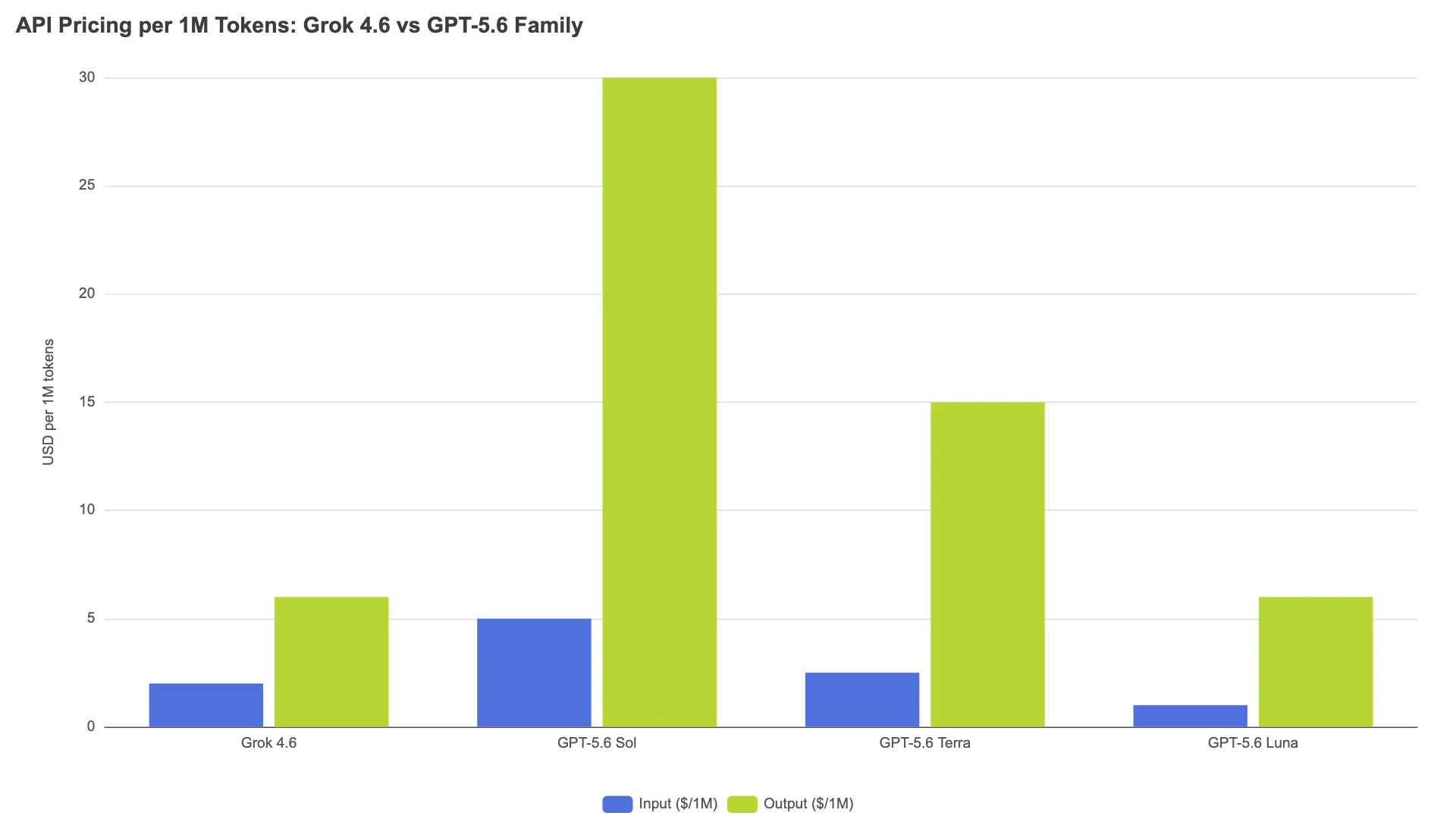
For a workload consuming 50M input and 10M output tokens monthly, Grok 4.6 costs $160. Sol costs $550. That's a 3.4x difference before considering that Sol's reasoning modes consume more tokens per task.
OpenAI does offer cheaper tiers: GPT-5.6 Terra at $2.50/$15.00 and GPT-5.6 Luna at $1.00/$6.00 (Luna's price was cut 80% on July 30, 2026). Luna matches Grok 4.6 on output pricing and undercuts it on input, but Luna is a smaller model with lower benchmark scores across the board. The honest comparison for intelligence parity is Grok 4.6 vs. Sol, and on that basis, Grok's cost advantage is substantial.
Context Window: 500K vs 1M Tokens
Grok 4.6 has a 500K-token context window, per xAI's API page. Sol offers approximately 1.05 million tokens, per OpenAI's documentation. 500K tokens covers ordinary component, module, and most service-level coding work. Sol's 1M window matters when a task requires loading an entire monorepo, multiple large documents, or a long conversation history into a single prompt. If your agent workflow involves analyzing 800K tokens of codebase context in one pass, Sol handles it; Grok 4.6 doesn't.
There's also a retrieval-reliability angle. OpenAI reports that Sol scores 77.1% on GraphWalks BFS at 1M tokens. Grok hasn't published equivalent long-context retrieval scores. If your use case is "find the bug in this 600K-token codebase," Sol's larger window isn't just about capacity, it's about whether the model can actually retrieve information from that depth.
Coding and Agent Benchmarks: Where They Actually Split
The Intelligence Index near-tie doesn't extend evenly across coding-specific benchmarks. Below are GPT-5.6 Sol's official scores from OpenAI alongside Grok 4.5 results reported by Fritz.ai as a proxy. Grok 4.6-specific coding benchmarks haven't been independently published, so treat the Grok column as a predecessor reference, not a Grok 4.6 head-to-head:
| Benchmark | GPT-5.6 Sol (official) | Grok 4.5 (proxy reference) | Gap |
|---|---|---|---|
| Artificial Analysis Intelligence Index v4.1 | 58.9 | - | Grok 4.6: ~61 (near-tied) |
| Coding Agent Index v1.1 | 80.0 | - | No Grok 4.6 data |
| Terminal-Bench 2.1 | 88.8% | 83.3% | Sol +5.5 pts |
| DeepSWE v1.1 | 72.7% | 53.0% | Sol +19.7 pts |
| SWE-Bench Pro | 64.6% | 64.7% | Effectively tied |
| GPQA Diamond | 94.6% | 93.1% | Sol +1.5 pts |
Sol's leads on Terminal-Bench and DeepSWE are the most telling. Terminal-Bench measures an agent's ability to complete real terminal tasks: installing packages, running tests, debugging failures. DeepSWE evaluates end-to-end software engineering on real GitHub issues. Sol's 19.7-point lead on DeepSWE over Grok 4.5 suggests it's substantially better at complex, multi-step coding tasks where the model must plan, execute, and recover from errors. Whether Grok 4.6's post-training improvements narrow this gap remains to be seen.
Benchmark results are directional, not definitive: agent harnesses, tools, prompts, and execution environments affect outcomes, so a model scoring lower on one harness might score higher on another.
Token Price vs Task Cost: The Real Comparison
Grok 4.6's lower per-token price looks dominant on a rate card, but agents buy completed tasks, not tokens. If Sol finishes a coding task in 3,000 output tokens and Grok 4.6 needs 6,000 output tokens for the same task (more retries, longer reasoning chains, less efficient tool use), the cost gap shrinks.
A sensitivity analysis at current pricing illustrates the range. For a coding task requiring 10K input and 4K output tokens with Sol versus 12K input and 8K output tokens with Grok 4.6 (a 2x token-efficiency advantage for Sol):
| Cost factor | GPT-5.6 Sol | Grok 4.6 |
|---|---|---|
| Input cost | $0.05 | $0.024 |
| Output cost | $0.12 | $0.048 |
| Total per task | $0.17 | $0.072 |
Even in this 2x-efficiency-disadvantage scenario, Grok 4.6 remains 2.4x cheaper per task. Reddit users citing Artificial Analysis estimated Grok 4.6's cost per Intelligence Index task at roughly $0.86. Whether Grok retains its cost advantage at Sol-level token efficiency in your specific workload depends on task complexity and agent harness.
The real risk isn't token economics, it's task completion. Sol's higher Terminal-Bench and DeepSWE scores mean it succeeds on complex agent tasks where Grok might fail outright, requiring a retry or human intervention. A failed task at any price is more expensive than a successful one.
Access and Ecosystem
Both models have moved beyond single-provider API access. xAI's API page and OpenAI's documentation serve as the primary sources:
| Access channel | Grok 4.6 | GPT-5.6 Sol |
|---|---|---|
| Azure | AI Foundry (x.ai) | Azure OpenAI (openai.com) |
| AWS | Not listed | Bedrock (openai.com) |
| Google Cloud | Vertex Model Garden (x.ai) | Not listed |
| Oracle | OCI Generative AI (x.ai) | Not listed |
| IDE integrations | Cursor, Devin | Cursor, Codex |
| SDK compatibility | OpenAI + Anthropic SDKs (x.ai) | OpenAI SDK |
| Consumer chat | SuperGrok ($30/mo), X Premium+ | ChatGPT Plus ($20/mo) (fritz.ai) |
| Training on consumer data | Default opt-in; opt-out required | API/Business data excluded by default |
According to xAI's documentation, Grok supports both OpenAI and Anthropic SDKs, meaning migration requires only an API key and endpoint change. For sensitive or proprietary code, OpenAI's default no-training policy on API and Business data is a procurement advantage; Grok consumers must manually opt out of training, per Fritz.ai's privacy analysis.
Which Model Should You Use?
| Workload | Pick | Why |
|---|---|---|
| High-volume coding agents | Grok 4.6 | 2.5-5x lower token cost at scale |
| Complex multi-step agent tasks | GPT-5.6 Sol (provisional) | Agent-benchmark leads are vs. Grok 4.5, not 4.6 |
| Large codebase analysis (>500K tokens) | GPT-5.6 Sol | 2x larger context window |
| Cost-sensitive batch processing | Grok 4.6 | Near-parity intelligence at lower per-token cost |
| Real-time social/web research | Grok 4.6 | Native X and web search (x.ai) |
| Sensitive / proprietary code | GPT-5.6 Sol | API data not used for training by default |
| Enterprise Azure deployment | Either | Both on Azure AI Foundry |
The most reliable way to decide: run a representative sample of your actual tasks through both APIs. Compare successful-completion rate, median cost per successful task, retry count, and latency.
FAQ
Should I compare Grok 4.6 against GPT-5.6 Terra instead of Sol?
Terra ($2.50/$15.00) is closer to Grok 4.6 on price but scores lower than Sol on all published benchmarks: Intelligence Index 55.0, Coding Agent Index 77.4, Terminal-Bench 87.4% (per OpenAI). If you're matching on intelligence, Grok 4.6 vs. Sol is the fair comparison. If you're matching on price, Grok 4.6 vs. Terra favors Grok on both cost and benchmark scores. Luna ($1.00/$6.00) is cheaper than both but trades off significantly on quality.
For a deeper look at Grok 4.6's specs and capabilities, see our Grok 4.6 guide. If you're comparing GPT-5.6 against an earlier Grok version, our GPT-5.6 Sol vs. Grok 4.5 analysis covers the predecessor matchup.