 AIREITER
A $0.034 image is a useful starting point, not a complete invoice. GPT Image 1.5 API pricing changes with output size and quality, while edits, reference images, prompts, and retries add separate usage.
Before you multiply $0.034 by 1,000
Budget $34 for 1,000 1024×1024 medium-quality outputs when all 1,000 requests are fresh generations and you count image output only. An edit, reference image, different size, or second attempt changes the estimate.
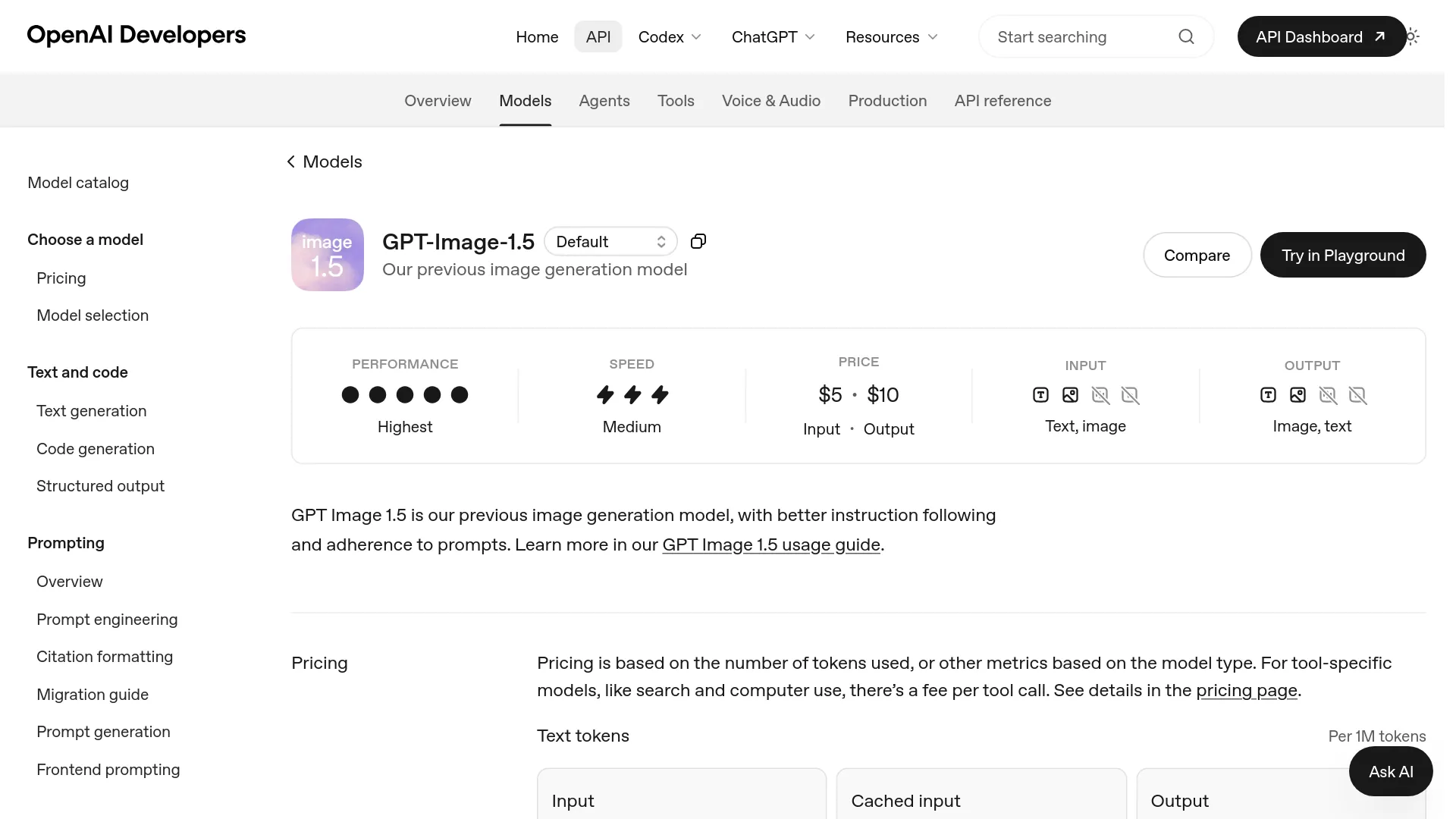
This guide uses OpenAI’s GPT-Image-1.5 model reference, the GPT Image 1.5 launch announcement, and pricing checked on August 30, 2026. The per-image rows are official output-image prices, not a universal total for each API request.
GPT Image 1.5 API pricing by output size and quality
OpenAI lists three supported image sizes: 1024×1024, 1024×1536, and 1536×1024. Each has low, medium, and high quality options.
| Quality | 1024×1024 | 1024×1536 | 1536×1024 |
|---|---|---|---|
| Low | $0.009 | $0.013 | $0.013 |
| Medium | $0.034 | $0.050 | $0.050 |
| High | $0.133 | $0.200 | $0.200 |
Prices range from $0.009 to $0.20. Square medium costs $0.034; non-square high costs $0.20.
OpenAI also lists token rates per 1 million tokens:
| Billing component | Price per 1M tokens |
|---|---|
| Text input | $5.00 |
| Cached text input | $1.25 |
| Text output | $10.00 |
| Image input | $8.00 |
| Cached image input | $2.00 |
| Image output | $32.00 |
What the headline per-image price leaves out
The table covers the generated image component. A complete request can also include text-input, image-input, and text-output tokens because GPT Image 1.5 accepts text and image inputs.
For standard, uncached usage, estimate the dollar total as:
total request cost ≈ output-image price
  + (text input tokens × $5 / 1,000,000)
  + (image input tokens × $8 / 1,000,000)
  + (text output tokens × $10 / 1,000,000)
Use the cached-input rates from OpenAI’s table when the request qualifies for caching. A new image, an edit, and a revision loop should be modeled separately:
- A fresh output starts with the selected size-quality row.
- An edit adds billed input-image tokens for the uploaded source or references.
- A retry adds another output charge and may add more input charges.
For a concrete, illustrative edit estimate, assume one 1024×1024 medium output at $0.034 plus 1,000 image-input tokens for an uploaded source. At the official $8 per million image-input-token rate, the source adds $0.008, making the image portion about $0.042 before prompt tokens and any retry. The 1,000-token input is an assumption for planning, not a universal source-image size.
Generation and editing are different budgets
Editing an existing visual adds input-image usage, so it should not share the same budget line as blank-slate generation. OpenAI claims better precise editing, prompt following, text rendering, and preservation of composition, lighting, faces, and other details. The launch post says API image inputs and outputs are 20% cheaper than GPT Image 1.
Those are OpenAI claims, not independent benchmark results. Real-user feedback is more conditional. In a Reddit discussion about the launch, u/DaW_ wrote:
“As far as image editing goes this new model is significantly better than NB in my opinion...but the lack of resolution makes it completely unusable in a professional capacity beyond creative direction.” — u/DaW_ on r/OpenAI
Test an edit on representative logos, products, faces, or layouts before treating the output as production-ready, and include image-input tokens in the test budget.
Pick quality by job, not by resolution
Low, medium, and high quality are budget controls as well as output controls. Reserve high quality for assets that have passed creative review; using it for exploratory variants pays the highest rate for images that may be discarded.
| Job | Starting setting | Why |
|---|---|---|
| Rough concepts and disposable variants | Low | $0.009 for a square output keeps iteration cheap |
| Reviewed social, editorial, and mockup work | Medium | $0.034 square or $0.050 non-square is a balanced baseline |
| Final detail-sensitive image | High | $0.133 square or $0.200 non-square is justified only when needed |
| Existing-image edit with important details | Medium first, then high if needed | Test preservation before paying the highest output rate |
Use low for exploration, medium as the default, and high selectively. Quality cannot fix a weak prompt or an output-size requirement the model does not support.
Budget examples for 100, 1,000, and 10,000 images
These figures multiply OpenAI’s published 1024×1024 output-image prices. They exclude prompt tokens, image inputs, text output, retries, and routing fees.
| Quality | 100 images | 1,000 images | 10,000 images |
|---|---|---|---|
| Low at $0.009 | $0.90 | $9 | $90 |
| Medium at $0.034 | $3.40 | $34 | $340 |
| High at $0.133 | $13.30 | $133 | $1,330 |
For non-square outputs, 1,000-image output-only budgets are $13 low, $50 medium, and $200 high. At 10,000 images, they become $130, $500, and $2,000.
Retries matter even before input tokens are counted. If 20% of 1,000 square-medium generations are repeated once, output charges become $40.80: 1,200 attempts × $0.034.
Access, limits, and version stability
GPT Image 1.5 is not documented as a free-tier image endpoint. OpenAI’s model page lists Free as not supported and shows image-per-minute limits by usage tier.
| Usage tier | TPM | IPM |
|---|---|---|
| Free | Not supported | Not listed |
| Tier 1 | 100,000 | 5 |
| Tier 2 | 250,000 | 20 |
| Tier 3 | 800,000 | 50 |
| Tier 4 | 3,000,000 | 150 |
| Tier 5 | 8,000,000 | 250 |
TPM means tokens per minute; IPM means images per minute in this model-specific table. A $9 output budget for 1,000 low-quality images does not mean a Tier 1 account can submit them in one burst because the listed Tier 1 limit is 5 IPM.
The current reference calls GPT Image 1.5 a previous image-generation model while also displaying a Default status. The alias is gpt-image-1.5; the dated identifier gpt-image-1.5-2025-12-16 is marked Deprecated. Verify the live model reference and migration path before starting a new integration.
The current OpenAI pricing reference lists image-generation pricing for newer models but does not list a current GPT Image 1.5 Batch row. Do not automatically halve the figures above; confirm the exact model and processing mode in the live pricing documentation.
What developers are reporting in practice
GPT Image 1.5 launched on December 16, 2025. Shortly after the announcement, developers in an OpenAI Developer Community thread reported 404, model_not_found, and unsupported-model errors during the rollout. Run a live availability test instead of assuming that a copied model name guarantees access.
OpenAI’s launch post says generation can be up to 4× faster, but that is a vendor-reported maximum rather than a latency guarantee for your queue. The Reddit report above shows why editing quality and professional output resolution should be tested separately.
For a GPT Image 1.5 versus newer-model decision, compare supported dimensions, quality settings, edit fidelity, lifecycle status, and migration cost, not only the per-image number. The GPT Image 2 API pricing guide covers that adjacent decision.
FAQ
Does the listed price include an edit or reference image?
No. Uploaded images are billed as image input tokens at $8 per 1 million image-input tokens, with cached image input listed at $2 per 1 million tokens.
Is there a free GPT Image 1.5 API tier?
The OpenAI model reference lists Free as not supported. Tier 1 is shown at 5 images per minute, with higher limits at Tiers 2 through 5.
Should I assume GPT Image 1.5 is the long-term model?
No. The reference calls it a previous image-generation model and marks the dated gpt-image-1.5-2025-12-16 snapshot as deprecated. Verify the live alias, supported endpoints, and migration options before committing to it.
GPT Image 1.5 can be economical at medium quality for fresh square images, but the finished-asset cost depends on inputs, edits, and attempts.