 AIREITER
A 1024×1024 GPT Image 2 output can cost $0.006 or $0.211, depending on quality. That spread is the important part: OpenAI does not charge one universal price per picture, and an edit with reference images is not the same bill as a simple text-to-image request. The figures below use OpenAI’s pricing and image-generation documentation checked on August 30, 2026.
The number you should put in your budget first
For a simple output-only estimate, use OpenAI’s published examples rather than the headline token rates. A 1024×1024 image is listed at $0.006 for low quality, $0.053 for medium, and $0.211 for high. The 1024×1536 portrait and 1536×1024 landscape examples are $0.005, $0.041, and $0.165 at the same quality levels.
These are output examples, not all-in invoices. Prompt text, uploaded reference images, retries, and the selected processing route can increase the final API charge.
| Output size | Low | Medium | High |
|---|---|---|---|
| 1024×1024 | $0.006 | $0.053 | $0.211 |
| 1024×1536 | $0.005 | $0.041 | $0.165 |
| 1536×1024 | $0.005 | $0.041 | $0.165 |
Source: OpenAI’s image-generation guide. Use the live calculator for dimensions or settings not represented in these rows.
For a quick workload estimate, 1,000 square outputs would be about $6 at low quality, $53 at medium, or $211 at high quality before input charges and additional attempts.
OpenAI's live GPT Image 2 price model
GPT Image 2 uses token-metered API billing. The OpenAI API pricing page lists separate meters for text input, image input, cached input, and generated image output. The practical formula for a Standard request is:
request cost =
(text input tokens × $5 / 1M)
+ (image input tokens × $8 / 1M)
+ (image output tokens × $30 / 1M)
Cached input is cheaper when the relevant input is eligible for caching. The current listed rates are:
| Meter | Standard | Batch |
|---|---|---|
| Text input | $5.00 / 1M tokens | $2.50 / 1M tokens |
| Cached text input | $1.25 / 1M tokens | $0.625 / 1M tokens |
| Image input | $8.00 / 1M tokens | $4.00 / 1M tokens |
| Cached image input | $2.00 / 1M tokens | $1.00 / 1M tokens |
| Image output | $30.00 / 1M tokens | $15.00 / 1M tokens |
Batch is the lower-cost path for eligible asynchronous work. It is not a general discount for interactive requests. Keep Standard and Batch as separate assumptions instead of blending them into one “GPT Image 2 price.”
The GPT-Image-2 model page identifies gpt-image-2 as an image-generation and image-editing model and lists v1/images/generations and v1/images/edits.
What the headline per-image examples include
The $0.006, $0.053, and $0.211 figures answer “what does the rendered output usually cost at this size and quality?” They do not answer “what will every API request cost?”
| Request part | When it appears | Budget treatment |
|---|---|---|
| Text input | Every prompt and instruction | Usually small, but not zero |
| Image input | Edits, masks, or reference images | Estimate separately for edit-heavy workflows |
| Image output | The generated result | Use the size-and-quality examples first |
| Additional attempts | Regenerations after rejection or QA failure | Count generated attempts, not only accepted images |
| Batch route | Eligible asynchronous processing | Apply Batch rates only when the workflow supports it |
This separation avoids multiplying accepted images by one advertised unit price while ignoring discarded candidates and uploaded assets.
Why quality beats pixels in the bill
At 1024×1024, moving from low to high quality changes the published output example from $0.006 to $0.211, roughly 35 times more. The quality decision matters more than small differences between the common portrait, landscape, and square examples.
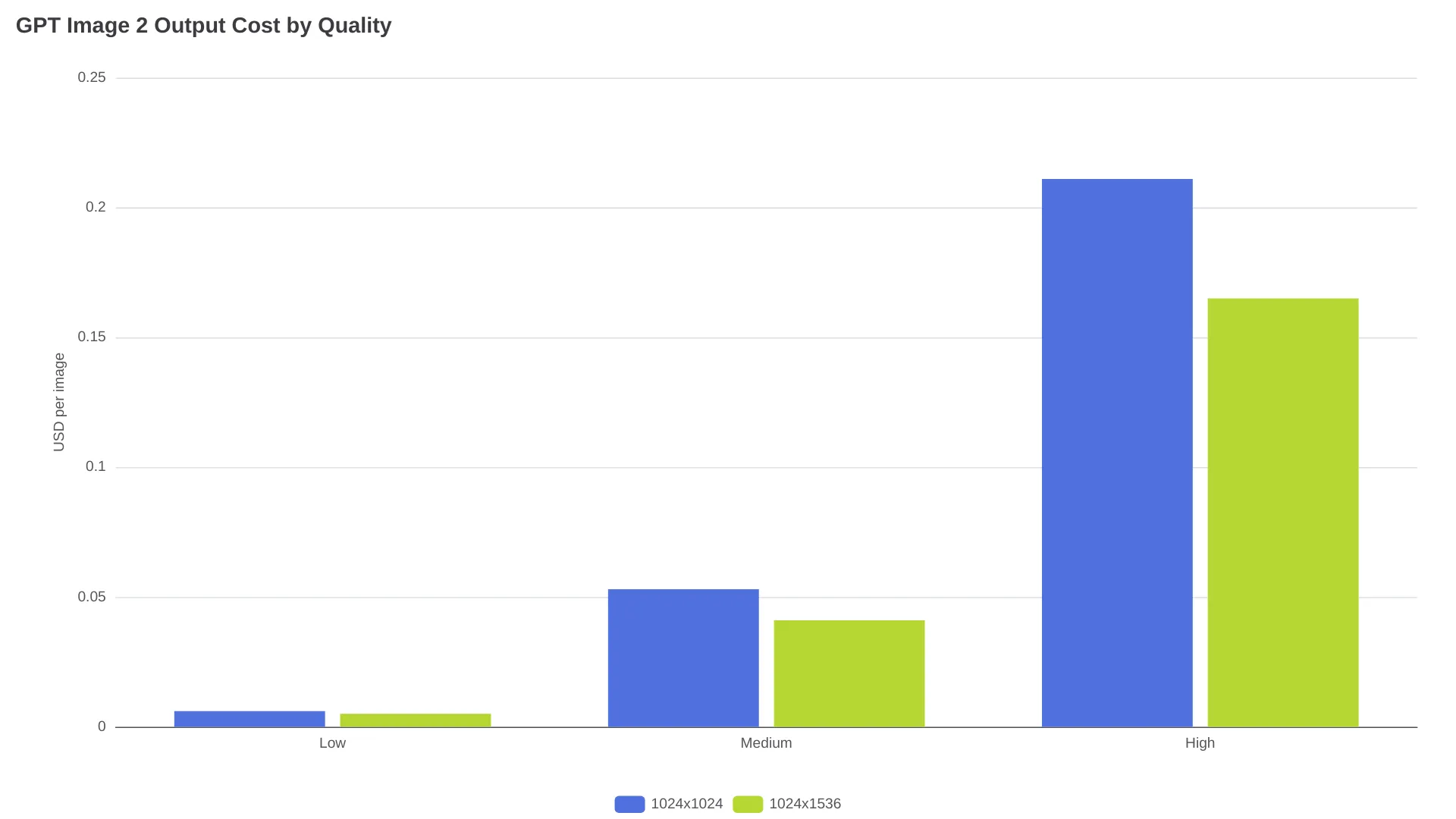
Output cost by size and quality
Across the three published sizes, listed output estimates range from $0.005–$0.006 at low, $0.041–$0.053 at medium, and $0.165–$0.211 at high quality.
A useful production gate is:
- Use low quality for prompt and composition exploration.
- Use medium for routine customer-facing assets after the layout is understood.
- Use high only after the concept, crop, and copy space have been approved.
This is a workflow recommendation, not an OpenAI benchmark claim. OpenAI’s model page gives qualitative positioning, but it does not publish a universal quality score or latency benchmark for these tiers.
The non-square pricing surprise
The published portrait and landscape examples are slightly cheaper than the square examples at the same quality level, even though the non-square canvases contain more pixels. That shows output-token usage is not a simple pixel-count formula.
For the three common sizes, use the published rows directly. For unusual dimensions, use OpenAI’s calculator or record the returned usage values instead of extrapolating from one square image.
The bill beyond one generated image
The output-only table is most useful for clean text-to-image calls. Real applications often add reference inputs, edit iterations, retries, and route-specific limits.
Text-to-image versus edit requests
A text-to-image call sends a prompt and receives an image. An edit or compositing call also sends one or more images, so image-input tokens can become a meaningful part of the cost. The OpenAI image guide separates the two main API choices:
- Use the Image API for a direct generation or edit from a prompt.
- Use the Responses API when image creation is part of a conversational or multi-step flow.
The Responses API supports image generation as a built-in tool, and OpenAI states that the request includes the mainline model’s token usage in addition to image-generation costs. That makes a conversational workflow a different budget category from a direct images.generate request.
An implementation field note from the open-source gpt-image-app API notes measured a 1024×1024 low-quality text-only call at $0.0063 with 24 input tokens, while a comparable call with two reference images cost $0.025 with 2,365 total input tokens. These are observed calls, not a universal price table, but they show why reference-image workflows deserve their own budget line.
Batch is cheaper only when the workflow can wait
OpenAI’s current pricing page lists GPT Image 2 Batch rates at half the Standard token rates: $15 per 1M image-output tokens instead of $30, $4 instead of $8 for image input, and $2.50 instead of $5 for text input.
That saving suits overnight catalogs, queued ad variants, or back-office jobs, not interactive editors. Verify the actual model and endpoint before migrating; a listed Batch rate does not guarantee that every account or client path accepts the request.
One user reported the following runtime error:
“The provided model
gpt-image-2is not supported by the Batch API.” — u/laxika in r/OpenAI.
This is a community report, so test the production account and endpoint before relying on Batch pricing.
API access is not ChatGPT subscription access
OpenAI’s billing guidance treats ChatGPT subscriptions and API billing as separate products. A ChatGPT plan with image generation does not provide API credits, so direct gpt-image-2 requests need their own API billing setup.
The same boundary applies to gateways and aggregators. A provider may advertise a flat per-image price, local payment method, or bundled interface. That is the provider’s contract, not OpenAI’s direct token price. Keep the route owner in every cost record:
| Route | Price owner | What to compare |
|---|---|---|
| OpenAI Standard API | OpenAI | Token usage and output examples |
| OpenAI Batch | OpenAI | Batch eligibility, delay, and token usage |
| Gateway or aggregator | The gateway | Its unit, limits, storage, and terms |
| ChatGPT product plan | OpenAI consumer product | Subscription access, not API usage |
A production budget that will not lie to you
A useful monthly estimate starts with accepted output volume but adds the attempts and inputs that create that volume:
monthly image budget =
accepted images
× average generated attempts per accepted image
× output estimate for the chosen size and quality
+ total text-input cost across all attempts
+ total image-input cost across all attempts
“Average generated attempts per accepted image” includes the first candidate and any regenerated candidates. It prevents the common double-counting problem where the same retries are included in both output volume and a separate multiplier.
| Workflow | First budget assumption | Main risk to measure |
|---|---|---|
| Prompt exploration | Low output example | Discarded variations |
| Routine production | Medium output example for the target size | User-requested regenerations |
| Campaign final | High output example after approval | Multiple ratios and late revisions |
| Product or reference edit | Output example plus image input | Input-image tokens and label errors |
| Overnight queue | Batch rates if verified | Completion delay and endpoint eligibility |
For example, 10,000 square low-quality outputs use the published output estimate of about $60 before prompt input and additional attempts. If a workflow generates two candidates for every accepted image, its output volume is closer to 20,000 before other failure modes are counted.
The fields to log
At minimum, store these fields with each request:
- Model ID.
- API route: Image API, Responses API, Batch, or a gateway.
- Size, quality, and number of outputs requested.
- Whether reference images or a mask were uploaded.
- Input and output token usage returned by the API.
- Accepted, rejected, failed, and regenerated status.
- Retry count and error category.
FAQ
How much does one GPT Image 2 image cost?
OpenAI’s listed output examples are $0.006, $0.053, and $0.211 for a 1024×1024 image at low, medium, and high quality. The 1024×1536 and 1536×1024 examples are $0.005, $0.041, and $0.165. Prompt, reference-image, and additional-attempt costs can make the final invoice higher.
Is GPT Image 2 priced per image or per token?
The API is priced by text-input, image-input, cached-input, and image-output tokens. OpenAI’s per-image figures are practical estimates for common size-and-quality combinations, not one flat fee for every request.
Does editing cost more than generation?
It can. An edit or reference-guided request sends image input in addition to the prompt and generated output. The exact increase depends on the input images and returned usage, so edit-heavy workflows should be measured separately from text-only generation.
Does Batch API reduce GPT Image 2 cost?
OpenAI’s current pricing page lists Batch image-output rates at $15 per 1M tokens versus $30 for Standard, with corresponding lower input rates. Batch is intended for eligible asynchronous work, so verify the endpoint and account before relying on the saving.
Is GPT Image 2 API free with ChatGPT Plus?
No. OpenAI’s billing guidance separates ChatGPT subscription billing from API billing. A ChatGPT plan may provide image generation inside the consumer product, but it is not an API credit balance.
Which official pages should I recheck before launch?
Recheck OpenAI API pricing for current token and Batch rates, the image-generation guide for output examples and API choices, and the GPT-Image-2 model page for model identity, endpoints, and rate limits.