 AIREITER
For everyday coding, GPT-5.6 Terra is the faster and cheaper pick: it returns answers in roughly half the wall-clock time, burns far fewer output tokens, and edges Claude Sonnet 5 on terminal-agent work. Sonnet 5 pulls even on real-world bug-fixing, scores a hair higher on composite reasoning, and, the part that matters day one, is available everywhere right now while Terra is still rolling out through preview access. This GPT-5.6 Terra vs Claude Sonnet 5 comparison walks through a live test, published benchmarks, the speed and price gaps, and a task-by-task pick.
| Task | Better pick |
|---|---|
| Interactive edit-run coding | Terra |
| Terminal / CLI agents | Terra |
| Real-repo bug fixing | Roughly tied |
| Computer-use / desktop agents | Sonnet 5 |
| Hardest multi-step reasoning | Sonnet 5 |
| Lowest effective cost per task | Terra |
I ran Terra live: the honest data point
I gave GPT-5.6 Terra a small but trap-laden task through a chat endpoint at temperature 0 (July 2026): implement my_atoi, the LeetCode #8 string-to-integer function, which has to handle leading whitespace, an optional sign, digit truncation at the first non-digit, and 32-bit overflow clamping. Then I ran its output against 20 test cases covering the tricky edges: empty strings, "words and 987", "-91283472332" (below INT_MIN), "+-12", and clamping at both boundaries.
Terra passed 20 of 20 in 5.5 seconds of client-observed time, using 193 output tokens. Its overflow guard was the clean version: it checks value > (2**31 - ... - digit) // 10 before multiplying, so it never overflows internally rather than clamping after the fact:
while i < n and "0" <= s[i] <= "9":
    digit = ord(s[i]) - ord("0")
    if value > (2**31 - (1 if sign == 1 else 0) - digit) // 10:
        return 2**31 - 1 if sign == 1 else -2**31
    value = value * 10 + digit
    i += 1
One caveat worth stating plainly: this is a single small task, not a benchmark, and it's one-sided. I don't have API access to a genuine Claude Sonnet 5 endpoint, so every Sonnet 5 number below is from a labeled public source, not my own run. Treat the Terra result as one concrete data point about its token economy, not a verdict on its own.
Where each model wins
The benchmark picture splits by task type rather than crowning one winner.
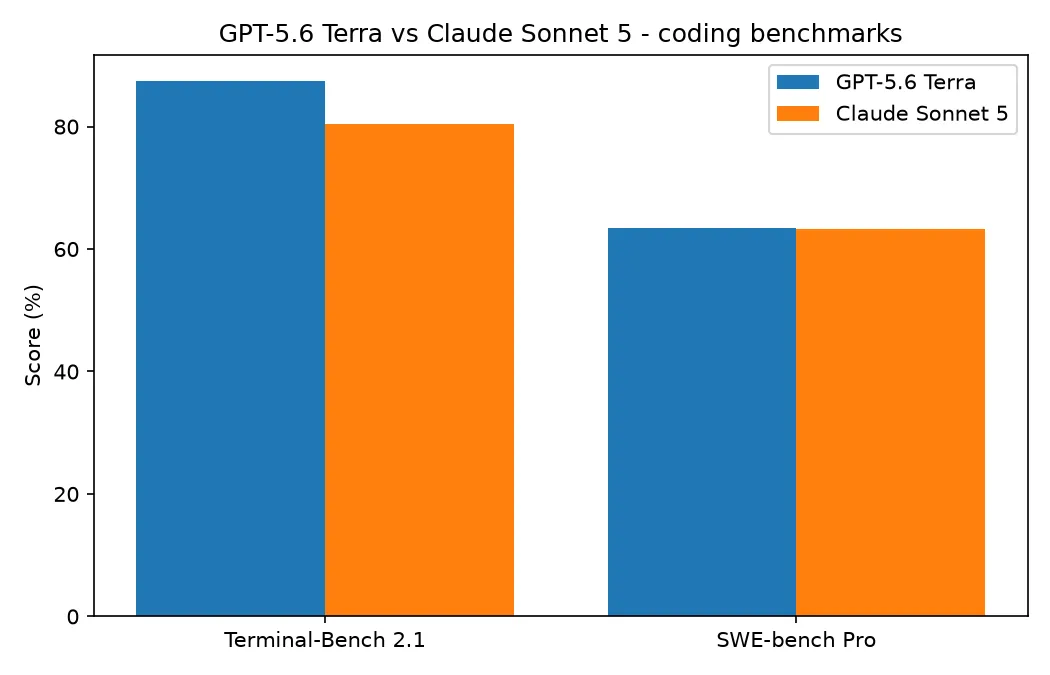
On Terminal-Bench 2.1, which measures terminal-driven agent coding, Terra scores 87.4% to Sonnet 5's 80.4%, a real gap if your work is CLI agents and shell-heavy automation. On SWE-bench Pro, which patches actual bugs in real repositories, they're effectively tied at 63.4% and 63.2%; neither has an edge on the messy, multi-file fixes that dominate day jobs.
Zoom out to composite reasoning and Sonnet 5 nudges ahead: Artificial Analysis puts its Intelligence Index at 53 versus Terra's 52 (Terra at xhigh effort, Sonnet 5 at max effort, as of July 2026). Sonnet 5 also posts 81.2% on OSWorld-Verified, the computer-use agent benchmark, an area where Terra's public numbers are thinner. So: Terra for terminal agents, a coin flip for repo bug-fixing, and Sonnet 5 for the hardest reasoning and desktop-agent work.
Speed and latency: the gap you'll feel
Benchmarks hide the thing you notice first: how long you stare at a spinner. Artificial Analysis clocks Terra at 118 output tokens/second against Sonnet 5's 71, and time-to-first-token at 16.3 seconds for Terra versus 198.7 seconds for Sonnet 5. That second figure is a worst case, not a default: it's Sonnet 5 at max reasoning effort, which front-loads a long thinking pass before emitting anything. Dial the effort down and TTFT drops sharply, but the ordering holds, Terra starts and finishes sooner.
A hands-on build test by Merge lands the same way: on a marketing homepage, Terra finished in 60.2 seconds to Sonnet 5's 136.6, and used 10,677 output tokens against 17,870. My own atoi run rhymes with it: Terra solved a correct, fully-clamped implementation in 193 tokens. The limited public and hands-on data all point the same direction, Terra is terser and quicker to first output, while Sonnet 5 spends more tokens and more time, some of it on reasoning you may or may not need.
If you're in a tight edit-run-edit loop, that latency gap compounds fast. If you're firing off one hard agentic task and walking away, it matters far less.
What it costs
Standard API pricing is close enough that it rarely decides things on its own.
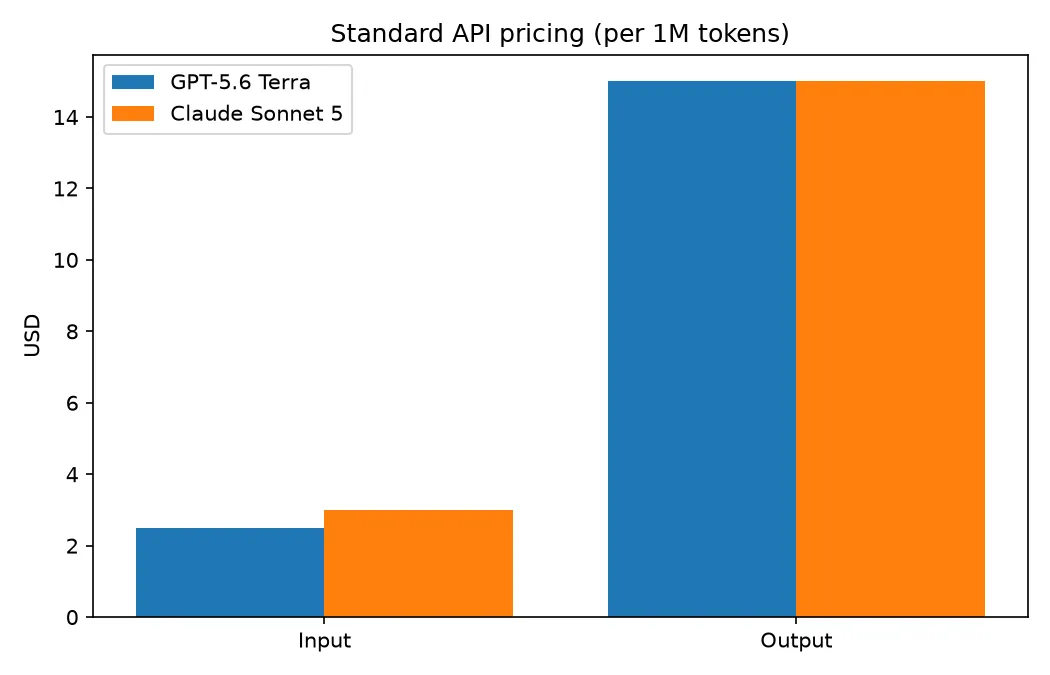
Terra lists at $2.50 per million input tokens and $15 output. Sonnet 5's standard rate is $3 input / $15 output, but Anthropic is running an introductory $2 / $10 through August 31, 2026, which makes Sonnet 5 the cheaper sticker price until then. Both carry a 1M-token context window and 128K max output. Terra also lands at roughly half the price of the prior GPT-5.5 tier for comparable everyday quality, so the value case isn't only against Sonnet 5.
Three cost numbers get quoted for these models, and they measure different things:
- List price per token: Terra is cheaper on input, level on output (and Sonnet 5's intro rate temporarily undercuts both).
- Blended index price: Artificial Analysis shows $2.17 for Terra and $1.54 for Sonnet 5, but that's a 3:1 input-output blend at their tested effort levels, not what you'll pay per task.
- Effective cost per finished task: because Terra emits fewer tokens for the same result, it usually wins here. Merge's build cost $0.120 with Terra against $0.179 with Sonnet 5, roughly a third less, despite Sonnet 5's discounted output rate.
For most workloads the effective-per-task number is the one that hits your bill, and it favors Terra. Both models are reachable through Anthropic- and OpenAI-compatible APIs, including third-party gateways that resell access at a discount if list price is a constraint.
What developers are choosing
Benchmarks and community behavior don't always agree, so the chatter is worth reading. On X in July 2026 it leaned toward the GPT-5.6 tiers for cost reasons. One developer described replacing an entire agent-integration pipeline (swapping Opus 4.8 for Terra and Sonnet 5 for Luna) and called the newer models "blazing fast, very capable and cheaper." Another said they'd "mostly stopped using Claude," keeping Cursor with Grok and Codex with Terra/Sol as their primary agentic-coding stack.
Terra also shows up as the model that unstuck something Claude couldn't: one builder reported Terra fixing a bug "that Claude Sonnet 5 couldn't crack" and generating a full site UI from a single prompt. The tempered read comes from a developer who noted Terra is "not as aggressive as Sol to hunt bugs, but it gets the job done." That fits Terra as the steady, cheaper workhorse rather than the maximal bug-hunter.
None of this erases Sonnet 5's pull. It's available on every plan tier today, it plugs into Claude's mature tool stack and adaptive-thinking workflow, and its long-context handling holds up on sprawling agentic tasks. For teams already standardized on Claude, that continuity is often worth more than a few cents per task.
Which one should you pick
The decision comes down to workload shape, not an overall "better." For the coding I do most, fast iterations, terminal agents, and watching cost per task, I default to Terra and keep Sonnet 5 on hand for the reasoning-heavy jobs.
- Pick GPT-5.6 Terra if you're doing high-frequency interactive coding, care about latency in an edit-run loop, run terminal or CLI agents, or want the lowest effective cost per task. Its speed and token thrift are the real draw.
- Pick Claude Sonnet 5 if your work leans on the hardest multi-step reasoning, long-context agentic runs, or computer-use tasks, or if you're already in the Claude ecosystem and want something available on every tier today. The intro $2 / $10 pricing through August 31 also makes it an easy trial.
For most builders shipping features day to day, Terra's speed-and-cost profile wins. For the genuinely hard reasoning jobs, or if switching stacks isn't worth the churn, Sonnet 5 stays the safer call. They're close enough that the tiebreaker is your workflow, not a leaderboard.
FAQ
Is GPT-5.6 Terra better than Claude Sonnet 5?
For speed and cost-efficient coding, yes: Terra is faster, cheaper per task, and leads on terminal-agent benchmarks. For the hardest reasoning and computer-use work, Sonnet 5 is at least even and often ahead. There's no single winner; it depends on the task.
Is Claude Sonnet 5 good for coding?
Yes. It matches Terra on SWE-bench Pro (63.2% vs 63.4%) for real-repo bug fixing and leads on OSWorld-Verified agentic tasks. Its weak spots against Terra are speed and time-to-first-token, not code quality.
How much cheaper is Terra than Sonnet 5?
On list price Terra is $2.50/$15 vs Sonnet 5's $3/$15 standard, though Sonnet 5's intro $2/$10 (through Aug 31, 2026) undercuts it temporarily. On effective cost per task, Terra usually still comes out ahead because it emits fewer output tokens.
Do Terra and Sonnet 5 have the same context window?
Effectively yes: both offer a 1M-token context window and 128K maximum output, so context size won't be your deciding factor.
Is GPT-5.6 Terra available everywhere yet?
Not fully. Sonnet 5 is available across all plan tiers today, while GPT-5.6 access is still gated to preview and select API partners in places, a practical point if you need it in production now.