 AIREITER
GPT-5.6 Terra lands at exactly half the API price of GPT-5.5 ($2.50 versus $5.00 per million input tokens) and it edges 5.5 on most public benchmarks. So the obvious move is to switch everything over and pocket the savings. Not quite. In the GPT-5.6 Terra vs GPT-5.5 matchup, Terra is the better default, but 5.5 is still the more thorough model on research-heavy and multi-step agent work, and Terra is only in limited preview as of July 10, 2026. Here is the full picture, with verified pricing, specs, and the tasks where each one wins.
The short version: half the bill, one caveat
Three facts settle most of the decision:
Price: Terra is $2.50 in / $15 out per million tokens. GPT-5.5 is $5 / $30. Same 1M-token context window on the API (though 5.5 is capped at 400K inside Codex), same 128K max output; Terra simply costs half.
Benchmarks: Terra is slightly ahead. It posts a new state-of-the-art on Terminal-Bench 2.1 (84.3% vs 5.5's 82.7%) and beats 5.5 by roughly 9 points across OpenAI's biology evals.
The caveat: developers running real agent loops report Terra is less thorough than 5.5. It will skip steps like browser research even when told to, and its design output is weaker.
So Terra wins on value for scoped, well-defined work. GPT-5.5 keeps an edge where you need the model to grind carefully through a long, open-ended task.
What actually changed from GPT-5.5 to Terra
GPT-5.5 shipped in April 2026 as a single general-purpose model and became the ChatGPT default. GPT-5.6 changed the shape of the product: instead of one model, it is a three-tier family, each tier tuned for a different point on the capability-cost curve.
Sol is the frontier tier for long-horizon agentic work and hard reasoning, priced identically to 5.5 ($5/$30).
Terra is the balanced everyday model, half the cost of Sol and 5.5, positioned as the "correct default" for most developers and business users.
Luna is the fastest, cheapest tier ($1/$6) for high-frequency, structured tasks like classification and routing.
The framing shifted too. GPT-5.5 was pitched as a better all-round assistant; GPT-5.6 is pitched around structured professional workflows, with new "max" reasoning and "ultra" modes (the latter can spin up sub-agents). Terra sits in the middle of that family: not a raw replacement for 5.5, but the tier meant to absorb the bulk of production traffic at a lower unit cost.
Pricing, and the long-context line that doubles your bill
Here is the official API pricing page, showing both generations in one table:
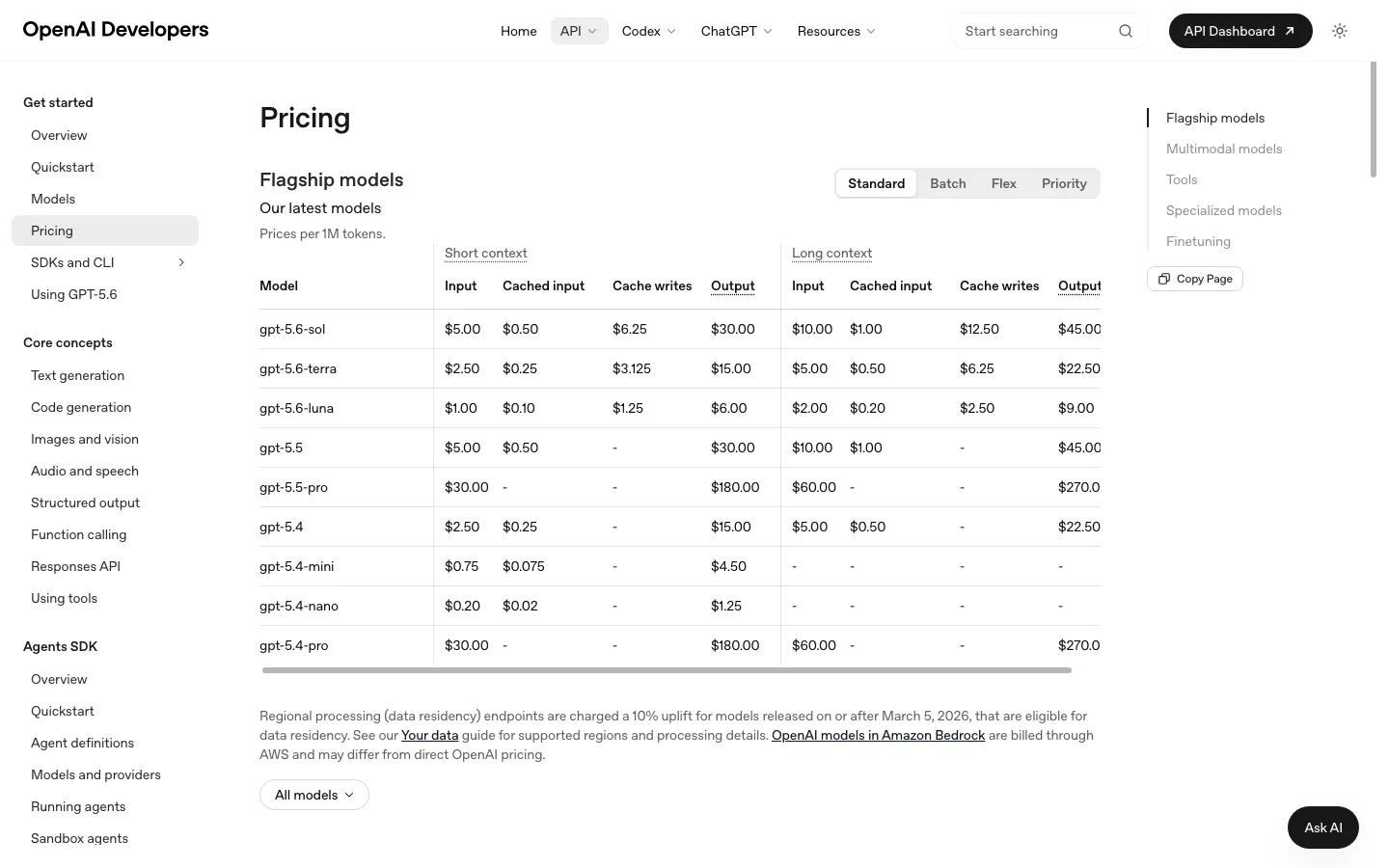
Pricing source: OpenAI's official API pricing page, verified July 10, 2026.
Per million tokens, short context:
Input | Cached input | Output | |
|---|---|---|---|
GPT-5.6 Terra | $2.50 | $0.25 | $15.00 |
GPT-5.5 | $5.00 | $0.50 | $30.00 |
Terra is a clean 50% cut at every line. Two details worth pausing on:
Long context is roughly double. Once a request crosses into the long-context tier, Terra jumps to $5 in / $22.50 out and GPT-5.5 to $10 / $45. The relative saving holds, but the absolute cost of a big-context agent run climbs fast on either model, so budget for it.
Terra's short-context price is identical to the older GPT-5.4 ($2.50/$15). You are effectively getting a newer, benchmark-topping model at last generation's mid-tier price.
A quick back-of-envelope: a workload that pushes 20M input and 5M output tokens a month costs about $125 on Terra versus $250 on GPT-5.5. Halving that line is the whole reason Terra exists. If you want the tier-by-tier breakdown, the GPT-5.6 pricing guide walks through Sol and Luna too. (Regional data-residency endpoints add a 10% uplift for models released on or after March 5, 2026.)
Benchmarks vs. the reality of agent work
On OpenAI's launch benchmarks, Terra wins the head-to-head:
Benchmark | GPT-5.6 Terra | GPT-5.5 |
|---|---|---|
Terminal-Bench 2.1 | 84.3% (SOTA) | 82.7% |
GeneBench | 28.4% | 25% |
Biology evals (avg) | ~+9 pts over 5.5 | baseline |
But benchmarks and daily agent behavior are two different things, and this is where the honest answer gets interesting. Developers testing Terra against 5.5 in the days after launch reported a consistent pattern:
On scoped coding and review tasks, Terra matches 5.5 while using fewer tokens and finishing faster. As developer @KaranD93 put it on July 10, Terra is "5.5-level capability at half the cost," while Sol is "a step change above."
On longer, open-ended agent runs, Terra is faster and cheaper but cuts corners. @nurullah_kuus, testing Terra on agentic dev tasks the same week, found it skipped browser research it had been explicitly told to do and concluded "gpt 5.5 is more thorough."
Design and UI output remain a weak spot; the same tester flagged "still awful design skills," a complaint echoed across several launch-week threads. @coderabbitai's coding-agent tests landed in the same place: Terra is "a cheaper lane for scoped work," Sol handles repos and long tasks better.
None of this shows up in a benchmark table. It is the difference between a model that scores well on a bounded test and one you trust to plod through a fifteen-step task without shortcutting.
When GPT-5.5 is still the better pick
Terra is the default, but paying double for GPT-5.5 is the right call in a few specific cases:
Research-heavy, multi-tool agents. If the job depends on the model running every tool and reading every source, 5.5's greater thoroughness is worth the premium. Terra's speed comes partly from a willingness to skip.
Customer-facing automation. GPT-5.6 shows a slightly stronger tendency than 5.5 to go beyond the user's request and take unrequested actions. The absolute rate is low, but in support or transactional flows that behavior is a liability, and 5.5 is more conservative.
You need it in ChatGPT today. 5.5 is the general-availability model. Terra, at launch, is API-and-Codex-only for preview partners (more on that next).
Established tooling and stability. 5.5 has been in production since April with a broad benchmark and integration track record; Terra is days old.
Can you actually use Terra right now?
This is the part the price comparison hides. GPT-5.6 launched on July 9, 2026, but only to a select group of trusted partners and organizations, via the API and Codex. During the preview it is not available in ChatGPT. OpenAI says broader rollout to ChatGPT, Codex, and the API is coming "soon," but there is no firm public date.
GPT-5.5, by contrast, is generally available and remains the ChatGPT default. So if you cannot get preview access, the practical GPT-5.6 Terra vs GPT-5.5 choice is made for you: 5.5 is what you can ship on today.
How to choose: route by task, not version number
The three-tier design rewards routing rather than picking one model for everything:
Scoped coding, code review, content generation, data extraction → Terra. Half the cost, benchmark parity or better, fast.
High-frequency, structured, short tasks (classification, routing, tagging) → Luna, cheaper still.
Research-heavy or long-horizon agents, customer-facing stability, hard reasoning → GPT-5.5 today, Sol once you have access.
If you are building on the API, keeping both generations reachable behind one endpoint makes this routing trivial. Providers such as AIReiter expose GPT-5.5 and the full GPT-5.6 family through a single OpenAI-compatible API, so scoped calls can go to Terra and thorough ones to 5.5 from the same integration. Match the tier to the task and the version number stops mattering.
FAQ
Is GPT-5.5 more expensive than GPT-5.6 Terra?
Yes, exactly double. GPT-5.5 is $5 input / $30 output per million tokens; Terra is $2.50 / $15. Note that GPT-5.6 Sol is priced the same as 5.5, so "5.6" is not automatically cheaper.
Is GPT-5.6 available?
As of July 10, 2026, only in limited preview to trusted partners via the API and Codex. It is not yet in ChatGPT. GPT-5.5 remains generally available.
Is GPT-5.5 the best coding model?
For scoped coding, Terra now matches it at half the price. But 5.5 is more thorough on long, multi-step agent tasks, and Sol outperforms both on frontier work, so "best" depends on the job.
Which version of GPT is better, 5.6 Terra or 5.5?
Terra for most everyday and scoped work on cost-efficiency alone. GPT-5.5 for research-heavy agents, customer-facing reliability, or when you need the model in ChatGPT today.
The bottom line
GPT-5.6 Terra is the model to reach for by default: a clean half-price cut on GPT-5.5 with slightly better benchmarks and real token savings on scoped work. But "half the price" is not "strictly better." For deep research agents, customer-facing flows, or anything you have to run in ChatGPT this week, GPT-5.5's thoroughness and availability still earn the extra spend. Route scoped tasks to Terra, keep the careful ones on 5.5, and you get the best of both.